
Many product teams still believe AI translations lack the quality needed for SaaS localization, but that perception is outdated. Modern AI translation systems now meet quality thresholds that rival human output for many language pairs, enabling efficient scaling across global markets. This guide reveals how to leverage AI-driven strategies to optimize your multilingual SaaS localization in 2026, covering everything from cultural adaptation to compliance. You’ll discover practical frameworks for integrating AI into your workflows while avoiding common pitfalls that derail global expansion.
Key takeaways
Point | Details |
|---|---|
AI meets quality standards | Modern AI translation systems consistently achieve quality thresholds suitable for professional SaaS localization workflows. |
Cultural adaptation matters | Successful localization extends beyond translation to include UI adjustments, cultural norms, and local market expectations. |
Phased AI adoption works | A gradual implementation strategy with human oversight mitigates risks while maximizing efficiency gains. |
Compliance drives retention | Legal conformity and price localization prevent user churn and accelerate market adoption in new regions. |
Why multilingual localization is critical for SaaS global success
Multilingual SaaS localization adapts your product content, user interface, and pricing structures for diverse markets, transforming a single-language application into a culturally resonant experience for global users. This process goes far beyond simple word-for-word translation, encompassing technical adjustments, legal compliance, and market-specific optimizations. Without proper localization, SaaS companies face severe consequences that directly impact revenue and growth trajectories.
Product localization is crucial for SaaS companies expanding internationally, as evidenced by high churn rates and low adoption in markets where localization is neglected. Users abandon products that feel foreign or confusing, regardless of underlying functionality. The financial impact extends beyond lost subscriptions to include wasted marketing spend targeting audiences who can’t effectively use your product.
Ignoring product localization leads to high churn, low adoption, legal and compliance risks, and wasted marketing spend. Consider these primary failure points:
UI confusion from untranslated elements or awkward phrasing that breaks user workflows
Cultural mismatches where features or messaging contradict local norms and expectations
Missing local payment options that create friction at the critical conversion moment
Legal non-compliance with regulations like GDPR that expose companies to penalties and market bans
Compliance with local laws represents a particularly critical aspect of localization that many teams underestimate. Data privacy regulations, accessibility requirements, and consumer protection laws vary dramatically across jurisdictions. A product fully compliant in the US market may violate fundamental requirements in the EU or Asia, creating legal exposure that threatens entire market opportunities.
“Companies that fail to localize properly see churn rates 3x higher in international markets compared to their home market, with the majority of users abandoning products within the first 30 days due to language and cultural barriers.”
The good news is that localization tool failures of the past have given way to modern solutions that address these challenges systematically. Understanding why localization matters sets the foundation for implementing AI-driven strategies that scale efficiently.
How AI translation has evolved to meet SaaS localization quality standards
The quality of AI translation has undergone a remarkable transformation, moving from obviously machine-generated text to output that often surpasses human translation in consistency and accuracy. The Multidimensional Quality Metrics (MQM) framework provides objective standards for evaluating translation quality, measuring error rates across categories like accuracy, fluency, and terminology. For SaaS localization, AI translation consistently meets defined quality thresholds, typically maintaining fewer than 5 major errors per 1000 words.

Recent evaluations reveal surprising results when comparing AI versus human translation performance. AI systems achieve near-human quality in blind tests for key language pairs, with human evaluators preferring AI output almost as often as human translations. This data challenges the assumption that only human translators can deliver professional-grade localization.
Language Pair | AI Error Rate (per 1000 words) | Human Error Rate (per 1000 words) | Evaluator Preference for AI |
|---|---|---|---|
English to Finnish | 3.2 | 3.8 | 48% |
English to Japanese | 4.1 | 4.3 | 46% |
English to German | 2.9 | 3.1 | 51% |
English to Spanish | 2.4 | 2.7 | 49% |
Regulatory bodies have begun accepting AI translations for certain compliance documentation, signaling institutional confidence in the technology’s maturity. This acceptance opens doors for SaaS companies to leverage AI across more content types, including user agreements, privacy policies, and help documentation that previously required expensive human translation.
Pro Tip: Combine AI translations with targeted human post-editing for optimal results. Use AI for initial translation speed and consistency, then apply human review to high-visibility content like marketing pages, onboarding flows, and error messages where cultural nuance matters most.
Adopting AI translation requires a strategic phased approach rather than wholesale replacement of existing processes. Technology maturity continues advancing, with clear milestones guiding when to expand AI usage:
2024-2025: AI for internal documentation and low-risk content
2025-2026: AI for product UI strings with human review
2026-2027: AI for customer-facing content with spot-checking
2027-2028: AI for most content types with exception-based human intervention
This roadmap allows teams to build confidence gradually while establishing quality benchmarks specific to their products and audiences. The AI translation quality improvements since 2023 have compressed timelines significantly, making 2026 an ideal year to accelerate AI adoption in your localization workflows. Understanding AI capabilities sets the stage for addressing the technical and cultural complexities that distinguish great localization from merely adequate translation.
Beyond translation: cultural and technical nuances in multilingual SaaS localization
Successful SaaS localization demands attention to user interface adaptation that extends far beyond translating button labels and menu items. Text expansion and contraction create layout challenges, with some languages requiring 30% more space than English for equivalent meaning. German translations often run longer, while Chinese characters pack more information into compact spaces. Font selection matters critically, as not all typefaces support extended character sets or maintain readability across scripts.
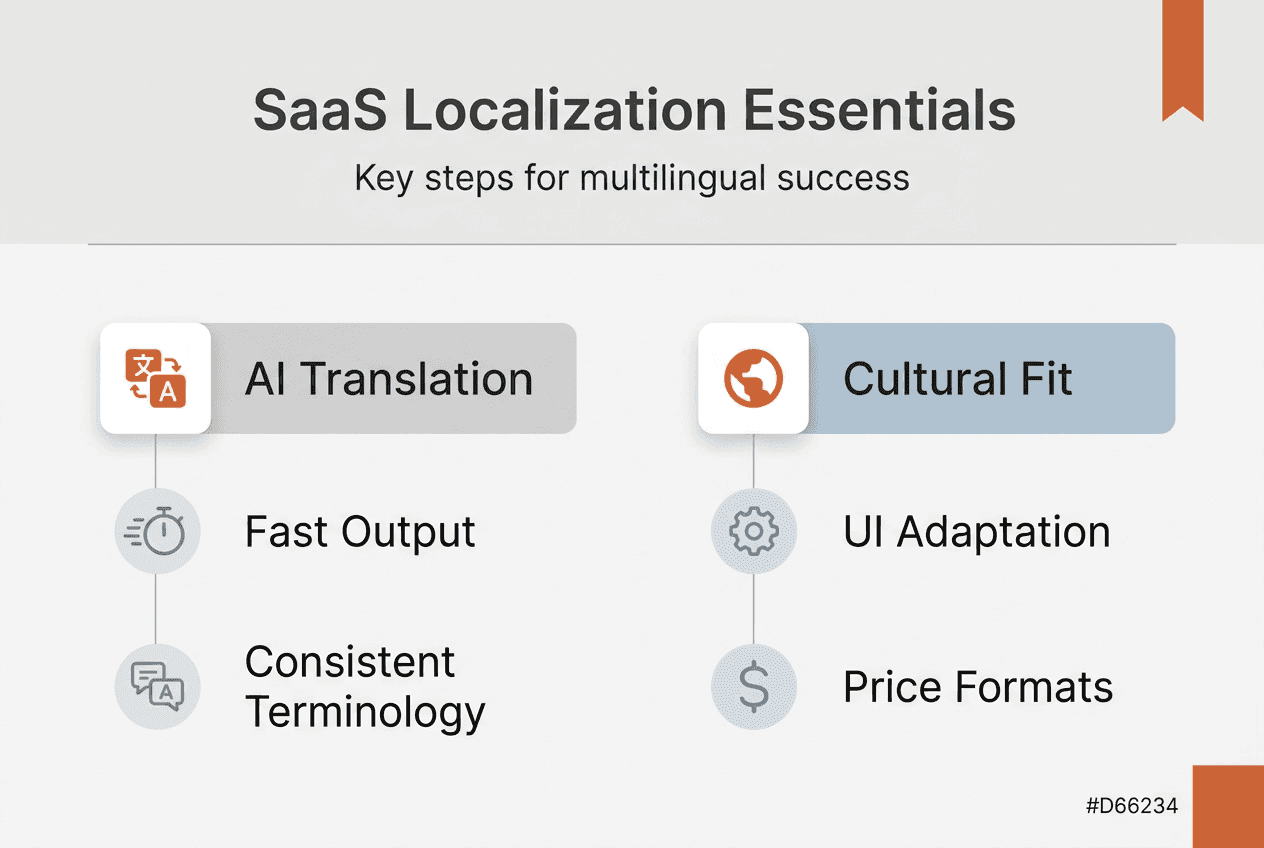
Right-to-left (RTL) languages like Arabic and Hebrew introduce fundamental design considerations that simple mirroring cannot solve. SaaS localization requires adapting UI layout for different languages, especially right-to-left languages like Arabic. Navigation patterns, icon placement, and reading flow all shift in RTL contexts, requiring thoughtful redesign rather than automated flipping.
Aspect | LTR Languages (English, Spanish) | RTL Languages (Arabic, Hebrew) |
|---|---|---|
Navigation flow | Left to right progression | Right to left progression |
Icon placement | Left-aligned for primary actions | Right-aligned for primary actions |
Text alignment | Left-aligned default | Right-aligned default |
Number display | Standard left-to-right | Often remains left-to-right |
Form layout | Labels typically left of inputs | Labels typically right of inputs |
Internationalization best practices establish the technical foundation that makes localization possible. Essential technical tasks include:
Separating all user-facing strings from code into resource files
Implementing flexible layouts that accommodate text expansion without breaking
Avoiding hardcoded date, time, and number formats
Supporting Unicode throughout the application stack
Building dynamic content loading based on user locale preferences
Price localization significantly impacts conversion rates and user trust. Price localization, including displaying prices in local currency and adjusting pricing based on local purchasing power, is crucial for a seamless purchase process. Users expect to see prices in familiar currency formats, and purchasing power parity considerations can mean the difference between market penetration and rejection. A $99 monthly subscription might represent reasonable value in the US market but prove prohibitively expensive in emerging economies without adjustment.
Pro Tip: Avoid simple UI mirroring for RTL languages. Instead, analyze how native speakers naturally interact with digital interfaces in their markets, then design experiences that respect those conventions. Icons that seem universal often carry different cultural meanings, and color symbolism varies dramatically across regions.
Cultural market fit transcends translation accuracy to encompass how your product aligns with local user expectations and behavioral norms. Cultural nuance localization determines whether users perceive your SaaS product as locally relevant or as a foreign import. Imagery, examples, case studies, and even feature prioritization may need adjustment based on regional preferences. What works as a compelling value proposition in North America might fall flat in Asia, where different pain points and aspirations drive purchasing decisions.
Understanding successful localization keys helps teams move beyond checkbox compliance toward creating genuinely localized experiences. This cultural and technical foundation prepares you to implement AI-driven workflows that respect these nuances while achieving operational efficiency.
Implementing an efficient AI-driven multilingual localization strategy for SaaS
Building an effective AI-driven localization strategy requires a systematic approach that balances speed gains with quality assurance. A phased strategy over the next 1–3 years is prudent, using clear indicators of technology maturity, cost benefits, and risk mitigation to guide the transition. This framework helps teams adopt AI capabilities without exposing products to quality failures that damage user trust.
Follow this five-step workflow to integrate AI into your SaaS localization process:
Assess readiness: Audit your current localization infrastructure, content volume, and quality requirements. Identify which content types carry the highest risk if translation quality falters, and which represent opportunities for immediate AI application.
Launch pilot projects: Select low-risk content categories like internal documentation or help center articles for initial AI translation trials. Establish baseline quality metrics and gather team feedback on workflow integration.
Implement phased AI adoption: Gradually expand AI usage to product UI strings, then marketing content, based on pilot results. Set clear quality gates that content must pass before publication, using both automated checks and human review.
Maintain human-in-the-loop oversight: Design review workflows where human linguists focus on high-impact content and cultural adaptation rather than word-by-word translation. This hybrid approach maximizes both efficiency and quality.
Monitor quality continuously: Track error rates, user feedback, and support ticket patterns across localized markets. Use this data to refine AI prompts, update terminology databases, and identify where additional human review adds value.
Pro Tip: Leverage AI tools that integrate directly with your design and development environment for maximum efficiency. Solutions like the Gleef Figma Plugin enable designers to manage translations without context switching, while CLI tools let developers automate localization in continuous deployment pipelines.
Risk mitigation tactics prove essential for maintaining quality during AI adoption. Implement compliance checks that verify translations meet legal requirements for each target market. Cultural QA processes should involve native speakers who evaluate not just linguistic accuracy but cultural appropriateness and user experience quality. These safeguards prevent the embarrassing mistakes that undermine market credibility.
Continuous feedback loops accelerate improvement and prevent drift from quality standards. Establish channels for users to report translation issues directly within your product. Monitor these reports alongside traditional quality metrics to identify patterns that indicate systematic problems versus isolated errors. Regular iteration based on real-world usage data ensures your localization improves over time rather than degrading.
Understanding localization strategy steps provides additional context for building robust processes. Equally important is learning from others’ mistakes, which you can explore through common localization mistakes to avoid. These resources complement the AI-driven approach by highlighting where human judgment remains irreplaceable and where automation delivers the greatest value.
Optimize your SaaS localization with Gleef’s AI-powered tools
Transitioning from strategy to execution becomes simpler with tools designed specifically for modern SaaS localization workflows. Gleef’s AI-powered localization platform addresses the exact challenges product teams face when scaling across multiple languages and markets.
Gleef integrates seamlessly with popular design tools and developer workflows, eliminating the context switching that slows traditional localization processes. The Gleef Figma Plugin lets designers manage translations directly within their design files, previewing how localized text affects layouts in real time. This in-context approach catches UI issues before they reach production, saving costly revision cycles.
For development teams, Gleef’s CLI tools automate translation workflows within existing deployment pipelines. Developers can trigger translations, sync updated content, and validate localization completeness without leaving their terminal. This automation accelerates release cycles while maintaining the quality oversight necessary for professional SaaS products.
Gleef combines AI translation speed with human oversight options, giving teams flexibility to match review intensity to content importance. Semantic translation memory ensures consistency across your product, while glossaries enforce brand-specific terminology. These features deliver the quality and coherence users expect from professional software.
Pro Tip: Use Gleef’s preview capabilities to simulate how your product appears in different languages before committing translations to production. This visual validation catches layout breaks, truncation issues, and cultural mismatches that text-only review processes miss.
“Gleef transformed our localization from a release blocker into a competitive advantage. We ship to new markets 60% faster while maintaining higher translation quality than our previous manual process delivered.”
Explore how Gleef’s AI-powered tools can streamline your multilingual SaaS localization by trying the Figma plugin or CLI in your next project. The platform’s design reflects the strategies outlined in this guide, providing practical infrastructure for the AI-driven localization approach that defines competitive SaaS development in 2026.
What is the difference between translation and localization?
Translation converts text from one language to another while preserving meaning and intent. Localization adapts content culturally and technically for a target market, encompassing translation plus UI adjustments, cultural customization, and legal compliance. A translated product uses the right words, while a localized product feels native to users in each market.
Localization includes elements translation alone cannot address, such as date and currency formats, imagery that resonates culturally, and features prioritized according to local user needs. Understanding translation vs localization helps teams scope projects accurately and allocate resources to the adaptation work that drives actual market success.
How can AI improve SaaS localization workflows?
AI speeds translations dramatically, reducing cycle times from weeks to hours while cutting costs by 60-80% compared to traditional human translation. This efficiency enables SaaS teams to support more languages and update localized content more frequently, keeping all markets current with product improvements. AI also ensures consistency across large content volumes, applying terminology and style rules uniformly.
Human review combined with AI ensures quality and contextual accuracy where it matters most. Linguists focus their expertise on culturally sensitive content, marketing messaging, and edge cases where AI may struggle, rather than spending time on routine translation. This hybrid approach delivers both speed and quality. Explore AI benefits in localization for deeper insights into how modern AI transforms localization economics.
What are common pitfalls to avoid in multilingual SaaS localization?
Ignoring cultural norms and UI adaptation causes user confusion and abandonment, even when translations are linguistically accurate. Users expect products to behave according to local conventions, from navigation patterns to form layouts. Treating localization as pure translation without cultural and technical adaptation wastes the investment and fails to capture market potential.
Skipping compliance checks risks legal penalties and market rejection that can permanently damage your brand in a region. Data privacy laws, accessibility requirements, and consumer protection regulations vary significantly across jurisdictions. Build compliance validation into your localization workflow from the start. Learn from others’ mistakes by reviewing common localization mistakes that derail global expansion efforts.
How do I measure the ROI of investing in better SaaS localization?
Track conversion rates, user retention, and support ticket volumes across localized markets compared to your primary market. Well-localized products show conversion rates within 10-15% of home market performance, while poorly localized versions often underperform by 40% or more. Support ticket analysis reveals whether users struggle with localized content, indicating quality issues that need attention.
Calculate cost savings from AI-driven localization by comparing translation expenses and time-to-market before and after implementation. Factor in opportunity costs of delayed market entry when evaluating different localization approaches. Most SaaS companies see positive ROI within 6-12 months when they implement systematic localization strategies that combine AI efficiency with strategic human oversight.
Recommended
2024 Recap Localization Trends That Redefined User Experience - Gleef
AI in Localization: Beyond the Hype and Into Reality - Gleef
How AI Localization is Helping Designers Build Unbreakable Designs - Gleef
Why Integrating AI into Your Localization Strategy is a Game-Changer - Gleef
The Rise of Digital Workers: AI Agents in the Modern Workplace — SimplyAI