
What does translation pricing actually cover for software teams?
Translation pricing is the cost structure that determines what you pay for language services on a software localization project. It is not a single number. It is a framework built from pricing models, service tiers, and project variables that interact in ways that can make two quotes for the same word count differ by 300%.
The four main billing models you will encounter:
Per word (most common): US rates for human translation vary, with common language pairs like Spanish and French generally being more affordable than rarer languages.
Per hour ($30–$90): used for proofreading, desktop publishing, and quality assurance work where word count does not capture the effort.
Per project: a flat fee for well-scoped work, common in enterprise SaaS localization.
Subscription or managed service: recurring access to a translation management system with predictable monthly costs, increasingly popular for continuous localization pipelines.
Full localization goes beyond translation. It adds file engineering, in-context review, glossary management, and QA testing, each of which carries its own line item. A product team that budgets only for per-word translation rates and ignores those layers will consistently underspend their estimates and overspend their actuals.
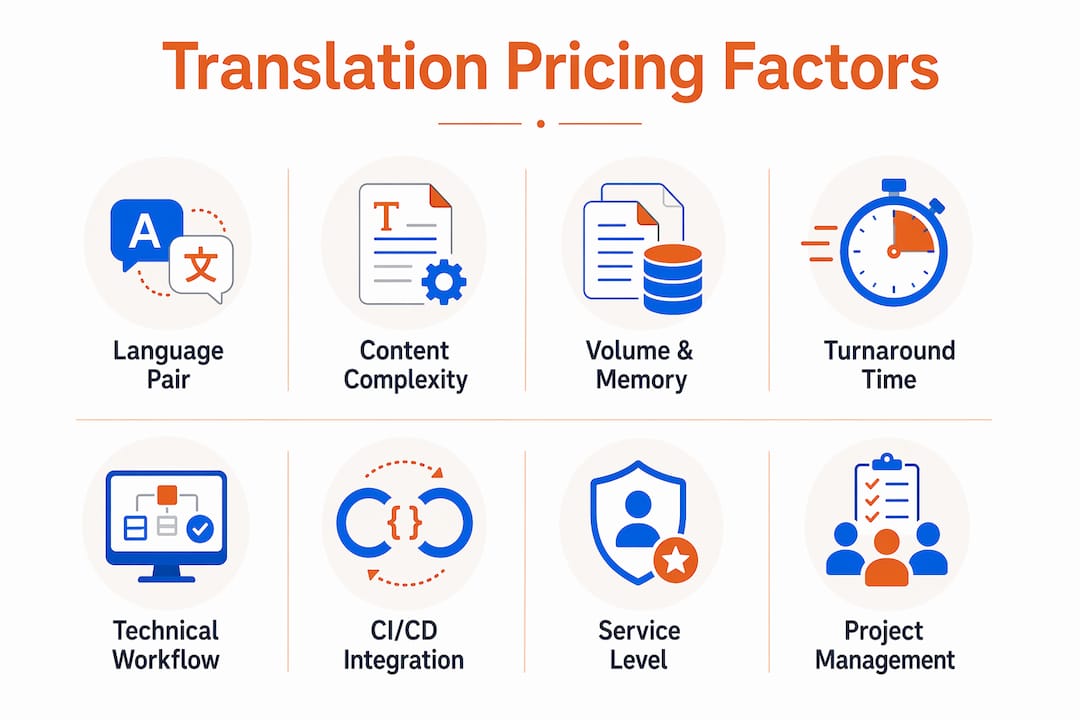
1. Language pair and how it moves your rate
Language pair is the single fastest way to predict whether a quote will be at the low or high end of the market. Common pairs like Spanish and French are more affordable because the qualified linguist pool is large. Nordic and CJK languages command higher rates due to fewer available specialists and higher regional cost of living. Rare combinations can cost two to three times the base rate.
2. Content complexity and domain expertise
UI strings are the cheapest content category to translate. Legal, medical, and technical content requires domain-credentialed linguists, and that expertise adds a significant premium over standard rates. A fintech app with regulatory disclosures and a gaming app with casual UI copy will carry very different per-word costs even if the word counts are identical.

3. Volume and translation memory leverage
Larger projects benefit from volume discounts, but the real long-term savings come from translation memory ™. TM stores previously translated segments and applies discounted rates to repeated or fuzzy-matched strings. For a SaaS product with recurring UI updates, TM is not just a discount mechanism. It is a reusable asset that compounds in value with every release cycle.
4. Turnaround time and rush surcharges
Standard delivery is the most cost-effective timeline. Rush surcharges typically add a substantial premium to base rates for compressed or overnight delivery due to additional resource requirements. For product teams shipping on sprint cycles, building translation into the sprint timeline rather than treating it as a last-minute task is the single most reliable way to avoid these fees.
5. Technical workflow and file format complexity
File format complexity can significantly affect total costs. Structured formats like JSON, XLIFF, and Android XML are easier and less expensive to process compared to proprietary formats and embedded PDFs, which require engineering work and can increase costs substantially, especially under tight deadlines.
6. CI/CD integration and continuous localization setup
Teams shipping weekly or daily need continuous localization, not batch translation. Setting up automated string extraction, TMS integration, and CI/CD pipeline hooks adds upfront cost. The payoff is lower incremental update pricing over time, which matters enormously for iterative products. Localization integrations for product teams cover the engineering decisions that shape this cost structure.
7. Service level: translation only vs. TEP
Translation, editing, and proofreading (TEP) is the full professional workflow. Translation only is a single pass. The gap in quality between the two is significant for customer-facing software, and the gap in price is real but often smaller than teams expect. Knowing which tier you are buying is the first question to ask any vendor before comparing headline rates.
8. Project management and hidden fees
Project management fees are commonly charged at a modest percentage at most agencies, covering coordinator time, deadline management, and final quality checks. Most agencies apply a minimum project fee regardless of word count. Engineering fees, desktop publishing reformatting, and in-country review can all add materially to the total if they are not disclosed upfront. Budget for them explicitly, not as a contingency.
Pro Tip: Ask every vendor to itemize their quote into translation, editing, project management, engineering, and QA line items. A vendor who cannot or will not do this is hiding costs.
Why ROI matters more than the per-word rate
The cheapest per-word rate is often the most expensive decision you can make. Localization ROI is calculated as: [(Value of Localization – Cost of Localization) / Cost of Localization] × 100%. That formula forces you to put a number on what bad translation costs, not just what good translation costs.
Poor quality translations carry three categories of downstream cost:
Brand damage: culturally inappropriate or inaccurate copy alienates users and erodes trust in markets you paid to enter.
Legal and compliance risk: in regulated industries, translation errors carry financial and regulatory consequences that dwarf any per-word savings.
Lost market opportunity: a failed localization launch means re-entering a market you already spent resources to reach.
Low per-word rates can be misleading because poor quality incurs hidden costs that never appear on the original invoice. Viewing translation providers as strategic partners rather than transactional vendors is what separates teams that build durable global products from those that re-translate the same content every 18 months. For a deeper look at how localization ROI connects to business outcomes, the calculus goes well beyond the language services invoice.
AI-first localization workflows and TM integration accelerate time-to-market while reducing total cost of ownership. That combination is where the real ROI lives.
How modern localization platforms cut costs without cutting quality
AI-powered translation management platforms reduce the cost of software localization by eliminating the repetitive manual work that inflates both time and spend. Gleef’s platform, for example, combines semantic translation memory, glossaries, and in-context editing so product teams can manage translations directly inside their existing workflow without switching tools.
Key platform capabilities that drive cost efficiency:
Semantic TM: matches not just identical strings but contextually similar ones, increasing reuse rates across releases.
Glossary enforcement: keeps brand terminology consistent across languages, reducing the back-and-forth correction cycles that burn hours.
Figma integration: designers and UX writers translate in place, eliminating the file export and re-import loop that adds engineering overhead.
Rules-based workflows: automated quality checks catch errors before they reach review, compressing QA cycles.
Teams using Gleef report measurable improvements in translation quality, process speed, and brand consistency across international markets. Avoiding release blockers caused by last-minute translation issues is one of the most concrete ways a platform pays for itself. App localization research confirms that quality localization directly affects download rates and user retention, making the platform investment defensible at the product level.
How to budget and manage translation costs in practice
Building a realistic localization budget means going beyond the per-word rate from the start.
Define content types upfront: UI strings, marketing copy, legal disclosures, and help documentation each carry different rates. Mixing them into a single word count and applying one rate produces an inaccurate estimate.
Clarify billing units: always ask whether you are billed on source words or target words. Spanish and French expand 20–25% versus English, so target-word billing on those pairs raises the final total.
Plan for technical costs: file engineering, CI/CD setup, and QA are not optional line items for software products. Budget them explicitly.
Track TM reuse actively: monitor your match rates across projects. A growing TM is a cost reduction that compounds over time.
Evaluate quotes beyond the headline rate: confirm whether the quote covers TEP or translation only, whether rush fees apply, and whether project management is included or added separately.
Monitor quality continuously: localization metrics tied to error rates and time-to-edit give you the data to renegotiate rates and justify platform investment.
Gleef gives product teams a faster path to global quality
Translation costs for software localization add up fast, especially when file engineering, QA cycles, and project management overhead pile onto the per-word rate. Gleef is built specifically for product teams who need to ship globally without those hidden costs eating the budget.
With Gleef’s Figma plugin, your designers translate in context, your developers push strings through an API, and your TM grows with every release, cutting the cost of future updates automatically. There are no agency markups, no file conversion loops, and no waiting on external project managers to move work forward. Teams that have moved their localization workflow into Gleef consistently report faster release cycles and stronger brand consistency across languages. If you are evaluating how to bring translation costs under control without sacrificing quality, start a free trial at Gleef today.
Key Takeaways
Translation pricing for software localization is shaped by far more than the per-word rate, and the teams that understand the full cost structure consistently get better outcomes at lower total spend.
Point | Details |
|---|---|
Per-word rates vary widely | US human translation in 2026 costs between $0.09 and $0.40 per word depending on language pair, volume, turnaround time, and content type. Common pairs like Spanish and French are generally billed at the lower end, typically around $0.10–$0.22 per word. |
Hidden costs are real | Project management, engineering, and QA add 8–15% or more on top of the base translation rate. |
Rush fees compound fast | Compressed timelines add 25–100% to base rates; building translation into sprint planning avoids them. |
ROI beats rate shopping | Poor quality translation creates brand damage, compliance risk, and lost market opportunity that exceed any per-word savings. |
Gleef reduces total cost | Semantic TM, in-context editing, and Figma integration eliminate repetitive overhead and lower per-update costs over time. |