
TL;DR:
Localization sprint planning integrates translation into the development cycle as a continuous, visible workflow. It involves mapping stages like extraction, translation, review, and testing, with WIP limits and real-time updates to prevent bottlenecks. Tools like Gleef enhance collaboration, accelerate translation, and ensure localization keeps pace with agile delivery.
What is localization sprint planning in an agile context?
Localization sprint planning means embedding translation and internationalization tasks directly into your agile sprint backlog as defined workflow stages, not as a last-minute handoff after development wraps. The core idea is simple but powerful: treat localization as a continuous, visible part of delivery rather than a post-release scramble.
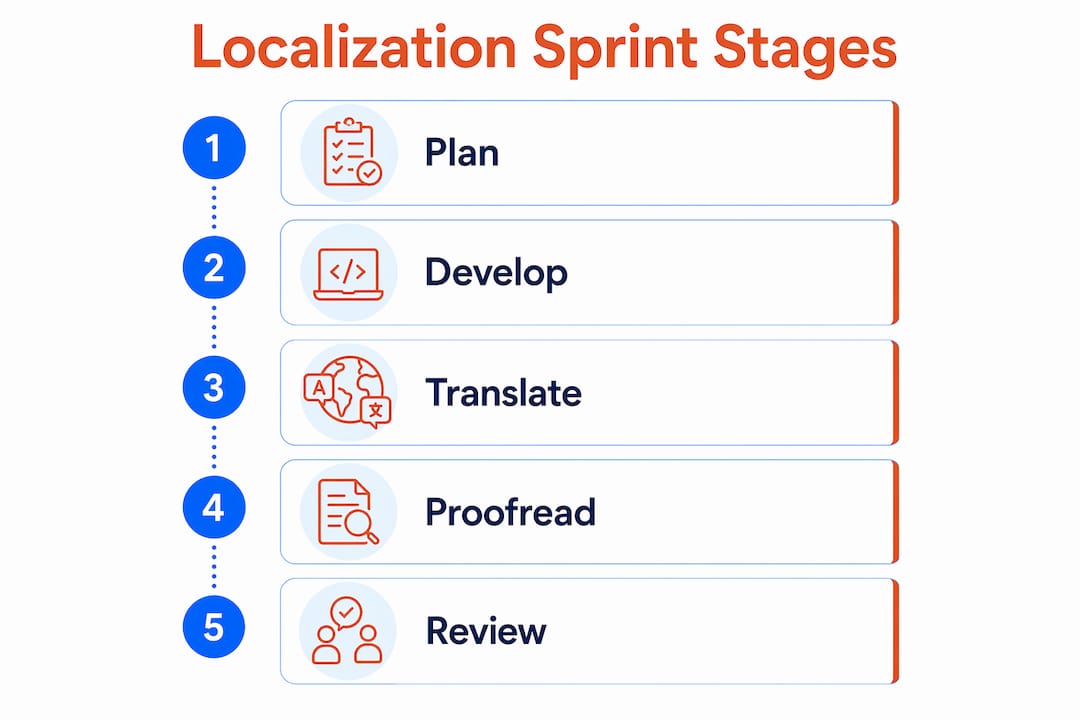
A well-structured localization sprint backlog mirrors your actual workflow. String coverage per locale is the key metric to track, giving every team member a transparent view of progress across languages. The workflow stages that matter most are:
String extraction from i18n-ready code
Translation per supported language, run in parallel where possible
Native speaker review for accuracy and tone
Integration of translated files back into the build
Locale testing to verify each language renders correctly
Release preparation with all locales confirmed complete
This structure keeps localization from becoming a bottleneck at the end of a sprint. When each stage is a named column in your board, blockers surface in hours, not days.
How do you integrate localization workflows into your agile backlog?
Mapping your current process before touching any tool is the most underrated step in localization project management. Interview translators, developers, and reviewers. Document every handoff. Then build your board to reflect reality, not an idealized process nobody follows.
Once your workflow is mapped, a Kanban board reflecting all localization stages from backlog to cultural review gives your team a shared, real-time view of every task. Here is how to make that structure work:
Use language-specific labels such as
lang:es,lang:fr, orlang:deto filter tasks by locale at a glance.Create one translation task per supported language for each feature, so parallel work across locales stays visible and accountable.
Add context comments inside every string extraction task. Translators who lack context produce lower-quality output, and fixing that downstream costs more time than writing the comment upfront.
Document internationalization guidelines in a shared knowledge base, covering pluralization rules, RTL support requirements, and date or number formatting per locale.
Prioritize localization backlog items alongside development work in sprint planning, not after the fact.
Pro Tip: Link each localization task directly to its source feature task. When a developer changes a string, the localization subtask is immediately visible to the translator assigned to that language.
A localization workflow guide that maps these stages before sprint kickoff prevents the most common failure mode: translation work arriving in a pile the day before release.
How should you set sprint goals for early localization sprints?
The goal of your first localization sprints is not to deliver fully translated content. It is to prove the process works. That distinction saves teams from wasted effort and false confidence.
Early sprints should validate that your internationalization architecture is sound, that your build pipeline correctly integrates translated files, and that translators have enough context to produce quality output in later sprints. Machine translation without post-editing is a legitimate tool here. The translations may not be polished, but the pipeline gets proven, and post-editing can run in parallel as the product matures.
Concrete early-sprint goals that actually move the needle:
Build the localization kit and confirm the extraction-to-integration pipeline runs end to end.
Establish a glossary for key product terms, with agreed translations per language. Glossary accretion in early sprints pays dividends in consistency throughout the project.
Improve source text quality based on feedback from translators. Ambiguous source strings are cheaper to fix early than to re-translate across six languages later.
Confirm translator context is sufficient, including screenshots, feature descriptions, and tone guidelines.
Think of these sprints as building the localization runway, not flying the plane yet. Each successive sprint adds altitude.
How do WIP limits and metrics keep localization sprints on track?
Bottlenecks in localization almost always appear at proofreading and cultural review, where specialist capacity is limited and upstream translation work arrives faster than reviewers can process it. WIP limits set equal to the number of people working in each stage plus one create a small buffer without letting queues build. Two proofreaders means a WIP limit of three for that column.

Tracking cycle time per stage tells you where work slows down. If cultural review consistently holds cards longer than translation, that is a signal to either add reviewer capacity or reduce the upstream WIP limit to slow the inflow of new work. Adjust limits based on data, not gut feel.
Beyond WIP limits, the metrics that give localization teams real visibility are:
String coverage per locale: percentage of strings translated and reviewed, tracked per language
Translation turnaround time: days from string extraction to completed translation
Quality rejection rate: percentage of translations sent back during review
Blocked card frequency: how often tasks stall and why
Real-time card updates are what make these metrics useful. When translators and reviewers move cards the moment a stage is complete rather than in an end-of-day batch, project managers can identify and respond to blockers within hours. Bring these metrics into every sprint retrospective. One or two process improvements per cycle compounds quickly over a quarter.
How do you build real collaboration between development and localization teams?
Cross-functional collaboration in localization sprints fails most often at the handoff point, when developers consider a feature “done” and localization is still waiting for final strings. The fix is structural: include localization leads in sprint planning from day one, not as observers but as contributors who shape sprint scope.
Involving localization experts early in sprint planning and embedding localization considerations into design sprints prevents the pixel-perfect vision from crumbling the moment text expands 40% in German or flips direction in Arabic. Practical collaboration habits that hold up under sprint pressure:
Make the board the single source of truth. Status conversations in email or chat should reference the board, not duplicate it.
Use multilingual design cheat sheets so designers account for text expansion, RTL layouts, and font compatibility before handing off to developers. Auto-layout in Figma prevents the layout issues that cascade into costly localization fixes downstream.
Run joint retrospectives where developers, translators, and product managers review localization outcomes together, not in separate silos.
Assign a localization point of contact per sprint who owns communication between the development team and translators.
Product managers play a specific role here. Coordinating localization efforts across agile teams requires someone who understands both the release timeline and the translation pipeline well enough to flag conflicts before they become blockers.
What should a post-sprint localization review actually cover?
Most teams treat the sprint retrospective as a development-only event. That is a missed opportunity. A post-sprint review that includes localization outcomes gives you the data to continuously improve your agile localization strategy.
The review should answer four questions. First, what percentage of strings reached “released” status across all supported locales? Second, which stages held the most blocked cards, and what caused those blocks? Third, did translation turnaround times meet the targets set at sprint planning? Fourth, what source text or context issues did translators flag that could be fixed before the next sprint?
Document the answers and assign owners to each improvement action. A retrospective without owners produces good intentions, not process change. Over time, these reviews build a feedback loop that tightens the entire localization workflow, reducing the gap between development completion and localized release.
How do you manage the risk of localization delays in a sprint?
Localization delays rarely appear without warning. They accumulate from small decisions made weeks earlier: strings hardcoded in the UI, context comments skipped, cultural review treated as optional. The most effective risk mitigation is upstream, not reactive.
Build these practices into your sprint workflow before delays happen:
Flag i18n-readiness as part of the definition of done for every development task. A feature is not sprint-complete if strings are hardcoded or extraction has not run.
Set a string freeze date at least two to three days before the sprint release date. Strings that change after freeze require re-translation and re-testing, which almost always misses the deadline.
Maintain a blocked lane on your board. When a task stalls waiting for a source file, a terminology decision, or stakeholder approval, move it to the blocked lane immediately with a note explaining the blocker. Stalled work that hides in active columns is the single most common cause of surprise delays.
Build buffer capacity into your translator assignments. A translator running at 100% capacity has no room to absorb a late string batch or a rework request.
Agile localization tools and workflows must support rapid iteration, fast removal of obsolete strings, and accurate tracking of localization data. If your current tooling cannot do those three things, the risk of delay is structural, not just a process problem.
Gleef gives your localization sprints a real advantage
Localization sprint planning works best when your tooling matches the pace of your agile workflow. Gleef is built for exactly that: a platform where product teams manage translations directly inside their design and development environment, without the context-switching that slows every sprint down.
Gleef’s Figma plugin lets designers and developers handle in-context translation without leaving the tool where the work lives. Semantic translation memory and glossary management keep terminology consistent across every locale and every sprint. AI-powered translations accelerate the review cycle, while in-context editing catches layout issues before they reach production. For teams running cross-functional localization across developers, UX writers, and product managers, Gleef’s collaboration features give everyone a shared view of translation status aligned with sprint goals. The result: fewer release blockers, faster localized delivery, and a localization workflow that actually keeps up with your development cadence.
Key Takeaways
Effective localization sprint planning treats translation as a continuous workflow stage inside agile delivery, not a post-development task, and measures progress through string coverage, cycle time, and quality rejection rates.
Point | Details |
|---|---|
Define workflow stages | Map localization steps (extraction, translation, review, integration, testing) as named board columns before sprint kickoff. |
Validate early, translate later | Use early sprints to prove the pipeline and build glossaries rather than deliver fully polished translations. |
WIP limits prevent pile-ups | Set WIP limits per stage at team size plus one to stop bottlenecks at proofreading and cultural review. |
Real-time updates catch blockers fast | Moving cards immediately when a stage completes lets project managers respond to blockers within hours, not the next day. |
Gleef accelerates sprint delivery | Gleef’s Figma integration and AI-powered translation memory keep localization aligned with development sprints and reduce release blockers. |