
Most product teams think translation is just swapping words between languages. This dangerous oversimplification costs companies millions in failed product launches and poor user experiences. A proper translation workflow coordinates multiple specialized steps, blending AI efficiency with human cultural expertise to deliver authentic localized experiences. This guide reveals how modern product teams build scalable, quality-driven translation workflows that accelerate global expansion while maintaining brand integrity across markets.
Key takeaways
Point | Details |
|---|---|
Translation workflow complexity | Translation workflows involve coordinated stages including content prep, translation, cultural review, and integration beyond simple text conversion. |
Hybrid methods win | Combining AI speed with human cultural expertise delivers superior results compared to pure AI or pure human approaches. |
Cultural localization challenge | Cultural localization remains the weak spot for AI translation, requiring human insight for idioms, tone, and local preferences. |
Systematic approach required | Product teams need structured workflows balancing quality, speed, and cultural relevance across UI, marketing, and user-facing content. |
What is a translation workflow and why does it matter for product teams?
A translation workflow encompasses the complete sequence of coordinated activities transforming source content into culturally appropriate, market-ready translations. For product teams managing global digital products, this process includes content extraction, translation execution, localization adaptation, quality review, and system integration. Each stage requires specific expertise and tools to maintain consistency while scaling across multiple languages and markets.
Product managers, UX writers, and designers face a critical challenge: balancing translation speed with quality and cultural authenticity. Pure machine translation delivers speed but risks awkward phrasing and cultural missteps. Traditional human-only translation ensures quality but creates bottlenecks that delay product launches. The solution lies in hybrid workflows that strategically deploy AI for repetitive technical content while reserving human expertise for culturally sensitive materials.
Software localization impact extends far beyond basic text conversion. UI elements demand conciseness and clarity. Marketing content requires emotional resonance and cultural relevance. Technical documentation needs precision and consistency. Each content type demands different workflow considerations, making a one-size-fits-all approach ineffective.
Consider these workflow components:
Content preparation and categorization by sensitivity level
Translation memory and glossary development for consistency
Machine translation for high-volume technical content
Human review for marketing and user-facing materials
Cultural adaptation for idioms and local preferences
Quality assurance and linguistic testing
Integration with design and development systems
Pro Tip: Categorize your content into three tiers before translation. Tier 1 (UI labels, error messages) can use AI with light human review. Tier 2 (help documentation, product descriptions) needs AI plus thorough human editing. Tier 3 (marketing campaigns, brand messaging) requires human-led translation with AI assistance only for terminology consistency.
The stakes are high. Cultural localization remains the weak spot for AI translation, making pure AI approaches risky for UX and marketing content where user trust depends on authentic, natural language. Hybrid methods recommended by localization experts combine the efficiency gains of AI with the nuanced judgment only humans provide.
Core stages of an effective translation workflow
Understanding each workflow stage helps product teams build systematic, repeatable processes that scale across markets while maintaining quality standards. Every successful translation workflow progresses through five essential phases, each serving specific quality and efficiency objectives.
The preparatory phase establishes the foundation for consistent, efficient translation:
Extract all translatable content from design files, code repositories, and content management systems
Build comprehensive glossaries defining key terms, brand voice, and product-specific vocabulary
Create style guides specifying tone, formality levels, and cultural considerations per target market
Establish translation memory databases capturing previously approved translations for reuse
Categorize content by type, sensitivity, and required quality level
Machine translation accelerates the initial conversion phase. AI localization benefits become apparent when handling high-volume UI strings, technical documentation, and repetitive content patterns. AI excels at maintaining terminology consistency across thousands of strings while processing content at speeds impossible for human translators alone.
The review and localization phase separates mediocre translations from exceptional ones. Human linguists with native fluency and cultural expertise evaluate machine-generated translations, correcting awkward phrasing, adapting idioms, and ensuring content resonates with local audiences. This stage catches the cultural nuances and contextual subtleties that AI speed and volume advantages cannot address.

Quality assurance validates translations within actual product contexts. Linguistic testing reveals how translations appear in real UI layouts, identifying truncation issues, formatting problems, and contextual mismatches. Functional testing ensures translated content triggers correct system behaviors and maintains user flow logic.
Final integration deploys approved translations into production systems. This stage coordinates with development teams to update resource files, verify encoding standards, and conduct regression testing ensuring translations display correctly across devices and platforms.
Approach | Speed | Quality | Cultural Fit | Best Use Case |
|---|---|---|---|---|
Pure Human | Slow | Excellent | Excellent | Marketing campaigns, brand messaging, legal content |
Pure AI | Very Fast | Variable | Poor | Internal documentation, user-generated content moderation |
Hybrid | Fast | Excellent | Excellent | Product UI, help content, customer communications |
Pro Tip: Implement parallel workflows for different content tiers. Route technical UI strings through fast AI-heavy workflows while simultaneously processing marketing content through human-led workflows. This parallelization reduces overall time to market without sacrificing quality where it matters most.
Navigating challenges in translation workflows for cultural localization
Cultural localization represents the most complex challenge in modern translation workflows. While AI handles literal translation efficiently, understanding cultural context, humor, idioms, and emotional nuance requires human insight that current language models cannot replicate reliably.
Product teams encounter specific cultural localization obstacles:
Idioms and colloquialisms that translate literally but lose intended meaning
Humor and wordplay that falls flat or offends in target cultures
Color symbolism and imagery carrying different cultural associations
Formality levels and honorifics varying significantly across languages
Date formats, measurement units, and numerical conventions requiring localization
Cultural taboos and sensitive topics differing by market
The risk of cultural missteps extends beyond awkward phrasing. LLMs struggle significantly with idioms and cultural nuances making pure AI solutions risky for marketing and UX content where user trust depends on authentic communication. A poorly localized product signals carelessness, damaging brand perception and user confidence.
Consider a fitness app translating “crush your goals” into languages where violent imagery carries negative connotations. Or a productivity tool using competitive sports metaphors in cultures valuing collective harmony over individual achievement. These subtle misalignments erode user engagement and conversion rates.
Recent studies show AI translation systems fail to accurately interpret cultural context in over 40% of marketing content samples, with idioms and humor presenting the highest error rates. Human cultural review remains essential for maintaining brand integrity across global markets.
Product teams must embed cultural review as a mandatory workflow stage, not an optional polish step. Assign native speakers familiar with local market preferences to evaluate translations for cultural appropriateness. This investment prevents costly post-launch corrections and protects brand reputation.
Pro Tip: Build a cultural review checklist covering idioms, humor, imagery, color symbolism, formality levels, and cultural sensitivities specific to each target market. Require native cultural reviewers to validate all customer-facing content against this checklist before approval.
Translation challenges examples reveal how seemingly minor oversights create major user experience problems. A navigation label that makes perfect sense in English might confuse users in languages with different information architecture conventions. Cultural localization demands ongoing learning and market-specific expertise that AI alone cannot provide.
Practical strategies to optimize your product’s translation workflow in 2026
Building an optimized translation workflow requires strategic decisions about where to deploy AI, where to invest in human expertise, and how to coordinate both approaches seamlessly. Product teams succeeding in global markets implement these proven strategies.
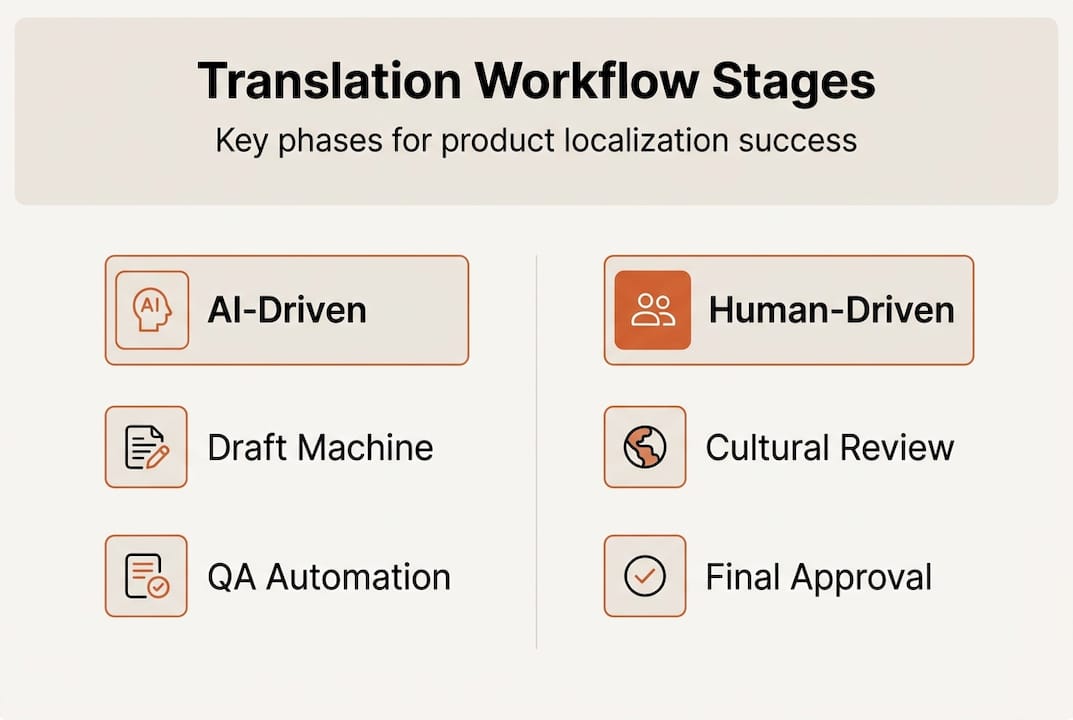
Deploy AI strategically for maximum efficiency gains. Use machine translation to handle repetitive technical content like UI labels, error messages, system notifications, and help documentation. These content types benefit from AI’s consistency and speed while presenting lower cultural risk. Reserve human translation capacity for high-impact materials where cultural nuance and emotional resonance drive user engagement.
Assign human experts to content categories where quality directly impacts business outcomes:
Marketing campaigns and promotional materials
Onboarding flows and first-run experiences
Customer support communications
Brand messaging and value propositions
Legal terms and privacy policies
Adopt translation management platforms supporting hybrid workflows and seamless tool integrations. Modern localization platforms connect design tools, content management systems, and development environments, enabling translators to work within proper context while maintaining version control and collaboration capabilities.
Workflow Type | Cost | Speed | Quality | Cultural Fit | Scalability |
|---|---|---|---|---|---|
AI Only | Low | Very Fast | Variable | Poor | Excellent |
Human Only | High | Slow | Excellent | Excellent | Limited |
Hybrid | Medium | Fast | Excellent | Excellent | Excellent |
Hybrid translation workflow models combining AI speed and human quality produce the best outcomes for digital product localization. This approach maximizes efficiency without sacrificing the cultural authenticity that builds user trust and drives adoption in new markets.
Establish continuous feedback loops between translators and product teams. Regular communication helps translators understand product evolution, new features, and shifting brand voice while giving product teams insight into translation challenges and localization opportunities. Schedule quarterly reviews analyzing translation quality metrics, user feedback, and market performance to identify improvement areas.
Implement context-rich translation environments. Provide translators with screenshots, user flow diagrams, and interactive prototypes showing exactly where translations appear and how users interact with them. Context dramatically improves translation quality by helping linguists understand space constraints, user intent, and interaction patterns.
Pro Tip: Create a translation brief template documenting target audience, tone requirements, key terminology, cultural considerations, and technical constraints for each project. This upfront investment reduces revision cycles and ensures translators have the context needed for accurate first-pass translations.
AI in localization insights demonstrate that successful teams view AI as an augmentation tool, not a replacement for human expertise. The most effective workflows leverage AI to eliminate tedious repetitive work, freeing human experts to focus on the creative, culturally sensitive aspects of localization that truly differentiate products in global markets.
Integrating AI into your localization strategy requires thoughtful planning about which processes to automate, which to keep human-driven, and how to coordinate both seamlessly. Teams achieving the best results start with pilot projects, measure outcomes rigorously, and refine their hybrid approach based on data rather than assumptions.
Streamline your translation workflow with Gleef’s Figma plugin
Product teams waste countless hours managing translation handoffs between design tools and localization platforms. Gleef eliminates this friction by bringing AI-powered translation directly into Figma, where designers and UX writers already work.
The Gleef Figma plugin enables seamless translation workflows without context switching. Translate text layers instantly, preview localized designs in real time, and collaborate with linguists directly within your design files. AI suggestions provide fast first-pass translations while human editors refine cultural nuances and brand voice alignment.
Key benefits transforming product localization:
Translate designs without leaving Figma
Preview layouts in target languages instantly
Maintain design consistency across markets
Reduce translation turnaround time by 60%
Eliminate file export and import cycles
Enable real-time collaboration between designers and translators
Gleef’s semantic translation memory learns your brand voice and terminology preferences, ensuring consistency across all product touchpoints. The platform combines AI efficiency with human cultural expertise, delivering the hybrid workflow approach that modern product teams need to compete globally. Start optimizing your translation workflow today and ship localized products faster without sacrificing quality.
Frequently asked questions about translation workflows
What tools help manage translation workflows efficiently?
Translation management platforms like Gleef, Phrase, and Lokalise centralize content, coordinate translator assignments, and integrate with design and development tools. These platforms provide translation memory, glossary management, and quality assurance features that maintain consistency across projects. AI localization benefits include automated first-pass translations and terminology suggestions that accelerate workflows while human reviewers ensure cultural appropriateness.
How does AI improve but not replace human translation?
AI excels at processing high-volume technical content quickly while maintaining terminology consistency across thousands of strings. However, AI struggles with cultural nuances, idioms, humor, and emotional tone that require human judgment. The optimal approach combines AI speed for repetitive content with human expertise for culturally sensitive materials, creating hybrid workflows that deliver both efficiency and quality.
When should product teams focus on cultural localization?
Prioritize cultural localization for all customer-facing content including marketing materials, onboarding flows, help documentation, and user communications. UI labels and technical content can use AI-heavy workflows with lighter human review. Any content influencing purchase decisions, brand perception, or user trust demands thorough cultural adaptation by native speakers familiar with target market preferences and sensitivities.
Can translation workflows be fully automated?
Full automation works only for low-stakes internal content where cultural nuance matters little. Customer-facing product content requires human oversight to ensure cultural appropriateness, brand voice alignment, and emotional resonance. Successful teams automate repetitive technical translation while maintaining human review for content impacting user experience and business outcomes. The goal is augmentation, not replacement, of human expertise.
What are common pitfalls to avoid in translation workflows?
Common mistakes include treating all content equally regardless of cultural sensitivity, skipping native speaker review for customer-facing materials, translating without proper context about where content appears, and failing to establish clear glossaries and style guides. Teams also underestimate the importance of continuous feedback loops between translators and product teams. Avoiding these pitfalls requires systematic workflows that match translation approach to content type and business impact.