
TL;DR:
Localization project management involves orchestrating internationalization, formatting, and cultural adaptation, not just translation. Proper management reduces errors, costs, and time-to-market, ensuring consistent, culturally resonant products worldwide. Integrating localization early, leveraging AI with human oversight, and using disciplined workflows are crucial for global product success.
Localization project management is not just a fancy term for sending files to a translator. It’s a full operational system that determines whether your product lands with confidence in global markets or quietly fails due to a chain of preventable mistakes. Product teams that treat localization as a last-minute task before release consistently face broken UIs, missed deadlines, and brand damage that takes months to repair. This guide gives you the frameworks, workflows, and tool selection criteria to get it right from the start.
Key Takeaways
Point | Details |
|---|---|
Localization is an operational system | It covers internationalization, formatting, cultural adaptation, and release coordination, not just text translation. |
Integrate early or pay later | Localization should be embedded during product design, not added as downstream cleanup. |
AI accelerates, humans govern | 48% of leaders require human review of all AI-generated localized content before publishing. |
Technology cuts cycle time dramatically | Teams that automate localization with AI reduce translation cycle time by 57%, from 28 days to 12. |
Native speakers are non-negotiable early on | 31% of leaders cite native speaker involvement as the single most important first-time localization investment. |
What localization project management actually means
Most teams conflate translation management with localization management. They are not the same thing. Translation management focuses on moving text through translation and review cycles. Localization management covers the entire system, including internationalization (i18n), date and number formatting, cultural adaptation, layout adjustments, and coordinated product releases across markets.
A localization manager is not a project coordinator who emails files to vendors. The role demands orchestrating cross-functional teams: developers who must externalize strings correctly, designers who need to account for text expansion, UX writers who set terminology standards, and regional reviewers who catch what automated tools cannot.
The operational scope becomes clear when you look at what breaks without proper management:
Internationalization gaps: Strings hardcoded into UI components, date formats that break for non-US markets, or right-to-left language support missing entirely from the codebase.
Formatting failures: Currency symbols in the wrong position, truncated translated text because German words are 40% longer than English equivalents, or untranslated pluralization rules.
Release misalignment: Engineering ships a feature without notifying the localization team, resulting in English strings appearing in a French product launch.
Cultural missteps: Color choices, imagery, or idioms that are neutral in one culture but offensive or confusing in another.
Each of these failures has a cost, not just in rework hours but in customer trust. Localization quality directly impacts brand reputation and user trust in local markets. When you manage localization properly, you control time-to-market, cost efficiency, content consistency, and the emotional connection your product builds with users worldwide.
Common pitfalls that break localization projects
The pattern is almost always the same. A product team treats localization as a final step before shipping. Someone emails a Word document to a translation vendor at 11 p.m. on the Friday before a Monday launch. The vendor returns a file. Someone pastes it in. Nobody checks the context, the character limits, or whether the translated strings even match the UI state the text describes.
The financial consequences of this approach are sobering. 41% of marketing and sales leaders have had to pause or revise a campaign due to localization mistakes, and 39% incurred over $10,000 in direct losses from a single localization failure. These are not typos. These are operational failures with real budget impact.
“Localization mistakes are not merely linguistic errors. They are operational failures that reveal how deeply localization is integrated into your product development culture.”
Several patterns cause the most damage:
Fragmented workflows: When designers work in one tool, developers in another, and translators in a spreadsheet, context vanishes. Translators guess at meaning, and errors compound across languages.
Appending instead of integrating: Teams that add localization at the end of a sprint, rather than planning for it from the start, consistently experience more rework and missed deadlines.
Over-relying on AI without oversight: AI translation tools are fast and increasingly accurate, but they do not understand cultural subtext. A chatbot error message that sounds apologetic in English may read as dismissive or even rude in Japanese if no human reviewer checks the tone.
No terminology governance: Without a shared glossary, “account,” “profile,” and “user” get translated differently across screens, making the UI feel inconsistent and unprofessional to native speakers.
Fixing these issues after the fact costs more in every dimension: time, money, and credibility.
Best practices for optimizing localization project management
The teams that ship globally without drama share one characteristic: they treat localization as an engineering and product function, not a service they outsource at the last minute. Here is how you operationalize that mindset.
Integrate localization at the roadmap stage. Before a single feature enters design, your localization manager should be in the planning room. String externalization requirements, i18n architecture decisions, and translator briefings should be part of the sprint definition, not the launch checklist.
Separate quality roles clearly. Following ISO 17100 standards, assign distinct roles: a translator handles first-pass rendering, a reviewer checks linguistic accuracy and brand tone, and an in-context tester validates that translations fit the actual UI without truncation or layout breaks. Collapsing these into one person is a false economy.
Build and enforce a translation memory and glossary. Translation memory reuses previously approved translations for repeated strings, which reduces cost and guarantees consistency. A terminology glossary prevents five different words appearing where only one should. These are not nice-to-haves. They are the difference between a product that feels native and one that feels translated.
Prioritize cultural adaptation over literal accuracy. A technically correct translation that uses the wrong register, metaphor, or cultural reference will alienate users. Involving local experts early in message development, rather than as post-translation cleanup, delivers faster launches and far fewer costly errors.
Define done criteria for localization. “Translated” is not done. Done means: translated, reviewed, tested in context, approved by a regional stakeholder, and confirmed in the build. Without this definition, localization tasks fall through the cracks every sprint.
Pro Tip: Set up a localization kick-off meeting for every major feature, not just product-wide launches. Ten minutes with your translator, developer, and UX writer before a feature enters design eliminates hours of rework after development closes.
Tools and technology that change what’s possible

Technology does not replace good localization project management. It multiplies whatever process you already have. If your process is fragmented, automation makes fragmentation faster. If your process is disciplined, the right localization software makes it bulletproof.
Here is how the major tool categories compare for product teams:
Tool category | Best for | Key limitation |
|---|---|---|
Spreadsheet-based translation | Very small teams, simple static content | No version control, no context, breaks at scale |
Standalone TMS (Translation Management System) | Mid-size teams needing workflow automation | Often siloed from design and dev tools |
API-integrated localization platforms | Engineering-led teams, CI/CD pipelines | Requires developer setup and ongoing maintenance |
Design-integrated localization tools | Product teams working in Figma | Newer category, not all support full workflow automation |
The most significant productivity shift comes from automating language workflows across your entire pipeline. Teams that centralize and automate localization with AI reduce their translation cycle time by 57%, bringing 28-day cycles down to under 12 days. That is not an incremental improvement. It is a structural change in how fast you can reach global markets.
The key architectural principle that makes AI-driven localization work at scale is treating translations as structured code with metadata rather than loose text files. When your localization pipeline knows the context, component type, character limit, and tone requirements for every string, AI can make far better decisions, and human reviewers spend their time on genuinely difficult cultural judgment calls rather than obvious errors.
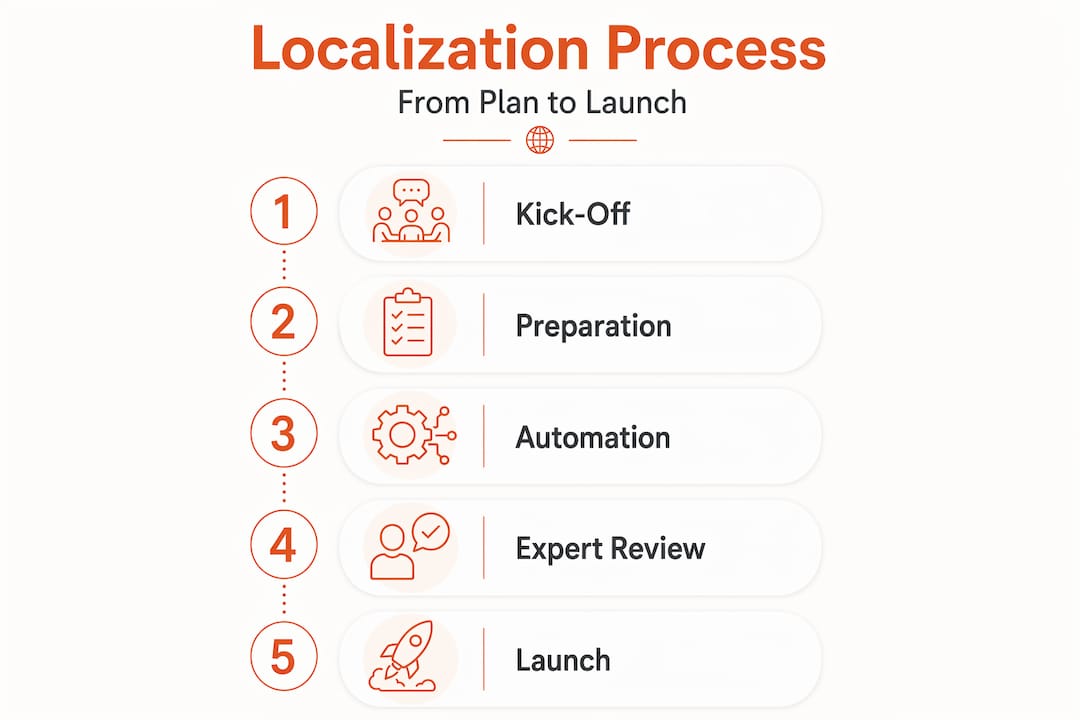
Automation paired with expert post-editing cuts internal review demands by up to 80% while preserving brand voice. That is time your team gets back to focus on product quality, not translation logistics.
Pro Tip: When evaluating any localization tool, test it with your actual Figma files and your actual strings before committing. A platform that cannot handle your component structure or character constraints will create more friction than it removes.
Practical steps to implement localization project management
Knowing the theory is not enough. Here is how you apply it as a product professional starting from wherever you are today.
Audit your current localization process before changing anything. Map where strings originate, who translates them, who reviews them, and where context is lost. Most teams discover three or four major friction points in this exercise alone.
Pick one market to pilot an integrated workflow. Do not overhaul your entire localization operation at once. Choose a language you are already supporting, apply the integrated process to one feature, measure the difference in cycle time and error rate, and then scale.
Establish your metrics before you start. Track time-to-localization per sprint, quality defect rates in localized builds, and translation memory reuse rates. Without baseline numbers, you cannot demonstrate improvement or justify investment in better localization translation services.
Involve native speakers from the messaging stage, not just as post-translation checkers. This is the most important investment for teams localizing for the first time, according to 31% of marketing and sales leaders surveyed.
Review and refine every quarter. Localization project management is not a one-time setup. Markets change, products evolve, and your tooling should keep pace. A quarterly review of your localization strategy prevents technical debt from accumulating in your translation pipeline.
My take on localization as a product discipline
I have watched teams spend six-figure budgets on localization translation services while their product still felt foreign to local users. The problem was never the translators. It was the process those translators were handed.
When localization is treated as an engineering discipline with clear ownership, structured data, and quality gates at every stage, the results are night-and-day different. I have seen product teams cut their time-to-market in new languages by more than half, not by hiring more translators, but by fixing the architecture that surrounded the translation work.
The uncomfortable truth is that most localization failures are design failures. They happen because no one asked “how will this string behave in German?” when the UI was still a Figma prototype. By the time engineering is involved, the layout is locked and the cost of fixing it is five times higher than it would have been at the design stage.
AI is genuinely changing what is possible here. But the teams winning with AI-driven localization are not the ones who turned off human review. They are the ones who used AI to eliminate low-value repetitive work so their expert reviewers could focus on the judgment calls that actually matter: tone, register, cultural resonance. That combination, structured AI throughput with disciplined human oversight, is where localization project management is heading. And the product teams that build this capability now will have a durable advantage in every market they enter.
— Antoine
How Gleef makes localization management faster
Managing a localization project across design, development, and review is hard enough without your tools working against you. Gleef is built specifically for product teams who need localization woven directly into their design workflow. With Gleef’s Figma plugin for AI localization, you can translate in context inside Figma itself, enforce brand terminology through glossaries, apply semantic translation memory across your entire product, and preview translations before a single line of code is touched. Teams using Gleef report measurable gains in translation quality, consistency, and release speed. If you are ready to stop treating localization as a release-day scramble, Gleef is where that change starts.
FAQ
What is localization project management?
Localization project management is the process of coordinating all tasks required to adapt a product for global markets, including internationalization, translation, cultural adaptation, formatting, and release coordination. It goes well beyond translation alone.
How is localization management different from translation management?
Translation management handles the movement of text through translation and review. Localization management covers the full system, including code-level i18n, cultural adaptation, layout testing, and coordinated launches across multiple markets.
When should localization start in the product development process?
Localization should begin at the product design and roadmap stage. Teams that embed localization from the start avoid downstream rework and experience significantly faster time-to-market in new languages.
How much does a poor localization process cost?
39% of marketing and sales leaders report losing over $10,000 from a single localization mistake, with 41% forced to pause or revise a campaign entirely. Prevention through disciplined process management is dramatically cheaper.
Do you still need human reviewers when using AI localization tools?
Yes. 48% of practitioners require human review of all AI-generated content before publishing. AI handles throughput efficiently, but human reviewers catch cultural nuance, register errors, and brand voice inconsistencies that automated tools miss.