
TL;DR:
Localization done criteria include linguistic accuracy, functional integrity, UI layout, and cultural suitability, with critical defects blocking release.
Risk-tiered QA allocates manual review efforts to high-risk areas like checkout flows and legal content, optimizing resources.
Localization done criteria are the explicit set of standards a product must meet to be considered fully localized, covering linguistic accuracy, functional integrity, visual layout, and cultural suitability for each target market. In practice, teams often call this a “definition of done” for localization, borrowing the term from agile software development. Without clearly defined localization acceptance criteria, teams ship products that read correctly but break on checkout, display truncated text in German, or fail legal requirements in France. The MQM (Multidimensional Quality Metrics) framework and LQA (Localization Quality Assurance) methodology both treat critical and high-severity defects as hard blockers to release. Getting this right is not a QA formality. It is the difference between a product that earns trust in a new market and one that quietly loses it.
What are the core components of localization done criteria?
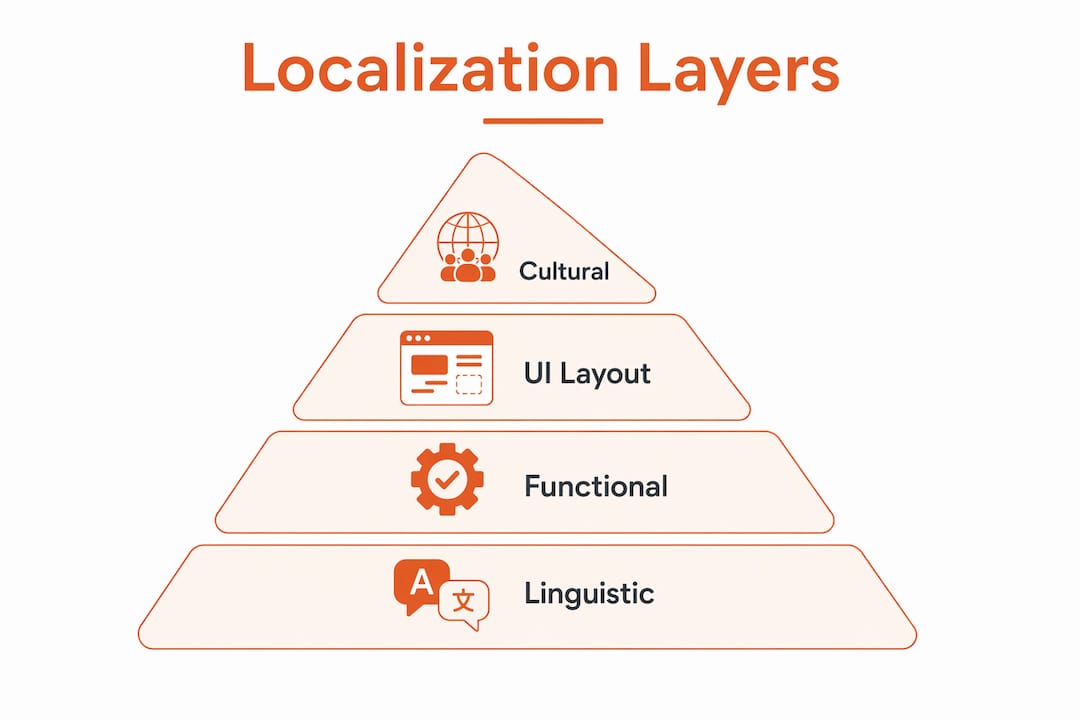
Localization done criteria consist of four layers: linguistic accuracy, functional integrity, UI layout, and cultural suitability, with critical and high-severity defects blocking completion. Each layer catches a different class of failure, and skipping any one of them creates gaps that surface after launch.

Linguistic accuracy
Linguistic accuracy covers grammar, terminology consistency, tone alignment with brand voice, and the complete absence of untranslated strings. A product that ships with a single English placeholder inside a French UI signals carelessness to native speakers. Terminology checks should reference a maintained glossary, and tone should match the formality level expected in the target locale. Japanese business software, for example, requires a formal register that differs sharply from casual consumer app copy.
Functional integrity
Functional integrity confirms that localized products behave correctly, not just look correct. This means verifying input formats (date fields, phone number masks, postal codes), geo-redirects, localized payment flows, and error messages. A checkout flow that accepts a U.S. ZIP code format but rejects a German postal code is a functional failure, not a translation failure. Functional and UI bugs caught early via in-context testing avoid costly post-release fixes.
UI and visual layout
UI layout criteria address text expansion, RTL (right-to-left) script support, font rendering, and imagery appropriateness. German compound words are a classic stress test: a string that fits a button in English can overflow by 40% in German. Arabic requires full RTL mirroring of navigation, icons, and form fields. Mapping locale-specific failure patterns before testing can reduce test design time significantly, since known problem areas like German truncation or Arabic timezone math can be targeted directly.
Cultural suitability
Cultural suitability is the layer most teams underinvest in. It covers legal compliance, culturally resonant imagery, local regulatory adherence, and the removal of content that carries unintended meaning in the target culture. A thumbs-up icon reads as positive in the U.S. but carries a rude connotation in parts of the Middle East. A structured sign-off matrix that checks translation accuracy, UI layout, functional flow, cultural appropriateness, and regulatory compliance prevents any critical aspect from being missed before launch.
Pro Tip: Build your cultural suitability checklist with input from a native reviewer in each target market, not just a translator. Native reviewers catch connotation issues that translation tools and even bilingual team members miss.
How to prioritize localization testing using risk-tiered criteria
Risk-tiered LQA focuses deep manual review on high-risk content like checkout flows and legal text, while lower-risk content gets reviewed through automation or sampling. This approach prevents teams from spreading QA effort evenly across content that does not carry equal business risk.
The classification works in three tiers:
High-risk content includes conversion funnels, payment screens, legal disclaimers, onboarding flows, and error messages. These areas directly affect revenue, legal exposure, and first impressions. Every string in this tier requires manual LQA by a native linguist with software testing experience.
Medium-risk content includes feature descriptions, help documentation, and settings screens. These areas affect user confidence but rarely block a transaction. A combination of automated checks and sampled manual review covers this tier efficiently.
Low-risk content includes static FAQs, blog posts, and marketing copy that does not appear inside the product UI. Automated quality checks and periodic spot reviews are sufficient here.
Properly tiered localization QA optimizes resource use by allocating more review effort where business risk and user impact are highest. The practical result is that your best reviewers spend their time on checkout flows, not FAQ pages.
Pro Tip: Assign a business risk score to each content category at the start of the project, not after strings are translated. Teams that score risk early avoid the scramble of reallocating reviewers two days before launch.
What tools and processes support achieving localization done criteria?
Localization QA requires contextual checks inside live software, not just file-based proofreading, to catch UI, functional, and cultural issues. A staging environment that mirrors the production build is the minimum requirement for credible in-context LQA.
Effective localization completion processes rely on four core elements:
Staging environments that replicate production conditions, including live API calls, real payment flows, and actual font rendering. Screenshots from a design file do not reveal truncation bugs or broken geo-redirects.
Multiple review roles working in sequence: an independent linguist checks translation accuracy, a functional tester verifies flows and formats, and a UI specialist confirms layout integrity across screen sizes and locales.
Structured defect reports that include the source string, the target string, a screenshot, environment metadata (device, OS, browser), and a severity tag. Proper bug reporting accelerates developer triage and reduces the back-and-forth that delays releases.
Coverage matrices that map every locale against every critical user flow and track test status. A matrix makes it immediately visible when a locale has passed linguistic review but not functional testing.
Regression and cross-locale testing are non-negotiable because UI elements are often shared across language versions. A fix applied to the Spanish locale can inadvertently break the Portuguese layout if shared components are not retested. Cross-locale regression is the safety net that prevents one fix from creating three new bugs.
You can find a detailed breakdown of UI localization validation steps in Gleef’s step-by-step guide for product teams, which covers staging setup, review sequencing, and defect tracking in depth.
How do you measure localization success with outcome-based KPIs?
Localization success is increasingly measured by business outcome KPIs like conversion rates, support ticket volume, and regional NPS shifts, not just linguistic quality scores. This shift matters because it connects localization work directly to revenue and retention, which is the language leadership understands.
Localization KPIs fall into three categories:
Process KPIs measure the efficiency of the localization workflow itself: turnaround time per word, bug rate per locale, and right-first-time percentage (the share of strings that pass review without revision). A rising right-first-time rate signals that your glossaries and style guides are working.
Outcome KPIs measure what happens after launch: trial-to-paid conversion by locale, support ticket volume per locale, and NPS delta between localized and non-localized markets. Tracking trial-to-paid conversion and support deflection per locale links localization work directly to revenue impact.
Strategic KPIs measure long-term market performance: percentage of ARR from localized markets, feature parity rates across locales, and support deflection rates. These metrics make the business case for continued localization investment.
Localization measurement frameworks recommend a concise executive dashboard with 5–7 KPIs combining efficiency, quality, and business impact indicators. Too many KPIs create noise. A focused set of metrics gives your team a clear signal and gives leadership a reason to fund the next localization sprint.
The top localization metrics guide from Gleef covers how to build a KPI dashboard that connects QA outcomes to business results, including how to present locale-level conversion data to non-technical stakeholders. For SaaS teams thinking about localization as a growth channel, tying locale performance to ARR is the most persuasive argument for sustained investment.
Key Takeaways
Localization done criteria require four validated layers: linguistic accuracy, functional integrity, UI layout, and cultural suitability, all confirmed through risk-tiered QA and measured against outcome-based KPIs.
Point | Details |
|---|---|
Four-layer completion standard | Linguistic, functional, UI, and cultural criteria must all pass before a locale is considered done. |
Critical defects block release | High-severity bugs in conversion flows or legal content are hard blockers, not items to defer. |
Risk-tiered QA saves resources | Allocate manual LQA to high-risk flows and use automation for static, low-risk content. |
Outcome KPIs prove ROI | Track trial-to-paid conversion and support ticket volume by locale to connect QA work to revenue. |
Focused dashboards outperform broad ones | A 5–7 KPI executive dashboard provides clearer signals than tracking every available metric. |
Why localization “done” needs to mean more than “translated”
The most common mistake I see localization teams make is treating sign-off as a translation milestone rather than a product milestone. A string can be grammatically perfect and still break the user experience if it overflows a button, triggers the wrong payment flow, or carries a cultural connotation that undermines trust. I have watched pixel-perfect designs crumble at launch because no one tested the Arabic RTL layout in a live staging environment, only in a static Figma file.
The shift to outcome-based KPIs is the most important evolution in how teams define localization readiness. When you can show leadership that a localized market produced a measurable lift in trial-to-paid conversion, you stop defending the localization budget and start expanding it. That requires connecting your QA criteria to your analytics from day one, not as an afterthought.
Risk-tiered LQA is the practical framework that makes this sustainable. You cannot apply the same depth of review to every string in a product with thousands of keys. Concentrating your best reviewers on checkout flows, legal text, and onboarding screens, while using automated checks for static content, is not a compromise. It is the right allocation of expertise. Teams that treat all content as equally critical end up with shallow coverage everywhere instead of bulletproof coverage where it counts.
The teams I have seen succeed at global scale all share one habit: they treat localization criteria as a cross-functional contract, not a linguist’s checklist. Product managers, UX writers, developers, and QA engineers all own a piece of the definition of done. When that ownership is shared, post-launch surprises become rare.
— Antoine
How Gleef helps you meet localization done criteria faster
Gleef’s Figma Plugin brings AI-powered translation directly into your design workflow, so your team can check linguistic accuracy and visual consistency without leaving the canvas.
The plugin uses semantic translation memory and glossaries to keep terminology consistent across every locale, and in-context editing lets UX writers and localization specialists review strings inside the actual UI, not in a spreadsheet. That means truncation issues, RTL layout problems, and brand voice mismatches surface during design, not during QA. Teams using Gleef report measurable improvements in translation quality and process efficiency. If your goal is to ship localized products that clear every layer of your localization completion checklist, Gleef is built for exactly that workflow.
FAQ
What does “localization done criteria” mean?
Localization done criteria are the explicit standards a product must meet across linguistic accuracy, functional integrity, UI layout, and cultural suitability before a locale is approved for release. Critical and high-severity defects in any layer block sign-off.
What is LQA and why does it matter for completion?
LQA (Localization Quality Assurance) is the process of reviewing localized content in context, inside live software, to catch translation errors, UI bugs, and functional failures that file-based review misses. It is the primary mechanism for confirming that localization done criteria are met.
How do you prioritize localization testing across many locales?
Classify content by business risk: apply manual LQA to high-risk flows like checkout and legal text, and use automated or sampled review for static, low-risk content. This risk-tiered approach reduces post-launch failures without requiring unlimited QA resources.
Which KPIs best measure localization success?
The most direct KPIs are trial-to-paid conversion by locale, support ticket volume per locale, and NPS delta between localized and non-localized markets. A focused dashboard of 5–7 metrics combining process efficiency and business outcomes gives the clearest signal.
How does regression testing fit into localization QA?
Regression testing across locales is required because UI components are often shared. A fix applied to one language version can break another. Running cross-locale regression after every significant change prevents localized fixes from creating new failures in adjacent markets.