
TL;DR:
A translation proxy is a server that intercepts and localizes website content in real-time without altering the underlying system. It uses CDN and edge networks to deliver fast, scalable, and CMS-agnostic multilingual experiences while maintaining translation ownership through standard file formats. Platforms like Gleef enhance this model with semantic memory, in-context editing, and automation to improve localization efficiency and quality.
What is a translation proxy and why it transforms website localization
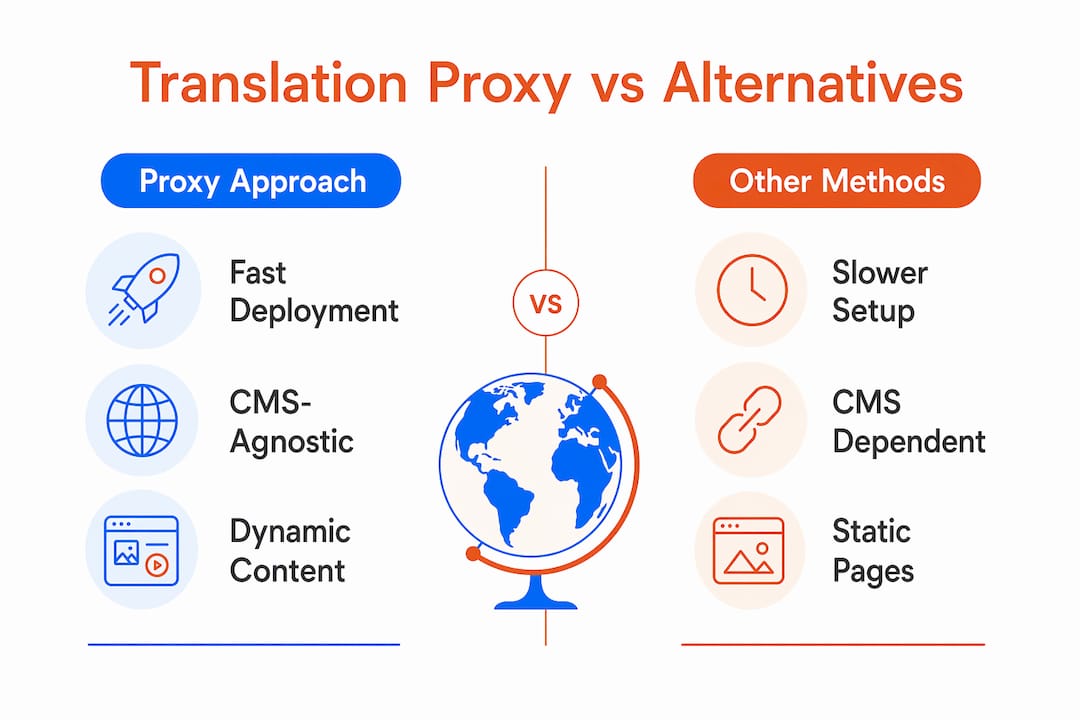
A translation proxy is a reverse proxy server that sits between your website visitors and your origin server, intercepting HTTP requests and injecting translated content on the fly before the page ever reaches the browser. No CMS changes. No backend rebuilds. No waiting for a development sprint to free up.
The technology works by routing your domain traffic through the proxy provider’s edge network via a DNS or CNAME update. When a visitor requests your French site, the proxy fetches the original page, swaps in the localized content, and serves the result. The visitor sees a fully translated experience. Your origin server never knows the difference.
This approach has made proxy-based localization the go-to choice for teams that need to enter new markets fast. Platforms like Easyling and MotionPoint built their businesses on this model, and enterprise services like LanguageLine Solutions rely on similar middleware principles to deliver real-time multilingual content at scale. The industry standard for translation file portability is XLIFF, which lets you own your translation memory regardless of which proxy provider you use.
Core functions at a glance:
Intercepts web traffic and injects localized HTML without touching the CMS
Fetches and translates dynamic content including JavaScript, AJAX, and JSON
Serves localized pages from edge networks for low latency
Supports XLIFF export so you retain full ownership of your translation data
Enables SEO-friendly URL structures through subdirectory or subdomain publishing
Handles image replacement and custom CSS/JS injection for full localization
Integrates with translation management systems and CAT tools
How a translation proxy actually works under the hood
The architecture is cleaner than most people expect. Every request to your localized domain passes through the proxy server, which acts as a dynamic middle layer. The proxy fetches the original page from your origin, identifies translatable strings, applies stored translations from its database, and returns the localized HTML to the visitor. The whole cycle happens with sub-millisecond overhead from global edge locations.
A translation proxy does not maintain a copy of your backend code or CMS data. It operates purely at the HTTP response layer, intercepting and rewriting content in transit. This means any website, regardless of its underlying technology, becomes localizable without a single line of backend code changing.
The request lifecycle, step by step:
Visitor requests
fr.yoursite.comoryoursite.com/fr/DNS routes the request to the proxy provider’s edge node
The proxy fetches the original page from your origin server
Stored translations are injected into the HTML response
If no translation exists yet, the proxy can trigger machine translation or flag the string for human review
The localized page is cached at the edge and served to the visitor
Handling dynamic content is where proxy technology gets genuinely interesting. Modern proxies process HTML, JavaScript, AJAX, and JSON content types, not just static HTML. You can configure additional AJAX endpoints, use regular expressions to filter specific content, and even inject custom CSS to handle text expansion in languages like German or Finnish. Flash translation is not supported, but that limitation is largely academic in 2026.
Caching is the performance backbone of any proxy setup. Translated pages are stored at the edge after the first request, so subsequent visitors get near-instant responses. Leading providers guarantee 99.99% uptime and practically unlimited traffic capacity, which means your localized site can handle traffic spikes without any infrastructure work on your end.

Why teams choose translation proxies over other localization approaches
Speed to market is the headline benefit, and it’s real. A team that would otherwise spend months integrating multilingual support into a legacy CMS can go live in a new language within days using a proxy setup. The DNS or CNAME change is the heaviest lift on the IT side.
The CMS-agnostic nature of the technology is what makes this possible. Whether your site runs on WordPress, Drupal, a custom React app, or a headless commerce platform, the proxy fetches and injects localized content the same way. Your development team does not need to touch the codebase.
Key operational benefits:
Minimal IT overhead: DNS or CNAME update is typically the only infrastructure change required
Continuous localization: New content on the origin site is automatically detected and queued for translation
Translation memory ownership: XLIFF export keeps your translated content portable across tools and providers
CAT tool compatibility: Translators keep using their preferred tools; the proxy handles the technical layer
SEO-friendly publishing: Subdirectory (
/fr/) or subdomain (fr.) URL structures support proper indexingDynamic content coverage: Forms, messages, and AJAX-loaded content are all translatable
Localized images: Replace images with language-specific versions on a per-target-language basis
For product managers, the continuous workflow is the real unlock. When your marketing team publishes a new blog post or your developers ship a new feature, the proxy detects the new strings and routes them through your translation workflow automatically. No manual extraction. No ticket to engineering.
Pro Tip: Pair your proxy setup with a multilingual SEO strategy from day one. Subdirectory publishing is generally preferred over subdomains for consolidating domain authority, and most proxy providers support both options.
Common concerns, risks, and myths about translation proxies
Is vendor lock-in a real risk?
No. This is the most persistent myth in the proxy space, and it does not hold up. Professional proxy solutions export translation memories in standard XLIFF format, which every major CAT tool and translation management system can import. Your translated content belongs to you, and you can migrate it to a different provider or a different localization approach without starting from scratch.
How secure are translation proxies?
Reputable cloud-based proxy providers operate on infrastructure that meets enterprise security standards, including encrypted traffic handling and privacy compliance frameworks. The proxy never stores sensitive user data beyond what is needed to serve the translation. That said, you should always review a provider’s data processing agreements, particularly if your site handles personal data under regulations like GDPR or CCPA.
Do proxies hurt site performance?
With caching and CDN integration, the performance impact is negligible for most sites. The 99.99% uptime guarantee offered by leading providers, combined with edge caching, means your localized pages often load faster than a self-hosted multilingual CMS setup. The first-request latency is slightly higher before a page is cached, but that overhead is measured in milliseconds.
What about SEO for translated pages?
Proxy solutions that publish via subdirectory or subdomain structures allow search engines to crawl and index localized content properly. Most providers include SEO configuration options, including hreflang tag injection, which signals to Google which language version to serve to which audience.
Setting up a translation proxy: what your IT team needs to know
The initial setup is straightforward, but the configuration details determine how well the proxy performs over time. Getting the DNS routing right is the first priority, followed by content crawling configuration and SEO settings.
Setup checklist:
DNS/CNAME update: Point your localized domain or subdirectory to the proxy provider’s edge network. This is the primary infrastructure change.
Content crawling: Configure the proxy to crawl your site and discover all translatable strings, including static pages and dynamic AJAX endpoints.
URL handling rules: Use the proxy’s URL normalization settings to define which URLs count as the same page and which represent unique content.
Regex content filtering: Apply regular expressions to exclude content you do not want translated, such as code snippets, brand names, or legal boilerplate.
SEO configuration: Enable CDN or reverse proxy integration for subdirectory publishing, and configure hreflang tags for proper language targeting.
Preview mode: Use the proxy’s in-context preview before going live to catch layout issues, missing translations, and formatting problems.
White-label options: If you are a language service provider, configure corporate logos and custom domains to brand the proxy as your own product.
The proxy configuration process also covers how to handle AJAX content that loads after the initial page render. You will need to add specific AJAX URLs with the correct parameters so the proxy knows to intercept and translate those responses too. This step is often skipped during initial setup and causes gaps in the localized experience.
Pro Tip: Run a full site crawl through the proxy’s discovery tool before launching. It gives you an accurate word count for budgeting translation costs and surfaces content types that may need special handling.
What translation proxies cannot do
Knowing the limits of any technology is as useful as knowing its strengths. Translation proxies are powerful, but they are not a complete localization solution for every content type.
Content types that proxies cannot translate:
Text embedded in images: Raster images with baked-in text require manual recreation or image localization workflows outside the proxy.
Flash content: Not supported. Flash is effectively extinct, but legacy sites may still have it.
PDFs and documents: Proxy technology operates at the HTTP/HTML layer. PDF content requires a separate document localization process.
Highly personalized or user-generated content: Content generated at runtime based on individual user data, such as personalized dashboards or user-submitted reviews, is difficult to translate consistently through a proxy.
Layout-breaking text expansion: Languages like German or Arabic can expand text by 30% or more. The proxy can inject custom CSS to compensate, but significant layout issues may require manual design adjustments.
Proxies also do not replace a content strategy. If your source content is poorly structured, inconsistent, or culturally tone-deaf, a proxy will faithfully translate those problems into every target language. The technology handles the technical delivery layer. The quality of what gets delivered depends entirely on your translation workflow and content quality upstream.
For teams dealing with traditional localization tool failures, a proxy solves the infrastructure problem but not the content quality problem. That gap is where modern SaaS localization platforms earn their place.
How SaaS localization platforms like Gleef extend the proxy model
A translation proxy handles the technical delivery of localized content. What it does not handle is the quality, consistency, and collaboration layer that separates good localization from great localization. That is where platforms like Gleef come in.
Gleef integrates with translation proxy workflows to add semantic translation memory, glossary management, and in-context editing on top of the proxy’s delivery infrastructure. When a new string is detected by the proxy, Gleef’s translation memory checks whether a semantically equivalent string has already been translated, applies the existing translation, and flags any inconsistencies with your glossary. The result is faster turnaround and fewer brand voice errors across languages.
The most expensive localization mistake is not a bad translation. It is a good translation that contradicts your brand glossary in 12 languages simultaneously. Semantic translation memory catches that before it ships.
The API-enabled collaboration that Gleef provides means product managers, UX writers, developers, and translators all work from the same source of truth. In-context editing lets translators see exactly how their text will appear on the live page, eliminating the guesswork that causes layout and tone errors. Preview simulations let the whole team review a localized build before it goes live, catching release blockers before they become production incidents.
Pro Tip: Use Gleef’s rules-based translation standards to enforce terminology consistency across your proxy-delivered localized sites. A single glossary rule applied at the platform level prevents brand name mistranslations across every language and every page.
Translation proxy vs. alternative localization methods
Method | Best for | Key tradeoff |
|---|---|---|
Translation proxy | Existing sites needing fast multilingual delivery | Limited control over highly dynamic or personalized content |
CMS-native multilingual | New builds with multilingual requirements from day one | High development cost and CMS dependency |
Manual localization | Small sites or high-stakes legal/marketing content | Slow, expensive, and hard to scale |
Translation API integration | Developer-controlled apps with custom translation logic | Requires engineering resources and ongoing maintenance |
CMS-native multilingual support, where the CMS itself manages multiple language versions, gives you the most control over content structure. The cost is significant upfront development work and a tight dependency on your CMS’s multilingual capabilities. Many enterprise CMSs handle this well, but retrofitting an existing site is often more expensive than a proxy deployment.
Manual localization, where translators work directly in the CMS or on exported files, works well for small sites or content types that require high human judgment, such as legal documents or brand campaigns. It does not scale. A site with thousands of pages and continuous publishing cannot rely on manual workflows without a dedicated localization team.
Translation API integration, using services like Google Cloud Translation API or similar, gives developers fine-grained control over what gets translated and how. The tradeoff is engineering overhead. Every content type, every dynamic element, and every edge case requires custom code. For teams without dedicated localization engineering resources, a proxy is almost always faster to deploy and cheaper to maintain.
The proxy model sits in a practical middle ground: fast to deploy, CMS-agnostic, and scalable, with the trade-off that some content types and highly personalized experiences require supplementary approaches.
Industries and use cases where translation proxies deliver the most value
Translation proxies work best when speed, scale, and CMS independence matter more than pixel-perfect control over every localized element.
E-commerce is the clearest use case. A retailer expanding from the US to Germany or Japan needs product pages, checkout flows, and customer support content localized fast. A proxy can deliver that without touching the e-commerce platform’s backend, and it handles the continuous flow of new product listings automatically.
SaaS and software companies use proxy-based localization to serve localized marketing sites and documentation while their product teams handle in-app localization separately. The proxy covers the public-facing web presence; platforms like Gleef handle the product strings.

Financial services and healthcare organizations with large, compliance-heavy websites use proxies to localize content without risking changes to the underlying CMS that could introduce compliance gaps. The proxy layer keeps the origin untouched.
Language service providers (LSPs) use white-label proxy solutions to offer website localization services under their own brand. The proxy handles the technology; the LSP focuses on translation quality and client relationships.
Media and publishing companies with high content velocity benefit from the proxy’s ability to detect and queue new content automatically. A news site publishing dozens of articles per day cannot rely on manual extraction workflows.
How translation proxies connect with translation management systems
The proxy handles content delivery. The translation management system (TMS) handles the workflow, quality assurance, and translator coordination. The two work best when they are connected.
Most professional proxy solutions support XLIFF export and import, which is the bridge between the proxy and any TMS or CAT tool. When the proxy detects new content, it exports the strings as an XLIFF file. The TMS picks up that file, routes it through the appropriate translation workflow, and sends the completed translations back. The proxy imports the finished XLIFF and serves the translated content.
This XLIFF-based workflow is what makes the vendor lock-in concern largely unfounded. Your translation memory lives in a standard format that any TMS can read. Platforms like Easyling explicitly support automated XLIFF export and import between CAT tools and the proxy, so translators never need to leave their preferred environment.
For teams using Gleef, the TMS integration goes further. Gleef’s semantic translation memory means that when the proxy surfaces a new string, the platform checks for semantically equivalent translations already in memory, not just exact matches. That distinction matters most for product interfaces and marketing copy, where the same concept gets phrased differently across pages. The translation process efficiency gains from semantic matching compound over time as your translation memory grows.
The practical setup involves configuring your proxy to push new content to your TMS automatically, setting up translation workflows and quality checks within the TMS, and pulling completed translations back to the proxy on a defined schedule or via webhook. Most enterprise proxy providers support API-based TMS integration in addition to file-based XLIFF exchange.
Key Takeaways
A translation proxy delivers multilingual website localization without CMS changes by intercepting HTTP traffic, injecting translations at the edge, and exporting content in standard XLIFF format to preserve your translation memory ownership.
Point | Details |
|---|---|
No CMS changes required | A DNS or CNAME update routes traffic through the proxy; your origin server is untouched. |
XLIFF export prevents lock-in | Standard file formats let you migrate translation memories between providers and CAT tools freely. |
99.99% uptime at the edge | Leading providers guarantee high availability and unlimited traffic capacity through CDN integration. |
Proxies have real content limits | Text in images, PDFs, Flash, and highly personalized runtime content require separate localization workflows. |
SaaS platforms extend proxy value | Tools like Gleef add semantic translation memory, glossary enforcement, and in-context editing on top of proxy delivery. |
Gleef extends the translation proxy model with semantic translation memory, in-context editing, and API-driven collaboration so your team ships localized products faster and with fewer errors. If you are ready to move beyond basic proxy delivery and build a localization workflow that actually scales, explore Gleef and see what a modern SaaS localization platform adds to your stack.