
TL;DR:
Localization system reliability depends on accurate technology and well-designed workflows for global launches. Most failures stem from calibration errors, inconsistent terminology, and poor security controls rather than advanced algorithms. Continuous monitoring and workflow mapping are essential for maintaining accuracy and compliance across markets.
Localization system reliability is defined as the consistent accuracy, security, and operational effectiveness of the technologies and workflows that enable successful global product launches. In the software and digital product world, this concept spans two distinct but related domains: the technical precision of location-tracking systems (UWB, BLE, WiFi) and the linguistic and compliance integrity of translation workflows. Both domains share the same failure modes. Errors compound silently, audits expose gaps at the worst possible moment, and a single inconsistency can block a release across multiple markets. This localization system reliability guide covers the core technologies, workflow design principles, monitoring practices, and troubleshooting methods your team needs to ship globally with confidence.
What core technologies and metrics determine localization system reliability?
Localization system performance depends on the accuracy of the underlying technology and your ability to measure that accuracy in real time. Three technologies dominate indoor and digital localization: Ultra-Wideband (UWB), Bluetooth Low Energy (BLE), and WiFi. Their accuracy differences are not marginal.

UWB error margins average approximately 29.9 cm, compared to 340.1 cm for BLE and 608.7 cm for WiFi. That gap means UWB is 88.05% more accurate than BLE for mobile tracking applications. For product teams building location-aware features or managing asset tracking in complex environments, choosing the wrong base technology is the single fastest way to introduce systemic failure.
Standalone technologies, however, have limits. Sensor fusion combining UWB, IMU, and vision reduces root mean square error (RMSE) by up to 67.6% and maximum error by 67.9% compared to single-sensor approaches. That reduction translates directly into fewer false readings, fewer incident escalations, and more stable system behavior under real-world conditions.
Technology | Typical error margin | Best use case |
|---|---|---|
UWB | ~29.9 cm | High-precision asset tracking |
BLE | ~340.1 cm | Proximity detection, low-cost deployments |
WiFi | ~608.7 cm | Coarse positioning, large open spaces |
UWB + IMU + Vision fusion | Reduced by up to 67.6% RMSE | Mission-critical, dynamic environments |
Beyond hardware, the metrics you track define whether your system is actually reliable or just operational. F1-score and RMSE are the two most useful measures. Real-time localization scoring architectures achieve F1-scores above 0.90 in 2026 tests by combining particle-filter indicators with map consistency checks. That approach catches degradation before it becomes a visible failure, which is exactly the kind of early warning your monitoring stack needs.
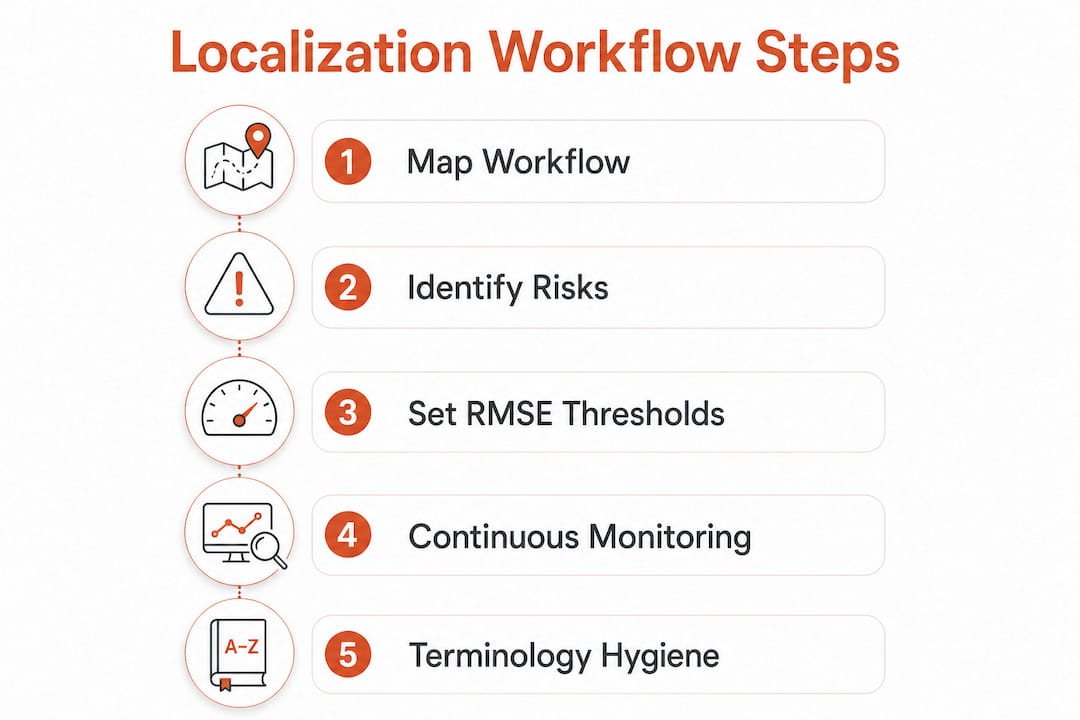
Pro Tip: Set RMSE thresholds as automated alerts in your monitoring dashboard. When RMSE drifts above your defined baseline, trigger a calibration review before the system reaches a failure state.
How to design and map localization workflows for security and compliance
Security and compliance reliability starts with workflow mapping, not policy writing. Mapping actual information flows within your localization process, including where data enters, moves, and is accessed, produces better security controls than applying generic policy language to an unmapped process. This is the foundation of a localization security compliance guide that actually holds up under audit.
When you map your workflow, you expose the real risk points: third-party vendor handoffs, translator access to sensitive product strings, and uncontrolled version branches. Each of those points needs a defined control. ISO/IEC 27001:2022 provides the framework for information security management, and its principles apply directly to localization operations. Access controls, data classification, and vendor agreements all need to be documented and operational, not just written into a policy document.
Terminology consistency is where most localization security workflows break down in practice. Inconsistent naming of standards like SOC 2 Type II reports or Standard Contractual Clauses (SCCs) triggers follow-up questions during enterprise security procurement and audit reviews. That inconsistency costs time and erodes buyer confidence. A centralized term base and translation memory, applied consistently across all locales, prevents this class of error entirely.
Legal terms like GDPR Article 28(3) and ISO/IEC 27001:2022 require exact, consistent translation reviewed by legal counsel. One locale using a paraphrase of a binding legal reference is enough to fail a compliance review. Your localization workflow needs a legal review gate before any security or compliance content goes live in a new market.
Common security pitfalls to avoid in localization workflows:
Unreviewed vendor access: Translators and agencies with access to product strings need documented, time-limited permissions.
Unversioned source files: Without version control on source strings, you cannot trace which content a translator worked from.
Missing locale-specific legal review: Each market has distinct privacy and data regulations. A single global legal review is not sufficient.
Inconsistent glossary enforcement: Terms approved in one locale must propagate automatically to all others through a shared term base.
Undocumented controls: Audit success requires documented and operational controls, not just policy existence.
Pro Tip: Build your localization workflow around information flow diagrams, not org charts. The diagram shows auditors exactly where controls apply and makes gaps visible before an external reviewer finds them.
What are actionable steps for continuous monitoring and long-term reliability?
Deploying a localization system is not the end of the reliability work. It is the beginning of a continuous calibration cycle. Sustained reliability depends on real-time tracking of latency, interference, and anchor positioning after installation. Systems that are not monitored degrade silently until a failure becomes visible to end users or auditors.
A practical continuous monitoring program follows these steps:
Define your baseline KPIs at deployment. Capture RMSE, latency, F1-score, and anchor health metrics on day one. These become your reference points for every future comparison.
Build a real-time dashboard. Display localization health metrics in a format your team checks daily. Dashboards that require manual queries get ignored.
Set automated degradation alerts. When any KPI crosses a defined threshold, the system should notify the responsible engineer automatically, without waiting for a scheduled review.
Schedule quarterly calibration audits. Review anchor positioning, interference sources, and sensor drift on a fixed calendar. Ad hoc reviews miss gradual degradation.
Log all calibration events. Every adjustment creates an audit trail. That trail is evidence of operational control during security reviews.
Integrate monitoring into your CI/CD pipeline. Localization quality checks should run automatically on every build, not just before a major release.
Localization scoring architectures add a proactive layer on top of standard monitoring. Rather than waiting for a binary “system down” flag, scoring systems combine multiple health indicators into a continuous reliability score. When that score drops below a defined threshold, your team investigates before users experience any degradation. This approach aligns directly with system reliability best practices used in industrial autonomy and is equally applicable to software localization pipelines.
For translation-focused localization systems, the equivalent of calibration is terminology and memory hygiene. Translation memory that has not been reviewed accumulates outdated strings. Glossaries that are not enforced allow drift. Both degrade output quality in ways that are hard to detect without structured review cycles.
How to troubleshoot common localization reliability issues
Most localization failures trace back to fundamentals, not algorithm complexity. Correct transform frames, precise extrinsic calibration, and honest covariance tuning predict system stability better than sophisticated filtering algorithms like extended Kalman filters. The implication is direct: before you add complexity, verify that your baseline setup is correct.
For translation-based localization systems, the equivalent fundamentals are terminology consistency and legal review. A product team that ships localized security pages without legal counsel review is taking the same risk as an engineer who skips sensor calibration. Both decisions create failures that are expensive to fix after the fact.
GDPR and regional privacy requirements add another layer of reliability risk that product teams often underestimate. Ignoring locale-specific data regulations does not just create legal exposure. It creates a reliability perception problem with enterprise buyers who evaluate your compliance posture before signing contracts. Teams expanding into new markets benefit from reviewing global expansion strategies that account for regulatory variation across regions.
Top five troubleshooting tips for localization reliability:
Verify calibration before adding sensors. New hardware does not fix a miscalibrated baseline. Calibrate first, then expand.
Audit your term base quarterly. Outdated or inconsistent terminology is the most common source of compliance audit flags in localization security documents.
Check localization key consistency across all locales. Missing or mismatched keys cause silent failures in production that are hard to trace.
Enforce access controls at the file level. Broad translator access to sensitive strings is a security control gap that auditors flag immediately.
Document every incident and resolution. Incident logs are evidence of operational maturity. Teams without them fail audit readiness reviews.
Pro Tip: Run a terminology consistency check across all locales before every major release. A single mismatched legal term in one market can block enterprise deals that took months to build.
Key Takeaways
Reliable localization systems require consistent calibration, precise terminology, documented security controls, and continuous monitoring to sustain accuracy and compliance across every market.
Point | Details |
|---|---|
Technology choice drives accuracy | UWB outperforms BLE and WiFi by a wide margin; sensor fusion reduces RMSE by up to 67.6%. |
Workflow mapping beats policy writing | Map real information flows to expose control gaps before auditors do. |
Terminology consistency prevents audit failures | Inconsistent legal terms in localized security pages trigger procurement delays and compliance flags. |
Calibration is continuous, not one-time | Monitor latency, interference, and anchor health with real-time dashboards after every deployment. |
Fundamentals outperform complexity | Correct calibration and consistent terminology predict reliability better than advanced algorithms. |
Why I think most teams get localization reliability backwards
Most product teams treat localization reliability as a launch checklist item. They verify translations, run a quick QA pass, and ship. The reliability work, in their mental model, is done. That assumption is wrong, and it is expensive.
What I have seen repeatedly is that the teams with the fewest localization failures are not the ones with the most sophisticated tools. They are the ones who obsess over fundamentals: calibration schedules, term base hygiene, legal review gates, and documented controls. The teams chasing algorithm complexity or the latest AI translation model while skipping quarterly glossary audits are the ones who get surprised by audit failures and enterprise deal blockers.
The governance piece is underrated. Product, legal, and localization teams need to sit in the same review cycle, not operate in separate lanes. When legal counsel reviews localized compliance pages before they go live, you catch the terminology errors that would otherwise surface during a CISO evaluation. That collaboration is not overhead. It is the fastest path to audit readiness.
The regulatory environment will keep evolving. GDPR interpretations shift. New markets add data localization requirements. The teams that future-proof their localization reliability are the ones who build operational transparency into their workflows now, not the ones who retrofit compliance documentation after a deal falls through.
Prioritize the boring work. It is the work that actually keeps your global product launches on schedule.
— Antoine
How Gleef supports reliable localization for global product teams
Gleef is built for product teams that cannot afford localization failures at launch. The Gleef Figma Plugin brings AI-powered translation directly into your design environment, so your team manages localized strings in context without switching platforms.
Gleef enforces consistent terminology through semantic translation memory and glossaries, which means the legal and compliance terms your legal counsel approved stay consistent across every locale automatically. Access controls, in-context editing, and rules-based translation standards give your team the audit-ready workflow that security reviews demand. For teams managing AI-powered localization across multiple markets, Gleef removes the manual overhead that creates reliability gaps. Try the Gleef Figma Plugin and see how much faster your next global launch can move.
FAQ
What is localization system reliability?
Localization system reliability is the consistent accuracy, security, and operational stability of the technologies and workflows that support global product launches. It covers both technical precision in location-tracking systems and linguistic integrity in translation workflows.
Which localization technology is the most accurate?
UWB is the most accurate indoor localization technology, with error margins around 29.9 cm compared to 340.1 cm for BLE and 608.7 cm for WiFi. Sensor fusion combining UWB, IMU, and vision reduces RMSE by up to 67.6% over standalone methods.
How does terminology consistency affect localization compliance?
Inconsistent terminology in localized security and compliance pages, such as varying names for SOC 2 Type II or GDPR Article 28(3), triggers delays during enterprise procurement and security audits. A centralized term base reviewed by legal counsel prevents this class of failure.
How often should localization systems be calibrated?
Calibration is a continuous requirement, not a one-time setup task. Real-time dashboards tracking latency, interference, and anchor health should run post-deployment, with formal calibration audits scheduled at least quarterly.
What causes most localization reliability failures?
Most failures trace back to miscalibrated baselines, inconsistent terminology, and undocumented security controls, not algorithm complexity. Correct transform frames, precise extrinsic calibration, and enforced glossaries predict reliability better than advanced filtering methods.