
TL;DR:
Global content marketing involves creating culturally relevant content for multiple markets to increase brand reach and revenue. Effective strategies incorporate localization, cultural adaptation, and international SEO within a unified workflow. Using AI tools and modular content structures enables faster, more accurate global deployment, avoiding common localization pitfalls.
Global content marketing is the deliberate process of crafting and distributing content that resonates across multiple countries and cultures to expand brand reach and drive measurable revenue. The industry backing this practice is enormous: the global digital marketing market is valued at $0.76 trillion in 2026 and is projected to reach $1.27 trillion by 2031. That growth signals one clear truth: brands that fail to build an international content strategy now will spend far more catching up later. The core pillars of any effective program are localization, cultural adaptation, and international SEO, and each one demands a deliberate, integrated approach rather than a last-minute translation pass.
How to develop an effective global content marketing strategy
A global content marketing strategy succeeds when it follows a structured process, not an improvised one. The 9-step implementation framework starts with market research and runs through goal setting, audience persona development, content calendar planning, channel selection, localization workflows, publishing, measurement, and iteration. Skipping any step, especially market research, produces content that feels generic to every audience and native to none.
The most common mistake teams make is treating global as a single audience. German B2B buyers consume long-form whitepapers. Indonesian consumers on mobile prefer short video. Brazilian audiences engage heavily on WhatsApp. Your editorial plan must reflect those differences from day one, not as an afterthought.
Balancing brand consistency with regional relevance requires a modular content structure. Modular content frameworks allow central teams to produce master assets, while regional teams swap headlines, visuals, calls to action, and examples to fit local context. This approach keeps your brand voice intact without forcing every market into the same mold.
The workflow itself must integrate three functions that most organizations keep separate: editorial planning, localization, and international SEO. When these operate as silos, you get delays, mistranslations, and campaigns that miss local search intent entirely. Treat them as one operating system and your speed to market improves dramatically.
Conduct market research by region, including search behavior, platform usage, and competitor positioning.
Set region-specific goals tied to pipeline, not just traffic or impressions.
Build a 12-month editorial calendar that accounts for local holidays, product launches, and content consumption peaks.
Select channels based on platform penetration data for each target market.
Design modular content templates that regional teams can adapt without rebuilding from scratch.
Integrate localization into the production workflow, not after it.
Apply international SEO at the keyword research stage, not at publication.
Publish and distribute through region-appropriate channels and schedules.
Measure and iterate using engagement and pipeline metrics, not output volume.
Pro Tip: Align your content calendar with regional holidays and local product launch windows. A campaign timed to Diwali in India or Golden Week in Japan outperforms a generic global push every time.
Why localization goes far beyond translation
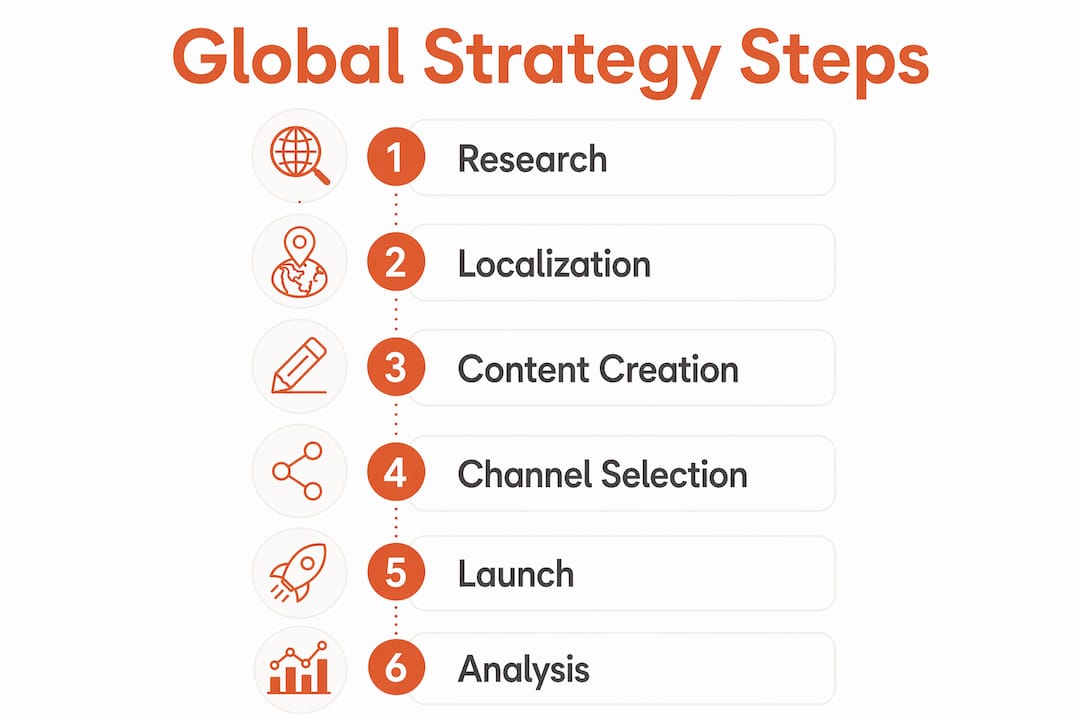
Localization is not translation. Translation converts words. Localization integrates editorial planning, SEO, and workflows to make content feel native to each market. The difference between the two is the difference between a campaign that lands and one that confuses.
Cultural adaptation covers far more than language. The elements that require attention include:
Visuals and imagery: Color symbolism, hand gestures, and models vary by culture. Red signals luck in China and danger in Western markets.
Idioms and tone: Humor that works in Australia falls flat in Japan. Formal register is expected in Germany and considered cold in Brazil.
Platform preferences: WeChat dominates in China. WhatsApp is the primary channel across much of Latin America, India, and the Middle East. Instagram skews younger in most Western markets.
UI and layout: Arabic and Hebrew read right to left. German text expands 30% compared to English equivalents. Both facts break layouts if ignored.
Local search intent: The keyword a French user types to find your product differs from what a Canadian user types, even when both speak French.
Identical global content consistently fails because it overlooks local search intent and cultural context. This is not a minor inefficiency. Companies that treat localization as simple translation waste capital, with campaigns failing in the majority of markets they enter.
A tiered translation approach solves the quality-versus-speed tension. High-stakes content, such as legal pages, brand manifestos, and product launch copy, gets professional human translation with native speaker review. High-volume technical content, such as UI strings, help center articles, and metadata, runs through AI-powered tools with translation memory. The combination keeps costs manageable without sacrificing accuracy where it counts most.
Pro Tip: Build an in-context review step into every localization workflow. Native speakers reviewing copy inside the actual product or page, not in a spreadsheet, catch layout breaks and tone mismatches that automated checks miss entirely.
What content formats and channels work for global audiences?
Content format decisions must follow audience behavior, not internal preference. Short vertical videos of 15–60 seconds dominate in Asia-Pacific markets, particularly on TikTok and its regional equivalents. Long-form SEO content drives organic traffic in Western markets where Google search remains the primary discovery channel.
32.4% of global internet users aged 16 and older use search engines for brand discovery. That number makes localized SEO non-negotiable for any brand targeting multiple regions. Pair it with the fact that social media platforms vary sharply by region, and you see why a single global channel strategy fails.
For digital strategy in markets like Saudi Arabia, the UAE, and Egypt, the platform mix and content approach differ significantly from Western norms, with messaging apps and video content carrying far more weight than blog-driven SEO.
Region | Preferred format | Primary channels |
|---|---|---|
Asia-Pacific | Short vertical video, live commerce | TikTok, WeChat, LINE |
Latin America | Video, conversational content | WhatsApp, Instagram, YouTube |
Western Europe | Long-form SEO, thought leadership | Google Search, LinkedIn |
Middle East | Video, visual storytelling | Instagram, YouTube, WhatsApp |
North America | Mixed: SEO, podcast, video | Google Search, LinkedIn, YouTube |
Platform penetration and demographic preferences vary enough by region that a single channel mix will underperform in at least half your target markets. The fix is simple: define your channel strategy per region at the planning stage, not after your content is already produced.
How AI and technology tools scale your international reach
AI has changed what a small content team can realistically accomplish across multiple markets. The core use cases that deliver the most value are translation memory, AI-powered content suggestions, and automated publishing workflows. Each one removes a manual bottleneck that previously required headcount to solve.

AI-powered localization works best when it handles volume and speed, while human reviewers focus on brand voice, cultural nuance, and high-stakes copy. The combination is faster and more accurate than either approach alone. Teams that try to use AI for everything end up with technically correct but culturally flat content. Teams that rely entirely on human translators struggle to scale.
The practical toolkit for a content team running multinational marketing tactics looks like this:
Translation memory: Stores approved translations of recurring phrases, so your brand terminology stays consistent across every market and every update.
AI content suggestions: Surfaces locally relevant angles, keywords, and formats based on regional search data and audience behavior.
In-context editing: Lets translators and reviewers work inside the actual product or page, catching layout and tone issues before they reach users.
Automated scheduling: Publishes content at optimal local times without manual intervention across time zones.
Glossary enforcement: Locks down product names, legal terms, and brand phrases so they never get mistranslated or paraphrased.
Automating language workflows removes the release blockers that slow down global campaigns. When localization runs in parallel with production rather than after it, go-to-market timelines shrink significantly.
Pro Tip: Set up a cross-functional localization review group that includes a UX writer, a regional marketing lead, and a native speaker from each target market. AI handles the volume. This group handles the judgment calls that protect your brand.
Key Takeaways
Effective international content strategy requires integrating localization, cultural adaptation, and international SEO as a single workflow, not three separate tasks.
Point | Details |
|---|---|
Localization is a revenue lever | Treating it as a translation task wastes budget and causes campaigns to fail in most target markets. |
Modular content scales faster | Central teams build master assets; regional teams adapt copy, visuals, and schedules without rebuilding. |
Channel strategy must be regional | Platform preferences differ sharply by market. Define your channel mix per region at the planning stage. |
AI handles volume, humans handle nuance | Use AI translation memory and automation for speed; reserve human review for brand-critical and high-stakes content. |
Measure pipeline, not output | Engagement and revenue metrics reveal what is working. Output volume tells you nothing about market fit. |
The uncomfortable truth about global content I’ve learned the hard way
Most teams I’ve worked with treat localization as the last step in their production process. They finalize the English copy, hand it off to a translation vendor, and call it global. That approach is how you spend a significant budget and still miss your pipeline targets in every non-English market.
The shift that actually works is treating content consistency in localization as a design constraint, not a post-production task. When your content structure is modular from the start, regional teams can adapt without breaking the brand. When localization runs in parallel with production, you don’t lose weeks waiting for translated copy before you can QA your layouts.
The other thing most articles won’t tell you: localization is not a cost center. Every market where your content feels native is a market where your conversion rate climbs. I’ve seen brands triple their organic traffic in a new region simply by rebuilding their keyword strategy around local search intent rather than translating their existing English keywords word for word.
The brands winning at international SEO right now are not the ones with the biggest translation budgets. They are the ones who built their content architecture to support adaptation from day one. That is a structural decision, and it has to happen before you write a single word of copy.
— Antoine
Gleef makes global content deployment faster and more consistent
Running a global content program means managing dozens of markets, languages, and regional teams at once. The localization bottleneck is almost always the same: copy gets finalized in one language, then sits in a queue waiting for translation before design and development can finish their work.
Gleef’s Figma plugin for AI localization removes that bottleneck by bringing translation directly into the design environment. Your team translates, reviews, and approves copy in context, inside the actual product screens, without switching platforms or waiting for handoffs. Translation memory and glossary enforcement keep your brand voice consistent across every language and every update. The result is faster releases, fewer layout breaks, and content that feels native in every market you enter.
FAQ
What is global content marketing?
Global content marketing is the process of creating and distributing content tailored to multiple countries and cultures to build brand visibility and drive revenue internationally. It combines localization, cultural adaptation, and international SEO into a single coordinated strategy.
How is localization different from translation?
Translation converts words from one language to another. Localization adapts the full content experience, including visuals, tone, platform choice, and layout, to make content feel native to each target market.
What content formats perform best in international markets?
Format preferences vary by region. Short vertical videos of 15–60 seconds dominate in Asia-Pacific markets, while long-form SEO content drives organic traffic in Western markets. Channel selection should follow local platform penetration data.
How does AI improve global content marketing workflows?
AI handles high-volume translation, enforces terminology consistency through translation memory, and automates publishing schedules across time zones. Human reviewers focus on brand voice and cultural nuance, where judgment matters most.
Why do global content campaigns fail in most markets?
Fragmented localization workflows and treating translation as a final step rather than an integrated process cause most failures. Campaigns that ignore local search intent and cultural context consistently underperform against locally adapted alternatives.