
TL;DR:
True content consistency in global products maintains a strong brand identity while allowing local market flexibility. Building systems, governance, and technology are essential to prevent brand drift and ensure authentic regional connections. Regular measurement and cross-functional collaboration optimize long-term global content performance.
Most product teams assume content consistency in global products means repeating the same message in every market. That assumption is where things start to break down. True consistency is not about uniformity. It is about maintaining an unbreakable brand identity while giving local markets the flexibility they need to connect authentically with users. Research confirms that companies with uniform global branding achieve 20% higher brand recall and a 15% increase in cross-border sales. The teams that get this right do not achieve it by accident. They build systems.
Key Takeaways
Point | Details |
|---|---|
Consistency is not uniformity | Define non-negotiable brand anchors while allowing local content to flex for cultural relevance. |
Governance prevents brand drift | Cross-functional ownership with clear decision rights stops local teams from fragmenting brand identity over time. |
Localization goes beyond translation | Tone, idiom, and cultural context matter as much as word choice in maintaining brand voice across markets. |
Technology enforces standards at scale | Locked templates, smart fields, and AI-powered tools prevent off-brand content before it is created. |
Measurement drives improvement | Track brand recall, approval cycle times, and segmented market performance to evolve your strategy continuously. |
Why content consistency matters for global digital products
Content consistency, in a global product context, means that a user in Tokyo and a user in São Paulo experience the same core brand promise, the same product logic, and the same level of quality. The words, tone, and cultural references may adapt. The integrity of the message does not.
The business case is clear. Uniform global branding drives 20% higher brand recall and measurable lifts in cross-border revenue. But the inverse is equally true. When content drifts across markets, users notice. Trust erodes. A checkout flow that uses one term in Germany and a completely different term in France creates friction that feels like a bug, even when it is a content decision. That friction accumulates.
For product teams specifically, inconsistency is not just a marketing problem. It is a UX problem. Users build mental models based on language patterns. When those patterns shift unexpectedly across regions, it breaks the predictability that makes a product feel reliable. A well-localized product with consistent structure feels native everywhere. A poorly managed one feels foreign everywhere, including in its home market.

The challenge is that content alignment strategies for global teams rarely start from a single source of truth. Content gets created across time zones, in multiple tools, by teams with different interpretations of what the brand stands for. Without a system, drift is inevitable.
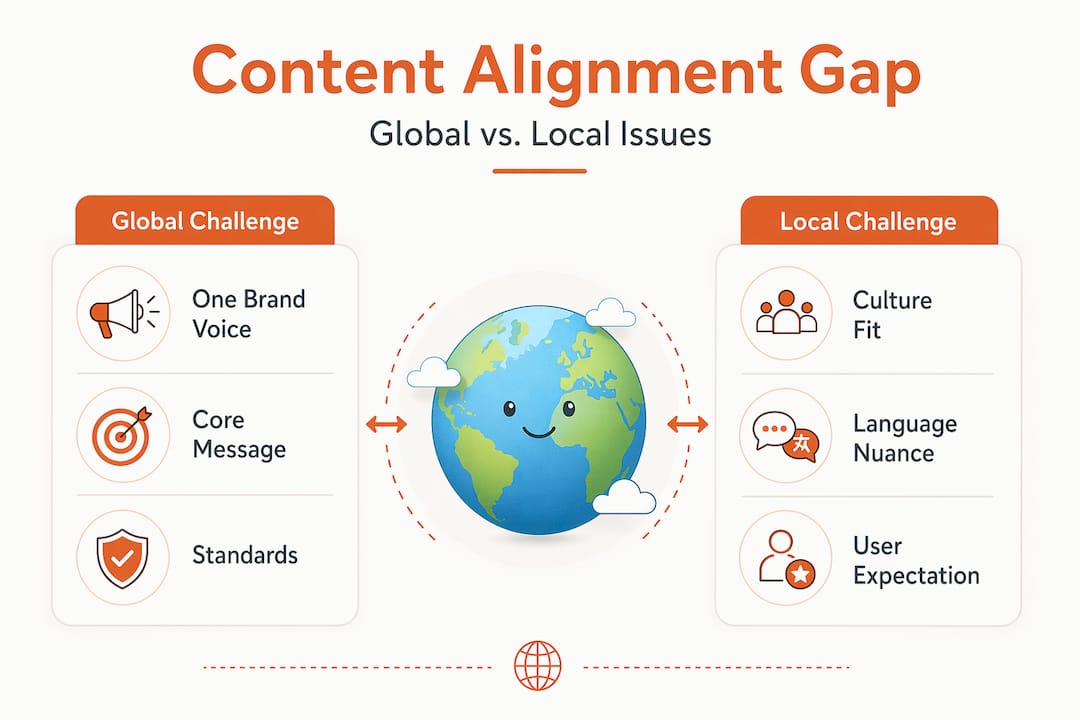
Key challenges in global content alignment
Getting content consistency right requires you to understand why it fails. The obstacles are structural, cultural, and technological, and they often hit simultaneously.
Localization is treated as translation. Over 50% of marketers identify poor adaptation to the target language as a leading cause of brand reputation damage. Swapping words is not adaptation. Idioms, humor, formality levels, and cultural references all shape how a message lands. A product team that ships a translated string without native speaker review is not localizing. It is gambling.
Governance is undefined. Most companies over-invest in market research and under-invest in governance, which is why local teams end up making brand decisions they were never qualified to make. When no one owns the boundary between “global standard” and “local adaptation,” that boundary disappears.
Workflow fragmentation creates asset silos. Content lives in Figma files, Notion docs, shared drives, email threads, and legacy CMS platforms simultaneously. Different teams pull from different sources. Version confusion is not an edge case. It is the default state for most distributed product teams.
Cross-functional misalignment slows everything down. Effective brand consistency requires governance that includes legal, compliance, marketing, and sales. When these groups operate in silos, content gets blocked in review cycles or, worse, ships without proper checks.
The tension between standardization and local relevance is real. Forcing a single global tone on markets with dramatically different communication norms does not create consistency. It creates alienation. The goal is structured flexibility, not rigid uniformity.
Understanding these failure points is the prerequisite to building something better. You cannot govern what you have not diagnosed.
Governance models that hold content together
Strong content consistency starts with decisions about what is fixed and what can flex. This is the foundation of every effective global product branding strategy.
Define your non-negotiables. Your product name, core value proposition, accessibility standards, and legal disclosures belong in a locked category. These do not change by market. Everything else is a candidate for local adaptation.
Build a hybrid governance model. Centralized control over brand anchors combined with local autonomy over tone and cultural framing is what effective decision-right mapping looks like in practice. Global sets the rules. Local applies them intelligently.
Bring legal and compliance into the content process early. Cross-organizational governance that includes legal, compliance, and sales prevents the execution gaps that cause post-launch scrambles. The earlier these stakeholders are involved, the less rework your team absorbs.
Create living brand guidelines built for digital product contexts. A PDF that gets updated once a year is not a governance tool. It is a historical document. Your guidelines need to live where your teams work, be versioned, and include explicit examples of localized content done right.
Enforce standards in your production environment. Locking brand elements into templates and using smart fields prevents off-brand content before it is ever created. This shifts quality control from manual review to structural design.
Schedule regular alignment reviews. Quarterly governance audits with cross-functional representatives catch drift before it becomes systemic. These are not creative reviews. They are content health checks.
Pro Tip: Create a one-page “Brand Boundary Map” that visually separates locked global elements from adaptable local ones. Share it with every team that touches content. When everyone can see the fence, fewer people accidentally cross it.
Tools and workflows that keep teams aligned
Strategy without execution infrastructure is just intention. Here is what bulletproof content alignment looks like at the workflow level.
Use real-time collaborative platforms. Distributed teams need a single source of truth for content, accessible to every function. This is not optional. Asset silos are where brand consistency goes to die.
Integrate AI-powered localization with human review. AI handles speed and scale. Humans handle nuance and cultural accuracy. Localization quality depends on native speaker involvement, particularly for tone, idioms, and market-specific sensitivities. The strongest workflows combine both. For a deeper look at what traditional approaches miss, see Gleef’s analysis of localization tool failures.
Build phased rollout and feedback loops. Before full release, test localized content with real users in target markets. Collect structured feedback. Treat localized content as a hypothesis to be validated, not a deliverable to be shipped and forgotten.
Use in-context editing tools. Reviewing translations in a spreadsheet divorced from design context is how subtle errors survive review. In-context editing, where you see strings inside the actual UI, catches problems that abstract review workflows miss. Gleef’s approach to managing multilingual content is built around this principle.
Run targeted training programs. Cultural education for content creators reduces the number of adaptation errors that reach review. It is cheaper to train your team than to fix off-brand content post-launch.
Benchmark by market, not globally. A global average content performance metric hides localized failures. Segment your analytics by region to identify which markets need more support.
Pro Tip: Think of localization as a first-class part of your product roadmap, not a post-production task. Teams that integrate localization early ship faster and with fewer corrections.
Measuring content consistency and improving over time
You cannot improve what you do not measure. For global product teams, content performance metrics need to work at a regional level to be meaningful.
Metric | What it measures | Typical benchmark |
|---|---|---|
Brand recall by market | Consistency of message reception | 20% lift with uniform branding |
Content approval cycle time | Governance efficiency | Reduction after workflow automation |
Cross-border conversion rate | Impact of content alignment on sales | 15% increase with brand consistency |
Localization error rate | Translation and adaptation quality | Tracked per release, targeted toward zero |
Most teams track surface metrics well. 87% of content teams monitor traffic, but only 31% track revenue attribution. Content ROI in global products often peaks between 24 and 36 months, which means short-term measurement cycles consistently undervalue the investment. Make the case for long-term benchmarking to your leadership by framing content operations as infrastructure, not overhead.
Qualitative feedback matters too. Regular input from regional stakeholders, customer support teams, and in-market users gives you signal that analytics cannot. The goal is a continuous improvement cycle where data and human insight feed each other.
My take on balancing global and local content
I have worked with enough global product teams to know that the most common mistake is not neglecting consistency. It is enforcing it in the wrong places. Teams that lock down every piece of content globally are not protecting their brand. They are suffocating the local teams who understand their markets better than any headquarters team ever will.
What I have found actually works is thinking of your core brand elements as anchors, not cages. Your name, your product promise, your visual language, and your legal requirements are anchors. Everything else is a sail. Local teams should be able to adjust the sails without touching the anchor.
The governance pitfalls I see most often are not dramatic failures. They are quiet ones. A local team makes a reasonable content call that no one reviews. Then another. Then another. Six months later, the regional product feels like a different brand entirely. This is why cross-functional compliance structures and regular audits are not bureaucratic overhead. They are what keeps your brand alive across borders.
My strongest advice: stop treating content consistency as a project with a finish line. It is a system you maintain. Build the feedback loops, fund the governance, and trust your local teams with the flexibility they have earned.
— Antoine
How Gleef helps teams own content consistency
For product teams managing global digital products, the gap between good content strategy and bulletproof execution usually comes down to tooling. Gleef’s Figma Plugin brings AI-powered localization directly into the design environment, so your team reviews translations in context, not in a spreadsheet.
Gleef’s platform supports semantic translation memory, brand-aligned glossaries, and rules-based standards that enforce your content non-negotiables at the source. That means fewer manual corrections, faster release cycles, and brand voice that holds across every market you ship to. If you are building a global product and want consistency that scales, Gleef is where product teams start.
FAQ
What is content consistency in global products?
Content consistency in global products means maintaining a unified brand voice, message, and quality standard across all markets while allowing for culturally appropriate local adaptation. It is the difference between a product that feels global and one that feels disconnected.
Why does content inconsistency harm user experience?
Inconsistent content disrupts the mental models users build around a product, making it feel unreliable or unfamiliar. This breaks trust and increases friction, particularly in markets where users have high expectations of native-quality experiences.
How do you maintain brand voice across different languages?
Maintaining brand voice across languages requires a combination of clear brand guidelines, glossaries, native speaker review, and in-context editing tools. Localization that starts early in the product process produces far more consistent results than post-production translation.
What governance model works best for global content teams?
A hybrid model works best: centralized control over core brand elements with local autonomy over tone and cultural framing. Clear decision-right mapping between global and local stakeholders prevents the brand drift that pure centralization or pure decentralization both produce.
How do you measure the ROI of content consistency efforts?
Track brand recall by market, content approval cycle times, cross-border conversion rates, and localization error rates per release. Content ROI typically peaks after 24 to 36 months, so frame investments in content operations as long-term infrastructure to leadership.