
TL;DR:
A global strategy coordinates a company’s operations across international markets to improve efficiency and competitiveness. It requires balancing standardization and local relevance, especially in a volatile geopolitical environment. Effective execution depends on organizational structure, political insight, localization, and dynamic capabilities to adapt quickly.
A global strategy is a centralized plan that integrates a company’s operations, products, and competitive positioning across international markets to achieve efficiency and sustainable advantage. Unlike a simple export plan, a true international management strategy requires coordinating pricing, product design, and brand positioning from a unified command structure while still accounting for local market realities. The tension between standardization and local relevance defines every decision executives make when building their approach. In 2026, geopolitical fragmentation, supply chain volatility, and digital transformation have made that tension sharper than ever. Getting the balance right is no longer optional. It is the difference between a company that scales globally and one that stalls at its borders.
What is a global strategy and why does it matter now?
A global strategy is defined as a plan that centralizes coordination of products and pricing while embedding cultural understanding to achieve both efficiency and local relevance. That definition captures the core tension executives must resolve: you cannot simply replicate your domestic model in 40 countries and call it a global business strategy.
The stakes are higher in 2026 than they were five years ago. Geopolitical volatility, digital fragmentation, and rising nationalism have forced multinationals to rethink assumptions that held for decades. A company that built its international management strategy on frictionless trade and stable supply chains now faces a fundamentally different operating environment.
Dynamic capabilities define modern strategic management and must drive global strategy formulation to adapt to rapid environmental disruption. This means the ability to sense shifts, respond to disruptions, and reconfigure resources rapidly is now a core competency, not a nice-to-have. Executives who treat their global management strategy as a fixed document rather than a living system will find it obsolete within months.
What are the main types of global strategies and how do they differ?
Three primary models define how companies approach international expansion: multinational, global, and transnational strategies. Each reflects a different answer to the standardization-versus-localization question.
Multinational strategy gives local subsidiaries significant autonomy. Products, pricing, and marketing adapt to each market. This approach maximizes local relevance but sacrifices economies of scale and brand consistency.
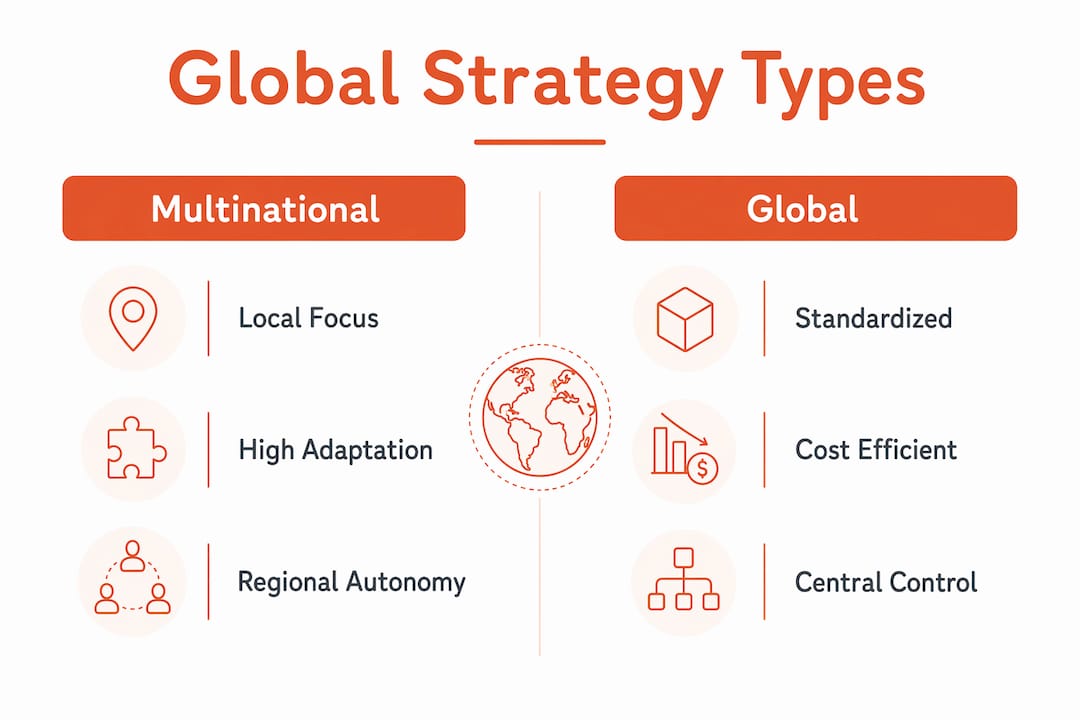
Global strategy does the opposite. The company standardizes products and processes worldwide, treating the world as a single market. Cost efficiency is high, but the model struggles in markets with strong cultural or regulatory differences.
Transnational strategy attempts to capture both. It pursues global efficiency while maintaining local responsiveness through a network of interdependent units. This is the most complex model to execute but often the most durable.
Three main global strategy types vary in their focus on cost reduction and local responsiveness. Choosing the wrong type for your industry and market conditions is one of the most common and costly mistakes executives make.
Strategy type | Standardization level | Local responsiveness | Best suited for |
|---|---|---|---|
Multinational | Low | High | Consumer goods, food, retail |
Global | High | Low | Industrial equipment, technology hardware |
Transnational | Medium | Medium | Pharmaceuticals, software, financial services |
The situational factors that drive your choice include industry pressure for cost efficiency, the degree of cultural variation across your target markets, and your organization’s capacity to manage complexity. A consumer packaged goods company entering Southeast Asia needs a very different model than a B2B software firm expanding into Europe.
How do companies integrate geopolitical risk and dynamic capabilities?
Geopolitics must move from compliance to core strategic capability. Executives who treat geopolitical exposure as a legal or regulatory matter rather than a strategic one risk losing market access entirely. Corporate diplomacy, which means actively managing government relations across multiple jurisdictions, is now a leadership competency, not a government affairs function.

The practical implications are significant. Companies are restructuring ownership to reduce political exposure. Leading multinationals localize ownership structures by listing subsidiaries domestically and partnering with host governments. This signals alignment with local interests and reduces the risk of regulatory retaliation or forced divestiture.
Dynamic capabilities sit at the heart of this shift. Strategic flexibility and continuous reconfiguration are vital for sustaining competitiveness amid rapid global changes. That means building processes that allow your organization to sense early warning signals, respond before a crisis forces your hand, and reconfigure supply chains, partnerships, or market positions without losing momentum.
Modern global strategy is shifting toward resilience, employing deliberate redundancy and decentralized decision-making to survive geopolitical volatility. This approach directly contrasts with traditional efficiency-only models, which optimize for cost but leave companies exposed when conditions change suddenly.
The key capabilities your organization needs to build include:
Political intelligence: Systematic monitoring of regulatory and geopolitical shifts in every operating market
Supply chain redundancy: Deliberate duplication of critical nodes to absorb shocks without halting operations
Decentralized decision authority: Empowering regional leaders to act without waiting for headquarters approval
Corporate diplomacy: Proactive engagement with host governments before problems arise, not after
Pro Tip: Map your top five markets against a geopolitical risk matrix every quarter. Assign a named executive owner to each relationship. Waiting for a crisis to activate government relations is always more expensive than building them in advance.
What frameworks and components should guide effective global strategy development?
A well-built international management strategy rests on four interconnected components: global ambition, global positioning, global business system, and global organization. Each component answers a distinct strategic question and forces specific decisions.
Global ambition defines the scope of your international aspirations. How many markets? Which segments? What share of global revenue do you target within five years? Without a clear ambition statement, resource allocation becomes political rather than strategic.
Global positioning determines how your brand and product compete across markets. Do you compete on price, quality, or differentiation? Does your positioning shift by region, or does it hold constant? Balancing global standardization with local cultural understanding remains a key tension and differentiator in strategy implementation. A positioning that resonates in Germany may land flat in Brazil without deliberate adaptation.
Global business system covers the operational architecture: supply chain design, manufacturing footprint, technology infrastructure, and partnership models. This is where digital strategy decisions intersect with strategic intent, particularly for technology companies managing distributed product development.
Global organization addresses governance, reporting structures, and talent. Who owns global decisions? Who owns local ones? The answer shapes everything from speed of execution to accountability.
Framework component | Core question | Key decision |
|---|---|---|
Global ambition | Where do we compete? | Market selection and revenue targets |
Global positioning | How do we compete? | Standardization vs. local adaptation |
Global business system | How do we operate? | Supply chain, technology, partnerships |
Global organization | Who decides what? | Governance model and talent strategy |
Aligning these four components is harder than building them individually. The most common failure point is a mismatch between ambition and organization: a company sets aggressive global targets but retains a headquarters-centric governance model that cannot move fast enough to capture them.
What are the common challenges and pitfalls in executing global strategies?
Execution is where most global strategies fail. The plan looks coherent on paper, but the organization cannot deliver it at market speed. Three failure patterns appear repeatedly across industries.
Underestimating cultural differences is the most common. Executives assume that a product or message that works at home will work everywhere with minor translation. It rarely does. Failing to integrate localization at the product design stage leads to increased customer acquisition costs and poor brand resonance. Localization retrofitted after launch costs far more than localization built in from the start.
Ignoring geopolitical shifts until they become crises is the second failure pattern. Companies that treated their China manufacturing concentration as a permanent efficiency advantage discovered in 2020 and again in 2024 that single-point dependencies are strategic liabilities. Resilience requires deliberate redundancy, which feels wasteful until it is the only thing keeping operations running.
Neglecting governance redesign is the third. Many companies attempt to execute a transnational strategy with a multinational organizational structure. The result is confusion about who owns decisions, slow responses to local market signals, and frustrated regional teams who lack the authority to act.
The practical fixes are direct:
Embed international product managers in design sprints from day one, not after the product ships
Assign geopolitical risk owners at the executive level, not the compliance level
Redesign governance to match the strategy type you have chosen, not the one you inherited
Build localization best practices into your product development cycle as a standard gate, not an optional step
Pro Tip: Run a “local failure audit” on your last three product launches. Identify every instance where a localization or cultural assumption caused a delay, a rework, or a missed target. The pattern will tell you exactly where your process breaks down.
How can technology and localization practices enhance global strategy outcomes?
Technology is the connective tissue between a global strategy on paper and one that delivers results in market. Localization platforms help balance centralized control with local adaptation, enhancing content consistency and global user experience. For product teams, this means maintaining a single source of truth for brand voice while enabling market-specific content variations without manual rework.
International SEO combined with true global reach strategies goes beyond translation to increase market presence and brand awareness. A product localized into French is not automatically visible to French-speaking users in search. Structural SEO decisions, including hreflang tags, local domain strategy, and market-specific keyword research, determine whether your localized content actually reaches its intended audience.
The technology decisions that most directly affect global strategy execution include:
Translation memory systems: Reduce per-word translation costs and enforce terminology consistency across all markets
In-context editing tools: Allow designers and product managers to see translations in the actual UI before shipping, eliminating layout breaks and truncation errors
Glossary enforcement: Ensure brand terms, product names, and legal language translate consistently across every language and every team
API-driven localization workflows: Connect your content management system, design tools, and translation pipeline so updates propagate automatically
The global user experience question is ultimately a strategic one. A product that feels native in every market it enters builds trust faster, converts better, and retains users longer than one that feels translated. That difference compounds over time into a measurable competitive advantage. Pairing your marketing strategy with localization-ready content architecture from the start is the most cost-efficient path to true global reach.
Key Takeaways
A global strategy succeeds when it integrates geopolitical resilience, dynamic capabilities, and localization into a single, coordinated operating model rather than treating each as a separate workstream.
Point | Details |
|---|---|
Define your strategy type first | Choose multinational, global, or transnational based on your industry and market conditions before allocating resources. |
Treat geopolitics as strategy | Assign executive ownership to government relations and build political legitimacy before entering new markets. |
Build dynamic capabilities | Create processes to sense, respond to, and reconfigure around disruptions rather than optimizing only for efficiency. |
Embed localization early | Integrate cultural and linguistic adaptation at the product design stage to reduce rework costs and improve market fit. |
Align organization to strategy | Match your governance model to your chosen strategy type or execution will stall regardless of how strong the plan is. |
The shift I keep seeing executives miss
The executives I watch navigate global expansion most successfully share one habit: they treat their organizational structure as a strategic variable, not a fixed constraint. Most strategy work focuses on markets, products, and positioning. The governance model gets inherited from the last reorganization and never revisited. That is where strategies die.
The shift from efficiency-first to resilience-first thinking is real and necessary. But resilience without organizational redesign is just redundancy spending. You can duplicate supply chain nodes and still fail if your regional leaders lack the authority to activate alternatives when a disruption hits. The dynamic capability that matters most is not the ability to sense a shift. It is the ability to act on it faster than your competitors.
Corporate diplomacy is the other blind spot. I have watched companies spend years building market position in a country, only to lose it in six months because they had no relationship with the government when a regulatory change came. The companies that survive geopolitical volatility are not necessarily the ones with the best products. They are the ones whose executives built trust with local stakeholders before they needed it.
The practical implication is uncomfortable: your global strategy review should spend as much time on governance, relationships, and organizational design as it does on market sizing and competitive positioning. The market opportunity is only accessible if your organization can actually reach it.
— Antoine
How Gleef supports your global strategy execution
Executing a global strategy means your product must feel native in every market you enter, not just translated.

Gleef’s AI-powered Figma plugin brings localization directly into your design workflow, so product teams can manage translations in context without switching tools or waiting on external agencies. Semantic translation memory, glossary enforcement, and in-context editing mean your brand voice stays consistent from Paris to São Paulo. Teams using Gleef report faster release cycles and fewer localization-related launch delays. If your global strategy depends on shipping products that resonate locally, Gleef gives your team the infrastructure to do it at speed.
FAQ
What is the global strategy definition in business?
A global strategy is a centralized plan that coordinates a company’s products, pricing, and operations across international markets to achieve competitive advantage and efficiency. It differs from a simple export strategy by requiring integrated decision-making across all markets rather than treating each country independently.
What are the three main types of international management strategies?
The three main types are multinational, global, and transnational strategies. Multinational strategies prioritize local adaptation, global strategies prioritize standardization, and transnational strategies balance both through interdependent regional units.
Why is localization critical to a global business strategy?
Failing to integrate localization at the product design stage increases customer acquisition costs and weakens brand resonance in target markets. Localization built into the development process from the start is significantly more cost-efficient than retrofitting it after launch.
How do dynamic capabilities strengthen a global management strategy?
Dynamic capabilities allow firms to sense environmental shifts, respond to disruptions, and reconfigure resources rapidly. Companies that build these capabilities into their operating model can adapt their international strategy faster than competitors who optimize only for efficiency.
What role does geopolitics play in international marketing strategies?
Geopolitics must be treated as a core strategic capability rather than a compliance function. Companies that actively manage government relations across jurisdictions and localize ownership structures reduce political risk and maintain market access during periods of instability.