
TL;DR:
Treat globalization as an integral part of product design, not a final step.
Early i18n planning prevents costly rework and UI failures during launch.
Balancing AI translation speed with human review ensures quality and cultural nuance.
Most product teams treat translation as a final checkbox before launch. Wrong. That assumption alone creates some of the most expensive, preventable bottlenecks in global product development. When localization is bolted on at the end, you’re not just dealing with translation delays — you’re dealing with broken layouts, hardcoded strings, missing plural forms, and a UI that collapses under right-to-left (RTL) languages. This guide cuts through the noise and gives your team a clear, repeatable approach to building digital products that work beautifully across every market from day one.
Key Takeaways
Point | Details |
|---|---|
Start with i18n | Planning for internationalization early prevents costly tech debt. |
Iterate localization | Tackle localization in stages to improve quality and speed of global launches. |
Mix AI and human review | Use AI for efficiency but rely on experts for critical translation quality. |
Avoid late-stage rework | Testing and involving local experts early prevents UI and UX crises. |
Leverage proven frameworks | Structured processes help teams scale globally with less friction. |
What is digital product globalization?
Before fixing your workflow, you need to get the terminology straight. These terms are often used interchangeably, but they mean different things — and confusing them leads to real problems.
Globalization is the overarching process of designing and building a product so it can function in any market. It’s the umbrella strategy. Under globalization sit two critical disciplines:
Internationalization (i18n): The engineering and design work that makes localization possible. Think Unicode support, externalized strings, flexible layouts, and locale-aware date/time/currency formatting. This is done once, early, and it’s foundational.
Localization (l10n): The actual adaptation of your product for a specific market — translating content, adjusting images, formatting numbers, and adapting tone to match cultural expectations. This happens repeatedly, per market.
The Modern Web i18n series makes a critical distinction: i18n should come first because it’s a tech debt killer, and l10n should follow iteratively. Miss this order, and you’ll spend sprint after sprint untangling spaghetti code instead of shipping features.
Understanding why localization matters is equally important. Users convert at significantly higher rates when a product speaks their language, both literally and culturally. But none of that works if the product’s architecture wasn’t built to support it.
Here’s what happens when teams skip early globalization planning:
Hardcoded strings buried across dozens of components that require manual hunting to extract
UI designs that assume left-to-right text flow and collapse completely in Arabic or Hebrew
Date and number formats hard-wired to a single locale, causing confusion or errors in other regions
Character encoding issues that corrupt non-Latin scripts
String concatenation patterns that make grammatically correct translation impossible
“UI string translation is not the same as holistic product readiness. Translation can be technically complete and still fail — because the product was never built to flex.”
That distinction matters enormously. You can have perfect translations sitting in a file and still ship a broken experience if i18n wasn’t part of the original architecture. Reviewing localization best practices for 2026 will show you how top teams are building this readiness into their product DNA from the start.
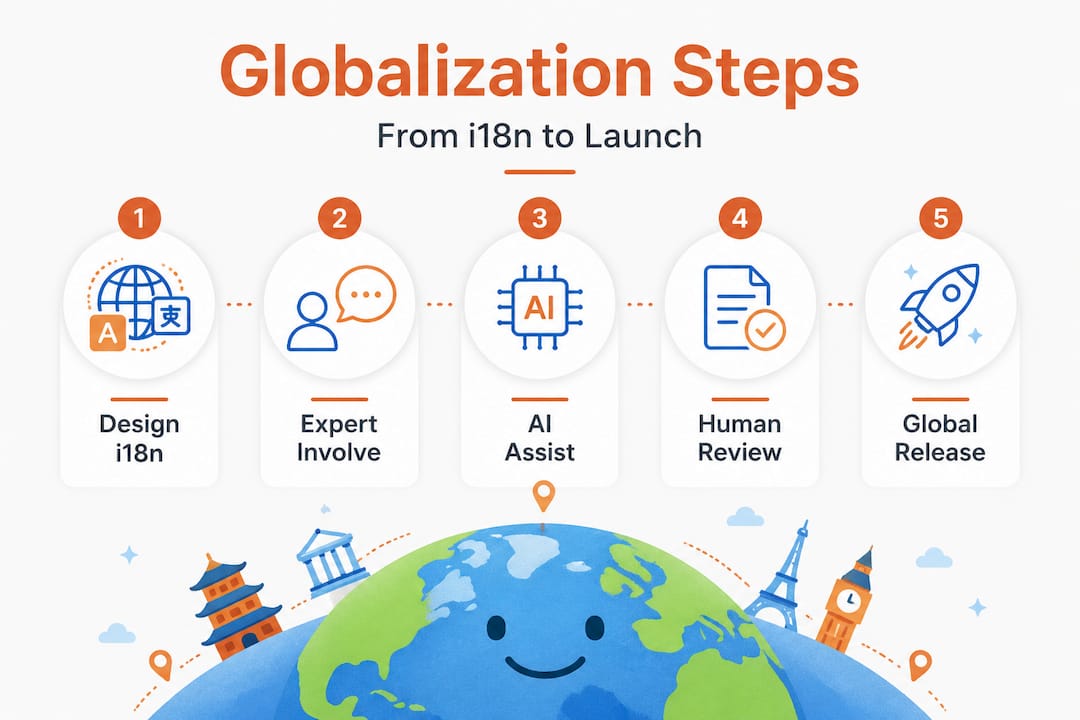
The digital product globalization framework
Now that the terminology is clear, here’s a practical, repeatable framework your team can apply. This isn’t theoretical — these are the stages that eliminate tech debt and make iterative localization actually achievable.
Design for i18n: Before a single line of code is written, design your UI with language expansion in mind. German text averages 30% longer than English. Arabic flows right to left. Thai has no spaces between words. Your design system needs to accommodate all of this from the beginning, not as an afterthought.
Code for flexibility: Externalize all user-facing strings into resource files. Avoid string concatenation. Support Unicode throughout. Use locale-aware libraries for formatting dates, times, currencies, and numbers. Design components that reflow gracefully rather than truncating text.
Extract translatable resources: Create a clean, structured repository of all translatable content. This means proper key naming conventions, context notes for translators, and version control for string updates. A messy string extraction process creates confusion and mistranslations downstream.
Test early with pseudo-localization and RTL: This is where most teams skip a step that could save them days of debugging. Pseudo-localization replaces real strings with extended, accented placeholders to simulate language expansion without actual translation. RTL testing flips your layout to catch directional assumptions baked into your CSS. The Modern Web i18n series specifically recommends testing RTL and pseudo-localization early to catch layout failures before they become expensive.
Localize iteratively: Once the technical foundation is solid, localization becomes a regular, manageable sprint activity rather than a crisis before launch. You can prioritize markets, test translations in context, and ship confidently.
Pro Tip: Involve localization experts during your very first design sprints, not after the product spec is locked. A localization engineer reviewing wireframes early catches i18n problems in minutes that would take developers hours to fix later.
Enabling cross-functional localization with AI is how leading product teams are scaling this framework without adding headcount.
Globalization stage | Impact on quality | Impact on speed |
|---|---|---|
i18n at design phase | High: prevents structural rework | High: no emergency retrofits |
Early pseudo/RTL testing | High: catches layout failures pre-launch | Medium: adds a short testing cycle |
Centralized string management | High: reduces translator confusion | High: fewer revision cycles |
Iterative l10n with AI | Medium: consistent baseline quality | Very High: rapid multi-market delivery |
Human review for UI-critical strings | Very High: brand voice preserved | Low: adds review time but prevents errors |
AI and automation: Enhancing speed without sacrificing quality
With the core framework in place, your team faces one of the most important strategic decisions in modern localization: where do you lean on automation and AI, and where do you insist on human expertise?
The honest answer is that AI is genuinely transformative for localization at scale — but it’s not a replacement for judgment. Here’s where each approach excels.
Where AI and automation shine:
Bulk translation of UI strings, error messages, and repetitive UI patterns
Building and maintaining a semantic translation memory that improves consistency across releases
Enforcing glossary terms and brand-specific vocabulary automatically
Flagging strings that have changed and need re-translation
Generating initial drafts that human reviewers can refine quickly rather than translate from scratch
Maintaining tone consistency across large string libraries
Where human review is non-negotiable:
Marketing copy, onboarding flows, and any emotionally resonant UI content
Product names, taglines, and any content that carries brand identity weight
Legal or compliance-related text where precision is critical
Culturally sensitive content that AI models may not navigate well
RTL languages and scripts with complex grammatical structures
The Modern Web i18n series puts it plainly: the winning strategy is balancing AI speed with human nuance for quality. Teams that use AI exclusively tend to produce translations that are technically accurate but feel flat, robotic, or off-brand in target markets. Teams that skip AI entirely can’t scale.

Understanding AI’s real impact on localization reveals why this hybrid model is becoming the industry standard. And if you want to see how AI translation improves quality at the string level, the data is compelling — especially for consistency across large-scale releases.
Strategy | Translation speed | Brand voice fidelity | Cost at scale | Best for |
|---|---|---|---|---|
Pure manual translation | Slow | Very high | Very high | Small-scale, premium content |
Pure AI/MT | Very fast | Low to medium | Low | Internal content, low-visibility strings |
Hybrid (AI + human review) | Fast | High | Medium | Most digital product teams |
AI with in-context review | Fast | Very high | Medium | UI-critical, customer-facing content |
Pro Tip: Use AI for bulk translation tasks and let your team’s energy go toward reviewing UI-critical strings in context. Automation in localization handles the volume; your experts handle the judgment calls.
For teams evaluating AI solutions, it’s worth looking at AI in localization beyond the hype to understand where the technology delivers and where it still falls short. Being an informed buyer protects your product quality. And when exploring how to weave it all together, looking at integrating AI into your localization strategy is a practical next step.
Common pitfalls (and how to avoid them)
Even with a solid framework, teams run into the same walls repeatedly. Here are the three most common globalization failures — and the fixes that work.
1. Leaving i18n too late
This is by far the most expensive mistake. When i18n isn’t part of the initial architecture, every future localization effort becomes a retrofitting project. Strings are hardcoded. Components don’t flex. Date formatting is locale-specific by assumption. Fixing this after the fact means touching dozens of files, retesting everything, and often delaying launches by weeks.
The Modern Web i18n series is unambiguous: prioritize i18n first because it’s the most effective way to kill tech debt before it starts. The fix is simple in theory: make i18n a definition-of-done requirement for every component from your very first sprint.
“Every week you delay i18n, you add a multiplier to the cost of going global. The debt compounds silently, then hits all at once when your first international launch date approaches.”
2. Relying solely on raw AI or machine translation output
AI translation has gotten remarkably good. But “remarkably good” and “brand-ready” are not the same thing. Raw machine translation output tends to be grammatically correct while missing cultural tone, idiomatic expression, and the specific voice your brand has worked to build. Ship raw AI output to a sophisticated market and users notice immediately.
The fix: never let unreviewed AI translation touch customer-facing strings. Build a review step into your workflow, even if it’s a lighter pass for lower-visibility content. Faster localization with a human touch shows how this balance works in practice without slowing your team down.
3. Not testing for RTL and language expansion
This one breaks UIs silently during development, then loudly in production. RTL support isn’t just flipping text direction — it affects button placement, icon orientation, navigation flow, and even animation direction. Language expansion means your clean English button label becomes a multi-line wrapping nightmare in Finnish or German.
The fix: build RTL and expansion testing into your QA checklist before localization begins. Use pseudo-localization tools to stress-test your UI with simulated content. Building designs that hold up under localization requires treating these tests as standard practice, not edge cases.
Make i18n a sprint requirement: Add it to your definition of done from day one.
Establish a human review tier: Classify strings by visibility and ensure customer-facing content gets reviewed by a native speaker or localization expert.
Add RTL and pseudo-localization to your standard QA process: Automate where possible so it doesn’t add manual overhead.
A pragmatic take: How we’ve seen digital product globalization work (and fail)
Here’s what doesn’t get said often enough: the companies that succeed at global product launches aren’t necessarily the ones with the biggest localization budgets. They’re the ones that treat globalization as an engineering value, not a marketing line item.
We’ve seen teams with generous localization budgets still ship broken global experiences because their codebase was never built to support multiple locales. And we’ve seen lean teams ship confidently to five markets simultaneously because they were rigorous about i18n from sprint one.
The Modern Web i18n series captures a truth that experienced practitioners know well: i18n is the tech debt killer. The teams that get this right aren’t doing extra work — they’re doing the same work smarter, in the right order, so they don’t have to redo it three times later.
Here’s the other thing: involving localization experts early produces surprising wins beyond just catching translation issues. A skilled localization engineer reviewing your design system early will often catch UX problems that affect all users, not just international ones. Flexible text containers that accommodate longer translations also accommodate accessibility use cases. Locale-aware formatting that works for German users also reduces confusion for American users switching between date formats.
The AI-only hype is also worth addressing directly. The best teams we’ve seen aren’t trying to remove humans from the loop — they’re using AI to make human judgment more powerful. AI handles the volume and consistency; human reviewers handle the nuance and brand voice. That combination, applied iteratively, is what produces 2026 localization best practices that actually hold up at scale.
The uncomfortable truth is that most globalization failures are organizational, not technical. The technology to do this well exists. The frameworks are proven. The challenge is getting product managers, designers, developers, and localization specialists to work in sync from the very beginning of a product cycle — not in sequence after the product is already built.
Ready to streamline your global launches?
You now have the frameworks, the pitfalls, and the perspective to build a globalization process that actually scales. But knowing the theory and having the right tools are two different things.
Gleef is built for exactly this workflow. Product teams use it to manage AI-powered translations directly inside their design and development environments, enforce glossaries and brand voice automatically, and review translations in context without switching platforms. If your team is tired of last-minute translation scrambles blocking releases, it’s worth seeing how a purpose-built localization platform changes the dynamic. Visit gleef.eu to see how teams are shipping global-ready products faster, with fewer revision cycles and stronger brand consistency across every market they enter.
Frequently asked questions
What is the difference between localization and globalization?
Globalization prepares a product for any market by enabling easy adaptation through proper i18n architecture, while localization customizes the product for a specific market’s language and culture. As the Modern Web i18n series explains, i18n comes first as a tech debt killer, and l10n follows iteratively per market.
Why start internationalization (i18n) early in digital product development?
Early i18n planning prevents expensive rework, broken UI layouts, and product launch delays caused by last-minute localization. According to i18n best practices, the cost of fixing i18n issues multiplies significantly the later in development they are addressed.
How does AI impact localization quality?
AI dramatically speeds up translation and ensures consistency across large string libraries, but it still requires human review for market-specific accuracy, cultural nuance, and brand voice. The Modern Web i18n series recommends balancing AI speed with human judgment for production-quality output.
What is a common mistake in digital product globalization?
The most costly mistake is delaying i18n until after the product is built, which creates technical debt that makes every future localization effort slower and more error-prone. Treating i18n as a tech debt killer from day one is the clearest way to prevent this pattern from taking hold.