
TL;DR:
Translation focuses on conveying meaning, not just replacing words, while preserving intent, tone, and culture.
Effective workflows require clear standards, modular documentation, and continuous management of glossaries and style guides.
Translation is defined as the communication of meaning from a source-language text to an equivalent target-language text, prioritizing the preservation of intent, tone, and cultural nuance over literal word substitution. For localization teams, understanding this definition and translation’s full scope is the foundation of every quality decision you make. The European Commission Translation Knowledge Centre now formally includes software, video, and multimedia content within that scope, which means your translation workflow extends far beyond documents. Getting the definition right shapes every methodology, tool, and quality standard that follows.
What is the definition and translation scope in 2026?
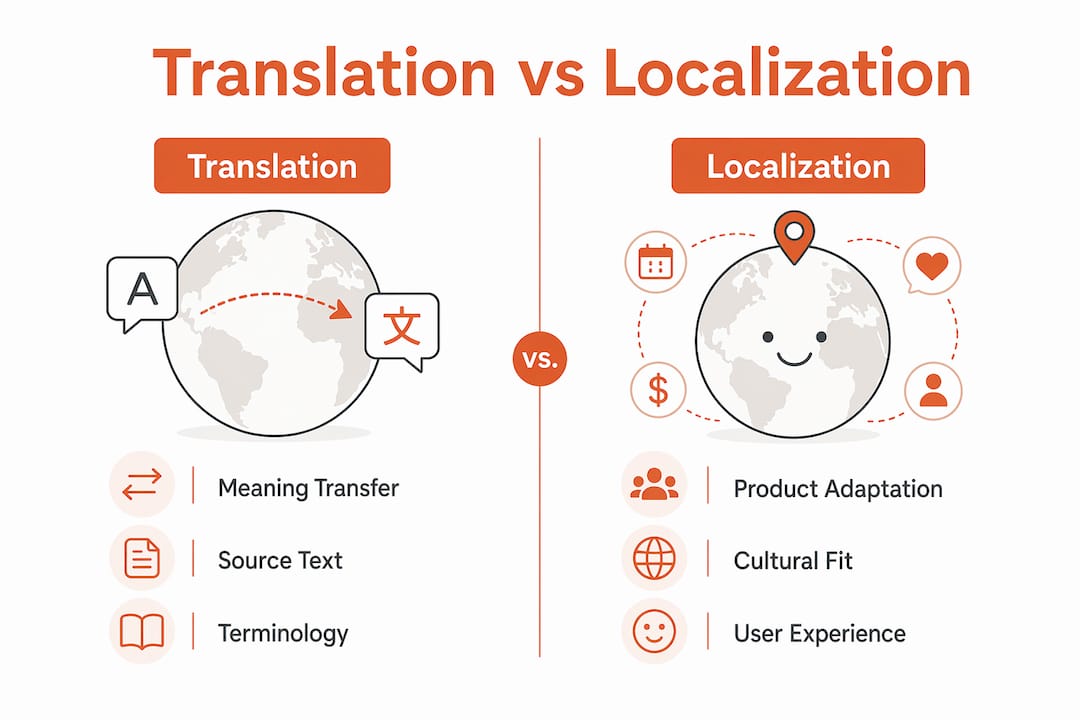
Translation is not word substitution. It is meaning transfer, and that distinction changes how you build every process around it.
“Translation is the communication of meaning from a source-language text to an equivalent target-language text, with the scope now formally expanded to include software interfaces, multimedia content, and digital products alongside traditional written documents.” — European Commission Translation Knowledge Centre, 2026
The expanded translation scope from the European Commission reflects a reality that product teams already live with daily. A single release can require translated UI strings, onboarding videos, help documentation, and push notifications, all at once. Each format carries its own cultural and tonal requirements. A phrase that sounds confident in English can read as aggressive in Japanese or passive in Brazilian Portuguese. Preserving intent across those shifts is the actual work of translation, and no automated tool resolves it without clear standards behind it.
Regulatory and quality standards shape what “equivalent” means in practice. The ISO 17100 standard for translation services, for example, sets minimum competency requirements for human translators and defines review stages that catch errors before they reach production. Teams that treat these standards as bureaucratic overhead pay for that decision in rework costs later.
What are the main methods and best practices in translation?
The three core approaches to translation are human translation, machine translation, and hybrid translation. Each has a defined role, and mixing them without a clear strategy produces inconsistent results.
Human translation is the standard for culturally sensitive, legally binding, or brand-critical content. A human translator brings domain expertise and cultural judgment that no current machine can replicate reliably. Translation accuracy depends equally on linguistic skill and deep subject-matter knowledge, which is why a certified medical translator and a general linguist are not interchangeable.
Machine translation tools like Google Translate and DeepL handle simple, repetitive, or high-volume text efficiently. They are suitable for internal communications, first-draft passes, or content with low cultural complexity. They are not suitable for final customer-facing copy without human review.
Hybrid translation combines machine output with human post-editing. This approach works well for large content volumes where speed matters and quality standards are non-negotiable. Structured terminology frameworks and clear quality guidelines reduce revision time significantly in hybrid workflows.
The single biggest lever in any of these approaches is your glossary. A well-maintained glossary eliminates ambiguity at the source. When every translator, human or machine, works from the same approved terminology, consistency follows automatically.
Pro Tip: Build your glossary before you start any translation project, not after. Retrofitting approved terminology into completed translations costs far more time than defining it upfront.

How do translation documentation and guidelines shape successful projects?
Translation documentation is a living asset, not a static file you create once and archive. The teams that treat it as a dynamic resource consistently outperform those that treat it as a one-time deliverable.
Effective translation documentation has three core components:
Style guide. This defines tone, voice, formality level, and sentence construction preferences for each target language. A style guide for a fintech product in German will differ significantly from one for a consumer app in Spanish. The style guide answers the question: “How should this brand sound in this language?”
Glossary and terminology list. This is your approved vocabulary. It specifies which terms to use, which to avoid, and how to handle brand-specific language that has no direct equivalent. Translation guidelines that incorporate specific “do/don’t” examples reduce errors more effectively than abstract style rules alone. Negative examples target the exact mistranslations that occur most often.
Translation memory. This is a database of previously approved source and target text pairs. It prevents translators from re-translating identical or near-identical strings, which saves time and enforces consistency across releases.
Modularizing these components matters. A single 60-page document that mixes style rules, terminology, and formatting guidance overwhelms translators and gets ignored. Separate, focused modules get used. Localization best practices consistently point to modular documentation as a key factor in translator accuracy and project speed.
Pro Tip: Version-control every documentation asset with a clear date and change log. When a translator uses an outdated glossary, the error is not their fault. It is a process failure.
Centralized version control prevents “version drift,” the costly problem where different translators work from different versions of the same guidelines. Maintaining a single source of truth is standard practice for high-performing localization teams. Without it, you spend project time reconciling conflicting translations instead of shipping.
What challenges must be managed in translation workflows?
Translation workflows fail in predictable ways. Knowing where the failure points are lets you build defenses before a release deadline forces the issue.
Rule hierarchy conflicts. Compliance requirements always override creative style preferences. A legal disclaimer must be accurate above all else. A marketing tagline can be adapted for local flair. When translators do not know which rule takes priority, they guess, and guesses in compliance content are expensive. Regulatory and compliance priorities must be explicit in your guidelines, not implied.
Source text ambiguity. Vague or inconsistent source content produces vague or inconsistent translations. Poor source hygiene, including outdated glossaries and inconsistent terminology in the original text, causes ambiguous content that leads to costly translation errors and rework. The fix starts upstream, in how you write and maintain your source strings.
Version drift. Without centralized asset management, teams end up with multiple versions of the same glossary or style guide circulating across email threads and shared drives. Centralized version control prevents this and can save up to 30% of project time otherwise lost to manual reconciliation.
Reactive quality management. Teams that check quality only at the end of a project find problems too late to fix cheaply. Shifting to proactive quality checks at each workflow stage catches errors when they are still inexpensive to correct.
The common thread across all these challenges is documentation quality. Strong documentation does not just guide translators. It prevents the conditions that produce errors in the first place.
What frameworks and technologies enhance translation quality?
A quality management framework formalizes the standards and review stages that keep translation output consistent at scale. Without a framework, quality depends on individual translator judgment, which varies. With one, quality becomes a process outcome.
Approach | Best for | Key benefit |
|---|---|---|
Human-only translation | Legal, medical, brand-critical content | Highest accuracy and cultural judgment |
Machine translation with post-editing | High-volume, time-sensitive content | Speed with quality control |
AI-assisted platforms with glossary enforcement | Product UI, software strings, digital content | Consistency at scale across releases |
Integrated translation memory systems | Recurring content across product versions | Reduced rework and cost over time |
Proactive quality management frameworks shift the team from reactive error-fixing to systematic error prevention. Technology supports these frameworks but does not replace the need for clear standards. An AI tool enforcing an outdated or poorly written glossary produces consistent errors, not consistent quality.
Translation technology trends in 2026 point toward integrated platforms that connect translation memory, glossary enforcement, and in-context editing within a single workflow. For product teams, this means translators see the actual UI context while they work, which eliminates a major source of string-level errors. Site architecture designed with a language-based top-level structure, with hierarchy kept under three levels, also reduces complexity in localized platforms and improves workflow efficiency.
The organizational benefits of a well-structured framework are concrete: lower revision costs, consistent brand voice across markets, and faster release cycles. Teams that invest in documentation and quality infrastructure ship faster because they spend less time fixing preventable errors.
Key Takeaways
Translation is the transfer of meaning, not words, and every process decision in localization flows from that definition.
Point | Details |
|---|---|
Translation transfers meaning, not words | Preserving intent, tone, and cultural nuance is the core task, not literal conversion. |
Hybrid workflows require clear rules | Combining machine and human translation only works when glossaries and quality standards are defined upfront. |
Documentation must be modular and live | Separate style guides, glossaries, and translation memories into focused assets with version control. |
Compliance always overrides style | Rule hierarchies must be explicit so translators never have to guess which standard takes priority. |
Proactive quality beats reactive review | Catching errors at each workflow stage costs far less than fixing them after final review. |
Why I think most teams underinvest in translation foundations
The teams I see struggle most with translation quality share one pattern: they treat documentation as a project deliverable rather than a product. They write a style guide once, file it, and move on. Six months later, a new translator joins, the glossary has drifted, and a product release ships with inconsistent terminology across three languages.
Translation accuracy requires continuous feedback loops, not static processes. That insight sounds obvious, but the operational implication is uncomfortable. It means someone on your team owns translation documentation the way a product manager owns a roadmap. It gets updated, versioned, and reviewed on a schedule.
The other thing I have seen teams get wrong is the relationship between AI and quality. AI is a delivery mechanism for your standards. If your standards are weak, AI scales the weakness. The teams getting the most out of AI-assisted translation are the ones who spent time building solid glossaries and style guides first. The technology then enforces those standards at a speed no human review process can match.
My honest advice: before you evaluate any translation platform or AI tool, audit your documentation. If you cannot answer “which version of our glossary is current?” in under 30 seconds, that is your first problem to solve. The technology investment comes second.
— Antoine
How Gleef fits into your translation workflow
Translation quality starts with the right tools in the right place. Gleef’s AI-powered Figma Plugin brings translation directly into your design environment, so product teams can manage strings, enforce glossaries, and review translations in context without switching platforms.
Gleef connects translation memory, glossary enforcement, and in-context editing into a single workflow built for product and localization teams. Translators see the actual UI while they work, which eliminates the string-level ambiguity that causes the most common errors. For teams building globally accessible digital products, that kind of collaborative translation workflow is the difference between a release that ships on time and one that stalls in review. Gleef is built to make that process faster, more consistent, and less dependent on manual reconciliation.
FAQ
What is the formal definition of translation?
Translation is the communication of meaning from a source-language text to an equivalent target-language text, preserving intent, tone, and cultural nuance. The European Commission’s 2026 guidelines formally extend this definition to include software, multimedia, and digital content.
What is the difference between translation and localization?
Translation converts text from one language to another. Localization adapts the full product experience, including formats, cultural references, and UI design, for a specific market. Translation is one component of localization.
What are best translation practices for product teams?
Best translation practices include maintaining a current glossary, using modular style guides, applying centralized version control, and combining machine translation with human post-editing for high-volume content.
How do translation guidelines reduce errors?
Translation guidelines that include specific “do/don’t” examples target the most common mistranslations directly. Concrete negative examples outperform abstract style rules in reducing translator errors and rework.
Why does source text quality affect translation output?
Poor source hygiene, such as inconsistent terminology or outdated glossaries in the original text, creates ambiguity that translators cannot resolve reliably. Clean, consistent source content is the single most effective upstream quality control.