
TL;DR:
Translation terms are domain-specific words with approved translations that ensure consistency in multilingual content. Proper terminology management improves translation quality, reduces costs, and maintains brand integrity at scale.
Translation terms are domain-specific words or expressions with precise definitions and approved translations that ensure consistency and clarity in multilingual content. Every product team, UX writer, and content manager who ships to global markets depends on these terms to keep messaging accurate across languages. Without a shared vocabulary, the same concept gets translated five different ways across five markets. The result is brand confusion, compliance risk, and costly rework. Understanding the core translation jargon behind terminology management gives your team the foundation to build localization workflows that actually hold up at scale.
What are translation terms and why do they matter?
Translation terms are the building blocks of consistent multilingual communication. Unlike general dictionary entries, these are domain-specific terms with approved translations, usage rules, and contextual guidance attached to each entry. A medical device company, for example, does not just translate “catheter” into French. It defines the exact French equivalent, specifies the grammatical form, and marks any regional variants as preferred or deprecated.

The stakes are high across every industry. In regulated fields like aviation, pharmaceuticals, and legal services, a mistranslated term can trigger compliance failures or safety incidents. In consumer software, inconsistent terminology erodes user trust. Consistent terminology is crucial not only for stylistic quality but also for regulatory compliance and brand integrity. That single insight explains why terminology management has grown from a niche linguistic discipline into a core localization practice.
Translation terms also carry organizational memory. When a senior translator leaves a project, their knowledge of approved phrasing leaves with them unless it is captured in a termbase. Terminology management shifts reliance from individual translator memory to institutional knowledge, enabling new translators to work at expert levels faster. That is a concrete competitive advantage for any team managing content across multiple languages.
What are glossaries, termbases, and terminology databases?
These three resources are related but not identical. Understanding the difference helps you choose the right tool for each stage of your localization workflow.
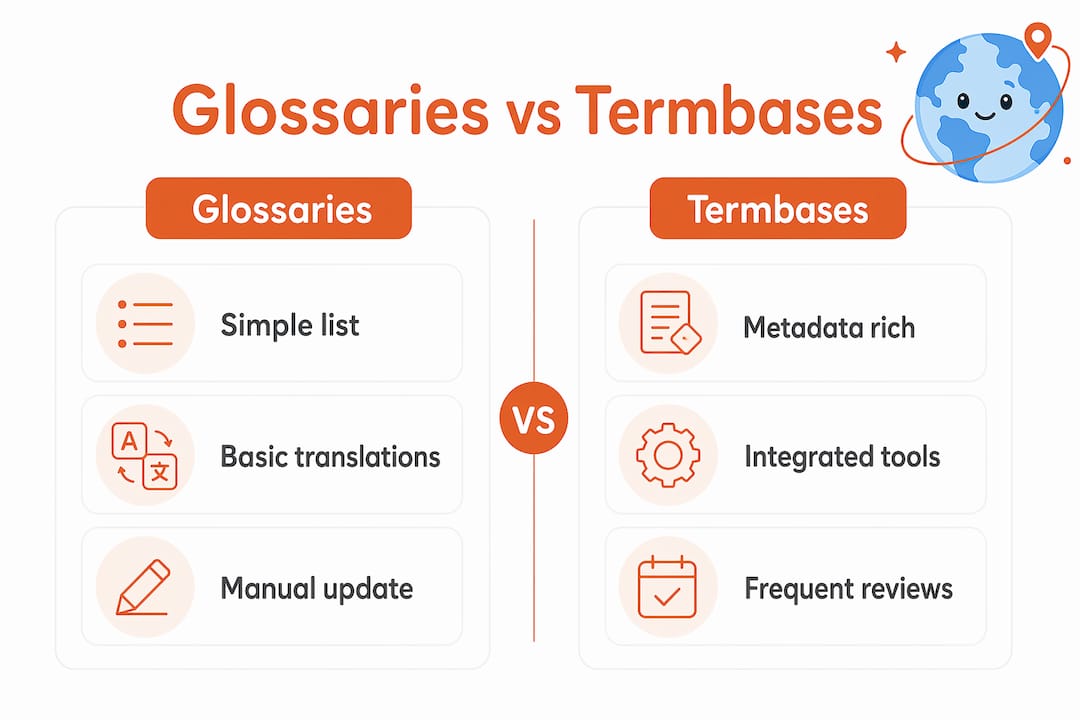
A glossary is a curated list of project-specific or domain-specific terms, each paired with a definition and one or more approved translations. Glossaries are typically lightweight, easy to share, and readable by non-linguists. A termbase is a more technical database that stores the same information but adds rich metadata: grammatical category, subject domain, term status, usage context, and links to related concepts. Termbases integrate directly with Computer-Assisted Translation (CAT) tools and Translation Management Systems (TMS), surfacing approved terms to translators in real time. A terminology database is the broadest category, covering any structured repository of terms, including large institutional databases like IATE, the European Union’s multilingual term collection.
Every strong term entry contains several components:
Source term: the original word or phrase in the source language
Target term: the approved translation in each target language
Definition: a precise explanation of the concept, not just the word
Context: an example sentence showing the term in use
Usage notes: guidance on when to use or avoid the term
Grammatical information: gender, number, part of speech
Term status: labels such as preferred, synonym, deprecated, or no-go
Term status labels are critical to prevent guesswork and maintain brand integrity. Without them, translators face ambiguity about which of three synonyms to use, and consistency breaks down fast.
Pro Tip: Build your termbase entries around concepts, not just words. High-quality termbases link each term to a superordinate concept in a hierarchical structure, which prevents vague or circular definitions that slow translators down.
Resource | Complexity | Integration | Best for |
|---|---|---|---|
Glossary | Low | Manual or basic | Small projects, client handoffs |
Termbase | High | CAT tools, TMS | Enterprise localization workflows |
Terminology database | Very high | Institutional systems | Cross-agency or regulatory use |
How does terminology management work in translation projects?
Terminology management is the systematic process of identifying, defining, approving, and maintaining translation terms across the life of a project. It is not a one-time setup task. It is an ongoing discipline that keeps your localization output consistent as products evolve.
The process follows four main stages:
Term extraction: Identify candidate terms from source content using automated mining tools or manual review. Focus on nouns, technical phrases, and brand-specific expressions that appear frequently or carry high stakes.
Defining and approving: Write precise definitions for each term, then route them through a validation workflow. This stage involves translators, subject matter experts, and often the client or legal team. Terms must be precisely defined and validated before they enter any terminology database.
System integration: Load approved terms into your TMS or CAT tool so translators see flagged suggestions during translation. Some systems support collaborative term suggestion and approval workflows, letting translators propose new terms directly from their translation interface.
Ongoing maintenance: Review and update your termbase regularly. Terminology reviews every 6–12 months prevent obsolescence and keep terminology aligned with product updates and industry changes.
The people involved matter as much as the process. Translators flag ambiguous terms. Terminologists structure and validate entries. Subject matter experts confirm technical accuracy. Clients confirm brand alignment. Each role is distinct, and skipping any one of them creates gaps that surface as errors in the final translation.
Pro Tip: Assign a terminology owner for each project. This person is responsible for approving new entries, archiving deprecated terms, and scheduling reviews. Without ownership, termbases drift into disrepair within months.
What are the main methods and challenges when translating specialized terminology?
Translating specialized terminology is not a word-for-word exercise. When no direct equivalent exists in the target language, translators apply specific techniques to find the closest conceptual match.
The most common methods include:
Calque: Translating each component of a compound term literally. “Software” becomes “logiciel” in French, built from “logique” (logic) and “matériel” (material).
Borrowing: Adopting the source term directly into the target language, often with minor phonetic adaptation. “Marketing” appears unchanged in dozens of languages.
Transposition: Changing the grammatical category of a term while preserving its meaning. A noun in English may become a verb phrase in German.
Descriptive translation: Replacing a term with a phrase that explains its meaning when no equivalent word exists. This is common in emerging technology fields.
Literal translation: Translating word-for-word when the structure and meaning align across languages. This works less often than most people assume.
Translators apply these methods based on conceptual equivalence, not surface similarity. The goal is to transfer the meaning of a concept, not just its linguistic form.
The challenges are real and persistent. Terminological polysemy occurs when a single term carries different meanings across disciplines. “Resolution” means something different in photography, law, and software development. Evolving vocabulary in fields like artificial intelligence or biotechnology means new terms appear faster than termbases can absorb them. And some concepts simply have no equivalent in the target language, requiring translators to make judgment calls that affect every future use of that term.
“Human translators remain crucial for translating specialized, context-sensitive terminology. A multidimensional approach involving cognitive, linguistic, and communicative skills is required for high-quality term translation. Automated tools can struggle with nuanced concepts that depend on cultural or disciplinary context.”
You can find concrete examples of how these challenges play out in real projects in this overview of translation challenges that localization professionals face regularly.
How do industry standards and organizational practices support terminology consistency?
Standards and governance structures turn terminology management from a best practice into a repeatable system. Without them, even well-intentioned teams produce inconsistent output as projects scale.
The European Commission sets one of the most rigorous examples. Consistent and researched terminology is required for legal certainty, coherence, and clear multilingual communication across EU languages. Terms must carry precise, neutral definitions and pass validation before entering institutional databases like IATE. That validation process involves terminologists, legal experts, and native-language reviewers working in parallel.
Most organizations do not operate at EU scale, but the principles apply universally. Term status labeling is the most impactful governance practice any team can adopt. Marking terms as preferred, synonym, deprecated, or no-go removes ambiguity at the point of translation. Translators stop guessing and start applying approved vocabulary consistently.
Practice | Impact | Frequency |
|---|---|---|
Term status labeling | Eliminates synonym guesswork | At entry creation |
Termbase validation | Confirms accuracy before use | Before system integration |
Scheduled reviews | Prevents terminology rot | Every 6–12 months |
Stakeholder sign-off | Aligns legal, brand, and technical teams | At approval stage |
Pro Tip: Treat your termbase as a living product, not a static document. Schedule reviews on your product release calendar so terminology updates happen in sync with content changes, not months after.
How do translation teams apply terminology in real-world localization workflows?
Practical terminology use happens at every stage of a localization project, not just during translation. Teams that integrate glossaries and termbases early produce faster, more consistent results.
During the translation stage, CAT tools surface approved terms automatically as translators work. This real-time guidance reduces the time spent searching for correct phrasing and cuts the rate of terminology errors. Glossaries and termbases support quality and efficiency by ensuring translators use approved terms, reducing ambiguity and translation errors across the board.
During review, terminology consistency checks catch deviations before content reaches the client. Reviewers compare translated terms against the approved termbase and flag any mismatches for correction. This stage is where sector-specific glossaries in fields like medicine, aviation, and real estate prove their value. A single incorrect term in a medical device manual or an aviation safety checklist carries consequences that go far beyond style.
Cross-functional alignment is the piece most teams underestimate. Terminology decisions affect marketing copy, legal disclaimers, technical documentation, and UI strings simultaneously. When these teams operate with separate term lists, conflicts emerge at the worst possible moment, typically right before a product launch. A shared, centrally managed termbase eliminates that conflict by giving every team a single source of truth.
Marketing teams use approved terms to keep brand voice consistent across campaigns in each market.
Legal teams rely on validated terminology to meet regulatory requirements in each jurisdiction.
Technical writers apply approved terms to documentation, reducing the cost of future translation updates.
Developers and UX writers embed approved strings directly into product interfaces, preventing UI inconsistencies.
For teams working within design tools, managing localization terminology workflows directly inside the design environment removes the handoff friction that causes terminology drift between design and development.
Key Takeaways
Effective terminology management is the single most reliable way to improve translation quality and reduce localization costs across multilingual projects.
Point | Details |
|---|---|
Define terms before translating | Build approved glossary entries with definitions, status labels, and context before translation begins. |
Use term status labels | Mark every entry as preferred, synonym, deprecated, or no-go to eliminate translator guesswork. |
Integrate termbases with tools | Connect your termbase to CAT tools or a TMS so translators see approved terms in real time. |
Review terminology regularly | Schedule termbase reviews every 6–12 months to prevent obsolescence and align with product changes. |
Align all teams on one source | Share a single termbase across marketing, legal, technical, and product teams to prevent conflicting translations. |
Why terminology is the most underrated investment in localization
Most localization teams I have worked with treat terminology management as a setup task. They build a glossary at the start of a project, hand it to translators, and move on. Six months later, the glossary is out of date, nobody owns it, and translators are improvising again.
The real problem is that terminology rot is invisible until it causes damage. A deprecated term slips into a product update. A preferred term gets ignored because nobody told the new translator it existed. By the time the inconsistency surfaces in a user complaint or a compliance audit, the cost of fixing it is five times what prevention would have cost.
The teams that get this right treat their termbase the way a software team treats a codebase. It has owners. It has version history. It gets reviewed on a schedule. New entries go through an approval process before they ship. That discipline is what separates localization programs that scale from ones that collapse under their own inconsistency.
Technology helps, but it does not replace the human judgment required to define a concept precisely or to recognize that a term has evolved in meaning. The best localization programs combine AI-assisted term extraction with expert human validation. Neither alone is sufficient.
— Antoine
Gleef brings terminology management into your design workflow
Terminology inconsistency often starts before translation even begins, in the design stage, where strings get written without any connection to approved glossaries.
Gleef integrates glossaries and termbases directly into the Figma environment, so your UX writers and designers work with approved terminology from the first string they write. The platform’s AI-powered translation memory flags deviations from approved terms in real time, and its in-context editing tools let teams review translations against the actual UI. The result is fewer terminology errors reaching production and faster release cycles for global markets. If your team is ready to close the gap between design and localization, the Gleef Figma plugin is where that work starts.
FAQ
What are translation terms?
Translation terms are domain-specific words or phrases with precise definitions and approved translations used to ensure consistency across multilingual content. They differ from general dictionary entries by including usage rules, term status labels, and contextual guidance.
What is the difference between a glossary and a termbase?
A glossary is a simple list of terms with definitions and translations, while a termbase is a metadata-rich database integrated with CAT tools and TMS platforms. Termbases include grammatical information, term status labels, and subject domain classifications that glossaries typically omit.
How often should a termbase be reviewed?
Termbases should be reviewed every 6–12 months to prevent terminology rot and keep entries aligned with product updates and industry changes. Scheduling reviews on the same calendar as product releases produces the most consistent results.
Why do human translators still matter for specialized terminology?
Human translators apply cognitive, linguistic, and communicative skills that automated tools cannot replicate when handling nuanced or context-sensitive terms. Conceptual equivalence across languages requires judgment that goes beyond pattern matching.
How does terminology management improve localization efficiency?
Terminology management reduces translation time by giving translators instant access to approved terms, cutting the need for research and reducing revision cycles. It also captures institutional knowledge, so new translators reach expert-level consistency faster.