
TL;DR:
Successful global expansion requires deep localization beyond translation, including functional, visual, and regulatory adaptation. Prioritizing transparent pricing, shipping costs, and clear policies at checkout significantly boosts international conversion rates and reduces cart abandonment. Continuous experimentation, cross-functional collaboration, and proactive regulatory monitoring are essential for sustained global growth and resilience.
Most product teams assume that translating their UI is enough to win in international markets. It is not. Understanding why optimize for global markets matters requires confronting a harder truth: your German users do not just want German words on screen. They want German payment methods, German return policies, and pricing in euros with no surprise fees at checkout. The gap between a translated product and a truly optimized one is where most global growth strategies quietly collapse. This guide breaks down the real drivers of global market success, from localization depth to regulatory planning, with data to back every claim.
Key Takeaways
Point | Details |
|---|---|
Translation is not localization | True global optimization requires linguistic, functional, visual, and regulatory adaptation, not just word-for-word translation. |
Pricing transparency drives conversions | Local currency pricing can boost conversion rates by up to 40% in international markets. |
Checkout friction kills global revenue | 48% of shoppers abandon carts due to unexpected fees, making cost transparency your highest-impact optimization lever. |
Policy risk is a product risk | Regulatory and geopolitical shifts require flexible, adaptive global strategies, not one-time market entry plans. |
Experimentation compounds returns | Teams that test payment, shipping, and language variations by region consistently outperform those with static global setups. |
Why optimize for global markets: beyond simple expansion
The case for global market optimization is not just about reaching more people. It is about building a business that is structurally resilient and competitively positioned for the long term. The benefits of global market optimization go far beyond incremental revenue.
Consider diversification. When your entire business depends on one domestic market, you are fully exposed to that market’s economic cycles, regulatory environment, and competitive shifts. International markets give you access to different growth trajectories. When one region slows, another may be accelerating. That buffer is not theoretical. The Magnificent Seven tech stocks comprise 32% of S&P 500 market value as of April 2026, up from 14% in 2019. That concentration creates fragility. Companies that have expanded into international markets carry far less single-market exposure.
“Optimizing for global markets is not a growth tactic. It is a risk management strategy disguised as an opportunity.”
There is also the competitive dimension. Your rivals are not waiting. When a competitor localizes their product for Southeast Asia before you do, they are not just capturing customers. They are building brand loyalty, local payment integrations, and supplier relationships that become harder to displace over time. Global market expansion reasons are rarely just about top-line growth. They are about not ceding territory by default.
Benefit | Domestic-only approach | Globally optimized approach |
|---|---|---|
Revenue diversification | Single market dependence | Multiple economic cycles and growth vectors |
Competitive positioning | Local market only | International brand recognition and market share |
Risk exposure | High concentration risk | Spread across regions and regulatory environments |
Customer insights | One cultural context | Cross-market behavioral data and product learnings |
Localization as your global conversion engine
Localization is the engine under the hood of every successful global product. The importance of global markets cannot be fully realized without it. And yet, most teams still treat localization as a final step rather than a core product function.
True localization goes well beyond translating strings. It encompasses four distinct layers:
Linguistic adaptation: Native-quality translation that reflects local idioms, tone, and register, not machine-translated sentences that technically say the right thing but feel foreign.
Functional adaptation: Integrating locally preferred payment methods, date and number formats, address field structures, and currency display. A checkout flow that does not accept Alipay will convert poorly in China regardless of how good the translation is.
Visual adaptation: Adjusting imagery, color choices, and layout to align with local cultural preferences and reading patterns. Right-to-left languages require structural layout changes, not just text flips.
Regulatory adaptation: Meeting local data privacy laws, consumer protection requirements, and product compliance standards before your product ever reaches users.
When a Southeast Asia-focused team applied all four layers to their checkout flow, they saw a 40% lift in conversions alongside a 52% reduction in cart abandonment at the payment stage. That is not a small optimization. That is a transformed revenue line.
Localization focusing on language alone underperforms every time. As the research shows, functional and visual adaptations aligned to local culture dramatically improve user trust and conversion rates in ways that word-for-word translation simply cannot. The real impact of software localization consistently shows up at the product level, not the marketing level.

Pro Tip: Run a localization audit on your checkout flow first, before any other part of the product. That is where buyer decisions are made, and it is where comprehensive localization returns the most measurable impact.
Reducing friction at checkout: pricing, shipping, and returns
If you want to understand why businesses go global and then fail to monetize it, look at the checkout page. This is where buyer uncertainty becomes abandonment. And the data here is unambiguous.
Currency and pricing transparency: Local currency pricing can increase conversion rates by up to 40%. Conversely, 33% of international shoppers abandon their carts when shown pricing only in USD. Showing a price in a currency the buyer uses daily removes a cognitive barrier and a trust concern in one move.
Shipping cost visibility: Unexpected fees cause 48% of cart abandonments according to Baymard Institute research from 2024. International buyers need to see total landed costs, including duties, taxes, and shipping, before they commit. Hiding these until the final checkout step is reliably destructive to conversion.
Delivery timeline clarity: Buyers in Germany expect different delivery windows than buyers in Brazil. Showing realistic, market-specific delivery estimates builds trust far more effectively than a generic “ships internationally” message.
Localized return policies: Clear, localized return information correlates with higher buyer confidence in cross-border purchases. When your return policy explains costs, timeframes, and the actual process in the buyer’s language and context, purchase hesitation drops significantly.
The striking finding from recent benchmarking is that certainty, not language, is the primary conversion driver for international buyers. Your customers want to know exactly what they will pay, when their order will arrive, and what happens if it does not work out. Answering those questions clearly, in the right language and format, is the core of global checkout optimization.
Navigating policy and regulatory complexity
Optimizing for global markets is not only a product challenge. It is a policy challenge. The impact of globalization on business now includes navigating an increasingly fragmented regulatory environment where rules shift faster than product roadmaps.
World Bank research highlights that open, predictable policy environments are foundational to sustaining the benefits of global value chains. When those environments become unpredictable, companies without flexible operational structures take the hardest hits.
Here is what forward-thinking product teams and business leaders are doing to manage this:
Monitor regulatory changes by market as a product function, not as a legal afterthought. Data privacy laws, consumer protection requirements, and import restrictions change. Your roadmap needs a regulatory input channel.
Build flexibility into global configurations. Product teams that hard-code country-specific logic into their codebase spend months unwinding changes that policy shifts require. Modular localization architecture makes adaptation far faster.
Plan for geopolitical disruptions. Trade policy volatility, sanctions, and market access restrictions are now regular features of the global business environment. Scenario planning for these is a competitive advantage, not an overreaction.
Balance global goals with local fiscal realities. Tax treatment, VAT obligations, and customs duties vary dramatically across markets. Products that do not account for these create pricing surprises that undermine the trust you build everywhere else.
Pro Tip: Treat your policy and compliance tracking the same way you treat your bug backlog: as a live, prioritized queue with owners. Assigning regulatory monitoring to a specific function prevents it from falling into the gap between legal, product, and ops.
Strategies for global market optimization that actually work
Global market optimization is not a one-time project. It is a continuous practice. The teams that consistently win internationally treat it as a living system, not a launch checklist. This is what separates the best localization practices from one-off translation jobs.
The framework that works looks like this. Start with structured regional experimentation. Rather than rolling out a single global configuration, test payment method preferences, language register, and shipping presentation by segment. Teams that run structured A/B tests per region consistently uncover conversion gaps that would be invisible in aggregate data.
Cross-functional collaboration is not optional here. Localization decisions touch UX, compliance, product, and engineering simultaneously. When these functions operate in silos, you get translation without context, compliance reviews that block launches, and UX designs that break under localized text length. The teams that move fastest give localization ownership to a cross-functional group with clear accountability.
Approach | Single-function ownership | Cross-functional ownership |
|---|---|---|
Translation quality | Technically accurate, culturally flat | Native-quality, brand-consistent |
Compliance coverage | Reactive, often delayed | Proactive, built into the roadmap |
Time to market | Slower, blocked by handoffs | Faster, parallel workstreams |
Ongoing adaptation | Infrequent, project-based | Continuous, feedback-driven |
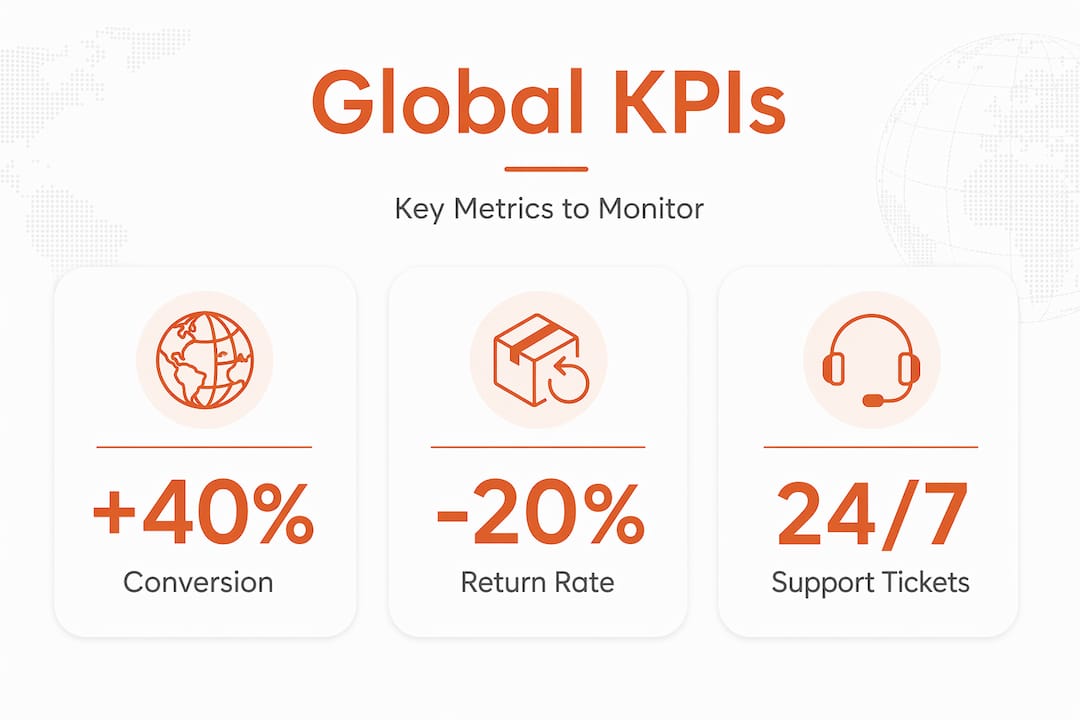
Finally, monitor performance metrics by market, not just by product. Conversion rates, return rates, and support ticket volume all behave differently across regions. A checkout flow that performs well in France may have a systemic problem in Japan. Market-specific KPIs are what allow you to see those gaps early and act on them before they compound.
My honest take on why global expansions fail
I have seen teams spend months preparing a global launch, invest real budget in product work, and still watch their international conversion rates flatline. The postmortem almost always reveals the same pattern. The translation was fine. The underlying product experience was not built for the market.
What I have learned is that most global expansion failures are not failures of ambition. They are failures of depth. Teams treat global optimization as a series of one-time tasks rather than a continuous discipline. They ship a translated product, see underwhelming numbers, and conclude the market is not right. The market is rarely wrong. The product experience usually is.
The complexity of global value chains requires genuine investment in understanding policy risk and global integration as much as user preferences. What I have found is that the companies that sustain international growth are the ones that build localization and regulatory monitoring into their operating rhythm, not their project plan. There is no finish line here. The 5 keys to successful localization all point to the same underlying truth: optimization is iterative, and the teams that accept that thrive.
— Antoine
How Gleef helps you win in global markets
Building a globally optimized product requires tools that match the ambition. Gleef was built specifically for product teams who know that localization quality is a competitive advantage, not a formatting task.

Gleef’s AI-powered platform handles translation memory, in-context editing, and glossary enforcement so your international product experiences stay consistent and brand-true across every market. It integrates directly into Figma and your development workflow, so localization happens alongside product work instead of blocking it. Whether you are optimizing checkout flows for Southeast Asia or adapting your SaaS UI for European compliance, Gleef gives your team the precision and speed to do it right. Explore how Gleef accelerates global product launches and book a demo to see it in action.
FAQ
Why is global market optimization different from translation?
Translation converts words between languages. Global market optimization adapts the entire product experience, including pricing, payments, UX, and compliance, to meet the expectations of buyers in each specific market.
What is the biggest conversion driver for international buyers?
Pricing and cost transparency consistently outperform language translation as conversion drivers. Clear local currency pricing can increase conversion rates by up to 40%, making it the highest-impact localization lever at checkout.
How do you enter global markets without overextending resources?
Start with one or two high-priority markets and treat them as optimization experiments. Test checkout localization, local payment methods, and shipping transparency before scaling your approach across additional regions.
What role does regulatory planning play in global market strategy?
Regulatory planning is a core part of sustainable global strategy. World Bank research shows that open, predictable policy environments support growth, but companies must monitor policy shifts actively and build flexible product architectures that can adapt quickly.
How often should global market strategies be revisited?
Global strategies require continuous review, not annual audits. Market conditions, regulatory environments, and buyer behavior shift frequently enough that monthly performance reviews by market are the standard for teams that sustain international growth.