
Many product teams remain skeptical of AI translation quality, clinging to outdated assumptions that automated systems produce clunky, unnatural text. Yet recent advances in neural machine translation have closed the gap dramatically, with AI now matching or exceeding human performance in many contexts. For product managers, UX writers, developers, and designers managing localization workflows, understanding when and why to use AI translation can transform speed, consistency, and cost efficiency. This article explores how AI translation technology works, where its limitations lie, and how to integrate it strategically into your product localization process to deliver high-quality multilingual experiences.
Key Takeaways
Point | Details |
|---|---|
Context aware translation | Modern neural machine translation analyzes entire sentences to preserve meaning and produce natural output in the target language. |
Handle high volume | AI translation can manage repetitive, high volume localization tasks faster than manual processes, boosting speed and consistency. |
Human oversight advised | Despite advances, reviewers should oversee translations for idioms, cultural nuance, and creative content. |
Domain specific training | Training models on software documentation and UI strings improves accuracy for product teams. |
Pilot and select models | Run pilots with your actual UI strings and documentation to choose the best model for your product domain. |
How AI translation technology works and why it matters
AI translation has evolved far beyond the awkward phrase-matching systems of the past. Modern neural machine translation relies on transformer architectures with attention mechanisms that analyze entire sentences for context, not just individual words. This allows the system to understand relationships between phrases and produce translations that sound natural in the target language. The encoder processes the source text into numerical representations, while the decoder generates the translated output, with attention layers ensuring the model focuses on relevant parts of the input at each step.
What makes this technology particularly powerful for product localization is its ability to learn from domain-specific data. Training models on software documentation, UI strings, and technical content improves accuracy for product teams. Pruning techniques optimize these models by removing redundant parameters, making them faster without sacrificing quality. This combination of context awareness and specialization means AI translation can handle the repetitive, high-volume work that would overwhelm human translators, freeing your team to focus on strategic decisions and creative refinement.
Compared to older rule-based or statistical methods, neural systems deliver dramatically better results. Rule-based translation relied on hand-coded grammar rules and dictionaries, producing rigid output that often missed contextual meaning. Statistical machine translation improved on this by learning patterns from bilingual text corpora, but still struggled with long-range dependencies and idiomatic expressions. Neural models solve these problems by processing entire sequences at once, capturing nuances that earlier systems missed. For product teams managing frequent updates and multiple languages, this translates directly to faster iteration cycles and more consistent website translation quality.
Neural machine translation uses transformer models with attention mechanisms for context-aware output
Domain-specific training data improves accuracy for product and technical content
Pruning optimizes models for speed without compromising translation quality
Neural systems outperform older rule-based and statistical methods significantly
Pro Tip: When evaluating AI translation for your product, request sample translations of your actual UI strings and documentation. Generic demos rarely reflect how the system will perform on your specific content.
“The shift from phrase-based to neural translation represents the biggest quality leap in machine translation history, enabling context-aware systems that understand meaning rather than just matching words.”
Recognizing AI translation limitations and challenges
Despite impressive capabilities, AI translation still struggles with specific scenarios that product teams must understand. Idiomatic expressions and cultural references often confuse neural models because they lack the lived experience to interpret figurative language. A phrase like “break the ice” might be translated literally in some languages, losing its intended meaning entirely. Similarly, humor, wordplay, and culturally specific metaphors require human judgment to adapt appropriately. This becomes particularly important for marketing copy, onboarding flows, and any content where tone and personality matter as much as literal accuracy.
Low-resource languages present another significant challenge. Neural models need massive amounts of training data to achieve high quality, but many languages lack sufficient digital text corpora. Languages spoken by smaller populations or those with limited online presence will see noticeably lower translation quality. Long documents also strain AI systems because transformer models have context window limits, meaning they may lose track of themes and terminology consistency across thousands of words. For product documentation or lengthy help articles, this can result in inconsistent term usage that confuses users.
Text expansion poses a practical problem for UI localization that catches many teams off guard. Translated text often runs longer than the source, with some languages expanding by 30% or more. AI translation doesn’t account for your button sizes or layout constraints, so you’ll need to review and adjust to prevent translation challenges like truncated labels or broken designs. Creative and literary content demands human nuance that AI simply cannot replicate yet. Poetry, brand slogans, and emotionally resonant messaging require cultural sensitivity and creative adaptation that goes beyond accurate word-for-word translation. Professional review remains essential for maintaining brand voice and ensuring the translated content achieves the same impact as the original.
Idiomatic expressions and cultural references confuse AI translation systems
Low-resource languages lack sufficient training data for high-quality output
Long documents exceed context windows, causing consistency issues
Text expansion in UI strings can break layouts and designs
Creative and literary content requires human cultural sensitivity
Pro Tip: Always budget time for human post-editing, especially for customer-facing content. Aim for 80% automation with 20% human refinement to balance speed and quality.
Challenge Type | Impact on Product Teams | Mitigation Strategy |
|---|---|---|
Cultural nuances | Misunderstood idioms and references | Human review for marketing and UX copy |
Low-resource languages | Lower accuracy and fluency | Combine AI with professional translators |
Text expansion | Broken UI layouts | Design flexible interfaces, test early |
Long documents | Inconsistent terminology | Break into sections, use glossaries |
Creative content | Loss of brand voice | Reserve for human translation |
For more on multilingual AI challenges, consider how your specific product and target markets intersect with these limitations.
Choosing and integrating AI translation for product localization success
Selecting the right AI translation model requires moving beyond vendor marketing claims to evaluate actual performance on your content. Industry benchmarks like TransBench and WMT25 provide standardized quality scores across language pairs and domains, giving you objective comparison data. However, these benchmarks test on general datasets that may not reflect your product’s specific terminology and style. The most reliable approach is to pilot multiple models on your actual UI strings, documentation, and help content, then compare output quality, consistency, and how well each system handles your domain-specific terms.
Your product’s domain significantly influences which AI model will perform best. A healthcare app needs a system trained on medical terminology, while a fintech platform requires financial language expertise. Generic translation models will struggle with specialized vocabulary and may introduce dangerous errors in regulated industries. When piloting, create a test set of 100-200 representative strings covering common patterns, edge cases, and terminology-heavy content. Run each candidate model through this test set and have native speakers evaluate fluency, accuracy, and appropriateness. Track specific error types to identify which model handles your content best.
Integrating AI translation into your product workflow requires thoughtful planning to maximize ROI while maintaining quality. Start by identifying high-volume, low-risk content suitable for automation, such as UI labels, error messages, and help documentation. Reserve human translation for marketing copy, legal text, and brand-critical messaging. Establish a clear review process where AI-translated content flows to bilingual reviewers who can quickly spot and fix errors. This hybrid approach delivers the speed of automation with the quality assurance of human expertise.
Evaluate AI models using industry benchmarks and your own content tests
Pilot on 100-200 representative strings covering common patterns and edge cases
Have native speakers assess fluency, accuracy, and domain appropriateness
Identify high-volume, low-risk content suitable for full automation
Establish review workflows combining AI speed with human quality control
Integrate translation APIs into your development and design tools
Monitor quality metrics and iterate on your process continuously
Balancing automation with human post-editing delivers the best outcome for most product teams. AI handles the heavy lifting of initial translation, while human reviewers refine nuances, fix errors, and ensure brand consistency. This approach typically reduces translation costs by 40-60% compared to fully human translation while maintaining quality standards. The key is setting clear guidelines for when automation alone suffices versus when human review is mandatory.
Model Selection Factor | What to Evaluate | Why It Matters |
|---|---|---|
Benchmark scores | BLEU, COMET, human evaluation ratings | Objective quality comparison across models |
Domain specialization | Training data relevance to your industry | Accuracy on technical and specialized terms |
Language pair coverage | Supported languages and quality variance | Ensures consistent quality across your markets |
Integration options | API, plugins, workflow compatibility | Seamless adoption into existing tools |
Cost structure | Per-character pricing, volume discounts | Budget predictability and ROI calculation |
For deeper insights on AI localization strategy, consider how these selection criteria align with your team’s specific needs. Teams managing multilingual SaaS localization benefit particularly from models optimized for software and technical content.
Maximizing translation quality and efficiency through AI-powered localization
AI translation transforms how product teams maintain consistency across languages and platforms. Traditional human translation often produces variation when different translators work on related content, leading to inconsistent terminology that confuses users. Neural systems apply the same translation rules uniformly, ensuring that technical terms, button labels, and feature names remain consistent throughout your product. This consistency extends across updates, as the AI remembers previous translations and applies them to new content, creating a cohesive multilingual experience that feels professionally crafted rather than piecemeal.

Speed advantages directly impact your time to market in global markets. Where human translation might take days or weeks for a major product update, AI translation supports localization by delivering initial translations in minutes. This acceleration allows product teams to launch features simultaneously across languages rather than staggering releases. For agile teams shipping frequent updates, this means localization no longer blocks releases. You can iterate quickly, test in multiple markets concurrently, and respond to user feedback without waiting for translation backlogs to clear.
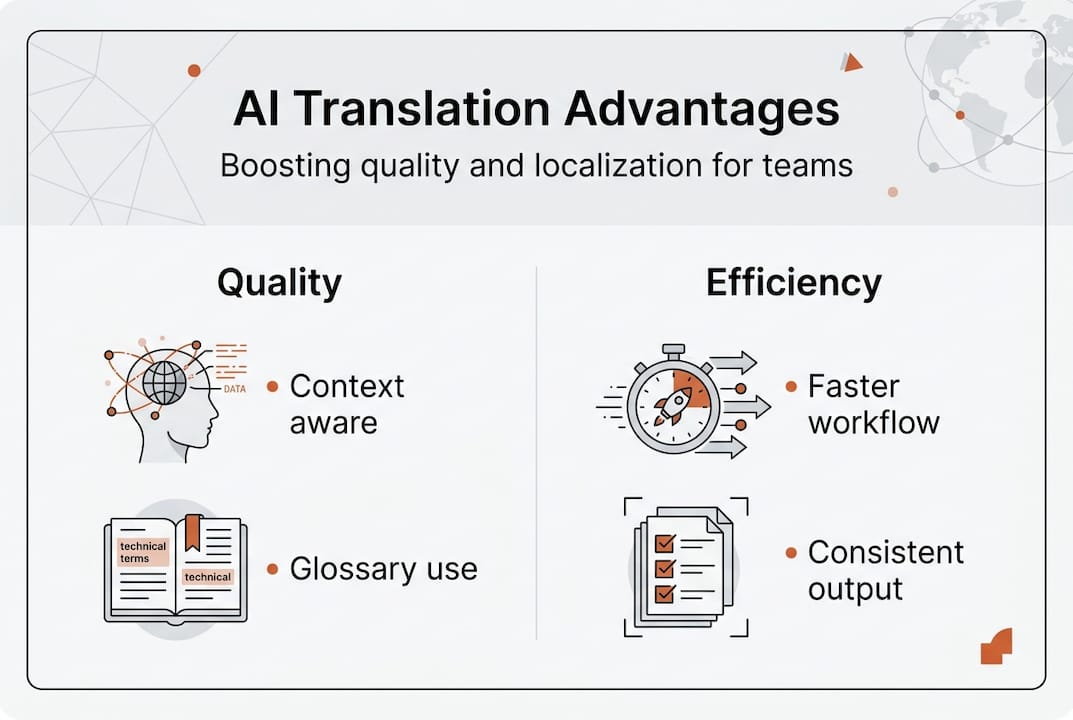
Scalability becomes effortless with AI-powered workflows. Adding a new language to your product no longer requires recruiting and onboarding specialized translators or managing complex vendor relationships. The same AI system that handles your existing languages can immediately support new ones, with quality dependent only on the model’s training for that language pair. This flexibility lets you experiment with new markets opportunistically, testing demand without major upfront investment. For startups and growing companies, this removes a significant barrier to international expansion.
Designers and developers gain practical benefits from AI localization that prevent common UI breakage issues. By integrating translation early in the design process, teams can preview how text expansion affects layouts before finalizing designs. Developers can automate translation in their continuous integration pipelines, catching localization issues during testing rather than discovering them in production. This proactive approach eliminates the frustrating cycle of design, translate, discover problems, redesign that plagues traditional localization workflows.
Improves multilingual content consistency across all platforms and touchpoints
Accelerates localization workflows, reducing time to market significantly
Scales effortlessly for frequent content updates and new language additions
Prevents UI breakage by enabling early testing of text expansion
Supports agile development with continuous integration of translations
Pro Tip: Implement translation preview tools that show designers how their layouts will look in all target languages before finalizing designs. This prevents costly redesigns and ensures layouts accommodate text expansion from the start.
For comprehensive guidance on maintaining content consistency in localization, focus on establishing glossaries and style guides that both AI systems and human reviewers can reference. Following localization best practices ensures your AI-powered workflow delivers maximum value while maintaining the quality standards your users expect.
Explore Gleef’s AI-powered localization tools
If you’re ready to streamline your product localization workflow with AI translation, Gleef offers purpose-built tools designed specifically for product teams. Our Figma plugin lets designers localize UI directly in their design files, previewing text expansion and catching layout issues before development begins. Developers can integrate our CLI tool into build pipelines to automate translation as part of continuous deployment, ensuring every release ships with up-to-date localized content.
Gleef’s platform combines neural machine translation with semantic memory and glossaries, maintaining consistency across your entire product ecosystem. The system learns your brand voice and technical terminology, applying them automatically to new content while flagging potential issues for human review. This hybrid approach delivers the speed of automation with the quality control your brand demands. Cross-functional collaboration becomes seamless, with product managers, UX writers, developers, and designers all working within their preferred tools while Gleef coordinates translations behind the scenes. Explore how Gleef can transform your localization process and accelerate your global product strategy.
FAQ
What is AI translation and how does it differ from traditional methods?
AI translation uses neural networks and transformer architectures with attention mechanisms to understand context and produce fluent translations. Unlike rule-based systems that rely on hand-coded grammar rules or phrase-based methods that match text segments, neural translation processes entire sentences to capture meaning and relationships between words. This enables more natural, accurate output that adapts to context rather than applying rigid patterns.
When should product teams avoid fully automating translation with AI?
Avoid full automation for content with heavy cultural nuances, idiomatic expressions, literary or creative elements, and legally sensitive material. Marketing copy, brand slogans, and emotionally resonant messaging require human judgment to maintain tone and impact across cultures. Human review ensures quality and brand integrity in these translation challenge scenarios where literal accuracy isn’t sufficient.
How can product teams pilot AI translation effectively?
Test multiple AI models on 100-200 real product strings covering typical patterns and edge cases from your actual content. Use benchmark scores like BLEU and COMET as starting points, but prioritize native speaker evaluation of fluency and domain appropriateness. Combine AI output with human post-editing to establish quality baselines, then gradually expand automation to low-risk, high-volume content. This measured approach from AI localization strategy ensures you maximize benefits while managing risks.
What benefits does AI translation bring to cross-functional product teams?
AI translation accelerates localization workflows dramatically, reducing time to market by enabling simultaneous multi-language releases. It improves content consistency across languages by applying terminology and style rules uniformly, eliminating the variation that occurs when multiple human translators work independently. Integrated tools facilitate collaboration, letting designers preview layouts in all languages, developers automate translation in CI/CD pipelines, and product managers track localization progress without switching platforms. These advantages help teams build unbreakable designs that work seamlessly across global markets.