
TL;DR:
The machine translation market is projected to reach $2.17 billion by 2031, driven by AI advances.
LLMs now match human quality for general translation but still face challenges with low-resource languages.
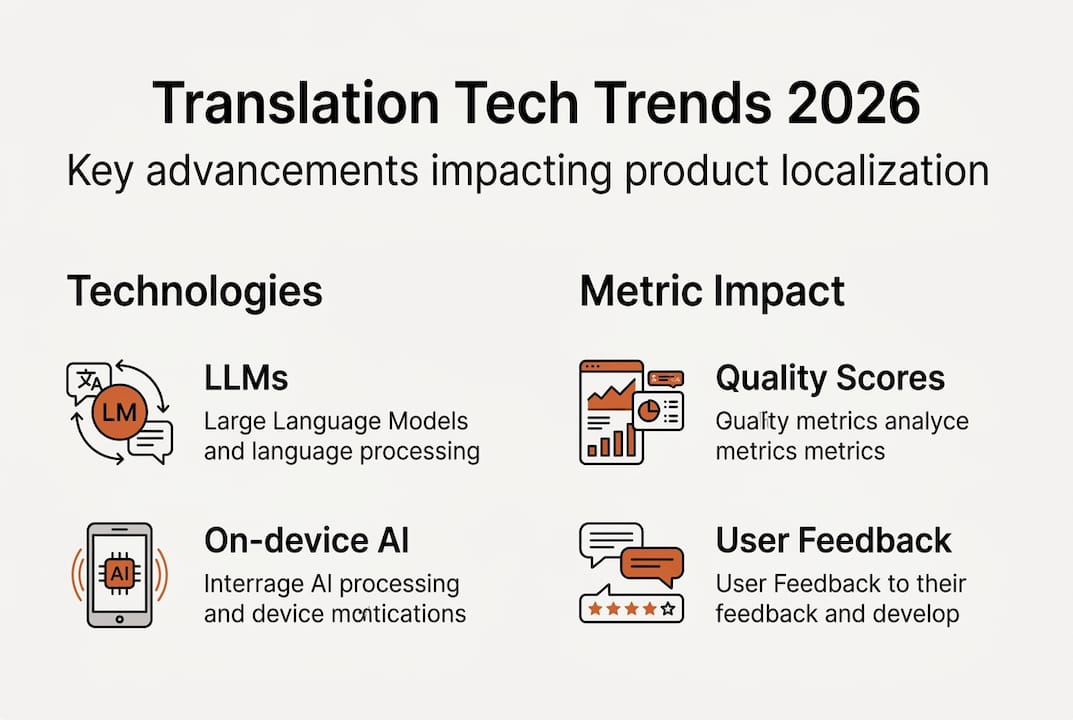
On-device translation enhances privacy and instant localization for sensitive content in 2026.
The machine translation market hit $1.25 billion in 2026, and it’s not slowing down. If your team still treats localization as an afterthought, you’re already behind. Translation technology has moved from clunky rule-based engines to AI-powered systems that can match human quality for most content types. For product managers, UX writers, and developers building global products, understanding these shifts isn’t optional. This guide walks through the 2026 translation landscape, the breakthroughs that matter most, how to measure quality, and the practical strategies your team can use to ship better localized products faster.
Key Takeaways
Point | Details |
|---|---|
LLMs reach parity | Large language models now match human translators in many product scenarios for general content. |
Privacy goes on-device | On-device translation technologies offer real privacy and instant localization for sensitive use cases. |
Quality metrics advance | Benchmarking systems like MetricX and COMET help teams measure translation quality and market impact. |
Open models surge | Open-source translation models lower costs and drive innovation in global product strategy. |
Practical team adoption | Product teams can implement modern translation tools for scalable, efficient localization in 2026. |
The evolution of translation technologies in 2026
The localization trends recap from recent years told a story of gradual improvement. In 2026, the pace has accelerated dramatically. The MT market is on track to reach $2.17 billion by 2031, growing at an 11.62% compound annual rate. That’s not just a market stat. It signals that demand for multilingual digital experiences is outpacing what traditional localization workflows can handle.
The biggest technical shift driving this growth is the rise of Large Language Models and open-source translation models. Google’s TranslateGemma open models are a prime example. A 12-billion parameter version outperforms larger proprietary baselines on key benchmarks, proving that model size alone doesn’t determine quality. Smarter architecture and better training data matter more.
What’s pushing product teams to adopt these tools faster? A few forces are converging:
Speed at scale: Global launches can’t wait weeks for manual translation cycles.
Multilingual UX demand: Users expect native-quality experiences in their language, not word-for-word translations.
Compliance and accessibility: Regulatory requirements in the EU and beyond now push teams to localize earlier and more thoroughly.
Cost pressure: Open models reduce per-word translation costs significantly compared to legacy vendors.
Here’s a snapshot of the major translation technologies trending in 2026:
Technology | Key feature | Best use case |
|---|---|---|
LLMs (GPT-4o, Gemini) | Context-aware, style-adaptive | Marketing copy, UX strings |
TranslateGemma 12B | High accuracy, open-source | Scalable product localization |
Hybrid MT + TM | Speed + consistency | Large-scale software strings |
On-device models | Privacy-first, offline capable | Health, finance, enterprise apps |
Neural MT (DeepL, ModernMT) | Domain-tuned quality | Legal, technical documentation |
Understanding software localization impact means recognizing that these aren’t just engineering choices. They directly shape how users feel about your product in every market you enter.
Big breakthroughs: From LLM parity to on-device privacy
With the stage set, it’s time to unpack the key breakthroughs shaping product decisions. The most talked-about development is LLM parity with human translators. WMT benchmarks confirm that top LLMs now match human quality for general content translation. That’s a genuine milestone. But the same data reveals real gaps: low-resource language pairs, negations, and numerical content still trip up even the best models.
“LLMs have reached near-human quality for general content translation, but domain-specific accuracy and low-resource languages remain the frontier where human expertise still wins.”
Here’s how LLMs stack up against human translators across the dimensions your team actually cares about:
Dimension | Human translators | Top LLMs |
|---|---|---|
Accuracy (general content) | Excellent | Near-human |
Domain adaptation | Strong with expertise | Requires prompt tuning |
Speed | Slow at scale | Instant |
Privacy | Controlled | Depends on deployment |
Scalability | Limited | Virtually unlimited |
Low-resource languages | Strong | Still developing |
The second major breakthrough is on-device translation. Prompting for domain and style combined with on-device deployment is now a viable strategy for privacy-sensitive applications. Think healthcare apps, financial tools, or any product handling personal data. Running translation locally means nothing leaves the user’s device.
Here’s how to leverage on-device translation for privacy-sensitive products:
Identify sensitive content flows where user data could be exposed through external API calls.
Evaluate on-device model options like quantized versions of open models that run efficiently on mobile hardware.
Test latency and quality tradeoffs in your specific language pairs before committing to a deployment model.
Build fallback logic so the app gracefully handles scenarios where on-device models underperform.
Audit your pipeline regularly as on-device model quality improves with each release cycle.
Pro Tip: Combine top LLMs for translation with a translation memory and glossary layer. This hybrid approach dramatically improves consistency in low-resource language pairs where LLMs still struggle, without sacrificing speed.
For teams serious about getting translation quality metrics right, these breakthroughs change the evaluation playbook entirely.

Measuring translation quality: Metrics, models, and market impact
Understanding benchmarks and breakthroughs is half the battle. Quality measurement is the other half. In 2026, the two dominant automated metrics are MetricX and COMET. Both evaluate translation quality by comparing outputs against reference translations and human judgments, giving you a numerical score that reflects real-world accuracy far better than older metrics like BLEU.
Here’s what your team should track when evaluating translation quality:
Accuracy: Does the output convey the exact meaning of the source?
Contextuality: Does the translation fit the surrounding UI or content context?
Error types: Are errors critical (meaning changes) or minor (stylistic issues)?
Domain accuracy: How well does the model handle your product’s specific terminology?
Consistency: Are repeated strings translated the same way across your entire product?
The numbers behind TranslateGemma’s benchmark improvements are striking. Across 55 language pairs, it improves MetricX and COMET scores consistently. For English to German translation, MetricX scores dropped from 1.63 to 1.19 compared to earlier Gemma versions. Lower MetricX scores mean fewer errors. That’s a 20 to 30% improvement in measurable quality, which translates directly to fewer post-edit cycles and faster releases.
Pro Tip: Whenever you switch translation engines or upgrade model versions, run a regression check using translation quality standards benchmarks on a fixed test set. Silent quality regressions are common and often go unnoticed until users complain.
The market impact of better quality measurement is real. Teams that track metrics for translation quality rigorously can enter more markets with confidence, reduce reliance on expensive manual review, and ship localized features in parallel with their primary language releases. Quality measurement isn’t just a QA task. It’s a growth lever.
Applying translation tech in your product: Team strategies for 2026
Now, let’s move from theory to practice with concrete strategies teams can use immediately. The gap between teams that understand translation technology and teams that actually deploy it well comes down to workflow integration.
Here’s how to integrate LLM and on-device translation into your product pipeline:
Audit your current stack to identify where manual handoffs slow down localization cycles.
Pick a model tier based on your content type: LLMs for UI copy and marketing, specialized models for technical or legal strings.
Implement prompt engineering to give the model context about your product’s tone, audience, and terminology.
Connect your translation layer to your design and dev tools so strings flow automatically without copy-paste workflows.
Set up automated quality checks using MetricX or COMET scores before any translation ships to production.
Run in-context reviews where translators or native speakers evaluate strings inside the actual UI, not in a spreadsheet.
Common pitfalls that derail even well-resourced teams:
Skipping in-context evaluation and approving translations that look fine in isolation but break in the UI.
Neglecting to customize prompts, resulting in generic translations that miss your brand voice.
Ignoring privacy settings when using cloud-based LLMs for sensitive user-facing content.
Treating localization as a final step rather than a parallel workstream from day one.
Prompting for domain and style is one of the highest-leverage tactics available to product teams right now. A well-crafted system prompt that includes your product glossary, target audience description, and tone guidelines can lift translation quality measurably without switching models.
Pro Tip: Open models give you flexibility that proprietary APIs don’t. Explore AI cross-functional localization workflows where PMs, UX writers, and developers share a single translation context layer. This reduces duplication and keeps brand voice consistent across every surface.
Look at how teams launching globally in 2026 are using design localization trends to ship localized products at the same time as their primary release, not weeks later.
Our take: What most teams miss about translation technology in 2026
Here’s the uncomfortable truth: most product teams are chasing the biggest, most talked-about models when the real gains are hiding in smaller, smarter decisions. We’ve seen teams spend months integrating a flagship LLM only to get worse results than a well-tuned, domain-specific model with a thoughtful prompt.
The crowd gravitates toward “biggest is best.” But a specialized 7B model with your product glossary baked in will outperform a 70B general model on your specific content every time. We’ve watched teams discover this the hard way after launch.
“The teams winning at localization in 2026 aren’t the ones with the biggest models. They’re the ones measuring user impact and iterating fast.”
The forward advice is simple: stop optimizing for benchmark scores and start measuring how real users respond to your localized product. Involve native speakers early. Track support tickets by language. Watch session recordings in your target markets. Those signals will tell you more than any automated metric.
If you want a grounding perspective on how translation market lessons shape smarter localization decisions, the pattern is consistent. Practical wisdom beats trend-chasing every time.
How Gleef accelerates localization innovation in 2026
Putting these insights to work requires the right platform behind your team. Gleef is built specifically for product teams who need to move fast without sacrificing translation quality.
With Gleef’s Figma Plugin for localization, designers and UX writers can manage translations directly inside their design workflow, no context switching, no copy-paste errors. The platform’s semantic translation memory, glossary enforcement, and in-context editing give your entire team a bulletproof localization layer that keeps brand voice consistent across every language. Whether you’re launching in three markets or thirty, the Gleef localization platform scales with your ambitions and keeps your releases on track.
Frequently asked questions
What are the most important translation technology trends for product teams in 2026?
LLM-powered translation, on-device processing for privacy, open model adoption, and new quality metrics like MetricX and COMET are the biggest trends reshaping localization strategies this year.
Have large language models (LLMs) really matched human translators?
For general content, LLMs reach near-human parity, but meaningful challenges remain with low-resource languages, negations, and complex domain-specific content.
How can translation quality be measured reliably in 2026?
Teams rely on MetricX and COMET benchmarks alongside domain-specific test sets to get an accurate picture of translation quality across language pairs.
What’s the practical value of on-device translation today?
On-device translation delivers privacy by keeping data local and provides instant results, making it the right choice for healthcare, finance, and other sensitive applications.
Is investing in translation technology necessary for smaller product teams?
Absolutely. The MT market’s rapid growth reflects that open models and AI-powered tools now make enterprise-grade localization accessible to teams of any size.