
TL;DR:
Localization failures like inconsistent translation can harm revenue and brand trust in 2026.
Implementing technical standards such as BCP 47 tags and Unicode CLDR ensures locale accuracy and consistency.
Hybrid AI-human workflows with clear governance help teams ship securely and culturally appropriate products globally.
You ship fast, your AI tools are humming, and your product is ready for global markets. Then the French version of your checkout button reads “Click here to finalize your command” instead of “Place your order,” and your German users see date formats that make no logical sense. Sound familiar? Even in 2026, localization failures like these cost companies real revenue and erode brand trust. The assumption that AI has solved translation complexity is one of the most expensive myths in product development. This guide cuts through that noise and gives you the practical translation standards your team needs to ship globally with confidence.
Key Takeaways
Point | Details |
|---|---|
Standards drive global consistency | Adhering to standards like W3C i18n and Unicode CLDR prevents costly translation errors. |
Hybrid AI-human workflows mitigate risk | Smartly routing content between AI and human translators balances efficiency with security and brand integrity. |
Design localization in from day one | Building localization-first products ensures smoother international launches and fewer costly post-launch fixes. |
Stay aware of compliance trends | Upcoming ISO updates and data privacy regulations will impact how translation standards are applied. |
Why translation standards matter for tech products
AI has absolutely accelerated localization. The speed is staggering compared to five years ago. But speed without structure produces fast mistakes, and in the localization world, mistakes have consequences that go far beyond a grammar error.
Consider what happens when your product launches in a new market without consistent translation standards. Your UX copy feels disjointed. Error messages use one term for “account” in one screen and a completely different word three screens later. Security warnings get softened in translation because the AI model interpreted formal legal language as overly harsh. These are not hypothetical scenarios. They are patterns teams run into every single release cycle when standards are missing.
AI in product localization is evolving fast, but the governance layer has not kept pace for many teams. Here is the uncomfortable reality: over 90% of enterprise teams now govern AI translation through multi-provider strategies, prioritize PII and security, and require human review for brand and legal nuances. Yet most still struggle with the foundational basics.
The risks are concrete. Here is what you are actually protecting against when you implement solid standards:
Inconsistent UX copy that makes users feel like they are using two different products
PII (personally identifiable information) leakage when AI systems handle sensitive form fields without proper context
Broken UI layouts caused by text expansion in German or Italian that no one tested
Misunderstood legal content that changes liability in ways your legal team never approved
Brand tone drift where your confident, direct voice becomes passive or overly formal in another language
“The question is no longer whether you use AI for translation. It is how you govern it. Low-risk content can flow to AI. High-risk content needs human judgment, every time.”
Translation technology trends in product localization confirm this pattern. The emerging challenges in AI translation are not about model quality alone. They are about context, consistency, and control. And that is exactly what standards solve. AI-integrated software delivery teams that invest in governance frameworks consistently report fewer localization-related release blockers and faster deployment cycles.
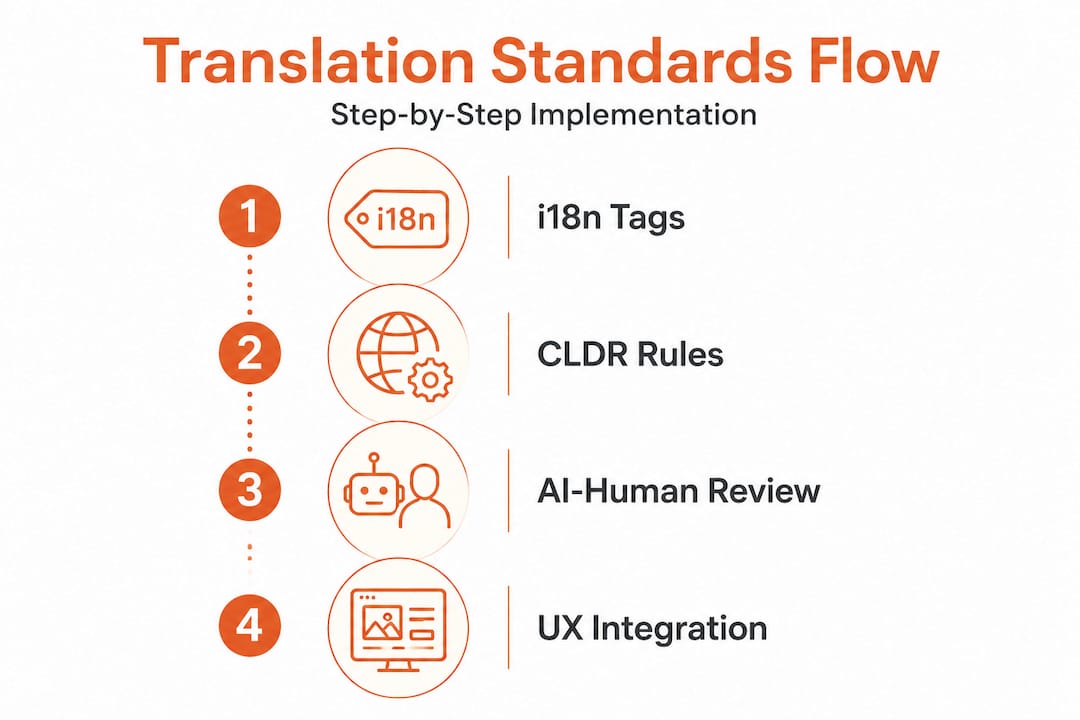
Core internationalization (i18n) standards every team needs
Internationalization, often shortened to i18n (because there are 18 letters between the “i” and the “n”), is the process of building your product so it can be adapted to different languages and regions without requiring engineering changes every time. Localization, or l10n, is the actual adaptation process for each specific locale. You cannot do l10n well without a solid i18n foundation.
Most product teams know these terms. Fewer teams actually implement the technical standards that make them work at scale. Let us fix that.
BCP 47 language tags are the starting point. These are standardized codes that identify specific languages and regions. “en-US” means English as used in the United States. “fr-CA” means French as used in Canada. “zh-Hant-TW” means Traditional Chinese as used in Taiwan. Every piece of text in your product should carry this metadata so that tools, browsers, and screen readers know exactly which language rules to apply.

The W3C i18n best practices require that you associate BCP 47 language tags and direction metadata with every piece of text using "langorxml:lang` attributes. This is not optional if you want to support right-to-left (RTL) languages like Arabic or Hebrew correctly. RTL support is not just about flipping the layout visually. It is about logical directionality, which affects keyboard navigation, form input behavior, and the order in which screen readers announce content.
Here is a comparison of what properly tagged versus untagged content produces in practice:
Standard element | Implemented correctly | Not implemented |
|---|---|---|
BCP 47 language tag | Browser applies correct hyphenation, quotes, and sorting | Browser guesses, often incorrectly |
RTL direction metadata | Layout flips logically, navigation order preserved | Visually broken layouts, accessibility failures |
Locale-specific encoding | Special characters render correctly | Garbled text, mojibake errors |
| Screen readers announce language switches | Screen readers use default voice for all text |
Implementing these standards early in your design and development workflow protects you from expensive retrofitting later. The design localization trends for 2026 consistently show that teams who implement i18n at the prototype stage spend significantly less engineering time on localization fixes before launch.
Pro Tip: In Figma, you can use text layer naming conventions and plugin support to simulate text expansion and RTL layouts before any code is written. This catches layout-breaking localization issues weeks before they would otherwise surface. Review UX localization best practices for a complete checklist of what to validate at the design stage.
The principle to internalize here is simple. i18n is infrastructure. You build it once, and it supports every localization effort that follows. Cutting corners here means rebuilding later at much higher cost.
Handling locale data and consistency with Unicode CLDR
With your i18n technical foundation in place, the next challenge is data consistency across locales. This is where many product teams fall into traps that feel minor until a user in Japan sees a European date format or a Brazilian user gets a plural form that makes no grammatical sense.
Unicode CLDR (Common Locale Data Repository) is the authoritative data source for locale-specific formatting rules. It defines how dates, times, numbers, currencies, and plural forms should be presented in every supported locale. Unicode CLDR standards provide standardized data for date and time patterns, plural rules, and locale-specific formatting, and they require translators and systems to handle bidirectional markers and calendar consistency correctly.
This matters more than most teams realize. Consider plural rules alone. English has two plural forms: singular (“1 item”) and plural (“2 items”). Russian has four distinct plural forms depending on the number. Arabic has six. If your product uses a simple “singular/plural” system and you are shipping to Arabic-speaking markets, your UI will display grammatically incorrect text in a significant percentage of cases. That is not an AI failure. That is a standards gap.
Here is how CLDR-compliant implementations compare against non-compliant ones:
Scenario | CLDR-compliant | Non-compliant |
|---|---|---|
Date display in Japan | 2026年3月15日 (correct Japanese format) | 03/15/2026 (US format, confusing) |
Plural rules in Russian | Four correct plural forms applied | Only singular/plural, grammatically broken |
Currency display in Germany | 1.234,56 € (comma decimal, period thousands) | $1,234.56 (wrong symbol, wrong separators) |
Calendar system in Saudi Arabia | Option for Hijri calendar | Gregorian only, cultural mismatch |
Pro Tip: Do not hard-code date or number formats in your codebase. Use a CLDR-aware internationalization library like Intl in JavaScript or ICU MessageFormat for plurals. These libraries pull from CLDR data automatically and update when standards change, saving you from manually maintaining locale formatting rules for every market.
The semantic translation guide covers how semantic memory tools can work alongside CLDR-compliant formatting to ensure your translations are not just linguistically correct but contextually appropriate for each locale. Consistency in locale data is not just about formatting. It is about user trust. When users see familiar date formats and grammatically correct text, they feel at home in your product.
What about the “standalone” versus “format” distinction in CLDR? This is a subtlety that trips up many teams. In some languages, the word for “March” changes depending on whether it appears in a full date (“March 15”) versus as a standalone label (“March” in a calendar header). CLDR defines both variants, and your translation workflow needs to account for which form is required in each UI context.
AI-human workflows: Trends and compliance in 2026
You have the standards. Now the question is how to operationalize them inside a modern product team that ships continuously. The answer in 2026 is hybrid AI-human workflows, and the leading organizations have figured out how to structure them effectively.
Here is how the best teams organize their translation pipeline:
Content triage: Every string is classified before translation begins. Low-risk content (marketing copy variations, microcopy, generic UI labels) goes straight to AI with automated CLDR and i18n validation.
AI translation with guardrails: AI translates using a glossary, style guide, and translation memory. Brand terms are locked. Prohibited terms trigger flags automatically.
Human review routing: High-risk strings (legal, security warnings, pricing, medical, PII-adjacent) are routed to qualified human reviewers. No exceptions.
In-context validation: Translators and reviewers see strings in their actual UI context, not isolated in a spreadsheet. This surfaces RTL layout issues, text truncation, and contextual meaning errors before release.
Post-release monitoring: User feedback and support ticket patterns are analyzed for localization-related friction. Issues feed back into the glossary and style guide.
The scale of AI governance in enterprise localization is striking. 91% of enterprise teams govern AI translation using multi-provider strategies, BYO API key flexibility, PII security measures, and mandatory human review for brand and legal content. This is not a niche practice anymore. It is the standard operating procedure for teams that ship globally at scale.
On the compliance side, you need to be aware of upcoming changes. The ISO 17100 revision planned for 2029 will integrate ISO 18587 post-editing requirements, add risk management frameworks, introduce competence-based role definitions, and mandate AI transparency disclosures, all while remaining technology-neutral so it applies regardless of which tools you use. Getting your workflow structured correctly now means you are ahead of these requirements rather than scrambling to comply later.
Pro Tip: Map your content types to risk levels right now, before your next release. Create a simple matrix that your PM, UX writer, and dev team all agree on. “What goes to AI only, what gets human review, and what requires legal sign-off?” This single document eliminates most localization-related release blockers before they happen.
Cross-functional localization with AI requires that everyone on the team, not just the localization manager, understands the routing logic. When designers, developers, and PMs all know which content requires human review, the process becomes proactive rather than reactive. The AI translation benefits are real and significant, but only when paired with the governance structure that standards provide. Teams that treat AI accountability standards as a bureaucratic burden miss the point. They are actually a competitive advantage that protects you from costly mistakes.
Rethinking translation standards: Beyond checklists
Here is the perspective that most localization guides skip entirely. Meeting translation standards is necessary. It is not sufficient.
We have seen teams that had perfect BCP 47 implementation, CLDR-compliant formatting, and a documented AI-human workflow. They still launched products that felt foreign and disconnected to their target users. The reason was not a technical failure. It was a cultural empathy failure. No standard tells you that the color red signals good luck in China and danger in Germany, or that direct marketing language reads as aggressive in Japan. No checklist surfaces the fact that your playful, informal UX copy sounds disrespectful when literally translated into Korean.
This is why we believe translation standards should be the foundation, not the ceiling. Localization and UX are inseparable at the highest level of product quality. The teams that win globally treat localization as product design, not as a post-development task. They involve translators and regional stakeholders in design reviews. They run usability testing in target markets before launch, not just after.
The second thing most guides miss is stakeholder buy-in as an ongoing practice. Standards drift. Glossaries go stale. Style guides get forgotten under deadline pressure. The teams that maintain localization quality over time have built a culture where every product decision includes a localization question. “How does this design choice affect our Arabic users? What happens to this button label when it triples in length in German?”
How localization impacts UX goes deeper than most teams explore until something breaks in production. The practical lesson is this: use standards to build your bulletproof technical foundation, then invest in the human layer of cultural knowledge and iterative testing that no standard can replace. That combination is what actually builds global products users love.
Implementing standards with the right tools
Understanding translation standards is one thing. Executing them consistently across a fast-moving product team is another challenge entirely.
Gleef is built to close that gap. The platform supports the full standards-compliant localization workflow, from semantic translation memory and locked glossary terms to in-context editing inside Figma so your team never has to leave the design tool to check how a translation actually fits. AI localization tools inside Gleef automate the low-risk, high-volume translation work while surfacing high-risk content for human review, exactly the hybrid model that leading enterprise teams rely on. If you are ready to move from standards awareness to standards execution, Gleef gives your team the infrastructure to ship globally without localization becoming a release blocker.
Frequently asked questions
What are the most important translation standards for tech in 2026?
Product teams should prioritize W3C i18n with BCP 47 language tags, Unicode CLDR for locale-specific formatting, and structured hybrid AI-human workflows for secure, brand-consistent translations across all markets.
How should sensitive or brand-critical content be handled?
Sensitive and brand-critical content should always go through human review rather than AI-only translation, since high-risk content such as legal warnings and brand messaging requires human judgment to protect both compliance and tone.
What is the impact of Unicode CLDR on localization?
Unicode CLDR ensures that dates, times, plural forms, and number formats display correctly for each locale, eliminating the formatting errors that erode user trust in global markets.
Is ISO 17100 required for software translation?
ISO 17100 is not legally mandated, but the planned 2029 revision integrating AI transparency and risk management makes it a smart benchmark for any tech team building a defensible, scalable localization process.
How can teams future-proof their translation workflows?
Adopt AI-human hybrid models with clear content routing rules, audit translation datasets for bias, and practice localization-first design by integrating RTL support and cultural considerations from the earliest prototype stage.