
TL;DR:
Globalization in business continues to grow, driven by access to specialized talent and regional markets. Companies increasingly focus on operational resilience through localization and regional strategies to adapt to geopolitical and supply chain challenges. Leaders who develop depth in regional operations and flexible supply chains will thrive amid ongoing global disruptions.
Globalization in business is defined as the intensifying integration of companies worldwide through cross-border flows of goods, services, capital, people, and ideas. This process has reshaped every industry, from manufacturing to software, and shows no sign of slowing. Globalization holds at a record level of 25% despite active geopolitical tensions. That figure tells you the world economy is more connected than at any prior point in history, even as individual trade relationships shift. For business leaders in 2026, the core challenge is not whether to participate in global markets. The challenge is how to do it with enough agility to stay ahead.
What is globalization in business, and where does it stand in 2026?
Business globalization, the standard industry term for this phenomenon, describes how companies build operations, supply chains, and customer bases that cross national borders. It is not simply about exporting a product. It encompasses where you source materials, where you process data, where you hire talent, and how you adapt your product for each market.
Global goods trade is expected to grow 2.6% annually through 2029. That growth rate is moderate but steady, and it signals that companies pulling back from global markets are ceding ground to those leaning in. AI-related goods and digital services are among the strongest contributors to this resilience. The globalization of markets is no longer driven solely by cheap labor arbitrage. It is driven by access to specialized talent, proximity to fast-growing consumer bases, and the ability to comply with local regulations.
The U.S.-China trade relationship illustrates how geopolitics reshapes, but does not reverse, globalization. U.S.-China trade dropped from 3.6% to 2.0% of world trade between 2015 and 2025. Trade did not disappear. It rerouted through Vietnam, Mexico, India, and other partners. Business leaders who understand this rerouting dynamic can position their companies to benefit from it rather than be blindsided by it.
How do multinationals expand globally: strategies and trade-offs?
Every international expansion decision involves a trade-off between control, cost, and speed. Multinational corporations use four primary methods, each sitting at a different point on that spectrum.
Exporting is the lowest-risk entry point. You produce at home and sell abroad, keeping full control of your product and operations. The downside is limited market presence and exposure to import tariffs.
Licensing lets a foreign company produce and sell your product in exchange for royalties. It is faster than building local operations but surrenders control over quality and brand experience.
Joint ventures offer rapid, relatively low-cost market entry by pairing your capital and technology with a local partner’s market knowledge. The risk is real: joint ventures carry integration failures and partner takeover risks that require rigorous due diligence and clear contracts to manage.
Direct foreign investment gives you the highest control and the highest reward potential. You build or acquire operations in the target country. Walmart’s model illustrates the scale this unlocks: 5,300 international stores and over $150 billion in 2025 sales show what full commitment to global markets can produce.
The right method depends on your risk tolerance, capital position, and how much local knowledge you already have. Many companies start with licensing or a joint venture, then convert to direct investment once they understand the market.
Pro Tip: Before entering a joint venture, map every scenario where your partner could become a competitor. Governments in some markets legally require local partners, which makes exit planning as important as entry planning.

How is globalization evolving toward regionalization and localization?
The globalization of markets is not retreating. It is restructuring. The shift is from pure efficiency, meaning the cheapest global source, toward resilience, meaning the most reliable regional source. Globalization is evolving toward regionalization and localization as companies absorb the lessons of pandemic-era supply chain failures, tariff shocks, and geopolitical instability.
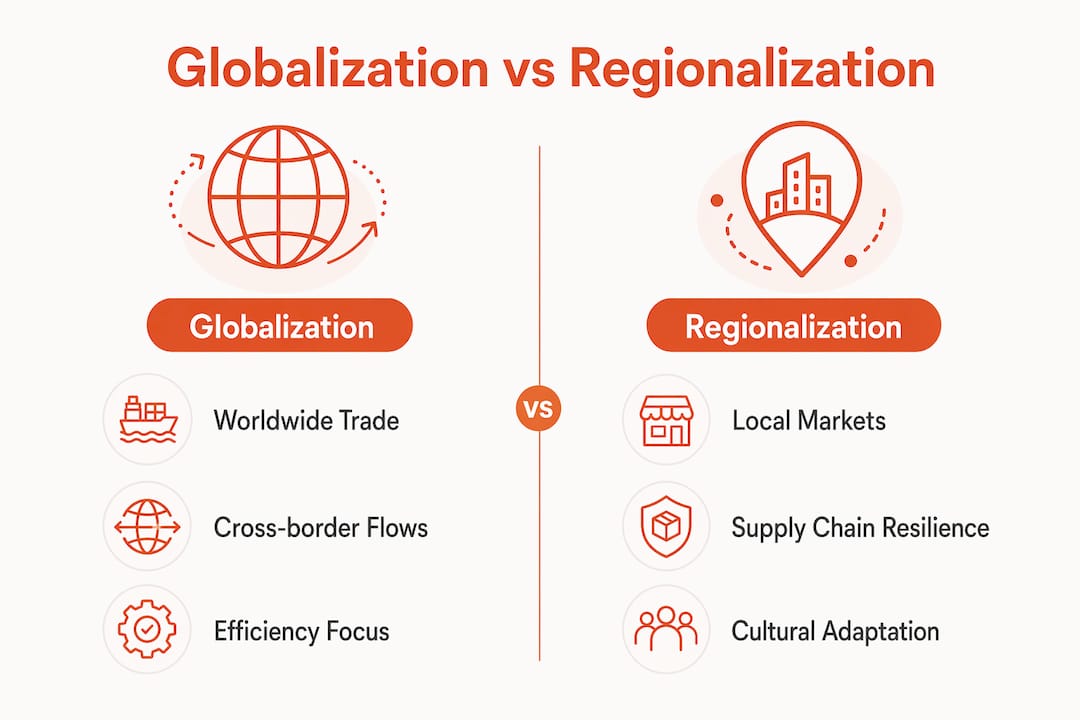
This shift has concrete operational consequences. Localization now means far more than translating your marketing copy. Companies must duplicate supply chains and localize R&D and data processing to comply with national data sovereignty laws and local sourcing mandates. That is a structural change, not a marketing adjustment. It forces companies to trade scale efficiencies for operational redundancy and regulatory compliance.
The table below shows how the old globalization model compares to the emerging one:
Dimension | Old model: efficiency first | New model: resilience first |
|---|---|---|
Supply chain | Single global source | Diversified regional sources |
Data processing | Centralized global servers | Localized per jurisdiction |
R&D | Headquarter-led | Distributed by region |
Market entry | Standardized global product | Locally adapted product |
Risk priority | Cost minimization | Disruption tolerance |
Regional trade blocs are accelerating this shift. The USMCA, RCEP, and the EU single market each create strong incentives to source, produce, and sell within the bloc. Companies that align their operations with these blocs gain tariff advantages and regulatory simplicity. Those that ignore them pay a compounding cost over time.
Pro Tip: Treat localization as an operational discipline, not a launch checklist. Leaders who adapt global business models toward regional structures build organizations that absorb shocks instead of breaking under them.
What is the impact of globalization on competition, innovation, and SMEs?
Globalization enlarges every market and every competitive threat simultaneously. A product that dominates a domestic market faces global challengers the moment it crosses a border. Globalization fosters market expansion and access to innovation but also intensifies competition, and that pressure falls unevenly across company sizes.
Large multinationals absorb the compliance costs of entering new markets because they spread those costs across massive revenue bases. Small and medium-sized enterprises face a different reality. SMEs risk shrinking market shares or bankruptcy when they cannot meet the regulatory, linguistic, and logistical demands of global markets. An SME selling into the EU must comply with GDPR, product safety standards, and local language requirements simultaneously. Each requirement is manageable alone. Together, they create a barrier that many smaller companies cannot clear without targeted support.
The innovation dynamic cuts both ways. Global competition forces companies to improve faster. Ideas, technologies, and business models spread across borders at speed. A manufacturing technique developed in Germany appears in factories in South Korea and Brazil within years. That diffusion raises the global baseline of quality and efficiency, which benefits consumers but compresses the window of competitive advantage for any single company.
For SMEs specifically, the path forward involves specialization and partnership rather than trying to match multinational scale. Building international product pages that convert in each target market is one concrete area where focused investment pays off. Meeting translation standards for product teams is another. These are not peripheral concerns. They are the front line of competitive differentiation in global markets.
How can business leaders navigate globalization in 2026?
The leaders who win in 2026’s global environment share one trait: they treat complexity as a design constraint, not an obstacle. The following steps reflect what that looks like in practice.
Diversify your supply chain by region, not just by vendor. Single-country sourcing creates single-point failure. Build redundancy across at least two regional supply bases so that a tariff shock or port closure in one region does not halt your operations.
Use dynamic production modeling. Sophisticated computer modeling lets multinationals shift production across countries in near real-time to respond to cost changes and regulatory shifts. This is no longer a capability reserved for the largest firms. Mid-market companies can access these tools through cloud-based supply chain platforms.
Build data sovereignty compliance into your architecture from day one. Retrofitting data localization after launch is expensive and slow. Designing for it upfront is a competitive advantage, not just a compliance cost.
Integrate cultural adaptation into product development, not just marketing. Language, UX conventions, payment preferences, and regulatory labeling all vary by market. Cross-functional localization with AI is now a core capability for product teams operating across regions.
Monitor geopolitical signals as a business input. The U.S.-China decoupling did not happen overnight. Companies that tracked policy signals early had time to reroute supply chains before tariffs hit. Treat trade policy monitoring as a standard part of your strategic planning cycle.
Pro Tip: Build a geopolitical risk dashboard alongside your financial dashboard. The companies that treated the 2018 tariff rounds as a one-time event paid twice: once in tariffs and once in emergency supply chain restructuring.
Key Takeaways
Business globalization in 2026 demands operational resilience, regional localization, and dynamic supply chain management as the foundation of any credible international strategy.
Point | Details |
|---|---|
Globalization is at a record high | Global connectedness sits at 25%, with goods trade growing 2.6% annually through 2029. |
Expansion strategy shapes risk | Exporting, licensing, joint ventures, and direct investment each carry distinct risk and control trade-offs. |
Localization is now operational | Companies must duplicate supply chains and localize R&D and data processing, not just marketing. |
SMEs face disproportionate pressure | Smaller firms must specialize and partner strategically to survive global compliance and competition demands. |
Agility is the core advantage | Dynamic production modeling and geopolitical monitoring separate leaders from laggards in complex markets. |
What I’ve learned about globalization that most strategy guides miss
The conventional wisdom on globalization treats it as a binary: you are either global or you are not. That framing is wrong, and it leads leaders to make expensive mistakes.
What I have seen repeatedly is that the companies struggling most with globalization are not the ones that went too far. They are the ones that went global in their sales motion but stayed local in their operations. They translated their website, opened a few regional offices, and called it done. Then a data sovereignty law in Germany or a sourcing mandate in India forced a full operational rebuild at the worst possible time.
The insight that changes how you think about this: localization is not a layer you add on top of your global strategy. It is the load-bearing structure underneath it. Leaders must move localization from a marketing layer to a core operational principle. That shift requires budget, organizational design, and technology investment. It is not a project. It is a capability.
The other thing most guides miss is that regionalization is not a retreat from globalization. It is a more sophisticated form of it. Building strong regional operations in Europe, Southeast Asia, and Latin America gives you a global footprint that is actually resilient, not just theoretically diversified. The companies I respect most in this space are the ones that made that investment before a crisis forced them to.
Globalization is not getting simpler. But the leaders who build operational depth, not just geographic breadth, are the ones who will still be growing when the next disruption hits.
— Antoine
How Gleef supports your global product strategy

Global expansion creates immediate pressure on product teams. Every new market means new languages, new regulatory labels, new UX conventions, and new compliance requirements. Teams that manage this manually hit release blockers that cost weeks.
Gleef’s AI-powered Figma Plugin puts localization directly inside your design workflow. Product managers, UX writers, and developers work in context, with semantic translation memory and glossaries that enforce brand voice across every language. You get native-sounding translations that meet local standards without switching platforms or waiting on external agencies. For teams scaling across multiple regions simultaneously, that speed is the difference between hitting a launch window and missing it.
FAQ
What is the business globalization definition?
Business globalization is the process by which companies expand operations, supply chains, and markets across national borders through flows of goods, services, capital, people, and ideas. It is the standard term for the increasing economic interdependence of countries and firms worldwide.
How does globalization affect small businesses?
SMEs face disproportionate challenges from globalization compared to large multinationals, including higher relative compliance costs, greater difficulty meeting international standards, and increased competitive pressure from global players entering their domestic markets.
What is the difference between globalization and regionalization?
Globalization refers to worldwide economic integration, while regionalization describes the concentration of trade and operations within geographic blocs such as the EU, USMCA, or RCEP. Globalization is evolving toward regionalization as companies prioritize supply chain resilience over pure cost efficiency.
What are the main international business strategies for global expansion?
The four main strategies are exporting, licensing, joint ventures, and direct foreign investment. Each offers a different balance of speed, cost, control, and risk, and the right choice depends on your capital position, market knowledge, and risk tolerance.
Why does localization matter more than ever for multinationals?
National data sovereignty laws and local sourcing mandates now require companies to duplicate supply chains and localize R&D and data processing, making localization a core operational requirement rather than a marketing option.