
TL;DR:
A translation firm, or language service provider, delivers expert translation and localization services using a combination of human expertise and AI technology. They offer a wide range of services including document translation, localization, multimedia production, and compliance-focused translations for regulated industries. Selecting a certified, AI-human hybrid firm with strong process management and security standards is crucial for successful global product launches and brand consistency.
A translation firm is a professional agency that delivers expert language translation and localization services to help businesses communicate accurately across global markets. The industry term is “language service provider” (LSP), and the best firms combine certified human linguists with AI-assisted workflows to handle everything from legal documents to full product localization. Leading agencies like AdHoc Translations, Transatlantic Translations Group, and MoniSa Enterprise serve clients across 85 to over 300 languages, with many carrying 15 to 30+ years of operational experience. For businesses launching products globally, choosing the right LSP is one of the highest-leverage decisions you will make.
What services does a translation firm actually offer?
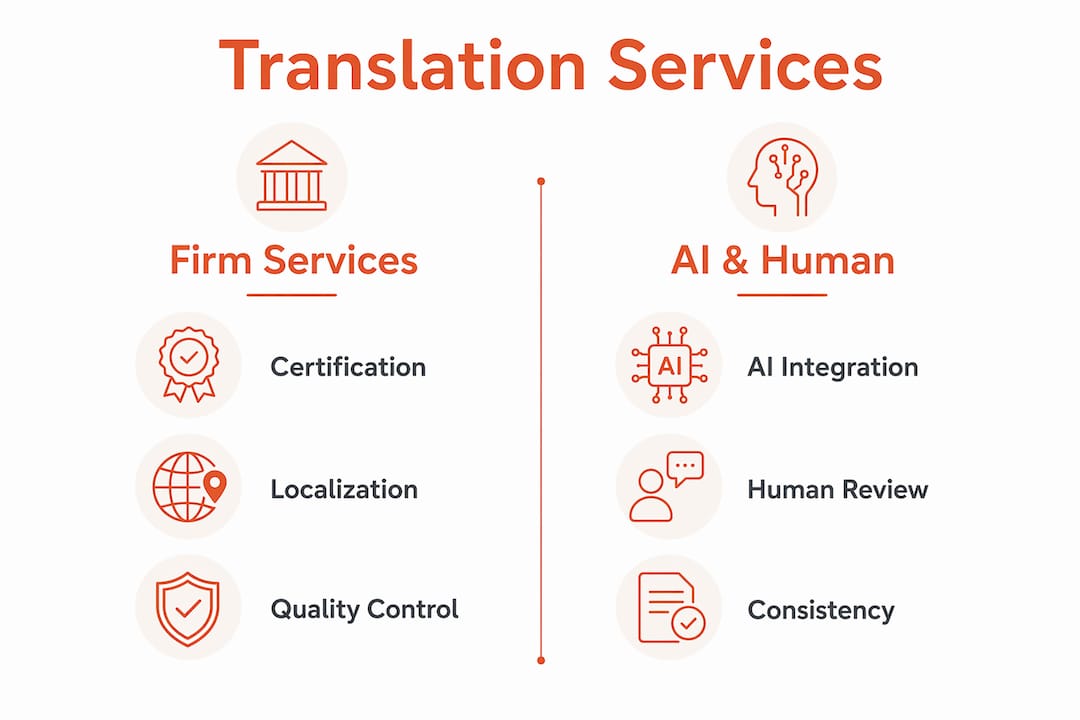
Most businesses assume a professional translation agency handles text documents. The reality is far broader, and understanding the full scope helps you avoid hiring a firm that cannot cover your actual needs.
Core services from established LSPs include:
Document translation across industries including legal, medical, financial, and technical sectors, covering regional language variations (Brazilian Portuguese vs. European Portuguese, for example)
Localization that adapts content to cultural norms, regulatory requirements, and local market expectations, not just word-for-word conversion
Multimedia services including voice-over production, subtitling, transcription, and video localization for training materials and marketing content
24/7 interpreting and telephone linguistic support, which Transatlantic Translations Group provides alongside SOC 2 and HIPAA-compliant workflows
Accessible format production including Braille and audio versions for compliance with accessibility regulations
Compliance-focused translations for regulated industries where terminology precision carries legal weight
Pro Tip: Ask any prospective firm whether their localization service includes in-country review. A translator fluent in Spanish may not catch regional idioms that matter in Mexico City versus Madrid.
AI-assisted workflows now handle high-volume content at scale, generating initial drafts that human linguists then review and refine. This hybrid model is the current standard among the best translation firms, not a shortcut. It means faster turnaround without sacrificing the cultural accuracy that pure automation cannot deliver.

How do translation firms combine AI and human expertise?
The modern approach to language translation services is a structured hybrid. AI does not replace human translators. It amplifies them.
Here is how the process typically works at a certified LSP:
AI generates the initial draft. Machine translation engines process high-volume content quickly, establishing a baseline that would take human translators days to produce alone.
Human linguists review for accuracy. Translators with subject-matter expertise check terminology, correct errors, and flag cultural mismatches the AI missed.
AI tools run automated quality checks. AI tools automatically review translations to identify errors missed by humans, including inconsistent terminology and formatting issues.
Editors adapt for cultural clarity. Human translators then edit and adapt AI drafts for cultural accuracy and clarity, ensuring the final text reads naturally to a native speaker.
Project managers sign off against style guides. Final review confirms alignment with client glossaries and brand voice before delivery.
“Modern localization workflows blend AI for initial drafts with human quality assurance, ensuring cultural accuracy and brand consistency.” — Acclaro Industry Insights
This workflow matters for your product launches because consistency across thousands of strings is nearly impossible to maintain manually at scale. Translation technology trends show that firms investing in AI-human integration consistently outperform those relying on either approach alone. The result is faster delivery, fewer revision cycles, and content that actually resonates with local audiences.
What certifications should you look for in a translation firm?
Certifications are not bureaucratic checkboxes. They are operational proof that a firm’s processes meet independently verified standards. When you are evaluating certified translation companies, these are the credentials that carry real weight.
Certification | What It Covers | Why It Matters |
|---|---|---|
ISO 17100 | Translation service quality and translator qualifications | Certifies the full workflow, not just the output |
ISO 9001 | General quality management systems | Confirms consistent process discipline across projects |
ISO 27001 | Information security management | Critical for protecting sensitive client data |
HIPAA Compliance | Health information privacy | Required for medical and healthcare translation |
SOC 2 | Data security and availability controls | Standard for technology-integrated LSPs |
ISO 17100, ISO 9001, and ISO 27001 together form the certification trifecta that signals a firm is built for enterprise-grade work. Firms with these certifications offer operational certainty that is critical for regulated industries like pharma, legal, and finance.
Pro Tip: Do not just ask if a firm is certified. Ask for the certificate number and verify it directly with the issuing body. Certification claims are easy to make and occasionally outdated.
For businesses in healthcare or financial services, HIPAA and SOC 2 compliance are non-negotiable. A data breach involving patient records or financial documents during translation is a liability no certification can fully undo, but working with a compliant firm dramatically reduces that risk.
How to choose the right translation firm for your business
Selecting the right document translation services partner requires more than comparing price sheets. The firms that deliver the most value are those that function as long-term localization partners, not one-off vendors.
Work through these criteria before signing any contract:
Language range and specialization. Confirm the firm covers your target markets and has subject-matter expertise in your industry. A firm strong in legal translation may not have the technical vocabulary depth for software UI localization.
Rare and low-resource language capability. Rare or low-resource languages may require firms to source linguists from community and academic networks, with lead times of 1–2 weeks. Know this upfront if your markets include languages like Tigrinya, Khmer, or Welsh.
Translation memory and glossary governance. Translation memory and glossary development are the tools that keep your brand voice consistent across every asset, every market, every year. Ask how the firm builds, stores, and updates these resources.
Project management infrastructure. You need a dedicated contact, clear escalation paths, and a project management system that gives you visibility into progress without requiring constant follow-up.
Data security practices. Verify compliance certifications and ask specifically how the firm handles confidential documents, NDA requirements, and data deletion after project completion.
Pricing model transparency. Affordable translation solutions do not always mean cheap. Look for firms that offer per-word pricing with clear surcharges for rush delivery, desktop publishing, or specialized review, rather than opaque bundled quotes.
The most effective approach is to treat your LSP selection like hiring a strategic partner. Consultative localization partnerships consistently outperform transactional vendor relationships because the firm builds institutional knowledge about your brand over time.
Translation firm vs. freelancer vs. ai-only platform: which is right?
Each option has a legitimate use case. The mistake is applying the wrong tool to the wrong job.
Attribute | Translation Firm | Freelance Translator | AI-Only Platform |
|---|---|---|---|
Quality assurance | Certified, multi-step review | Depends on individual | Minimal to none |
Compliance | ISO, HIPAA, SOC 2 available | Rarely certified | Not applicable |
Speed | Fast with AI-human hybrid | Variable | Fastest |
Cost | Mid to high | Low to mid | Lowest |
Scalability | High | Limited | Very high |
Brand consistency | Enforced via glossary and TM | Inconsistent | Inconsistent |
Translation firms provide more operational certainty than freelancers or AI-only platforms through certified, process-driven workflows. This is critical in high-regulation contexts like pharma, legal, and finance where a mistranslated dosage instruction or contract clause carries real consequences.
Freelancers work well for short, low-stakes projects where you have an existing relationship and can verify quality yourself. AI-only platforms are useful for internal content, rapid prototyping, or markets where near-perfect accuracy is less critical. For a global product launch, a regulated industry filing, or any content that represents your brand publicly, a certified LSP is the only defensible choice.
Key takeaways
Choosing the right translation firm requires matching your industry needs, language scope, and compliance requirements to a certified LSP with proven AI-human workflows.
Point | Details |
|---|---|
Certifications signal process quality | Look for ISO 17100, ISO 9001, ISO 27001, HIPAA, and SOC 2 before signing any contract. |
AI-human hybrid is the current standard | The best firms use AI for volume and humans for cultural accuracy, not one or the other. |
Glossary and translation memory protect brand voice | Ask every prospective firm how they build and maintain these assets for your account. |
Rare languages need lead time | Low-resource language sourcing can take 1–2 weeks; plan this into your launch timeline. |
Firms outperform alternatives in regulated contexts | For legal, medical, or public-facing content, certified LSPs reduce compliance and brand risk. |
Why i think most businesses underestimate the translation decision
After working closely with product teams launching across multiple markets, the pattern I see most often is this: companies spend months perfecting their product and two weeks on translation. That ratio is backwards.
The businesses that succeed globally treat their LSP selection with the same rigor they apply to hiring a key vendor or technology partner. They invest 1–2 weeks upfront in glossary and style guide preparation, and that investment pays back in fewer revision cycles, faster approvals, and content that actually converts in local markets. The firms that skip this phase spend that time later fixing errors that should never have existed.
The other thing I have observed is that people conflate linguistic fluency with localization competence. A translator who speaks perfect Mandarin may still produce content that feels foreign to a Shanghai audience if they lack cultural context for your product category. Operational certainty via certified processes matters more than raw language skill in regulated or brand-sensitive contexts.
AI is genuinely changing this field, and I am optimistic about where it is heading. But the firms using AI well are the ones pairing it with experienced human linguists, not replacing them. The technology raises the floor on quality. Human expertise raises the ceiling. You need both to build a product that feels native in every market you enter.
— Antoine
How Gleef fits into your localization workflow
If your team builds digital products in Figma, the gap between design and translation is where launches stall. Gleef’s AI-powered Figma plugin closes that gap by bringing translation directly into your design environment. Your team manages localization in context, without switching platforms or exporting files.
Gleef combines AI translation with semantic translation memory, glossary enforcement, and in-context editing so your brand voice stays consistent across every market. Product managers, UX writers, and developers work from the same source of truth. The result is fewer release blockers, faster global launches, and translations that sound native rather than mechanical. If you are building for global audiences, Gleef is where your localization workflow starts.
FAQ
What is a translation firm?
A translation firm, also called a language service provider (LSP), is a professional agency that delivers certified translation, localization, and interpretation services across multiple languages. Leading firms combine human linguists with AI-assisted workflows to handle everything from legal documents to full product localization.
How do i verify a translation firm’s certifications?
Ask for the specific certificate number for ISO 17100, ISO 9001, or ISO 27001 and verify it directly with the issuing certification body. Certification claims without verifiable documentation should be treated as unconfirmed.
What is the difference between translation and localization?
Translation converts text from one language to another. Localization adapts the full content experience, including cultural references, date formats, regulatory requirements, and tone, so it feels native to the target market rather than simply translated.
When should i use a translation firm instead of a freelancer?
Use a certified translation firm for any content that is public-facing, regulated, or brand-sensitive. Freelancers work for short, low-stakes projects, but they cannot match the certified workflows, quality control, and scalability that established LSPs provide.
How long does it take to translate a product for a new market?
Timelines vary by content volume and language complexity. Standard projects run 1–3 weeks, but rare or low-resource languages may require 1–2 additional weeks for linguist sourcing. Building a glossary and style guide before the project starts reduces total time significantly.