
TL;DR:
Prioritizing native translations increases user trust, engagement, and revenue by ensuring content feels authentic.
Effective localization is a strategic process that impacts product adoption, brand reputation, and market success.
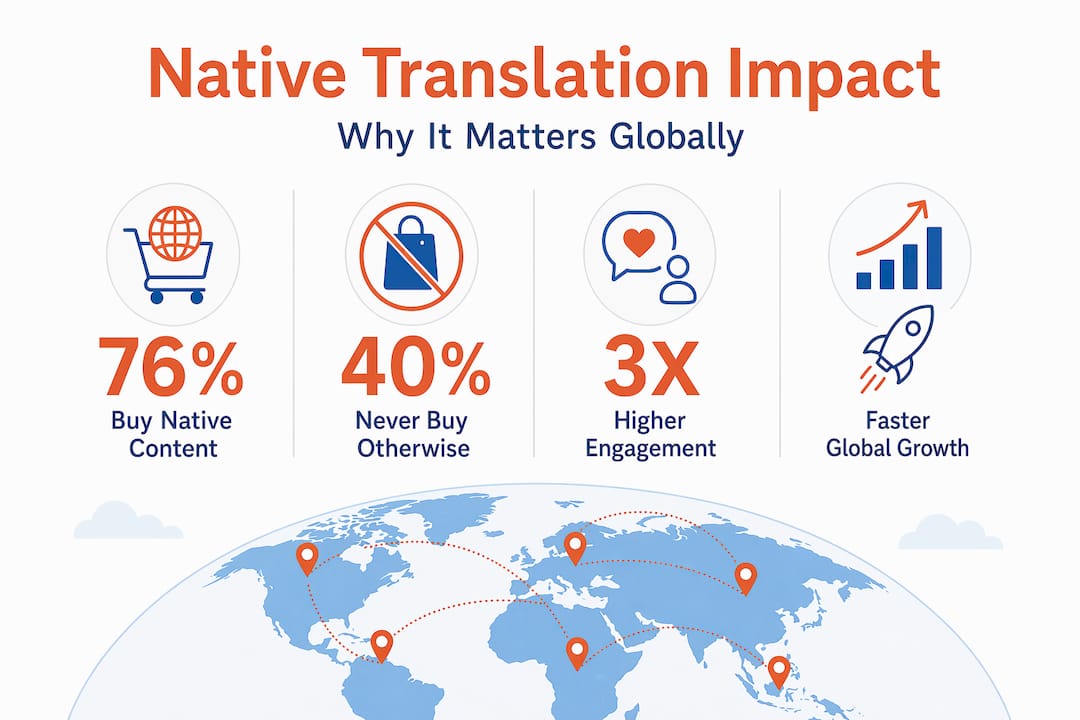
When 76% of consumers prefer to buy products in their native language and 40% say they would never purchase from a site that isn’t in their language, the case for why prioritize native translations becomes impossible to ignore. Yet product teams still launch localized products built on word-for-word translations, wondering why conversion rates stall and user trust fails to materialize. Localization is not a translation checkbox. It is a market entry strategy, and the quality of your native translations directly determines whether your product earns a place in users’ lives or gets quietly abandoned.
Key Takeaways
Point | Details |
|---|---|
Consumer preference | Most consumers only buy from native-language content, making localization essential for conversions. |
Cultural nuance | Effective native translation requires understanding local culture, tone, and buying behaviors beyond literal text conversion. |
Strategic investment | Allocating budget to native-language marketing boosts conversion, unlike mere translation. |
Prioritize key content | Focus native translation on user-critical and culturally sensitive product content for best ROI. |
Workflow integration | Incorporate native speaker review early and often in localization to avoid costly mistakes. |
The business case for native translations
The financial stakes of poor localization are real and measurable. A Lokalise study found that 41% of marketing and sales leaders had to revise campaigns because of localization issues, and 39% reported those mistakes cost more than $10,000 in lost revenue and reputation repair. For a product team, that is not just a translation budget problem. That is a product release problem.
“Localization mistakes are not edge cases. They are systemic failures that compound across markets, eroding brand trust at exactly the moment you are trying to build it.”
The importance of native translations shows up most clearly in conversion data. When your product speaks a user’s language fluently, not just technically, trust accelerates. When it sounds foreign or stilted, users hesitate. They wonder whether the company really understands them. That hesitation is where revenue leaks.
Here is what product teams consistently underestimate about native translation complexity:
Idiomatic accuracy requires understanding how native speakers actually talk, not just how grammar rules say they should
Tone calibration differs by market. A playful, casual tone that works in the US may feel unprofessional in Germany or Japan
Keyword alignment in native markets affects both SEO ranking and how naturally users search for your product
Error compounding means one poor translation decision in core UI text multiplies across every screen that references it
Understanding the real impact of software localization goes well beyond avoiding embarrassing gaffes. It shapes whether your product gains traction or stalls at the starting line.
Localization quality level | Typical outcome | Cost of errors |
|---|---|---|
Word-for-word translation | High bounce rates, low trust | Revision costs + lost revenue |
Native-reviewed translation | Improved engagement and retention | Minimal rework |
Full native translation workflow | Strong conversion, brand consistency | Lowest total cost |
Why literal translation falls short: the role of cultural context and native speakers
Getting the grammar right is not the same as getting the message right. Word-for-word translation carries over a home market’s habits and beliefs but misses local tone, market-specific keywords, and the sales arguments that actually resonate, causing lost revenue and higher bounce rates. That distinction is what separates competent localization from effective localization.
“Translating content without cultural context is like sending a sales team into a new market without training them on local customs. The message lands flat, and you never find out why.”
Cultural context shapes everything from the metaphors users find intuitive to the trust signals they expect to see. In some markets, social proof through peer reviews dominates. In others, institutional authority matters more. A native translator who has actually lived and worked in that market knows this instinctively. A machine or a non-native translator working from a brief does not.
Why use native translators instead of relying solely on automated output? Consider these concrete benefits:
They catch false cognates before they become product embarrassments (words that look similar across languages but mean completely different things)
They know what not to translate — some terms, brand names, and cultural references carry more weight in their original form
They flag tone mismatches that automated tools score as technically correct but feel wrong to native readers
They adapt persuasion patterns to match how local audiences make purchasing decisions
The difference between translation and localization is not academic. It is the difference between a product that feels imported and one that feels built for the user.
Pro Tip: Include native speakers in your review cycle specifically to evaluate tone and intent, not just accuracy. Ask them to read the text as a customer, not as an editor. Their gut reaction is data.

Native language marketing: bridging accuracy and persuasive intent
Here is a distinction most product teams miss entirely. There is technically accurate translation, and then there is marketing that actually converts. They are not the same thing, and treating them as interchangeable is expensive.
Native translation must be treated as a brand and marketing process, not just language conversion. Without creative native-market briefs, even accurate translations can fail to convert because they deliver information without persuasion. The words are correct. The intent is absent.
Think about how your best marketing copy reads in English. It probably uses wordplay, rhythm, emotional pull, and specific cultural references that make it land. All of that evaporates in a direct translation. You need native-language marketing, not just native-language text.
Here is how to enable that inside your product team:
Create a native-language brief for each market. Document the audience profile, the key pain points as locals experience them, the tone of voice, and the persuasive goal of each piece of content.
Brief your linguists like you brief your copywriters. Share brand guidelines, competitor positioning in that market, and examples of content that already resonates locally.
Separate the translation pass from the localization pass. One ensures accuracy. The other ensures persuasion. Both are necessary.
Review localized marketing content with native speakers who match your target persona, not just professional linguists. They catch what experts miss.
Measure localized content performance independently. Track conversion, engagement, and drop-off by market to know what is working.
The benefits of native translations in a marketing context are not just qualitative. Teams that invest in native-sounding translations see measurably better product adoption in new markets because users feel the product was built for them.
Pro Tip: Write a one-page “market brief” for each target locale before translation begins. Include local competitor tone, audience expectations, and three to five phrases that native customers actually use. This single document saves dozens of revision cycles.
Strategic focus: where to prioritize native translations for maximum impact
Not every string in your product needs the same level of native translation investment. Prioritizing where to focus your best native talent is one of the most practical skills a product team can develop.
The guidance from localization specialists is clear: focus native translation efforts on UI microcopy, pricing and plan wording, onboarding flows, and idiomatic or culturally specific content to balance quality with localization efficiency. These are the moments where users make decisions. Everything else can follow a lighter-touch process.
Content type | Native translation intensity | Why it matters |
|---|---|---|
UI microcopy (buttons, errors, tooltips) | High | Shapes moment-to-moment user trust |
Pricing and plan pages | High | Directly impacts purchase decisions |
Onboarding and first-run experience | High | Sets long-term retention trajectory |
Help documentation | Medium | Accuracy matters, tone is secondary |
Marketing blog content | High | Drives organic discovery and brand voice |
System notifications | Medium | Clarity over nuance |
Legal and compliance text | High | Accuracy is non-negotiable |
Use these criteria to decide when native translation priority is non-negotiable:
The content influences a conversion decision (sign up, upgrade, purchase)
The content contains idioms, humor, or cultural references that do not transfer literally
The content is the first thing a new user sees in onboarding or welcome flows
The content carries brand voice and needs to feel authentically local, not translated
The content will be seen repeatedly at high volume across your user base
Reviewing translation standards for product teams gives you a framework for documenting these decisions so the whole team applies them consistently.
Implementing native translation workflows in product teams
Strategy without execution is just intention. The teams that win in global markets build processes that make native translation a natural part of the product cycle, not an afterthought bolted on before release.
Strong global teams integrate localization into planning and messaging early, testing consistently with native speakers before launch to avoid the expensive mistakes that happen when translation is treated as a final step.
Here is a practical workflow to adopt:
Flag translatable content at the design stage. If your team works in Figma or a similar tool, localization context should be part of the design file, not a separate document created later.
Build a translation memory and glossary from day one. Every approved native translation becomes a reusable asset that enforces consistency and cuts future costs.
Run localization QA with native speakers on staging environments. Text that looks fine in isolation can break layouts, confuse users, or carry unintended tone in context.
Establish a feedback loop with native reviewers post-launch. Real users will find things your reviewers missed. Make it easy to capture and act on that feedback.
Track localization health metrics by market. Engagement drop-off, support ticket volume by language, and in-app error rates all signal localization problems before they become revenue problems.
Look at successful product launches like the Shoppilot app to see how early localization investment pays off in global market adoption. The teams that scale fastest are the ones that treat localization as infrastructure, not decoration.
Exploring the key features of localization platforms helps you understand what tooling your workflow needs to support native review cycles without slowing down releases.
Pro Tip: Build native reviewer feedback directly into your sprint retrospectives. Even one native speaker observation per sprint compounds into a dramatically better product over a quarter.
Why native translation is not just a task, but a strategic advantage
Here is the opinion you will not hear from most localization vendors: native translation is one of the few remaining sources of genuine competitive differentiation in global software markets.
Most product teams treat localization as cost of entry. You translate, you ship, you move on. But the companies that grow fastest in new markets do something different. They treat their native translation teams as product collaborators, not vendors. They share roadmaps. They ask linguists what competitors are saying in market. They use native speaker insight to inform product decisions, not just string files.
This is the gap between accelerating global SaaS translation and actually winning global markets. Speed matters, but so does depth. A product that launches fast with hollow localization loses ground to a competitor that launches slightly slower with content that genuinely speaks to local users.
Companies that ignore native nuances do not just have worse translations. They have weaker brands in those markets, higher support costs because users misunderstand the product, and lower retention because the experience feels foreign. Those are compounding disadvantages that take years to reverse.
The product teams that make native translation a first-class investment are the ones building lasting market trust. Everyone else is playing catch-up.
Pro Tip: Treat your native translation team as a standing focus group. They are inside the language and culture of your target market every day. Ask them what is resonating, what feels dated, and what your competitors are doing better locally. That intelligence is worth more than any survey.
Discover how Gleef elevates your native translation quality and localization efficiency
The principles in this article are only as powerful as the workflow that supports them. Product teams need tools that make native-quality translation achievable at scale, without turning every release into a localization sprint.
Gleef is built specifically for product teams who know that translation quality and release speed are not a tradeoff. With AI-powered translation that leverages semantic translation memory, built-in glossaries, in-context editing directly inside Figma, and rules-based quality controls, Gleef gives your team the infrastructure to deliver native-sounding translations consistently across every market. Native reviewer feedback integrates directly into the workflow, so your linguists and product managers collaborate in the same environment instead of trading files. The result is faster releases, fewer revisions, and localized products that actually convert.
Frequently asked questions
Why is it important to prioritize native translations in product localization?
Prioritizing native translations ensures your content resonates naturally with target audiences, increasing trust, engagement, and sales. 76% of consumers prefer to buy products in their native language, making this a direct revenue lever.
Can automated translation tools replace native speaker involvement?
No. Automated tools handle volume efficiently but cannot replicate the cultural nuance and persuasive adaptation that native speakers provide. AI translation fails to account for cultural context or purchasing intent, resulting in lower trust and weaker sales performance.
What types of content should product teams prioritize for native translation?
Focus native translation on UI microcopy, pricing pages, onboarding flows, and culturally nuanced messaging. These are the assets where nuance drives comprehension and brand perception most directly.
How can product teams avoid costly localization mistakes?
Integrate localization early in planning, not at the end of a release cycle. 41% of marketing leaders revised campaigns post-launch due to localization issues; consistent native speaker testing before launch is the most effective prevention.