
TL;DR:
Maintaining content consistency involves establishing a governance system with clear documentation, automation, and continuous auditing. Building foundational documents like an editorial charter, approved content brief, and a digital asset management system is essential before publishing. Automated checks, canonical assets, and proactive management prevent brand drift across multiple channels and languages.
Content consistency is defined as the practice of delivering uniform voice, tone, terminology, and messaging across every platform, language, and team member who produces content on your behalf. For content creators and marketers managing localization at scale, inconsistency is not a style problem. It is a systems problem, and governance is the fix. This guide covers the foundational tools, workflow structures, troubleshooting tactics, and measurement methods you need to build consistency that holds up across languages, channels, and growing teams.
How to ensure content consistency: the foundational layer
Knowing how to enforce content consistency starts with building the right infrastructure before a single piece of content goes live. Three documents form the backbone of that infrastructure.

The editorial charter is the single source of truth for your brand. Editorial charters define core brand elements, approved terminology, tone guidelines, and channel-specific variations so that every contributor, from a freelance translator to a senior copywriter, works from the same playbook. Without one, every writer makes independent judgment calls that slowly pull your brand in different directions.
The approved content brief locks in positioning and key claims before writing begins. Brief-first content creation is the 2026 standard for high-output teams. It prevents brand dilution by fixing numeric claims, approved product names, and core value propositions at the brief stage rather than during review.
A digital asset management (DAM) system stores approved logos, copy blocks, and canonical paragraphs in one location. Version control inside a DAM prevents teams from pulling outdated assets and publishing content that contradicts your current brand position.
Here is a summary of the foundational tools every team needs:
Tool | Purpose |
|---|---|
Editorial charter | Defines voice, tone, terminology, and channel rules |
Approved content brief | Fixes positioning and key claims before writing starts |
DAM system | Centralizes approved assets with version control |
Style guide | Covers grammar, formatting, and punctuation standards |
Governance roles | Assigns ownership of consistency reviews and approvals |
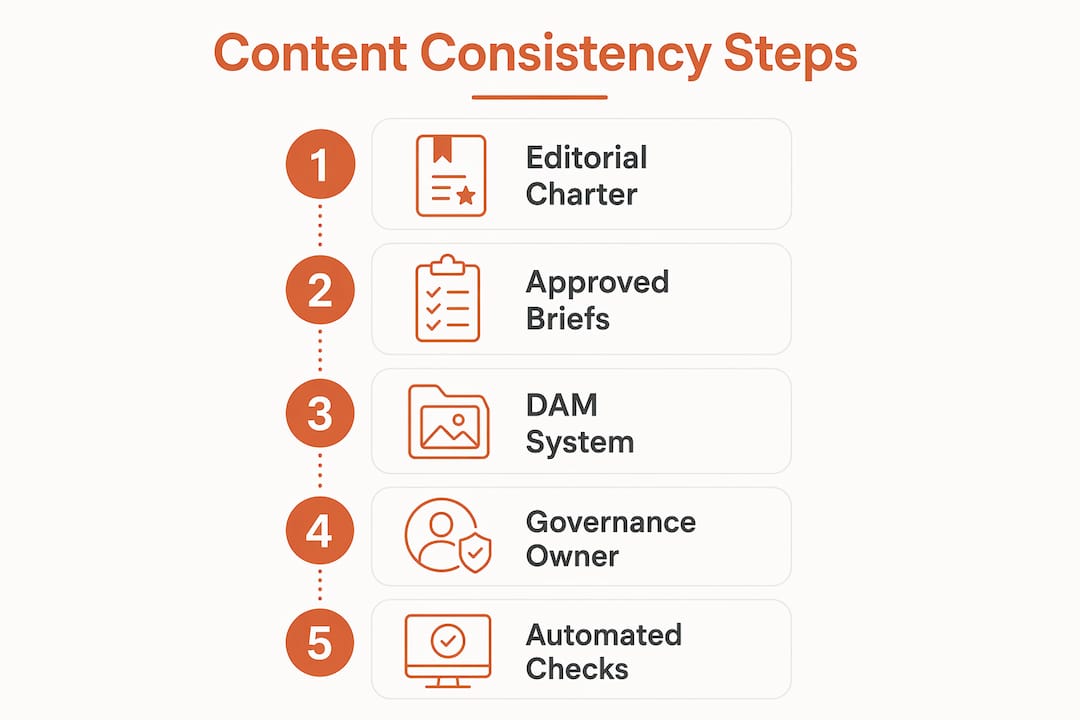
Pro Tip: Assign a named content governance owner, not just a team, to each major channel. Accountability by name prevents the “someone else will catch it” failure mode that causes drift.
High-performing marketing organizations succeed through strong governance and defined team roles, not through content volume. Building this layer first saves enormous rework downstream.
What workflows and automation actually enforce consistency?
Once your foundational documents exist, the next challenge is making sure every content creator actually uses them. Workflows and automation are what turn guidelines from a PDF nobody reads into a system that actively catches errors.
Here is a proven workflow sequence for multi-platform and multilingual teams:
Start every piece with an approved brief. The brief should specify the target audience segment, approved product names, required claims, and prohibited phrases. This single step eliminates the majority of consistency errors before writing begins.
Run automated style checks during drafting. Tools like Grammarly Business and custom tone models apply your editorial charter rules in real time. AI-powered editing tools support consistent tone, grammar, formatting, and style across platforms and languages, reducing the manual workload on your review team significantly.
Use automated consistency scanners before publication. Automated scans compare drafts against your brand governance configuration and flag deviations. This eliminates the manual post-edit bottleneck that slows down high-volume teams. A human reviewer then focuses only on flagged items rather than reading every word.
Store canonical paragraphs for repeated messages. Product descriptions, legal disclaimers, and value proposition statements should exist as locked, reusable text blocks. Canonical paragraphs in localization prevent semantic drift and keep brand messaging perfectly aligned across every language version.
Run cross-channel checks on a fixed schedule. Compare the same message as it appears on your website, app, social media, and email campaigns. Inconsistencies between channels erode trust faster than inconsistencies within a single channel, because users move between platforms constantly.
Close the loop with a feedback system. When a reviewer flags an inconsistency, that flag should trigger an update to the editorial charter or the brief template, not just a one-time fix. Consistency governance is a living system, not a checklist.
Pro Tip: Build your canonical paragraphs directly into your localization platform’s translation memory. That way, approved source text is automatically suggested every time a translator encounters a familiar phrase, and deviation requires a deliberate override.
Automated, context-aware brand checks during content creation reduce excess rework and improve throughput at scale. The teams that scale content without losing quality are the ones that automate the guardrails, not the ones that hire more reviewers.
What causes content drift, and how do you fix it?
Content drift is the gradual divergence of your published content from your current brand standards. It happens slowly, which makes it dangerous. By the time you notice it, the damage to brand recognition and SEO is already done.
The most common causes of content drift include:
Terminology drift: Writers use synonyms for approved product names or feature labels. Over time, your product is called three different things across your own website.
Tone inconsistency: Different contributors interpret “professional but friendly” differently. Without examples in your editorial charter, tone guidance is subjective.
Outdated claims: Pricing, feature names, and statistics change. Published content that references old numbers creates trust problems and SEO conflicts.
Conflicting assets: Multiple versions of the same document exist in different folders. Contributors pull the wrong one.
The AI dimension makes this worse. AI can exacerbate content drift when brand assets are contradictory. If you feed an AI writing tool a mix of old and new brand guidelines, it will blend them and produce content that fits neither. Cleaning and unifying your source assets is a prerequisite for effective AI-assisted content creation.
“Treating consistency, accuracy, and freshness as an integrated system is what distinguishes well-governed teams from inconsistent ones.” — Content governance best practices
To troubleshoot and prevent drift, apply these corrective actions:
Audit all content under 24 months old for terminology, tone, and factual accuracy. Content older than that should be reviewed for full replacement or archiving.
Deprecate old asset versions immediately. When you update a canonical paragraph or a product name, remove the old version from every shared folder the same day.
Run a terminology reconciliation pass across your top 20 highest-traffic pages every quarter. Flag any page that uses an unapproved synonym for a core product term.
Update your editorial charter whenever brand standards change, not after the next content audit. Static guides become obstacles rather than tools.
The team coordination guide from Gleef covers how product teams can align across functions to prevent exactly this kind of drift at the enterprise level.
How do you measure content consistency at scale?
Measurement turns content consistency from a feeling into a fact. Without metrics, you cannot tell whether your governance system is working or whether drift is quietly accumulating.
The most reliable metrics for content consistency success are:
Metric | What it measures | How to track it |
|---|---|---|
Terminology accuracy rate | Percentage of approved terms used correctly | Automated scanner reports |
Brand voice score | Alignment of tone and style with charter | AI scoring tools or manual rubric |
Cross-channel message alignment | Consistency of key claims across platforms | Quarterly cross-channel audit |
SEO keyword consistency | Uniform use of target terms across pages | SEO platform reports |
Engagement delta | Change in engagement after consistency improvements | Analytics platforms |
A content audit scoring system that measures vocabulary, structure, proof density, voice consistency, and buyer alignment can objectively quantify consistency. This kind of scoring removes subjectivity from the review process and gives your team a number to improve against.
Regular audits, including monthly social media reviews and quarterly website checks, maintain consistency and prevent brand drift. Monthly cadences catch fast-moving channels like social media before problems compound. Quarterly cadences are appropriate for slower-moving assets like product pages and documentation.
Continuous governance means your editorial charter updates in real time as brand standards evolve. A living document with a version history and a named owner outperforms a static PDF every time. Pair it with an SEO consistency check to confirm that your target keywords appear uniformly across all pages covering the same topic.
How does content consistency enforcement work in localization?
Localization is where content consistency faces its hardest test. You are not just maintaining one voice across channels. You are maintaining it across languages, cultural contexts, and teams that may be working in different time zones with different tools.
The translation consistency practices that work at scale share a common structure. Here is what that structure looks like in practice:
Use a single source-of-truth version for every repeated message. Your approved English product description should be the master record. Every translated version derives from that master, not from a previous translation or a regional adaptation.
Build a multilingual glossary. Approved translations for product names, feature labels, and brand terms should be locked in a glossary that every translator and AI tool references. Deviation from the glossary requires explicit approval.
Align tone guidelines across languages. “Professional but approachable” means different things in German, Japanese, and Brazilian Portuguese. Your editorial charter needs language-specific tone notes, not just a single global description.
Coordinate localization teams with content creators upstream. When a source message changes, localization teams need to know immediately. A broken feedback loop between content and localization is the single most common cause of multilingual brand inconsistency.
Leverage AI translation tools with built-in consistency enforcement. Platforms that combine translation memory, glossary enforcement, and in-context editing prevent translators from inadvertently introducing new terminology. Gleef’s AI localization workflow covers how teams can apply these methods at scale in 2026.
Storing and reusing canonical paragraphs prevents semantic drift and enables perfect alignment of brand messaging across languages. This is the single highest-leverage practice for localization teams managing more than five languages simultaneously.
Key Takeaways
Content consistency enforcement requires a governance system that combines centralized documentation, automated verification, and continuous auditing to hold brand standards across every platform and language.
Point | Details |
|---|---|
Build the foundation first | An editorial charter, approved briefs, and a DAM system are prerequisites, not optional extras. |
Automate the guardrails | Automated consistency scanners eliminate manual bottlenecks and catch drift before publication. |
Fix drift at the source | Clean and unify brand assets before using AI tools, or AI will amplify inconsistencies. |
Measure with real metrics | Use terminology accuracy rates, brand voice scores, and cross-channel audits to track progress objectively. |
Localization needs its own rules | Multilingual glossaries, canonical paragraphs, and upstream coordination prevent cross-language brand drift. |
Why I think most teams are solving consistency backwards
Most content teams I have worked with treat consistency as a review problem. They hire more editors, add more approval layers, and wonder why content still drifts. The real problem is upstream. If your brief does not lock in the approved terminology, no amount of review will catch every violation at scale.
The teams that get this right build their governance into the creation process, not the review process. Automated style checks during drafting, locked canonical paragraphs in the translation memory, and a brief template that forces writers to confirm approved product names before they start. These are not bureaucratic hurdles. They are the difference between a brand that compounds recognition over time and one that slowly fragments across its own channels.
The future of content consistency is not more human reviewers. It is cleaner source assets, smarter automation, and governance systems that update themselves when standards change. AI tools are genuinely powerful here, but only if you feed them clean, unified inputs. A contradictory brand asset library fed into an AI tool produces confidently inconsistent content at scale. That is worse than the manual process it replaced.
My pragmatic advice for scaling teams: pick one channel, build the full governance stack for it, measure the improvement, and then replicate that stack across your other channels. Trying to fix everything at once produces a governance document that nobody reads and a process that nobody follows.
— Antoine
How Gleef keeps your localization bulletproof
Gleef is built for exactly the challenge this article describes: keeping content consistent when your product ships in multiple languages and your team works across Figma, development, and content tools simultaneously. The Gleef Figma Plugin brings AI-powered translation, semantic translation memory, and glossary enforcement directly into your design workflow. You manage translations in context, without switching platforms, and every translator works from the same approved terminology. For product teams that cannot afford release blockers caused by inconsistent localization, Gleef turns consistency enforcement from a manual review burden into an automated, in-workflow standard.
FAQ
What is content consistency in marketing?
Content consistency is the practice of delivering uniform voice, tone, terminology, and messaging across all platforms, channels, and languages. It builds brand recognition and trust through repeated, coherent exposure.
Why enforce content consistency across localized content?
Inconsistent localization fragments brand identity across markets and confuses both users and search engines. A multilingual glossary and canonical paragraph library are the most direct fixes.
How often should you audit for content consistency?
Monthly audits for social media and quarterly audits for website content are the recommended cadences. Content older than 24 months should be reviewed for full replacement.
What tools help maintain content quality at scale?
Grammarly Business handles tone and grammar enforcement during drafting. Automated consistency scanners compare drafts against your brand governance configuration. Gleef handles terminology and translation consistency in localization workflows.
How does an editorial charter support brand voice consistency?
An editorial charter defines approved terminology, tone guidelines, and channel-specific rules in one document. It gives every contributor, including translators and AI tools, a single reference point for brand standards.