
TL;DR:
Global brand voice combines fixed core messaging with adaptable local elements to maintain consistency across markets. Effective governance, clear ownership, and embedded workflows are essential to prevent voice drift and ensure alignment. Regular audits and concrete examples help sustain a cohesive brand identity worldwide.
Global brand voice is defined as a system of fixed core messaging and flexible local adaptations that together preserve brand identity across every market and language. Knowing how to maintain brand voice globally separates brands that build international trust from those that fragment into disconnected regional identities. The framework requires three things working in parallel: a documented voice architecture, operational governance with named owners, and localization workflows that treat voice as a concrete requirement. Tools like Grammarly, Frontify, and Gleef each play a role in keeping that system running at scale.
How to maintain brand voice globally: fixed vs. flexible elements
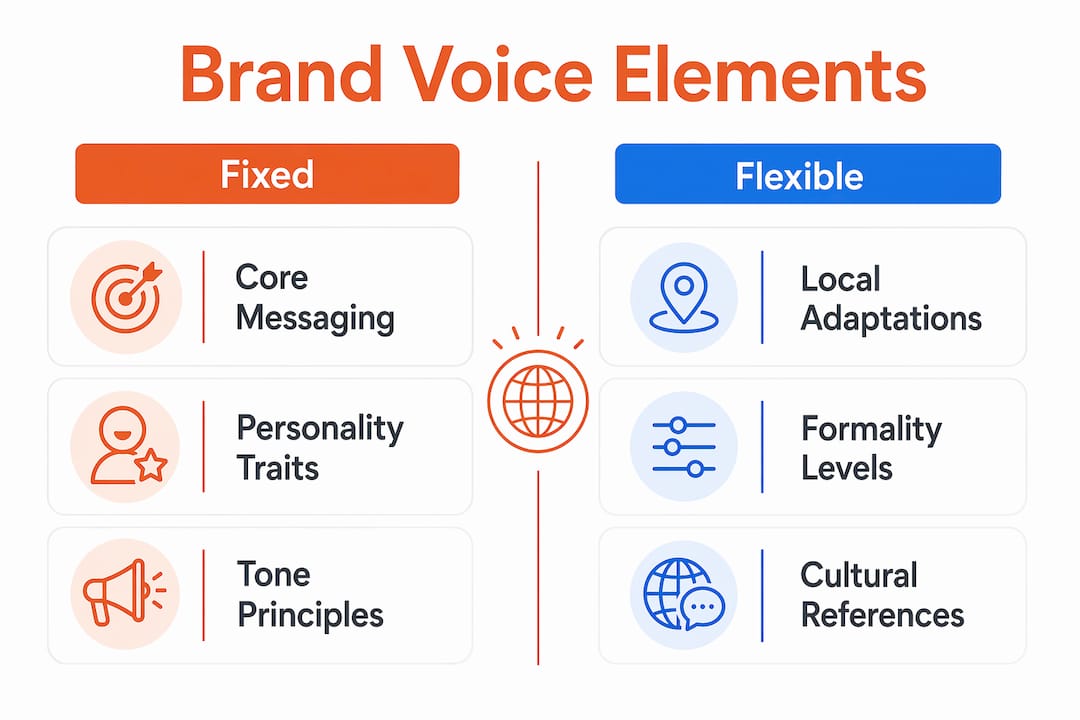
The most effective global voice architecture splits brand expression into two tiers. The first tier is fixed. The second tier is flexible. Getting that split right is the foundation of everything else.
Fixed core elements are the traits that never change regardless of market, language, or channel. These include:
Brand personality traits (e.g., direct, warm, authoritative)
Core values expressed in messaging (e.g., transparency, reliability)
Tone principles (e.g., never condescending, always solution-focused)
Prohibited language (slang, competitor references, taboo topics)
Structural patterns (e.g., CTA format, headline style)
Flexible elements are the expressions that adapt to local context without abandoning the core. These include formality level, idiomatic phrasing, humor style, campaign hooks, and CTA wording. A brand that is “direct and confident” in the United States might express that same confidence with more formal sentence structures in Germany or Japan.
A widely used framework recommends roughly 70–80% fixed output and 20–30% flexible adaptation. That ratio gives local teams room to connect with their audiences while keeping the brand recognizable across borders.

Documentation is not optional here. Your voice guide must include before/after examples and do/don’t pairs for common scenarios. Abstract trait descriptions like “be authentic” produce inconsistent results. Concrete examples for typical content types give writers and translators a rubric they can actually use.
Pro Tip: Get CEO or senior leadership sign-off on the fixed core before distributing the guide. Without that authority signal, local teams will negotiate every trait, and your fixed tier will drift.
Who owns brand voice? governance and accountability
Brand voice is a system, not a style guide. That distinction matters because a system requires onboarding, training, editorial review, quality checkpoints, and governance ownership to function. A PDF document sitting in a shared drive does not enforce anything.
Effective governance assigns named owners at two levels:
Global brand voice owner: A senior marketing or brand leader (often a Head of Content or Editor-in-Chief equivalent) who controls the fixed core, approves updates, and resolves escalations.
Local market voice owners: Senior marketers in each region with authority to approve tone decisions and adapt flexible elements within defined boundaries.
Without named tone owners, decisions default to whoever is loudest in the room. Voice consistency degrades quickly when no one has the authority to say “this is off-brand.”
Editorial review gates are the operational muscle of governance. Every content type should pass through a voice check stage before publication. For high-volume channels like social media, this can be a lightweight checklist review. For campaign copy or product messaging, it warrants a full brand voice audit against the documented rubric.
Onboarding and ongoing training complete the system. New writers, translators, and regional marketers need structured orientation to the voice guide, not just a link to the document. Quarterly voice calibration sessions, where global and local teams review real examples together, prevent the slow drift that accumulates between formal audits.
How do you embed brand voice into localization workflows?
Translation accuracy and brand voice fit are two separate quality dimensions. Correct language may still be too formal, casual, or misaligned with brand personality if the review only checks for translation accuracy. This is the most common failure point in multilingual brand management.
The fix is to operationalize voice requirements before translation begins. Here is a workflow that works:
Brief stage: Define tone, CTA behavior, taboo phrases, and risk tolerance in writing before the translator starts. Do not ask them to “preserve the voice.” Tell them exactly what that means for this content type.
Glossary and style guide: Provide a market-specific glossary of approved terms, brand-specific vocabulary, and prohibited substitutions. Gleef’s glossary and translation memory features are built for exactly this step.
Role-based review: Route translated content through a native-speaking editor who assesses voice fit, then a brand owner who checks against the fixed core, then legal review where required.
In-channel QA: Review content in its final format, whether that is a product UI, email, or social post. Voice reads differently in a button label than in a paragraph.
Annotated example library: Build a living collection of approved and rejected content samples for each market. Teams learn faster from real examples than from abstract rules.
Encoding voice requirements as briefs, checklists, and approval stages reduces rework by giving reviewers a concrete rubric instead of renegotiating wording at the end of the process.
Workflow Stage | Owner | Voice Check Focus |
|---|---|---|
Brief | Global brand manager | Tone, taboo terms, CTA format |
Translation | Translator | Accuracy plus glossary compliance |
Voice review | Native editor | Formality, idiom fit, personality match |
Brand approval | Local voice owner | Fixed core alignment |
In-channel QA | Channel manager | Format, context, final tone read |
Pro Tip: Build your localization workflow around voice checkpoints, not just language accuracy gates. The two questions are different and need separate reviewers.
How do you audit brand voice across global markets?
Maintaining brand consistency requires ongoing operational discipline with regular audits and feedback loops across key channels and markets. A one-time style guide launch is not a strategy. It is a starting point.
A practical audit program covers four content surfaces:
Website copy: Check product pages, landing pages, and help documentation against the fixed core every quarter. These are high-visibility assets that set audience expectations.
Social media: Review a sample of posts from each market monthly. Social is where voice drift appears first because publishing volume is high and review gates are often lighter.
Email campaigns: Audit subject lines, body copy, and CTAs for tone consistency. Email is a direct channel where off-brand voice erodes trust fast.
Blog and editorial content: Assess long-form content semi-annually for personality alignment, especially in markets where local writers have more autonomy.
The audit format matters. A scorecard with specific criteria (personality trait present, prohibited language absent, CTA format correct) produces consistent results across reviewers. A vague “does this sound on-brand?” question produces debate.
Early detection is far less costly than crisis management. A single off-brand campaign in a major market can require months of corrective messaging. Catching drift in a quarterly audit costs a few hours of review time.
Feedback loops close the system. When audits surface deviations, the findings should update the voice guide, not just correct the offending content. Real-world usage reveals gaps in documentation that no amount of upfront planning can fully anticipate.
What are the biggest challenges in global brand voice?
The most common failure in global brand voice is not a translation error. It is a governance gap. Teams know the brand exists but no one owns the voice decision.
Here are the pitfalls that derail even well-resourced brand teams, and how to address each one:
Vague guidelines: “Be authentic” and “sound human” are not instructions. Replace abstract traits with specific examples. Show what “direct” looks like in a product error message versus a campaign headline.
Confusing translation accuracy with voice fit: Assessing voice fit independently from accuracy requires separate review criteria and often a different reviewer. Build both into your workflow.
No local ownership: Assigning voice responsibility to a global team alone creates bottlenecks and resentment. Local market owners need real authority, not just advisory roles.
Guidelines treated as constraints: Involving global and local voices in building the framework encourages ownership and better usage. Teams that helped write the rules follow them.
Slow governance processes: If getting brand approval takes two weeks, local teams will skip the step. Streamline review gates for routine content and reserve deep review for high-stakes assets.
Pro Tip: Run a “voice calibration” workshop with global and local teams twice a year. Bring real content samples, score them together, and discuss disagreements. The conversation builds shared judgment faster than any document.
Key takeaways
Maintaining a consistent global brand voice requires a documented fixed core, named governance owners, and voice requirements embedded into every localization workflow.
Point | Details |
|---|---|
Define fixed and flexible tiers | Keep 70–80% of brand output fixed; allow 20–30% to adapt to local market context. |
Assign named voice owners | Appoint a global brand voice owner and local market owners with real approval authority. |
Operationalize voice in workflows | Encode tone, taboo terms, and CTA rules into briefs and checklists before translation starts. |
Audit regularly across channels | Review website, social, email, and blog content on a set schedule to catch drift early. |
Separate voice fit from accuracy | Require a dedicated voice review stage distinct from translation accuracy checks. |
What i’ve learned after years of global brand work
The uncomfortable truth about international brand voice is that most teams treat it as a documentation problem when it is actually a culture problem. You can write the most detailed style guide in the world and still watch your brand sound like three different companies across five markets.
What actually works is building shared judgment, not shared documents. When I have seen global brand programs succeed, it is because local teams felt ownership over the voice, not just compliance with it. They were in the room when the fixed core was defined. They contributed the flexible examples for their market. They had a named person they could call when a tricky content decision came up.
The governance piece is where most programs fall apart. Assigning voice ownership to a global content team without giving local managers real authority creates a system where every decision escalates and nothing moves fast enough for publishing schedules. The localization best practices that hold up over time are the ones that distribute authority clearly, not the ones that centralize every decision.
The other thing I would push back on is the idea that more detailed guidelines solve the problem. After a certain point, more rules produce more confusion. What teams need are better examples and faster feedback loops, not longer documents. A quarterly calibration session where you review real content together does more for voice consistency than adding another page to the style guide.
— Antoine
Keep your brand voice intact across every market
Building a global voice architecture is one thing. Keeping it intact as your product ships across dozens of languages and design contexts is another challenge entirely.
Gleef’s Figma plugin brings AI-powered localization directly into your design workflow, so your team can manage translations in context without switching platforms. Glossaries, translation memory, and in-context editing work together to preserve your brand voice at the component level, before content ever reaches a reviewer. Teams using Gleef report faster release cycles and stronger brand consistency across international markets. If you are building globally accessible digital products and want voice preservation built into the process from day one, Gleef is where that work starts.
FAQ
What is global brand voice?
Global brand voice is the system of fixed personality traits, tone principles, and messaging standards that a brand maintains across all markets and languages. It combines an immutable core with flexible local adaptations to stay recognizable while remaining culturally relevant.
How do you unify brand voice across multiple markets?
Unifying brand voice requires a documented fixed core, named voice owners in each market, and voice requirements embedded into localization workflows as concrete briefs and checklists rather than abstract guidelines.
Why does brand voice change in translation?
Translation accuracy and voice fit are separate quality dimensions. A correctly translated sentence can still sound too formal, too casual, or misaligned with brand personality if the review only checks language accuracy and not tone alignment.
How often should you audit brand voice globally?
Audit website and campaign copy quarterly, social media monthly, and long-form editorial content semi-annually. Early detection through regular audits costs far less than corrective messaging after a major voice deviation reaches audiences.
What is the difference between brand voice and brand tone?
Brand voice is the fixed personality of a brand that stays consistent across all contexts. Brand tone is how that voice adjusts in specific situations, such as being more formal in a legal notice and warmer in a customer support message, while still sounding like the same brand.