
TL;DR:
Effective brand voice localization balances core brand attributes with culturally adapted expressions, enhancing user trust and engagement. Neglecting local nuances, relying solely on automation, or failing to implement structured workflows can erode brand consistency and diminish market impact. Combining AI tools with native linguistic expertise and continuous measurement ensures localized content resonates authentically across global audiences.
Your product just launched in three new markets. The UI is polished, the onboarding is smooth, and the engineering is bulletproof. But something is off. Users in Germany find your friendly tone condescending. In Japan, your bold CTAs feel aggressive. In Brazil, your humor lands flat. None of this is a translation error. It’s a brand voice failure, and it’s more expensive than most product teams realize. This guide gives you a practical framework to adapt your brand voice across languages without losing what makes your product compelling in the first place.
Key Takeaways
Point | Details |
|---|---|
Brand voice matters | Localizing your brand voice maximizes resonance and user trust in global markets. |
AI plus human review | Combining AI tools and native linguists is essential for nuanced, high-quality localization. |
Transcreation drives results | Adapting expressions, humor, and slogans increases engagement and conversion rates. |
Edge cases require care | Humor, metaphors, and layout issues demand strategies tailored by locale and expert review. |
Track and iterate | KPIs like CTR, CPA, and conversions should guide ongoing optimization of brand voice localization. |
Understand what makes brand voice unique in global tech
Brand voice is not your logo or color palette. It’s the personality behind every word your product speaks, from onboarding tooltips to error messages to push notifications. It’s what makes users feel like they’re interacting with something alive, something that gets them. And in competitive global markets, it’s a serious differentiator. Products that sound generic get treated as commodities.
The challenge is that the same voice that feels warm and confident in English can feel presumptuous in Korean or overly casual in German. This is where glocalization becomes your core strategy. Glocalization balances core traits with local adaptation, the way Nike maintains its “Just Do It” defiance globally while shifting the cultural references behind it. Apple does the same: the sleek, minimalist tone holds across languages, but the specific expressions of warmth or innovation are calibrated to each market.
The goal isn’t to water down your brand. It’s to carry its essence through every cultural filter without losing what makes it yours. Good localization best practices start with clearly defining which traits are non-negotiable and which are flexible.
Core brand attributes vs. localized expressions
Brand attribute | English expression | German adaptation | Japanese adaptation |
|---|---|---|---|
Friendly tone | “Hey, let’s get started!” | “Willkommen, legen wir los.” | “ようこそ。始めましょう。” |
Confidence | “You’ve got this.” | “Das schaffen Sie.” | “きっとうまくいきます。” |
Innovation emphasis | “Smarter, faster, better.” | “Effizienter. Smarter. Schneller.” | “より賢く、より速く。” |
Humor | Light wordplay in CTAs | Understated, dry tone | Formal, no puns |
These native-sounding translations are not just aesthetic choices. They directly affect user trust and product adoption.
Common pitfalls of neglecting voice localization:
Using the same tone for all markets because “it tested well in English”
Treating localization as a post-launch task rather than a design requirement
Relying on automated translation without cultural review
Allowing inconsistent terminology to fragment the experience across touchpoints
Ignoring the difference between formal and informal registers in languages like French or Spanish
These mistakes are not hypothetical. They drain engagement and erode user trust. Explore the keys to successful localization to understand where most teams go wrong before they start. A solid foundation in brand identity strategies also helps teams understand how voice fits into the larger picture.
Set up your localization workflow for brand voice
Defining your brand voice is only the first step. Next, you must prepare your team and toolkit for high-impact localization. The most common mistake global product teams make is skipping the infrastructure and jumping straight to translation. That’s where costs multiply and quality collapses.
Your team must include at minimum:
A product manager who owns the localization roadmap
A UX writer or content designer who maintains the original voice standards
Native linguists who understand not just language but cultural context
Developers who can handle text expansion, RTL scripts, and dynamic string injection
A localization lead who bridges all of these roles
Tools matter just as much. Your style guide cannot live in a PDF that nobody reads. It needs to be integrated, enforceable, and dynamic. Integrated AI-enforced guides and glossaries can scale localization across large string libraries, but they require human review to catch cultural nuance that AI misses. This is not a weakness. It’s the design of an effective hybrid system.
Static PDF vs. integrated AI style guide

Feature | Static PDF style guide | Integrated AI style guide |
|---|---|---|
Accessibility | Low, often siloed | High, embedded in workflow |
Update speed | Slow, manual | Real-time, automatic |
Enforcement | None | Rules-based consistency checks |
Cultural nuance | Depends on author | Requires human review layer |
Scalability | Poor for large projects | Strong across large string sets |
Collaboration | Fragmented | Centralized and tracked |
Must-have workflow components:
A live glossary covering brand terms, product names, and forbidden translations
Locale-specific tone guidelines for each target market
A review stage with native linguists before sign-off
In-context editing capability so translators see strings in the actual UI
Version control so teams can track changes across languages
Building cross-functional localization practices into your sprint cycle ensures that voice consistency isn’t an afterthought. It becomes a product quality standard. Think of it as scaling localization workflows the same way you scale engineering: with systems, not heroics.
Pro Tip: Assign at least one native linguist per target locale not just for translation, but for calibration. Their job is to read the localized product the way a real user would and flag anything that feels off. This review layer is where brand voice is either saved or lost.
Execute brand voice localization: step-by-step
With your workflow set, it’s time to localize brand voice for maximum impact. This is where strategy meets execution. The steps below are designed for product teams shipping software at scale, not marketing agencies producing one-off campaigns.
Audit your source strings. Identify every UI string, onboarding message, notification, and error message that carries brand voice. Not all strings need the same treatment. “Submit” doesn’t need transcreation. “You’re crushing it!” does.
Classify strings by type. Split strings into three categories: functional (labels, buttons), informational (instructions, tooltips), and expressive (motivational messages, slogans, empty states). Expressive strings are your voice-critical content.
Apply transcreation to expressive strings. Transcreation preserves emotional impact and intent in marketing content, adapting idioms and slogans for local resonance rather than direct meaning. A phrase like “Let’s make it happen” might become something that evokes collective action in Japanese or individual determination in German.
Use translation memory for functional strings. Consistency tools ensure that “Save” always means “Save” and that your product terms stay aligned across the app. This prevents user confusion and reduces review cycles.
Test localized strings in context. Place translated text inside the actual UI or a high-fidelity prototype. Check for text expansion (German can run 30% longer than English), truncation, and visual balance.
Run a native review cycle. Send voice-critical strings to native reviewers with a localized tone brief. Give them permission to flag anything that sounds unnatural, awkward, or off-brand.
Iterate based on user feedback. Don’t treat launch as the finish line. Watch engagement data in each locale and listen for user sentiment in support tickets and app reviews.
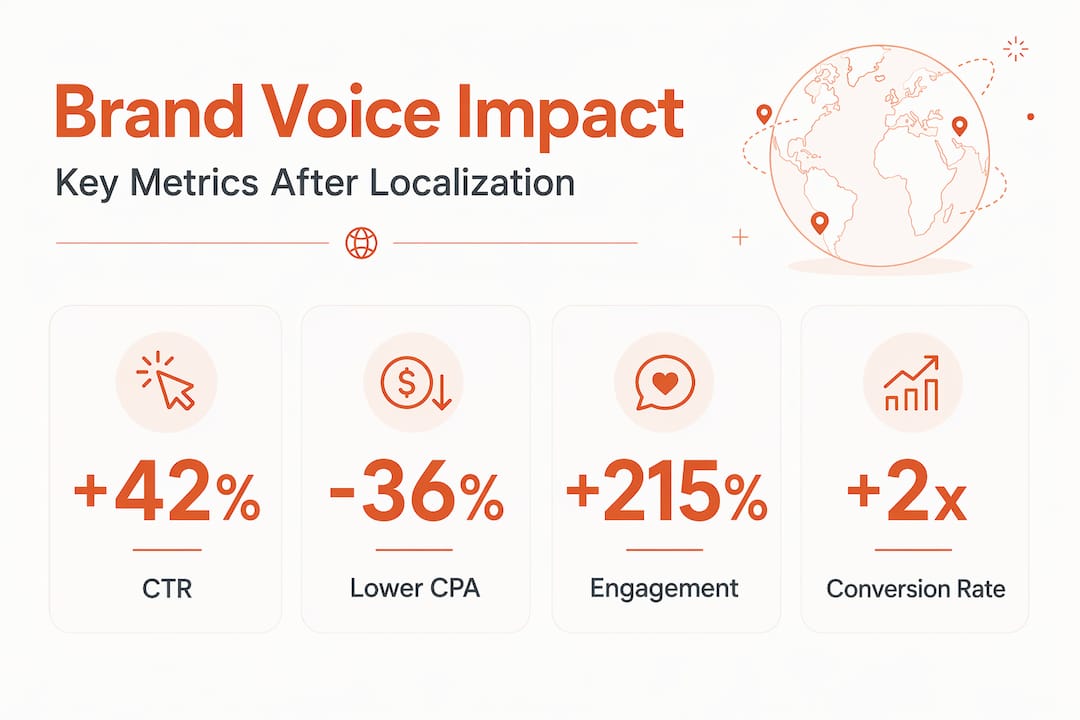
The results of doing this well are not marginal. Proper localization benchmarks show 42% higher CTR, 22 to 36% lower CPA, and up to 215% engagement lift in some markets. These numbers are not flukes. They reflect the compounding effect of a product that users actually feel connected to.
Pro Tip: Never apply literal translation to marketing copy or interface text that carries emotional weight. The translation vs localization distinction isn’t academic. It’s the difference between a product that resonates and one that just exists. Also check out the real impact of software localization to put the business case in front of your stakeholders.
Troubleshooting and common pitfalls in brand voice localization
As you execute, it’s crucial to know where brand voice localization can trip up even the most prepared teams. Most problems fall into predictable categories, and recognizing them early saves you from expensive post-launch fixes.
Edge cases like humor, cultural taboos, metaphors, and RTL scripts require careful attention by native linguists. A joke that works in English might be offensive in Arabic or simply confusing in Mandarin. Metaphors built around sports, seasons, or animals carry wildly different cultural weight across regions.
Common mistakes and how to solve them:
Humor fails to land: Replace culture-specific jokes with universal warmth or wit. Test humor locally before shipping.
Idioms get translated literally: Flag all idiomatic expressions in the source file and mark them for transcreation, not translation.
Taboo topics surface unexpectedly: Build a locale-specific sensitivity checklist that reviewers consult before sign-off.
Text expansion breaks the UI: Design with 40% expansion buffer in mind. German and Finnish consistently exceed English string lengths.
RTL scripts disrupt layout: Test RTL (right-to-left, as in Arabic and Hebrew) layouts separately. Mirrors and alignment are structural, not cosmetic.
Inconsistent formality: Define your register upfront. Does your product use “tu” or “vous” in French? This decision shapes the entire user experience.
You can resolve inconsistent brand messaging before it becomes a systemic problem by building these checks into your QA process rather than treating them as edge cases.
“Brand voice adaptation across languages isn’t just about words. It’s about emotional equivalence. A native reviewer doesn’t just check grammar; they feel whether the product sounds right.” Native expertise is the variable that AI cannot fully replicate.
Strong localization challenges for product teams are often systemic, not linguistic. They emerge when process gaps leave cultural calibration to chance.
Verification and measurement: Is your localized brand voice working?
Even the best localization process needs validation. Shipping localized content is not the end. It’s the beginning of a measurement cycle that sharpens your brand voice over time.
KPIs and benchmarks for localized brand voice
Metric | Pre-localization baseline | Post-localization target | Strong result indicator |
|---|---|---|---|
Click-through rate (CTR) | Varies by channel | +20 to 42% improvement | Above +35% in key markets |
Cost per acquisition (CPA) | Varies by market | 22 to 36% reduction | Below 25% of original cost |
Engagement rate | Varies by locale | +50 to 215% lift | Sustained lift over 90 days |
Conversion rate | 0.8% average | 2.5 to 3.5% post-localization | 3%+ in primary market |
A 215% engagement lift in a Thai campaign, alongside a conversion rate jump from 0.8% to 3.5%, isn’t an outlier. It’s what happens when brand voice actually speaks to a local audience. Therabody cut translation costs by 60% through an AI-plus-human approach, proving that quality and efficiency aren’t mutually exclusive.
Steps for ongoing assessment and iteration:
Baseline all KPIs before localization goes live in each market.
Monitor engagement and conversion data for 30, 60, and 90 days post-launch.
Analyze support ticket language to identify confusion caused by localized text.
Conduct quarterly native reviewer audits of the highest-traffic strings.
A/B test tone variations in expressive strings to identify what resonates best in each locale.
Feed learnings back into your glossary and tone guidelines to continuously improve.
This measurement loop is what separates teams that localize once from teams that build an unbreakable competitive advantage. Boosting UX with localization is not a project. It’s an ongoing practice.
Our take: Why true brand voice localization requires both AI and human insight
Here’s the candid view after working with global product teams across multiple markets: shortcuts don’t work. Not pure AI. Not bulk machine translation with a quick review. Not copy-pasting your English tone guidelines into every locale.
The uncomfortable truth is that most teams underinvest in native linguist calibration because it feels slow and expensive. So they trust AI tools to fill the gap. AI is genuinely powerful, especially for consistency and scale. But AI doesn’t know that “efficiency” has a different emotional connotation in Japan than in the US. It doesn’t feel the difference between a CTA that motivates and one that pressures.
The teams that win in global markets treat their native reviewers as cultural translators, not proofreaders. They give reviewers creative authority to flag voice problems, not just grammar errors. And they build content consistency in localization as a living standard, not a one-time checklist.
The other trap is treating brand voice localization as a marketing function separate from the product. When your UX writers and your localization team aren’t aligned on tone standards, you get a product that sounds schizophrenic across screens. Your onboarding might sound friendly while your error messages sound corporate. Users notice. They just don’t always tell you.
Pro Tip: Always test your localized voice with real users in each market, not just your QA team. Run short usability tests where you ask users to describe the product in their own words. If the words they use don’t match your intended brand voice, you have a localization gap. Fix it before it compounds.
The best localization is invisible. Users don’t think “this was translated well.” They just think the product feels right.
How Gleef accelerates brand voice localization for tech teams
Building bulletproof brand voice across global markets is exactly the kind of challenge Gleef was designed to solve. Product teams no longer have to choose between speed and quality.
With Gleef, your entire localization workflow lives inside the tools you already use. The Gleef Figma plugin lets designers and UX writers manage translations in context, right inside Figma, without switching platforms or waiting on handoffs. AI-powered translation memory, integrated glossaries, and rules-based consistency enforcement keep your brand voice locked in across every locale. And because every string goes through in-context review, your native linguists see exactly how their words will appear in the UI. That’s the difference between fast localization and great localization. Gleef gives you both.
Frequently asked questions
What is the difference between translation and localization for brand voice?
Translation conveys the exact meaning of words, while localization adapts tone, emotional intent, and cultural resonance for each market. For brand voice, literal translation vs. transcreation is the critical distinction, especially for marketing and UI copy.
How can tech teams avoid common localization mistakes?
Assign native linguists for cultural calibration and build structured review cycles for humor, idioms, and UI layout. Edge cases require native expertise that automated tools consistently miss.
Does localized brand voice really drive engagement?
Yes, the data is clear. Campaigns with proper localization saw up to a 215% engagement lift and conversion rates jump from 0.8% to 3.5%, a result of genuine cultural resonance rather than just language accuracy.
What KPIs should teams track for localization success?
Track CTR, CPA, engagement rate, and conversion rate per locale. CTR and CPA benchmarks post-localization give you the clearest signal of whether your brand voice is connecting with local audiences.
Should technical documentation use transcreation or translation?
Technical documentation works best with accurate, literal translation for technical docs, while marketing copy, slogans, and expressive UI strings benefit from transcreation to preserve emotional impact.