
TL;DR:
Localization resource allocation prioritizes high-impact content with a tier framework to improve ROI. It involves strategic budgeting, continuous review, and utilizing tools like TMSs to optimize workflows and prevent overspending. Regular adjustments based on metrics and market changes ensure efficient and timely product launches.
Localization resource allocation is the process of strategically assigning budget, personnel, and technology to maximize the impact and efficiency of translation projects across markets. Product teams that treat this as a financial afterthought pay for it twice: once in wasted spend on low-value content, and again in delayed launches when critical pages aren’t ready. SaaS localization budgets for initial setup and a first-language launch range from $15,000 to $80,000, with ongoing monthly maintenance running $2,000 to $8,000 for 10 languages. That scale makes structured planning non-negotiable. This localization resource allocation guide gives product teams and project managers a practical framework to prioritize tasks, control costs, and ship quality translations on time.
How do you assess and prioritize localization resources effectively?
The most common budget mistake in localization is trying to translate everything at once. Most teams waste budget by attempting to localize 100% of their content, when a focused audit of revenue-impacting pages delivers far better ROI. The fix is a content tier framework that ranks every asset by its business value before a single word gets translated.
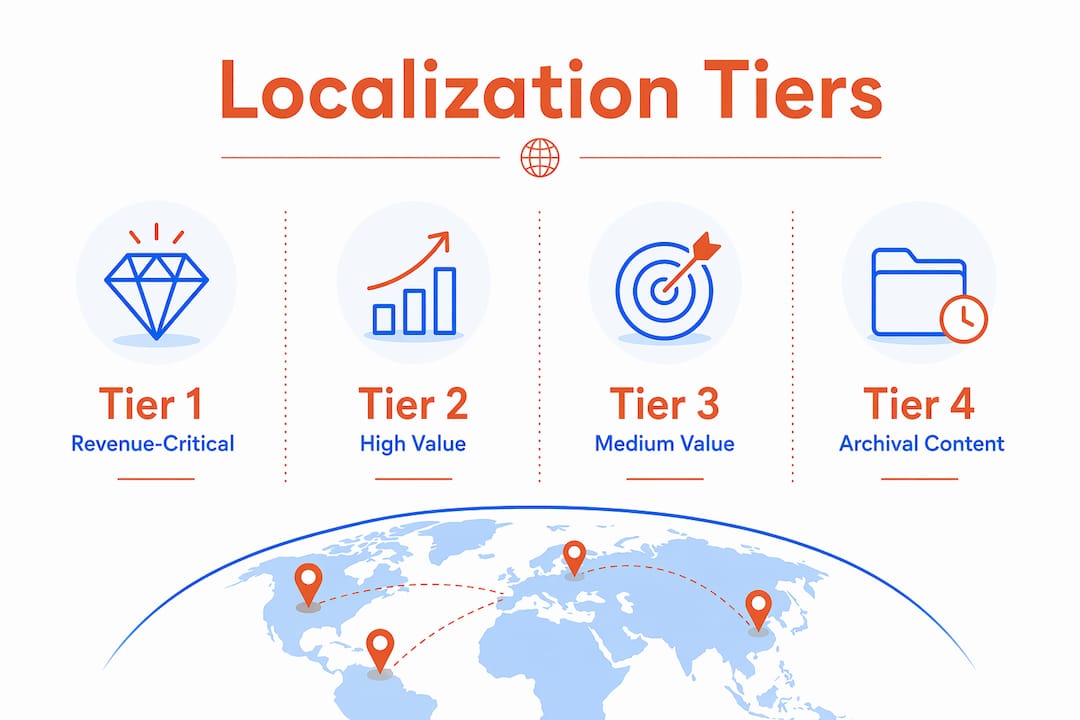
A four-tier model works well for most product teams:
Tier 1: Revenue-critical content. Pricing pages, checkout flows, onboarding screens, and core product UI. These get native copywriting and a human review pass. No shortcuts.
Tier 2: High-traffic support content. Help center articles, FAQs, and feature documentation that drive organic traffic and reduce support tickets. Machine translation with human post-editing is appropriate here.
Tier 3: Marketing and blog content. Mid-funnel pages with moderate conversion contribution. Use machine translation with light review, prioritizing by traffic volume.
Tier 4: Internal or archival content. Legal notices, internal wikis, and legacy documentation. Raw machine translation is acceptable, with no review cycle.
Applying a tier framework reduces localization spend by an estimated 30–50%. That’s not a rounding error. It means a team spending $100,000 annually on translation could redirect $30,000 to $50,000 toward higher-impact work or new market entry.
The metrics that drive tier assignment are traffic volume, conversion contribution, and strategic importance to the target market. A page with 50,000 monthly visits and a 4% conversion rate belongs in Tier 1 regardless of its content type. A blog post from three years ago with 200 visits per month belongs in Tier 4 even if it’s well-written.
Cultural adaptation is a separate budget line, not an afterthought. Native reviewers catch tone mismatches, idiomatic errors, and culturally inappropriate references that machine translation misses entirely. Build native review into your Tier 1 and Tier 2 budgets from the start.
Pro Tip: Run your content audit in a shared spreadsheet before touching any translation tool. Tag every page with its tier, monthly traffic, and conversion rate. Teams that skip this step routinely discover they’ve been paying to translate content that generates zero revenue.
What strategies optimize resource allocation across different project complexities?
No single resource allocation strategy fits every localization project. The right approach depends on your business priorities, team capacity, and the complexity of the content you’re shipping. Two frameworks cover most scenarios product teams face.
Priority-based allocation directs the majority of your budget and your best translators toward the highest-impact initiatives first. This works well when you’re entering a new market and need a polished, complete experience for a defined set of core pages. The risk is that lower-priority content gets delayed indefinitely if the team is small.

Capacity-based allocation distributes work according to what your team can realistically deliver without burning out or creating bottlenecks. This approach prevents overcommitment and keeps quality consistent across the project. It works best for ongoing localization programs where content volume is predictable month over month.
Strategy | Best for | Key advantage | Main risk |
|---|---|---|---|
Priority-based | New market launches | Concentrates quality on high-impact content | Lower-tier content stalls |
Capacity-based | Ongoing programs | Prevents overload and quality dips | May delay urgent requests |
Skill-based | Specialized domains (legal, medical) | Matches expert translators to complex content | Harder to scale quickly |
Hybrid | Complex SaaS products | Balances urgency and capacity | Requires active coordination |
Skill distribution matters more than most project managers expect. A translator fluent in French may not be the right choice for French Canadian fintech copy. Specialized domains require specialized reviewers. Budget for that specificity in your localization project planning phase, not after a quality issue surfaces in production.
Effective allocation balances immediate delivery needs with long-term capacity planning. Teams that consistently overcommit their translators see quality decline within two to three sprints. Build buffer time into every allocation cycle.
Pro Tip: Reserve 15–20% of your translator capacity each sprint for urgent requests and scope changes. Localization projects almost always expand mid-cycle. Teams that plan for this avoid the scramble that kills launch timelines.
What tools and processes support scalable localization resource allocation?
Translation Management Systems (TMS) are the operational backbone of any scalable localization program. They centralize translation memory, glossaries, and workflow automation in one place, replacing the manual spreadsheet methods that make proactive planning nearly impossible.
Automation and TMS platforms provide real-time budget tracking, historical data analysis, and workflow automation that are essential for scenario planning. Manual tracking in spreadsheets creates blind spots. By the time a project manager notices a budget overrun, the damage is done.
Workflow type | Translation method | Review level | Best use case |
|---|---|---|---|
Manual | Human translation | Full human review | Tier 1 critical content |
Semi-automated | MT + human post-editing | Targeted review | Tier 2 support content |
Fully automated | Machine translation | Spot-check only | Tier 3–4 low-priority content |
Scenario-based financial modeling takes budget planning from reactive to proactive. A well-built model includes three scenarios: likely, best-case, and worst-case content volume. When a product roadmap shifts and a new feature needs localization in two weeks, teams with scenario models already know what that costs and where the budget comes from.
Gleef integrates directly with Figma, letting product teams manage translations in context without switching platforms. This cuts the feedback loop between design and localization significantly. Designers see translated strings in their actual layouts, catching text expansion issues before they reach development. That kind of localization workflow visibility is what separates teams that ship on time from teams that discover localization bugs in QA.
Real-time budget dashboards inside your TMS or project management tool give stakeholders a live view of spend versus plan. That transparency reduces the surprise conversations that derail quarterly planning.
How do you maintain and adapt localization resource allocation over time?
Localization resource allocation is not a one-time decision. Markets shift, products evolve, and content volumes change every quarter. Teams that set an allocation plan in january and ignore it until december consistently overspend and underdeliver.
Sustained success requires these ongoing practices:
Monthly content audits. Review which pages gained or lost traffic. Tier assignments change as your product grows. A feature page that was Tier 3 six months ago may now drive 20% of trial signups.
KPI tracking tied to localization. Measure organic traffic by language, conversion rates per locale, and support ticket volume in each market. These numbers tell you where your localization investment is working and where it isn’t.
Contingency budget. Set aside 5–10% of your total localization budget for unforeseen scope changes. A product pivot, a regulatory update, or a sudden market opportunity can all demand fast translation work. Teams without contingency funding either delay or overspend.
Stakeholder alignment sessions. Hold a quarterly review with product, marketing, and engineering leads to align localization priorities with the company roadmap. Localization that isn’t connected to business strategy becomes a cost center instead of a growth driver.
Retrospectives after each launch. A localization launch targeting one new market with around 30 revenue-critical pages typically takes 4–6 weeks end to end. Adding multiple markets in parallel increases overhead by 20–30%. Use those numbers to calibrate your next allocation cycle.
Learning from results is the fastest way to improve your allocation model. Track what you planned versus what you spent, and adjust tier assignments and capacity buffers accordingly. Teams that run this loop quarterly build institutional knowledge that makes every subsequent launch faster and cheaper.
Key Takeaways
Effective localization resource allocation combines content prioritization, structured strategy selection, and continuous adjustment to deliver translation quality without overspending.
Point | Details |
|---|---|
Tier your content first | Assign every asset to Tier 1–4 based on traffic, conversion, and strategic value before allocating budget. |
Match strategy to project type | Use priority-based allocation for new market launches and capacity-based allocation for ongoing programs. |
Automate tracking and workflows | TMS platforms with real-time dashboards replace spreadsheets and prevent budget surprises. |
Reserve contingency budget | Hold back 5–10% of your localization budget to cover scope changes and urgent requests. |
Review and adjust quarterly | Monthly KPI tracking and quarterly stakeholder alignment keep allocation tied to business goals. |
What I’ve learned from watching teams get resource allocation wrong
The most expensive mistake I see product teams make is treating localization as a translation task rather than a resource planning problem. They hand a word count to a vendor, get a quote, and call it a budget. Then the roadmap changes, a new market gets added, and suddenly the “budget” is a fiction.
The teams that get this right think about localization the way engineering thinks about sprint capacity. They know their velocity, they protect their buffer, and they don’t commit to work they can’t staff. That discipline is rare in localization, but it’s the single biggest predictor of whether a global launch goes smoothly.
The tier framework changed how I think about content audits. Before I started using it, I assumed teams knew which content mattered most. They almost never do. Marketers want everything translated. Product managers want their feature pages first. Engineers want the API docs done. Without a shared framework tied to actual traffic and conversion data, every stakeholder wins the argument and the budget gets spread too thin to do anything well.
The other thing I’d push back on: the idea that automation replaces human judgment in allocation decisions. It doesn’t. Automation gives you visibility and speed. Human judgment tells you that the German market needs a different tone than the Austrian market even though they share a language. That nuance lives in your team, not your TMS. Build allocation plans that respect both.
— Antoine
Gleef makes localization resource allocation visible and fast
Product teams that want to stop guessing about translation quality and budget impact need tools that work where they already work.
Gleef connects directly to Figma, so your designers, UX writers, and product managers handle translations in context, inside the design file, without switching platforms. Gleef’s semantic translation memory and glossary features mean your Tier 1 content stays consistent across every locale, every release. The platform’s AI-powered translation engine handles Tier 2 and Tier 3 content at speed, while in-context editing keeps your team in control of quality. Teams using the Gleef Figma Plugin report faster release cycles and fewer localization-related launch blockers. If you’re building a global product and want your localization workflows to match your engineering pace, Gleef is worth a close look.
FAQ
What is localization resource allocation?
Localization resource allocation is the process of assigning budget, personnel, and technology to translation workflows based on content priority and business impact. It ensures high-value content gets the most attention and spend.
How much should a SaaS company budget for localization?
Initial setup and a first-language launch typically cost $15,000 to $80,000, with ongoing monthly maintenance running $2,000 to $8,000 for 10 languages. Total annual spend scales significantly with content volume and the number of target markets.
What is the tier framework for content prioritization?
The tier framework ranks content from Tier 1 (revenue-critical, native translation) to Tier 4 (archival, raw machine translation). Applying it reduces localization spend by an estimated 30–50% by focusing resources on content that drives measurable business outcomes.
How often should you review your localization resource plan?
Monthly KPI reviews and quarterly stakeholder alignment sessions are the minimum. Markets and product roadmaps change fast enough that annual reviews leave teams reacting to problems instead of preventing them.
What contingency budget should localization teams hold?
Reserve 5–10% of your total localization budget for unforeseen scope changes, regulatory updates, or new market opportunities. Pre-approved spending plans tied to specific risk scenarios let teams respond quickly without derailing the broader project.