
TL;DR:
The translation profession involves converting meaning and cultural context across languages with accountability and ethical responsibility. Success requires fluency, certification, subject-matter expertise, and mastery of AI tools to evaluate and govern machine-generated output. Building a sustainable career depends on specialization, professional credentials, and a clear identity as a risk and meaning manager.
The translation profession is defined as the specialized practice of converting meaning, intent, and cultural context across languages with professional accountability. Fluency alone does not guarantee a translation career. Today’s professional translators are decision scientists who evaluate risk, govern AI output, and take ethical responsibility for every word that reaches a global audience. From legal contracts to medical device instructions, the stakes are high and the skill set required has never been more demanding. This guide covers what you need to qualify, specialize, and build a career that lasts.
What qualifications and skills are essential for the translation profession?
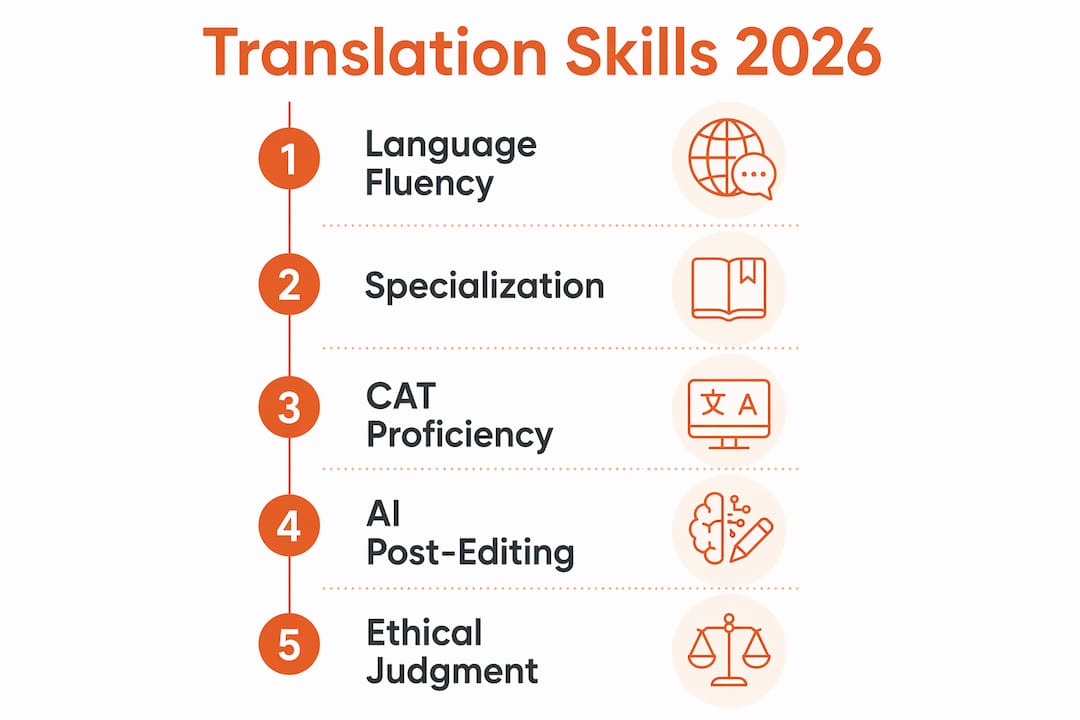
Most translation employers require fluency in at least two languages, a four-year degree, proficiency in computer-assisted translation (CAT) tools, and professional certification. These are the baseline requirements for accessing serious, well-compensated work in 2026. Meeting them positions you as a credible professional rather than a casual bilingual.
The core qualifications break down into four areas:
Language fluency: Native or near-native command of your source and target languages, including regional dialects, register shifts, and idiomatic usage. Fluency means you catch what a machine misses.
Formal education: A bachelor’s degree in translation, linguistics, or a subject-matter field like law or medicine. Subject-matter degrees are increasingly valuable for specialized niches.
CAT tool proficiency: Hands-on experience with tools like SDL Trados, memoQ, or Wordfast. These platforms manage translation memory, glossaries, and consistency at scale. Clients expect you to use them.
Professional certification: The American Translators Association (ATA) certification is the gold standard in the United States. ATA certification builds credibility and opens access to higher-tier legal and corporate work.
Beyond credentials, the soft skills that separate good translators from great ones include critical thinking, cultural intelligence, and ethical judgment. You are not just transferring words. You are making dozens of micro-decisions per page about tone, implication, and risk. That requires a mindset closer to an analyst than a typist.
Pro Tip: If you are early in your career, pursue ATA certification in a specialized language pair before marketing yourself to agencies. Certified translators consistently command higher rates and attract more serious clients.

How has AI reshaped the translation profession?
AI has not replaced professional translators. It has changed what the job actually requires. AI tools augment translators by supporting structured decision-making, evaluation, and accountability rather than eliminating the human role. The translators who thrive in 2026 are the ones who understand this distinction clearly.
Here is how the modern AI-augmented translation workflow operates:
Raw machine translation (MT) output: Tools like DeepL or Google Translate generate a first draft. This draft is fast but unaccountable. It carries no cultural judgment, no ethical filter, and no awareness of client-specific terminology.
Human evaluation and post-editing: The professional translator reviews the MT output against source intent, brand voice, legal requirements, and cultural appropriateness. This is where expertise earns its fee.
AI-assisted governance: Platforms like NovaLexy provide structured evaluation frameworks, mentorship layers, and governance tools that help translators audit AI output systematically. Governance frameworks like NovaLexy’s raise professional standards by making the evaluation process repeatable and defensible.
Quality control sign-off: The translator takes accountability for the final output. This accountability is what clients pay for and what AI cannot provide.
Continuous feedback loops: AI tools learn from corrections when properly configured, improving translation memory over time and reducing repetitive work on recurring content.
The risk in this workflow is not that AI takes your job. The risk is that you treat AI output as finished work. Ethical AI tools that empower translators rather than replace them are the ones worth integrating into your practice. Understanding AI in localization beyond surface-level hype is now a core professional competency.
Pro Tip: When post-editing machine translation, always work from the source text, not the MT output. Anchoring your review to the original prevents you from inheriting the machine’s errors as your own.
What are the key specializations and career paths in translation?
Specialized translators in medical, legal, technical, and marketing fields command higher rates and build long-term client trust compared to generalists. Specialization is not just a career strategy. It is a quality argument. Clients in high-stakes fields need translators who understand the subject matter deeply enough to catch errors that a generalist would miss entirely.
Specialization | Typical clients | Key demand drivers |
|---|---|---|
Legal translation | Law firms, courts, corporations | Contract precision, liability, regulatory compliance |
Medical translation | Pharma companies, hospitals, device manufacturers | Patient safety, FDA/EMA requirements, clinical accuracy |
Technical translation | Engineering firms, software companies | Terminology consistency, safety documentation |
Financial translation | Banks, investment firms, auditors | Regulatory filings, market-sensitive language |
Audiovisual (AV) translation | Film studios, streaming platforms, ad agencies | Timing, lip-sync, cultural adaptation |
Marketing localization | Global brands, e-commerce platforms | Brand voice, cultural resonance, conversion optimization |
Career paths within the translation profession range from freelance work to corporate in-house roles to public-sector positions. Freelance translators enjoy flexibility but carry the full weight of client acquisition and business management. In-house translators at corporations like pharmaceutical companies or financial institutions trade some autonomy for stability, benefits, and deep subject-matter immersion. Public-sector roles offer a different kind of reward. Translators working with critical languages like Arabic, Mandarin, Russian, Farsi, Korean, and Spanish can reach GS-13 to GS-15 pay grades in U.S. federal positions. That is a significant earning ceiling for the right language combination.
Conference interpreting sits adjacent to translation but deserves mention. Simultaneous interpreters at organizations like the United Nations or the European Commission operate under extreme cognitive pressure and command premium rates. It is a distinct skill set that requires dedicated training beyond translation competency.
What challenges does the translation profession face today?
The translation profession faces a structural tension between industry pressures and professional standards. Commoditization and downward price pressure are the defining challenges for freelancers in 2026, with automation and non-negotiable deadlines increasing stress across the board. Understanding this tension is the first step to navigating it.
The core challenges you are likely facing or will face include:
Race-to-the-bottom pricing: Translation marketplaces and large language service providers (LSPs) often compete on price, pushing rates down for generalist work. This squeezes translators who have not differentiated themselves.
AI ethics and cultural bias: Machine translation systems trained on biased datasets produce biased output. When translators accept MT output uncritically, they become complicit in spreading that bias into legal, medical, or political content.
Intellectual property and confidentiality risks: Uploading client documents to public AI tools without data processing agreements creates legal exposure. Many translators are unaware of the contractual implications.
Professional identity erosion: When clients treat translation as a commodity, the professional identity of the translator erodes. Translators as cultural ambassadors and risk managers of meaning carry ethical responsibilities that commodity pricing ignores.
Isolation and lack of support structures: Freelance translators often work without the peer review, mentorship, or quality assurance systems that in-house professionals benefit from.
The adaptation strategies that work are specific, not generic. Joining professional organizations like the ATA or the International Association for Translation and Intercultural Studies (IATIS) provides credential validation, networking, and a professional community that differentiates career professionals from casual freelancers. Niche focus, advanced credentials, and a visible professional presence online are the three levers that consistently move translators out of commodity competition.
How can you build a sustainable translation career in 2026?
A sustainable language translation career in 2026 is built on four pillars: education, credentials, technology mastery, and professional visibility. Each one reinforces the others. Neglecting any one of them creates a gap that competitors will fill.
Pursue structured education and training. A degree in translation, linguistics, or a specialized field gives you the theoretical foundation and the credential that serious clients check. Programs at institutions like the Middlebury Institute of International Studies or the University of Geneva’s Translation School provide both.
Earn and maintain professional certification. ATA certification for U.S.-based translators, or equivalent credentials from the Chartered Institute of Linguists (CIOL) for those working in UK and European markets, signals that you meet a verified professional standard. Recertification requirements keep you current.
Master the technology stack. SDL Trados, memoQ, and CAT tools are table stakes. Beyond that, understanding how to work with AI evaluation tools and translation technology trends shaping the industry gives you a genuine edge over translators who treat technology as optional.
Build a personal brand and client relationships. A professional website with a clear specialization, a LinkedIn profile with client testimonials, and a portfolio of published or certified work are the minimum for attracting direct clients. Agencies are a starting point, not a destination.
Practice ethical discipline consistently. Clients require cultural alignment, legal certainty, and accountability in translations beyond mere correctness. Translators who document their decision-making process and maintain transparent quality standards build the kind of client trust that survives market disruptions.
The translators who build 20-year careers are not the ones who translate the most volume. They are the ones who become indispensable to a specific client base by combining deep subject-matter knowledge with consistent professional standards. Learning to build effective AI translation skills for global reach accelerates that process significantly.
Key takeaways
The translation profession in 2026 demands fluency, specialization, ethical judgment, and technology mastery working together as a unified professional practice.
Point | Details |
|---|---|
Credentials matter | ATA certification and a four-year degree are the baseline for accessing high-tier legal and corporate work. |
AI augments, not replaces | Translators who govern and evaluate AI output are more valuable than those who resist or blindly accept it. |
Specialization drives earnings | Medical, legal, and technical translators command premium rates because subject-matter depth reduces client risk. |
Professional associations protect careers | Organizations like ATA and IATIS provide credentials, networking, and identity that commodity markets cannot erode. |
Ethics is a competitive advantage | Translators who document decisions and maintain cultural accountability build client trust that outlasts price competition. |
Why the translator’s identity is the profession’s most important asset
I have spent years watching talented linguists undervalue what they actually do. The instinct to describe yourself as “just a translator” is a career-limiting habit. What you are, when you work at a professional level, is a risk manager of meaning. Every document you touch carries consequences. A mistranslated drug dosage instruction, a misread contract clause, a culturally tone-deaf marketing campaign. These are not abstract risks. They are the exact scenarios where your judgment, not your vocabulary, determines the outcome.
The tension between the translation industry and the translation profession is real and worth naming clearly. The industry wants volume, speed, and low cost. The profession demands accuracy, accountability, and ethical rigor. You live in both worlds simultaneously, and the pressure to prioritize the industry’s demands over the profession’s standards is constant. The translators I respect most are the ones who have drawn a clear line and held it.
AI is not the threat most people think it is. The actual threat is the normalization of unreviewed AI output as acceptable professional work. When you audit, govern, and take accountability for AI-generated content, you are not doing less work. You are doing different work. That work is harder to automate, harder to commoditize, and worth more to clients who understand what they are buying.
My honest advice: specialize early, certify formally, and treat every translation decision as a documented professional judgment. The translators who do this are not just surviving the current market. They are defining what the profession looks like for the next generation.
— Antoine
How Gleef supports modern translation workflows
Professional translators and product teams increasingly work at the intersection of language and software. Gleef is built for exactly that intersection.
Gleef’s AI-powered localization platform integrates directly with Figma, giving translators and product teams the ability to manage translations in context without switching tools. Features like semantic translation memory, glossary enforcement, and in-context editing mean that every translation decision is made with full visibility into how the text actually appears in the product. For translators working on digital products, that context is the difference between a technically correct translation and one that actually works for users. Explore the Gleef Figma Plugin to see how AI-powered localization fits into a professional translation workflow.
FAQ
What does the translation profession require in 2026?
Professional translators need fluency in at least two languages, a four-year degree, proficiency in CAT tools like SDL Trados or memoQ, and ideally ATA certification. Specialization in a subject-matter field significantly increases earning potential and client trust.
How does AI affect translation job opportunities?
AI creates more translation work by expanding global content volume, but it shifts the required skill set toward evaluation, post-editing, and governance of machine output. Translators who master AI-assisted workflows are more competitive, not less employed.
What is the best certification for translators?
The American Translators Association (ATA) certification is the most recognized credential for translators working in the U.S. market. The Chartered Institute of Linguists (CIOL) Diploma in Translation is the equivalent standard for European markets.
Is freelance translation work sustainable long-term?
Freelance translation is sustainable when built on specialization, direct client relationships, and professional credentials. Generalist freelancers competing on price face the greatest pressure from automation and marketplace commoditization.
What skills separate professional translators from casual bilinguals?
Professional translators combine subject-matter expertise, CAT tool proficiency, ethical judgment, and cultural intelligence. The ability to manage translation risk and document professional decisions is what clients in legal, medical, and financial fields are actually paying for.