
TL;DR:
Building a reusable AI translation skill transforms localization from a bottleneck into a competitive advantage through standardized quality controls and seamless integration.
Prerequisites like clean source content, glossaries, and infrastructure planning ensure high-quality, scalable, and compliant multilingual delivery.
Picture this: your product team is two weeks from a major release into four new markets. The copy is finalized, the UI is polished, and then localization brings everything to a halt. Translators are backlogged, terminology is inconsistent across languages, and the review cycle adds another sprint to your timeline. This bottleneck is a pattern that streamlined translation frameworks are designed to break, and in 2026, building a reusable AI translation skill is the most powerful way to do it. This guide walks you through the ideas, best practices, and technical choices that turn localization from a release blocker into a competitive advantage.
Key Takeaways
Point | Details |
|---|---|
Preparation is key | Thoroughly prepare your content, glossaries, and style guides before starting to ensure high translation accuracy. |
Hybrid models win | Combining dedicated translation engines with LLMs and human oversight delivers the best results. |
Benchmark for success | Always measure your AI translation skill using domain-specific data, BLEU/COMET, and human feedback. |
Automate and review | Automate workflows where possible but route low-confidence translations to human reviewers for quality. |
Handle edge cases | Account for cultural, technical, and formatting nuances to avoid costly translation errors. |
What you need before starting
Once the opportunity and need for an AI translation skill is clear, it is important to ensure you have the right foundation and resources. Rushing into implementation without solid groundwork is how teams end up with low-quality translations, inconsistent terminology, and brittle pipelines that break under scale.
Start with your source content. Before any AI model touches your strings, your content must be clean, segmented, and up to date. Stale copy, ambiguous phrasing, and orphaned strings all degrade translation quality downstream. Think of clean source content as the bedrock of a bulletproof localization pipeline.
Here is what you need to have locked in before you begin:
Glossaries and style guides: Key steps include preparing glossaries, style guides, and defining terminology consistency across all target languages. This is the single most impactful investment you can make before writing a single line of integration code.
Target language pairs: Identify your priority markets and languages. Not all language pairs behave the same way with AI models, and high-resource pairs like English to Spanish will perform very differently from low-resource pairs like English to Burmese.
Infrastructure decisions: Decide on API access, hosting resources, and who owns what in your tech stack. Will you run a server-side proxy, or will translations be triggered by events in your CI/CD pipeline?
Team roles: Assign clear ownership. Who reviews AI output? Who maintains the glossary? Who monitors quality metrics over time?
Compliance requirements: Define data handling rules upfront, especially if your product operates in regulated industries. Translation data can contain sensitive user information, and privacy requirements vary widely by region.
Pro Tip: Create a localization readiness checklist before your first sprint. Teams that audit their source content and finalize glossaries before integrating any AI model consistently report faster implementation and better output quality from day one.
Prerequisite | Why it matters | Who owns it |
|---|---|---|
Clean source strings | Reduces AI errors at the root | Content/UX writers |
Glossary and style guide | Enforces brand voice consistency | Localization manager |
Target language pairs | Shapes model and API selection | Product manager |
Infrastructure plan | Prevents scaling surprises | Engineering lead |
Compliance checklist | Avoids legal and privacy risks | Legal/security team |
Step-by-step process to build your AI translation skill
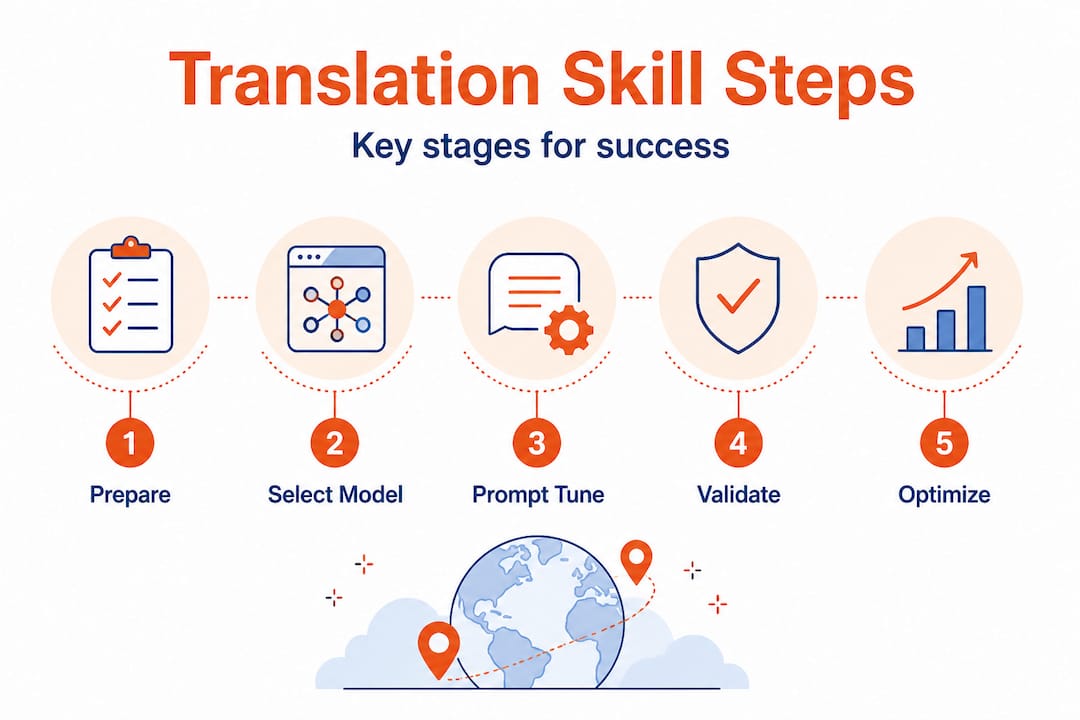
With prerequisites in place, you can move into the technical process of crafting your AI translation skill. In 2026, the concept of a “skill” in major AI platforms like GPT, Gemini, or Claude refers to a reusable, scoped agent or prompt configuration that can be invoked consistently across workflows. Building a translation skill means packaging your instructions, context, and quality controls into a repeatable unit. Here is how to do it well.
Prepare and preprocess source texts. Segment your content into translation units. Strip irrelevant markup, normalize whitespace, and flag strings that contain dynamic variables or placeholders. Variables like "{username}
or{count}` must be protected from translation. This preprocessing step is often skipped, and it causes hallucinations and broken UI strings later.Build your glossary and style guide layers. Feed your AI skill a structured glossary as part of its system prompt or context. Define preferred terminology, forbidden words, and tone guidelines for each locale. When you embed these rules directly into the skill, every translation request automatically respects your brand voice. This is the difference between a generic AI output and a native-sounding localized experience.
Choose your architecture. You have two primary options: a server-side proxy with API retries, caching, and rate limiting, or an event-driven model where translation is triggered by content updates, webhooks, or CI/CD events. The event-driven approach scales better for large product teams shipping continuously. Your architecture choice directly affects latency, cost, and reliability.
Integrate your AI model. Choose architecture, integrate the API with retries, caching, and rate limiting, add quality estimation, and build a human post-editing workflow. Do not treat the AI as the final step. Quality estimation (QE) scores each translation’s confidence level and routes low-confidence output to human reviewers before it ships.
Add quality estimation and human review routing. QE is the safety net that separates mature localization pipelines from fragile ones. Tools like COMET-QE can score translations without a reference translation, flagging risky output automatically. Pair this with a clear escalation path to human reviewers for anything that falls below your threshold. You get quality standards for localization that hold across every release.
Automate with CI/CD and webhooks. Connect your translation skill to your deployment pipeline. When new content is pushed, a webhook triggers the skill, translations are generated and scored, and approved output flows directly into your localization files. This eliminates the manual handoff that kills release velocity.
Choose your model strategy. Dedicated MT models like DeepL or Google are better for high-resource languages, while LLMs excel at context-sensitive content. A hybrid approach, where you route content to the best model based on type and language pair, consistently outperforms any single-model solution. The AI translation benefits of this hybrid approach are most visible in complex UI copy and marketing content where tone matters as much as accuracy.
“The best translation skill is not the smartest one. It is the most consistent one. Glossaries, rules, and routing logic do more for quality than model size alone.”
Model type | Best for | Weakness |
|---|---|---|
Dedicated MT (DeepL, Google) | High-resource languages, speed | Struggles with context and tone |
LLMs (GPT, Gemini, Claude) | Context, nuance, marketing copy | Slower, costlier at scale |
Hybrid approach | Broad coverage, balanced quality | More complex to orchestrate |
Pro Tip: When writing your translation skill’s system prompt, include three to five concrete examples of your preferred output style for each locale. Few-shot examples inside the skill dramatically improve tone consistency without requiring fine-tuning.
Handling edge cases and common pitfalls
Once your AI translation skill covers general use cases, it is vital to address special cases and prevent failures that harm trust or quality. Edge cases are where AI translation falls apart in production, and handling them proactively is what separates a solid skill from one that creates more work than it saves.
Handling low-resource languages, cultural nuances, script-specific chunking, and requiring human review for high-risk content are the most common gaps teams discover after launch. Here is how to address each:
Low-resource languages: Standard AI models often perform poorly on languages with limited training data. Fine-tune a specialized model or use a fallback strategy that routes to a human translator when confidence scores drop below a defined threshold. Never let a low-confidence translation ship automatically.
Cultural nuances and regional terms: A word that works perfectly in Brazilian Portuguese can feel jarring or offensive in European Portuguese. Build locale-specific glossary layers and include regional context notes in your skill’s system prompt. Semantic translation best practices go beyond word-for-word conversion to account for meaning in context.
Markup preservation: HTML tags, markdown formatting, and platform-specific tokens must survive the translation process intact. Implement a markup protection layer that strips, protects, and reinserts these elements around the translation step.
Hallucinations: LLMs occasionally fabricate content, especially when handling ambiguous source strings or rare terms. Use confidence thresholds and automated format validation to catch outputs that deviate from expected patterns.
High-risk content categories: Legal disclaimers, medical instructions, and financial terms should always route to human review, regardless of the AI’s confidence score. The cost of a mistranslation in these contexts far exceeds the cost of expert review.
CJK and complex scripts: Chinese, Japanese, and Korean require careful chunking because sentence boundaries and character segmentation work differently than in Latin-script languages. Validate your segmentation logic specifically for these scripts before launch.
“Edge cases are not exceptions. In production, they are the rule. Build your skill to handle them from day one, and you will avoid the painful retrofitting that most teams face after their first global launch.”
Test, validate, and optimize your translation skill
Once your skill is functional, ongoing validation is essential to ensure high-quality translation and relevance to your product domain. Shipping once is not enough. Your content evolves, your markets expand, and your AI models update. A validation loop is not optional.

No single model wins all benchmarks; you need to benchmark on your own domain and language pairs using BLEU and COMET metrics combined with human evaluation, and consensus or ensemble methods reduce errors across the board.
Here is what a strong validation practice looks like:
BLEU scores measure how closely AI output matches a reference translation. Useful for regression testing, but limited for evaluating fluency and tone in UI copy.
COMET scores use neural models to evaluate translation quality without needing a perfect reference. They correlate more closely with human judgment, making them better for real-world product content.
Human evaluation remains irreplaceable for nuanced content like marketing copy, onboarding flows, and error messages. Build a lightweight human review cadence into your localization sprint.
Ensemble and consensus methods combine outputs from multiple models and select the best translation by agreement or weighted scoring. This approach consistently reduces error rates on difficult language pairs.
Continuous monitoring means tracking quality metrics over time, not just at launch. Set alerts for sudden quality drops that may indicate a model update or a content change that broke your glossary alignment.
For teams using the cross-functional localization guide approach, integrating validation into shared sprint ceremonies keeps quality visible across the whole product team, not just the localization function.
Metric | What it measures | Best used for |
|---|---|---|
BLEU | Similarity to reference | Regression testing, bulk content |
COMET | Neural quality scoring | UI copy, nuanced content |
Human eval | Fluency, tone, cultural fit | Marketing, onboarding, legal |
Ensemble agreement | Cross-model consistency | High-stakes or critical strings |
A smarter way forward: What most guides miss about AI translation skills
Having covered the core process, let’s discuss a strategic perspective that most how-tos miss and why it matters for your product roadmap.
Most teams approach AI translation as a technology problem. They pick a model, wire up an API, and call it done. The real challenge is not technical. It is systemic. The organizations that get the most value from AI translation skills are the ones that treat localization as a living workflow, not a one-time integration.
Here is the uncomfortable truth: hybrid or ensemble models reduce errors by up to 22% compared to single-model approaches, yet the majority of product teams still rely on a single provider because it feels simpler. Simplicity in your stack is a valid goal, but not when it costs you quality in markets where trust is everything.
The second thing most guides miss is the power of real user feedback. Your localized users notice problems that no automated metric will ever catch. A phrase that scores perfectly on COMET can still feel robotic to a native speaker in Tokyo or São Paulo. Building a lightweight feedback loop where users can flag awkward translations feeds directly back into your glossary and rules, making your skill smarter over time. This is not a nice-to-have. It is the compounding advantage that separates teams who are beyond AI translation hype from those still chasing vanity metrics.
Finally, no single AI translation approach fits every domain or every use case. Your checkout flow needs different handling than your help documentation, which needs different handling than your marketing landing pages. Routing content to the right model and the right review process based on content type is the architectural decision that most teams make too late. Make it early, and you will avoid the costly retrofitting that stalls global rollouts.
Ready to get started? Take your AI translation further
Now that you know how to create and optimize an AI translation skill, consider leveraging dedicated solutions to accelerate your rollout.
Building a translation skill from scratch is powerful, but the most successful product teams pair that knowledge with purpose-built tooling that handles the hardest parts automatically.
Gleef’s Figma AI translation plugin lets your designers and UX writers manage translations in context, inside the tool they already use every day, without switching platforms or breaking their flow. Behind the scenes, Gleef runs a context-aware LLM pipeline enriched with semantic translation memory, custom glossaries, and rules-based quality controls. This means every AI translation your team generates is already grounded in your brand voice, your terminology, and your product’s specific content patterns. You get the speed of automation and the precision of a system that actually knows your product. Explore product localization solutions designed specifically for product teams who need to ship fast and ship right.
Frequently asked questions
What is the best AI architecture for translation skills?
A hybrid approach combining ML and human review is best, using dedicated machine translation for high-resource language pairs and large language models for context-sensitive content, with human oversight for quality assurance.
How do you handle low-resource languages in AI translation?
Fine-tuning and fallback strategies are required for low-resource languages; combine model fine-tuning with human post-editing for high-risk content to maintain acceptable quality thresholds.
How do you measure AI translation quality?
Benchmark using BLEU and COMET on your own domain data alongside human evaluation, since automated metrics alone do not capture fluency, tone, or cultural fit for real product content.
Can I automate the entire translation process without humans?
Automation alone is insufficient; always incorporate human review for critical, ambiguous, or high-stakes content to prevent costly errors that automated quality estimation cannot reliably catch.
What are common mistakes when building AI translation skills?
Teams most often overlook quality estimation and edge case handling, including missing markup preservation, ignoring cultural nuances, and failing to route low-confidence or high-risk strings to human reviewers before they ship.