
TL;DR:
Language translation involves converting written content between languages while maintaining meaning and tone. Modern tools like neural AI systems handle diverse mediums and languages, but human oversight remains essential for cultural nuance, coherence, and legal precision. Combining AI efficiency with human expertise ensures accurate, culturally appropriate, and high-quality multilingual communication.
Language translation is the process of converting written content from one language into another while preserving the original meaning, tone, and intent. Most people picture a human expert swapping words between French and English, but the reality in 2026 is far more expansive. Translation now covers software, video, and multimedia content, not just printed documents. Tools like Google Translate handle billions of queries daily, while neural AI systems power everything from legal contracts to mobile app interfaces. Understanding how translation works gives you a real advantage when building products or communicating across cultures.
What is language translation, and how is it defined?
Language translation is defined as the transfer of meaning from a source language to a target language in written form. That last part matters. The European Commission’s DG Translation draws a clear line: translation handles written texts, while interpretation handles spoken, live communication. A court interpreter works in real time without a script. A legal translator works from a document with time to research, revise, and verify.
The distinction shapes everything about the workflow and the quality standard. A spoken interpreter can clarify meaning on the spot. A written translator must anticipate every ambiguity in advance and resolve it on the page. This is why translation is more than word substitution. It aims to produce content with equivalent impact and legal validity, especially in institutional contexts where a mistranslated clause can invalidate an entire agreement.
Think of it this way: when the EU publishes legislation in 24 official languages, every version carries equal legal weight. That is not a word-for-word swap. It is a precision engineering task performed by specialists who understand both the source language and the legal system it operates within.
What are the types of language translation and how do they differ?
Translation is not a single discipline. It branches into specialized fields, each with its own standards, tools, and failure modes.
Type | Primary output | Key requirement |
|---|---|---|
Legal translation | Contracts, legislation, court documents | Terminology precision, legal equivalence |
Medical translation | Clinical trials, patient records, drug labels | Regulatory compliance, zero ambiguity |
Technical translation | Manuals, engineering specs, software UI | Domain expertise, consistency |
Literary translation | Novels, poetry, screenplays | Creative adaptation, voice preservation |
Audiovisual translation | Subtitles, dubbing, voice-over | Timing, lip sync, cultural fit |
Post-edited machine translation | Any content type | Human review of AI output |
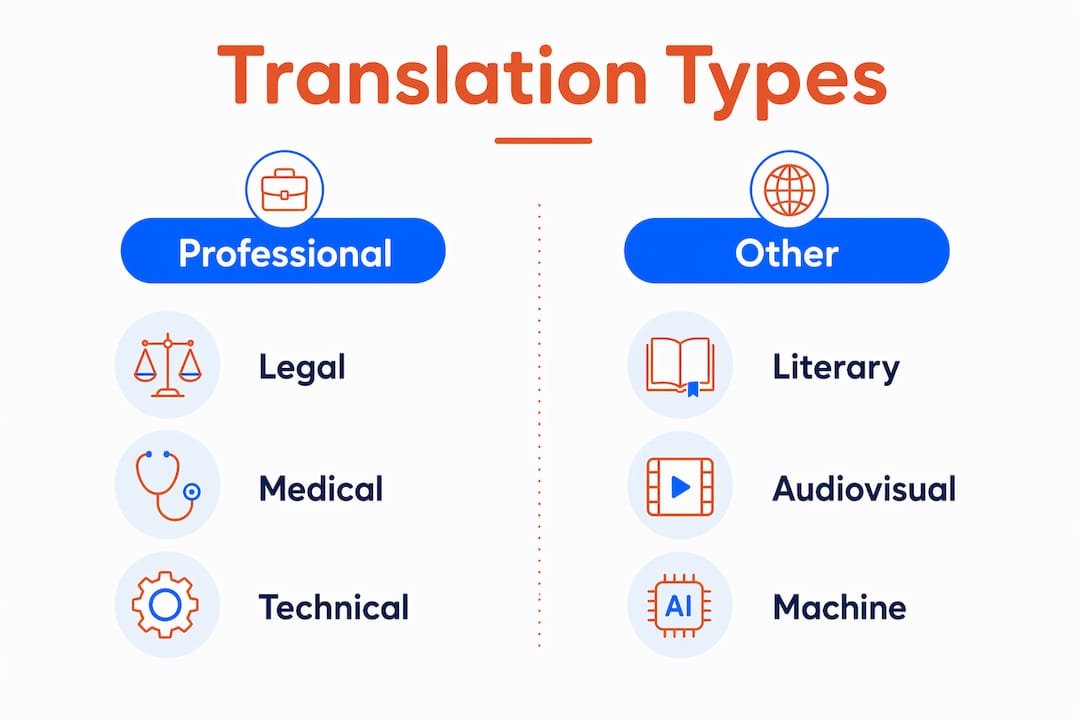
Post-edited machine translation has become a standard workflow in professional agencies. A machine produces a first draft, and a human translator refines it for accuracy, tone, and consistency. This hybrid approach cuts turnaround time significantly without sacrificing quality on high-stakes content.
Here is what separates these types in practice:
Legal and medical translation require certified translators with domain credentials. A mistranslated dosage instruction is a patient safety issue, not just a language error.
Literary translation demands creative judgment. Translating Gabriel García Márquez into Japanese is not about finding equivalent words. It is about recreating a reading experience.
Audiovisual translation adds a timing constraint. Subtitles must fit within character limits per line and sync to the speaker’s rhythm.
Software and UI translation requires understanding how text behaves inside an interface, where a German string can be 40% longer than its English source and break a button layout entirely.
How does modern language translation technology work?
Modern machine translation is built on neural networks, specifically a model architecture called the transformer. Transformer-based models) encode a source sentence into a numerical representation and then decode it into the target language, using an attention mechanism to weigh the relevance of every word in the source against every word being generated. This is what allows the model to handle long-range dependencies, like connecting a pronoun at the end of a paragraph to the noun it refers to at the beginning.

The practical result is that neural machine translation (NMT) systems now handle over 200 languages within a single model. Multilingual NMT systems share parameters across languages, which means a model trained heavily on Spanish and Portuguese can transfer that knowledge to Catalan, even with far less Catalan training data. This is called zero-shot translation, and it is one of the most significant advances in the field.
Current AI-driven platforms like Google Translate and DeepL use transformer architectures at their core. Large language models like GPT-4 and Claude have expanded contextual translation capabilities, but dedicated NMT systems remain more efficient at scale and speed for production workloads. The two approaches are converging, with retrieval-augmented systems pulling from terminology databases to improve domain-specific accuracy.
Key capabilities of modern machine translation systems:
Attention mechanisms that capture context across entire sentences, not just adjacent words
Zero-shot translation between language pairs with no direct training data
Domain adaptation through fine-tuning on specialized corpora like legal or medical texts
Integration with translation memory tools that reuse previously approved translations for consistency
Pro Tip: Use machine translation for high-volume, lower-stakes content like internal communications or first-draft localization. Reserve human translators or post-editing workflows for customer-facing copy, legal documents, and any content where brand voice or regulatory compliance is non-negotiable.
You can explore how these translation technology trends are reshaping product localization in practice, particularly for software teams shipping to global markets.
What are the main challenges and limitations in language translation?
Translation is hard. Machine translation is harder than it looks from the outside. Here are the core problems that no system has fully solved yet.
Ambiguity and idiomatic expressions. The English phrase “kick the bucket” means nothing useful if translated literally into Mandarin. Idiomatic language requires cultural knowledge, not just linguistic knowledge. Machine systems frequently produce literal translations that confuse or offend native speakers.
Cultural adaptation beyond words. Adapting marketing slogans and humor requires human judgment that goes beyond literal word translation. A joke that lands perfectly in Brazilian Portuguese may be incomprehensible or inappropriate in Korean. This is where translation ends and localization begins.
Low-resource language data scarcity. Data scarcity is the root cause of poor translation quality for less common languages. Languages like Yoruba, Quechua, or Tigrinya have far less training data available than English or Mandarin, which means AI models produce lower-quality output for speakers of those languages. This is a global equity issue, not just a technical one.
Document-level coherence. Most AI systems translate sentence by sentence, without tracking what was said three paragraphs earlier. A character referred to as “she” in paragraph one might become “he” by paragraph ten if the system loses context. This creates consistency failures that are difficult to catch without a full human review.
Terminology consistency. In legal and institutional translation, the same concept must be expressed with the same term throughout an entire document and across all related documents. Terminology coordination is a dedicated discipline within institutional translation, and it is one of the areas where AI tools still require significant human oversight.
Pro Tip: When reviewing AI-translated content, prioritize checking proper nouns, technical terms, and any sentence containing negation. These are the three categories where machine translation errors are most frequent and most damaging.
For a deeper look at how localization professionals handle these problems day to day, the examples of translation challenges that product teams face are worth reading before you commit to a translation workflow.
How is language translation applied in real-world contexts?
Translation powers more of the global economy than most people realize. Here is where it shows up most visibly.
Legal and institutional contexts are the highest-stakes environment for translation. The EU operates in 24 official languages, and every piece of legislation must carry equal legal validity in all of them. A single terminology inconsistency can create interpretive conflicts between member states. This is why the EU maintains dedicated multilingual glossaries and terminology databases managed by specialist teams.
Software and product localization is where translation meets interface design. When a product team ships a SaaS application to German, Japanese, and Arabic markets simultaneously, they are not just translating strings. They are adapting layouts for text expansion, adjusting date and number formats, and ensuring that the UI still makes sense when the language reads right to left. Understanding the difference between translation and localization is the first step toward building a product that feels native in every market.
Multimedia and audiovisual translation is growing fast as streaming platforms expand globally. Netflix, for example, localizes content into dozens of languages per title, combining subtitling, dubbing, and audio description tracks. Each format has different constraints and requires different specialists.
E-commerce and business communication depend on translation to reach customers in their own language. Research consistently shows that consumers are more likely to purchase from websites in their native language, even when they speak English fluently. This makes professional translation a direct revenue driver, not just a compliance cost.
Application area | Primary translation type | Key success metric |
|---|---|---|
EU legislation | Institutional/legal | Terminology equivalence |
SaaS product UI | Technical/software | String accuracy and layout fit |
Streaming content | Audiovisual | Timing and cultural adaptation |
E-commerce | Marketing/commercial | Conversion rate by locale |
Key takeaways
Language translation is a precision discipline that combines linguistic expertise, cultural knowledge, and increasingly powerful AI tools to move meaning across language boundaries without losing accuracy or impact.
Point | Details |
|---|---|
Translation vs. interpretation | Translation is written; interpretation is spoken and live. The workflow and quality standards differ fundamentally. |
Types vary by domain | Legal, medical, literary, and audiovisual translation each require specialized skills and tools beyond general fluency. |
NMT powers modern tools | Transformer-based neural models handle 200+ languages and enable zero-shot translation for low-resource language pairs. |
AI has real limits | Machine translation fails on idioms, cultural humor, document coherence, and low-resource languages without human oversight. |
Translation drives revenue | Multilingual product and e-commerce content directly increases conversion rates and market reach across global audiences. |
Why the human-AI partnership in translation is still underestimated
I have spent years watching product teams treat translation as a checkbox. Ship the English version, run it through an AI tool, call it done. The results are predictable: confused users, broken layouts, and the occasional PR incident when a slogan lands badly in a new market.
What I find genuinely exciting about where translation is heading is not the AI itself. It is the emerging clarity about what AI is actually good at versus what it cannot do. Neural machine translation is extraordinary at speed and coverage. It can produce a serviceable first draft in 200 languages faster than any human team. But it has no cultural intuition. It does not know that a color associated with celebration in one culture signals mourning in another. It does not catch when a translated headline sounds condescending to a regional audience even though every word is technically correct.
The teams getting this right are the ones treating AI as a first-pass accelerator and human expertise as the quality gate. They are also investing in terminology management and translation memory from day one, not as an afterthought. The cost of fixing inconsistent terminology across 50,000 strings after launch is orders of magnitude higher than building a glossary before you start.
The other thing I would push back on is the assumption that translation is a one-time task. Every time your product changes, every time your marketing copy updates, every time a new feature ships, the translation layer needs to keep pace. That is an ongoing operational challenge, not a project. The teams that build systems for it outperform the ones that treat it as a series of one-off requests.
— Antoine
How Gleef helps you translate and localize with confidence
Translation quality is only as good as the system behind it. Gleef is built for product teams who cannot afford to let translation issues block a release or dilute their brand in a new market. The platform combines AI-powered translation with semantic translation memory, in-context editing inside Figma, and glossary enforcement that keeps your terminology consistent across every language and every update. You get native-sounding output that aligns with your brand voice, not generic machine output that needs a full rewrite. If you are building a product for global markets and want to see how a purpose-built localization platform handles the full translation workflow, Gleef is worth a close look.
FAQ
What is the language translation definition?
Language translation is the process of converting written content from one language into another while preserving the original meaning, tone, and intent. It is distinct from interpretation, which handles spoken communication in real time.
What is machine translation and how does it work?
Machine translation uses neural networks, specifically transformer-based encoder-decoder models, to convert text from a source language to a target language automatically. Modern systems like Google Translate handle over 200 languages using multilingual models that share parameters across language pairs.
What are the biggest challenges in language translation?
The main challenges include handling idiomatic expressions, cultural adaptation, data scarcity for low-resource languages, document-level coherence, and maintaining terminology consistency across long documents. AI systems struggle most with cultural nuance and sentence-to-sentence context tracking.
What are the main types of language translation?
The primary types are legal, medical, technical, literary, audiovisual, and post-edited machine translation. Each type requires different expertise, tools, and quality standards depending on the content and its intended audience.
Why does language translation matter for software products?
Software localization requires translating UI strings while accounting for text expansion, layout constraints, and cultural conventions like date formats and reading direction. Accurate translation directly affects user experience and conversion rates in international markets.