
TL;DR:
Maintaining translation consistency is crucial to prevent trust erosion in localized products. It relies on well-managed linguistic assets, disciplined workflows, and ongoing quality verification. Establishing shared glossaries, using technology enforcement, and regular QA checks ensure a scalable and reliable localization process.
When users encounter “checkout” in one screen and “purchase” in the next, they notice. They may not articulate it, but trust quietly erodes. Translation consistency best practices exist precisely to prevent that erosion, and for localization professionals managing digital products across dozens of markets, the gap between a consistent experience and a confusing one is often a process problem, not a talent problem. This guide covers the three layers that matter most: building the right linguistic assets, running disciplined execution workflows, and verifying quality with metrics that actually track consistency over time.
Key Takeaways
Point | Details |
|---|---|
Build linguistic assets first | Glossaries, style guides, and translation memories must exist before translation work begins, not after. |
Enforce consistency with technology | TMS platforms can automatically flag terminology deviations, catching errors humans miss at scale. |
Set measurable consistency KPIs | Industry benchmarks require 95% or higher terminology consistency to meet professional standards. |
Maintain your TM proactively | Translation memories degrade without scheduled cleaning, creating pollution that actively harms consistency. |
Close the feedback loop | Continuous improvement requires structured input from translators, reviewers, and product teams together. |
Translation consistency best practices: start with the right assets
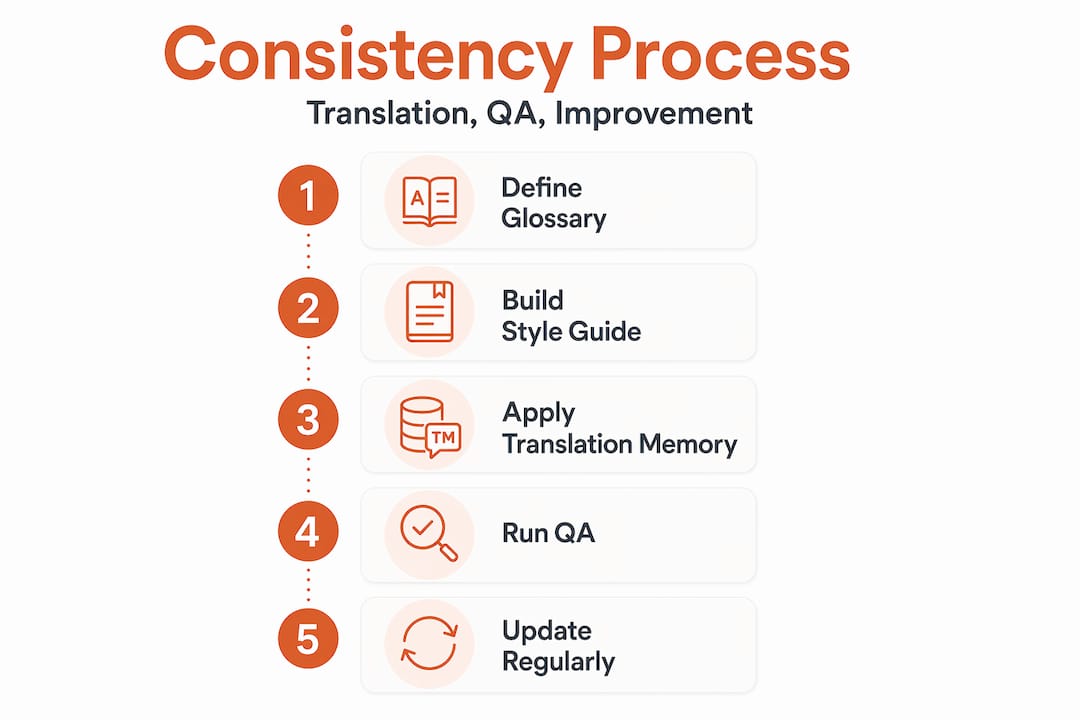
You cannot enforce what you have not defined. Before a single string reaches a translator, your team needs three foundational assets in place: a glossary, a style guide, and a translation memory ™. Each plays a distinct role, and none of them can substitute for the others.
Glossaries and style guides form your linguistic constitution. A glossary locks down approved translations for product-specific terms, so “dashboard” is never “panel” in French across different modules. A style guide defines tone, formality level, punctuation rules, and cultural preferences for each target market. According to localization research, glossaries and style guides reduce errors and costs while accelerating time-to-market. The key is making these documents living resources, not one-time deliverables.
How to build glossaries and style guides that actually get used
The most common mistake teams make is creating these assets in a silo. Involve subject matter experts, product managers, and at least one native-speaking reviewer per language from the start. Version your glossary so translators always know which document is current. And critically, update glossaries regularly with stakeholder input on a quarterly cadence as your product evolves.
Translation memories work differently. A TM is a database that stores every approved source segment paired with its translated equivalent. When new content arrives, the TM surfaces exact matches (100% identical segments) and fuzzy matches (similar but not identical segments) so translators can reuse approved work rather than retranslate from scratch.
TM Match Type | Match Range | Typical Translator Action |
|---|---|---|
Exact match | 100% | Accept and verify context |
High fuzzy match | 75–99% | Review and lightly edit |
Low fuzzy match | 50–74% | Use as reference only |
No match | Below 50% | Translate from scratch |
A well-structured TM can reduce translation costs by 20 to 40 percent and meaningfully accelerate turnaround on content-heavy releases. The catch: your TM is only as good as the content you put in it. Poor segmentation rules, inconsistent source content, or importing legacy translations without review will poison the database quickly.
Pro Tip: Set your TM segmentation rules before you import any content. Consistent segmentation across languages is one of the highest-leverage decisions you can make. Segmentation consistency directly improves TM match rates and prevents one source sentence from producing two different TM entries depending on punctuation differences.
Execution strategies that enforce consistency at scale
Having the right assets means nothing if your workflow does not make them impossible to ignore. Execution is where most consistency problems actually originate, and where process design gives you the most control.
Follow these steps to build a consistency-enforced translation workflow:
Onboard translators with a structured briefing. Every translator, whether in-house or freelance, should receive the glossary, style guide, and a sample of previously approved translations before touching a single string. A 30-minute orientation call reduces misalignment that would otherwise take weeks of revision cycles to correct.
Configure your TMS to enforce terminology automatically. Modern translation management systems can flag when a translator uses an unapproved term variant. Technology-enforced consistency via TMS catches deviations in real time, before review even begins. This is not about replacing judgment. It is about removing the mechanical errors that clutter review queues.
Define pre-translation rules and TM leverage thresholds. Set clear policies for when exact matches are auto-accepted versus when they require human sign-off. Many teams auto-accept 100% matches for UI strings but require human verification for legal or onboarding copy regardless of match score. Context matters more than the percentage.
Stage your human review appropriately. Not all content carries equal risk. A button label and an error message both need to be consistent, but a terms-of-service clause needs a senior reviewer. Build tiered review stages into your workflow so human attention concentrates where it adds the most value.
Manage cross-content consistency explicitly. When your product ships marketing copy, UI strings, and help documentation simultaneously, all three content types must use the same approved terminology. Many teams manage these as separate workstreams, which is exactly how terminology drift begins. Map your glossary to all content types, not just your primary translation project.
Pro Tip: Before each release cycle, run a consistency check across all active content types in a target language. A single approved term list applied inconsistently across marketing and UI copy creates the same brand confusion as having no glossary at all.
QA processes and metrics for ongoing consistency
Execution gets you consistent translations. Verification keeps them consistent as your product grows. The difference between teams that sustain quality and teams that drift is a structured QA cycle with metrics tied to specific consistency outcomes.
Start by establishing KPIs before your first project ships. Terminology consistency of 95% or higher is the professional benchmark. Track revision rates per language pair, the percentage of approved TM matches accepted without edit, and the frequency of glossary deviations caught in review.
Automated QA versus human proofreading
Both are non-negotiable, and they catch different problems. Automated QA tools combined with human review outperform either approach used alone. Automated tools excel at catching terminology deviations, missing variables, formatting errors, and consistency failures across large batches of content. Human reviewers catch tonal inconsistency, cultural missteps, and context-sensitive errors that no rule set can fully anticipate.
QA Method | Catches | Misses |
|---|---|---|
Automated QA tools | Terminology deviations, formatting, variables | Tonal drift, cultural nuance |
Human proofreading | Tone, context, cultural accuracy | High-volume mechanical errors |
Combined approach | Both categories addressed systematically | Nothing critical falls through |
TM maintenance is the QA task teams consistently underestimate. Translation memories degrade without maintenance, accumulating size bloat, outdated entries, and inconsistencies that then propagate into new translations automatically. Follow a scheduled maintenance approach: immediate cleanup after each major project, quarterly deduplication cycles, and an annual deep optimization pass that purges obsolete segments and realigns entries with current glossary standards.
A quality management framework transforms consistency work from reactive firefighting into a proactive, scalable discipline. When you track consistency KPIs release over release, you spot language pairs that are drifting before users do. That is the goal.
Pro Tip: Create a shared dashboard where localization managers and product teams can both see consistency KPIs. When product teams see translation quality metrics alongside release data, they start treating localization as a product quality signal rather than a deadline task.
Common pitfalls and how to fix them
Even well-designed workflows hit predictable roadblocks. Knowing them in advance is half the defense.
Outdated glossaries. A glossary that has not been updated since your last product pivot is worse than no glossary. Translators who trust an outdated document will confidently produce wrong terminology. Assign a glossary owner with a calendar reminder for quarterly review.
Segmentation inconsistencies. If your source content segments differently across file types (strings in JSON versus paragraphs in DOCX), your TM will store duplicate entries for functionally identical content. Standardize segmentation rules across all file formats before your first import.
Mixed or polluted TMs. Importing translations from an agency, a previous vendor, or a machine translation pass without quality verification contaminates your TM. A polluted TM actively degrades consistency by surfacing unvetted matches. Clean before you import.
Poor translator communication. Glossaries sent as PDF attachments in an onboarding email rarely get consulted. Integrate your glossary directly into your TMS so it appears in-context during translation, not as a separate document the translator has to remember to open.
Content drift across teams. When marketing, product, and support each manage their own localization workstreams without a shared glossary, terminology drift is guaranteed. A centralized collaborative translation workflow with a single source of truth for terminology prevents teams from unknowingly translating the same concept three different ways.
Legacy content creates its own category of problems. If your product has years of translated strings that predate your current glossary, those strings will appear as TM matches and pull reviewers toward outdated terminology. Prioritize a legacy alignment pass before scaling new translation volume into a market.
My honest take on what actually works
I’ve watched teams spend months building picture-perfect glossaries and TM setups, then launch with embarrassing inconsistencies anyway. The tools were never the problem. The process was.

In my experience, the single most underrated factor in translation consistency is translator continuity. When the same translator works a product over multiple releases, they internalize the voice, the terminology, and the product’s logic in ways no glossary fully captures. The moment you rotate to a cheaper option or fragment the work across too many contributors, you pay for it in revision time and user-facing inconsistencies. The math rarely favors the cost savings.
I’ve also seen teams treat their TM as a set-and-forget asset. It isn’t. A TM that isn’t cleaned quarterly becomes a liability. I’ve audited TMs that were surfacing machine-translated segments from a pilot project three years prior as high-confidence matches. That kind of pollution is invisible until it ships.
What I’ve found actually works is a simple rhythm: tight linguistic assets updated on a real schedule, a TMS configured to enforce those assets automatically, and a feedback loop where translators can flag glossary gaps in real time. The last part gets skipped constantly. Translators are your best source of intelligence on where your glossary is incomplete or where a cultural nuance makes an approved term awkward. Closing that loop, formally, with a response protocol and a process for updating the glossary, transforms your consistency program from static to adaptive.
AI-assisted workflows accelerate this when they are set up to surface human judgment, not replace it. The teams I’ve seen succeed treat AI as a first-pass filter and a consistency enforcer, not a final answer.
— Antoine
How Gleef helps you make consistency permanent
Gleef was built for exactly the challenge this article describes. The platform combines semantic translation memory, in-product glossary enforcement, and in-context editing so your team can manage translation quality standards without juggling disconnected tools. Instead of chasing consistency after translations ship, Gleef surfaces glossary matches and flags deviations while translators are working, inside Figma and across your product strings simultaneously. If you want to see how a purpose-built localization platform can turn the practices in this article into your default workflow, explore Gleef and request a demo.
FAQ
What is the industry benchmark for translation consistency?
Professional translation projects require terminology consistency of 95% or higher to meet industry standards. Teams should track this metric per language pair across each release cycle.
How often should a translation glossary be updated?
Glossaries should be reviewed and updated on a quarterly cadence with input from product stakeholders, and immediately after any major product change that introduces new terminology or retires existing terms.
What causes translation memory degradation?
Translation memories degrade when they are not maintained, accumulating outdated entries, duplicate segments, and unvetted content from external sources. Scheduled quarterly deduplication and an annual deep clean prevent this buildup from undermining consistency.
Can automated QA tools replace human proofreaders?
No. Automated QA tools catch mechanical errors like terminology deviations and formatting issues at scale, but human proofreaders are necessary for tonal consistency, cultural accuracy, and context-sensitive judgment. The most effective approach combines both.
What is the biggest cause of translation inconsistency in product teams?
The most common cause is treating localization as a series of isolated projects rather than a continuous workflow. Without a shared glossary enforced across all content types and teams, terminology drift is almost inevitable regardless of translator quality.