
TL;DR:
A global product deployment workflow is a structured, repeatable process that coordinates localization, pricing, legal documentation, and operations across markets to ensure synchronized international launches. It involves parallel workstreams, strategic sequencing models, and governance frameworks that prevent fragmentation and delays, with AI assisting translation but requiring local review for quality. Implementing these practices reduces launch time, mitigates risks, and maintains brand consistency in cross-border product rollouts.
A global product deployment workflow is a repeatable, multi-workstream process that enables product teams to launch products internationally with synchronized localization, translation, pricing, and operational readiness across multiple markets. Without this structure, launches fragment. Teams end up with translated UI copy that contradicts legal documentation, pricing that ignores commercial rounding conventions, and shipping configurations that go live weeks after the product itself. A well-structured international product deployment is not a luxury for enterprise teams. It is the difference between a coordinated market entry and an expensive, reputation-damaging scramble. A typical international product launch takes 4 to 9 months, with localization costs ranging from 5% to 15% of the launch budget per market.
What is a global product deployment workflow?
A global product deployment workflow is the structured sequence of decisions, tools, and parallel workstreams that a product team executes to bring a product to market in multiple countries simultaneously or in staged waves. The industry also refers to this as an international rollout process or a cross-border deployment strategy. Both terms describe the same operational reality: you are not just translating a product. You are coordinating content, compliance, pricing, logistics, and user experience across jurisdictions that each have their own rules, languages, and buyer expectations.

The core insight is this: most international launches fail not because of bad products but because of misaligned workstreams. Legal documentation is finalized before UI copy is reviewed. Pricing is set without accounting for local tax structures. Translations are approved by the central team rather than local reviewers who understand the commercial context. A disciplined global deployment strategy prevents all of these failure modes by treating each workstream as a parallel track with defined owners, handoff points, and quality gates.
What prerequisites and tools prepare product teams for global deployment?
Before your team writes a single line of translated copy, you need three foundational elements in place: centralized data, defined roles, and the right tooling.
Centralized product data is the non-negotiable starting point. A Product Information Management system, or PIM, structures your product catalog so that every locale-specific attribute, from dimensions to safety certifications, is stored, versioned, and accessible in one place. Without a PIM, each workstream becomes its own standalone manual project. A catalog with 40,000 SKUs, each needing 15 locale-specific values, requires fundamentally different planning than a 200-SKU catalog. The scope of data preparation alone can consume more time than the translation itself.
Defined roles matter just as much as tooling. Your deployment needs:
A design authority: the centralized governance body that owns the global template and approves deviations
Localization experts: in-market reviewers who validate translations for commercial accuracy, not just linguistic correctness
Legal and compliance leads: responsible for jurisdiction-specific documentation and regulatory sign-off
Pricing and finance owners: accountable for commercial rounding, tax configuration, and currency formatting
Product managers and UX writers: responsible for UI copy, in-app messaging, and feature naming consistency
Pro Tip: Assign a single deployment coordinator who owns the master launch calendar and has authority to escalate blockers across all five workstreams. Without this role, no one has a complete view of interdependencies.
For translation tooling, AI-assisted platforms accelerate first-pass translation dramatically. Gleef, for example, integrates directly with Figma so UX writers and designers can manage translations in context without switching platforms. Features like semantic translation memory and glossary enforcement mean your brand voice stays consistent across every market, even when different reviewers are working in parallel. Pair AI-first translation with localization best practices to build a workflow that scales without sacrificing quality.
Which deployment sequencing models work best for global rollouts?
Three main sequencing models exist for international product rollouts, and each fits a different organizational context.
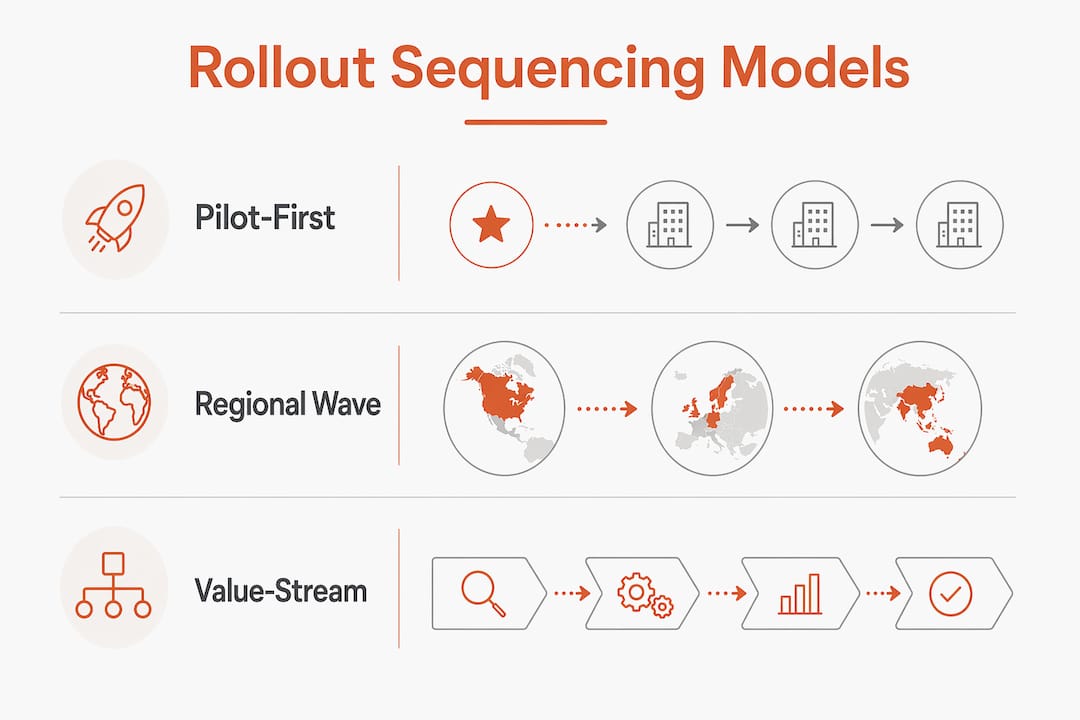
Model | Best for | Key advantage | Key risk |
|---|---|---|---|
Pilot-first | New markets with uncertain product-market fit | Validates global template before full investment | Slower time-to-market in priority regions |
Regional wave | Regulated industries, large enterprise deployments | Aligns rollout with legal and support readiness | Requires strong governance to prevent template drift |
Value-stream sequencing | Manufacturing, supply chain, and ERP deployments | Follows operational dependencies rather than geography | Complex to plan; requires deep process mapping |
The pilot-first model deploys to one or two markets first, typically those with the lowest regulatory complexity and the strongest existing customer relationships. The goal is not revenue. It is validation. You are testing whether your global template, your translated content, your pricing logic, and your support infrastructure actually hold up under real conditions. Entering markets like Japan or LATAM without local partners slows expansion significantly because buyer relationships and trust signals differ sharply from Western markets.
Regional wave deployment is the model most product teams default to, and for good reason. It aligns your rollout sequence with legal readiness, support capacity, and regional infrastructure. Successful global SaaS rollouts rely on a global template with controlled localization, wave sequencing by operational readiness, and a governance design authority. The governance body balances speed, control, and local compliance to maintain template integrity across waves.
Value-stream sequencing is the most complex model and applies primarily to manufacturing and ERP contexts where operational dependencies dictate the order of deployment. You cannot go live in a distribution center before the warehouse management system is configured. You cannot launch a product line before the supplier onboarding workflow is complete. For SaaS architecture deployments, this model translates to sequencing feature releases by the downstream systems they depend on.
How to synchronize localization, translation, and operational workstreams
A new-country launch involves five parallel workstreams that must be synchronized: product content, pricing, shipping configuration, legal documentation, and website localization. Each has its own lead time, its own reviewers, and its own definition of “done.” The failure mode is treating them as sequential rather than parallel.
Here is how to run them in sync:
Kick off all five workstreams on the same day. Legal documentation and shipping configuration take longer than most teams expect. Starting them two weeks after content translation begins creates a bottleneck at the finish line.
Use AI for first-pass translation, then route to local human reviewers. AI accelerates volume. Local reviewers catch commercial errors. A translated product description that uses the wrong unit of measurement or an ambiguous safety claim can create liability, not just confusion.
Lock pricing before translating any commercial copy. Pricing rounds, currency symbols, and tax-inclusive versus tax-exclusive display conventions vary by market. Translating promotional copy before pricing is finalized means you will retranslate it.
Version-control all legal documents from day one. Privacy policies, terms of service, and regulatory disclosures change. If you do not version-control them, you will lose track of which markets are running which version.
Run a pre-launch content audit across all five workstreams. Check for consistency between the UI copy, the marketing site, the legal documentation, and the support content. Inconsistencies at launch erode user trust faster than any single translation error.
Pro Tip: Build a shared launch readiness tracker in a tool like Notion or Linear that all five workstream owners update daily in the final two weeks before launch. A single shared view of “green, amber, red” status prevents last-minute surprises.
Product marketing managers play a critical role in positioning calibration by adjusting core value propositions to local markets without full repositioning. This is not a localization task. It is a strategic one. Your UX writers and translators cannot make this call. Your product marketing team must own it and feed the output into the localization workflow before translation begins.
What techniques help mitigate risks like market fragmentation and rollout failures?
The most effective risk mitigation model for cross-border product deployment is the launch ladder. It works like this:
Internal dogfood: deploy to your own team first and validate core functionality
Small pilot: release to a controlled cohort of real users in one market, typically 1% to 5% of the target audience
Regional cohort: expand to a full region with telemetry monitoring active
Full launch: open to all target markets once regional cohorts confirm readiness
The launch ladder pattern uses feature flags and telemetry-based criteria to expand deployments regionally, balancing speed with risk reduction. Only advancing launch rungs with telemetry-confirmed readiness prevents surprises and fragmentation. This is not just a software engineering practice. It applies equally to product content, pricing activation, and support readiness.
Feature flags give your team surgical control over what is live in which market at any given moment. If a translated feature name creates confusion in Germany but works perfectly in France, you can roll it back in Germany without touching the French deployment. Segmented telemetry, meaning market-specific dashboards for error rates, conversion, and support ticket volume, tells you which markets are healthy and which need intervention before users start churning.
“The safest and most effective rollout uses staged geographic launches with automated telemetry-based rollbacks, ensuring continued momentum in healthy regions while containing localized issues.” — Regional launches and fragmentation strategies
Governance frameworks complete the picture. Every exception to the global template needs a defined approval path. Without one, local teams make ad hoc decisions that create technical debt, compliance risk, and brand inconsistency. A centralized design authority balances standardization and local flexibility without becoming a bottleneck.
What common pitfalls should product teams avoid in international deployment?
Most international deployment failures trace back to four recurring mistakes:
Underestimating translation scope for attribute labels and values. Teams budget for marketing copy and forget that every product attribute, filter label, error message, and tooltip also needs translation and local review. AI can accelerate this work but does not eliminate the need for structured workflows and early scope decisions.
Delaying decisions on phased launches and product selection. Which SKUs go live in which markets on day one? This decision affects every workstream. Teams that defer it until week eight of a twelve-week launch cycle create a cascade of rework.
Skipping local review of translations. Central teams approve translations based on linguistic accuracy. Local reviewers catch commercial errors: wrong pricing formats, culturally inappropriate imagery references in copy, and product claims that do not comply with local advertising standards.
Lacking operational rollout governance. Without a defined governance structure, local teams customize the global template without approval, creating fragmentation that compounds over time and makes future updates exponentially harder.
Pro Tip: Create a “translation scope inventory” at the start of every international launch. List every string, label, document, and UI element that needs localization. Assign word counts and review owners. Teams that do this in week one consistently hit their launch dates. Teams that skip it consistently miss them.
For teams building translation standards into their deployment process, the payoff is compounding. Every market you launch correctly makes the next one faster because your glossaries, translation memories, and governance processes are already in place.
Key takeaways
A global product deployment workflow succeeds when product teams run five parallel workstreams, apply a structured sequencing model, and enforce governance that balances global standardization with local flexibility.
Point | Details |
|---|---|
Run five workstreams in parallel | Product content, pricing, shipping, legal, and website localization must start simultaneously to avoid launch blockers. |
Choose the right sequencing model | Pilot-first validates your template; regional waves align with legal readiness; value-stream sequencing fits operational dependencies. |
Use AI plus local human review | AI accelerates first-pass translation; local reviewers catch commercial and compliance errors that AI misses. |
Implement the launch ladder | Stage your rollout from internal dogfood to full launch, advancing only when telemetry confirms readiness in each region. |
Govern exceptions centrally | A design authority that approves template deviations prevents fragmentation and protects brand consistency across markets. |
What I’ve learned building global deployment workflows
Global rollouts fail because teams treat them as technical projects rather than scalable ways of working. I have seen this pattern repeat across product teams of every size. The technology gets deployed. The translations get approved. The launch date gets hit. And then, six months later, the product is a patchwork of local customizations that nobody owns and nobody can update efficiently.
The teams that get this right share one characteristic: they design the way of working before they design the deployment. They define who owns what, how exceptions get approved, and how the global template evolves over time. They treat localization not as a final step before launch but as a parallel workstream that starts on day one.
My honest observation on AI in this context: it is genuinely transformative for translation volume and speed, but it creates a false sense of completion. A product team that runs AI translation and skips local human review is not saving time. It is deferring risk to the moment a user in a new market encounters a commercially incorrect or culturally tone-deaf string. The fix costs more than the review would have.
The other thing I would push back on is the instinct to over-centralize. A design authority is necessary. A design authority that becomes a bottleneck kills momentum and pushes local teams to work around it. The best governance frameworks I have seen are opinionated about the global template and permissive about local expression within defined boundaries. That balance is hard to find, but it is the only one that scales.
— Antoine
How Gleef powers your global deployment workflow
Gleef is built for exactly the localization challenges this article describes. Product teams using Gleef manage translations directly inside Figma, with semantic translation memory and glossary enforcement keeping every market’s copy consistent with the global brand voice. The platform’s localization integrations connect your design, development, and review workflows so that UI copy, in-context editing, and translation approval happen in one place rather than across five disconnected tools. For teams running parallel workstreams across multiple markets, Gleef removes the translation bottleneck that most commonly delays launch dates. If you are ready to build a deployment workflow that actually holds up at scale, explore Gleef and see how your team can go from first-pass AI translation to launch-ready copy faster than you thought possible.
FAQ
What is a global product deployment workflow?
A global product deployment workflow is a structured, repeatable process for launching products across multiple international markets, coordinating localization, translation, pricing, legal documentation, and operational readiness in parallel workstreams.
How long does an international product deployment take?
A typical international product launch takes 4 to 9 months, depending on market complexity and regulatory requirements. SaaS launches in English-speaking markets can compress to 3 to 4 months, while regulated sectors often require 9 to 18 months.
What are the three main sequencing models for global rollouts?
The three main models are pilot-first, regional wave deployment, and value-stream sequencing. Pilot-first validates your global template; regional waves align with legal and support readiness; value-stream sequencing follows operational dependencies.
Why do global product rollouts fail?
Most global rollouts fail because teams treat them as technical deployments rather than scalable workflows. Misaligned workstreams, insufficient local review of translations, and lack of governance over template deviations are the leading causes of failure.
How does AI fit into a global product deployment workflow?
AI accelerates first-pass translation and reduces manual overhead for large catalogs, but it does not replace local human review. The most effective approach combines AI translation with in-market reviewers who validate commercial accuracy and cultural fit before launch.