
TL;DR:
Multilingual translation involves converting content into multiple languages to reach global audiences while maintaining accuracy and consistency. Ensuring high quality requires ISO 17100 certification, a two-stage process, and careful management of glossaries, workflows, and validation per language. Modern AI tools like neural machine translation, integrated with human review, streamline localization, reduce bottlenecks, and improve coverage across diverse markets.
Multilingual translation is the practice of converting content from one source language into multiple target languages simultaneously, enabling businesses to reach global audiences with consistent, accurate messaging. For product teams and project managers, this goes far beyond swapping words between languages. It covers text, audio, UI strings, and full product localization across markets. Tools like the European Commission’s eTranslation platform, Meta’s Omnilingual MT, and AI-powered platforms like Gleef have redefined what’s possible at scale. Getting this right determines whether your product feels native or foreign to every user you’re trying to win.
What are the key quality standards for multilingual translation?
ISO 17100:2015 is the international standard that defines minimum quality requirements for professional translation services, and it sets the bar every serious project team should measure against. The standard’s most significant requirement is a mandatory two-stage production process: a qualified translator produces the first version, then a separate, independent reviser performs a full bilingual review. That second linguist is not optional under ISO 17100. It is the single most consequential quality gate in the entire workflow.
Translator qualification requirements under ISO 17100 are equally specific. Translators must hold a recognized degree in translation, a degree in another field combined with two years of documented translation experience, or five years of full-time professional translation experience. This matters to you as a buyer because it gives you an auditable paper trail. When a legal contract, medical device manual, or regulated software interface goes wrong in translation, that audit trail is your protection.
ISO 17100 is voluntary, but certification provides a verifiable external audit that separates credible language translation services from single-pass vendors. For business-critical content, working with a certified professional translation agency is not a luxury. It is risk management.
A separate standard, ISO 18587:2017, governs machine translation post-editing (MTPE) and applies different requirements suited to AI-assisted workflows. The two standards are not interchangeable. Applying ISO 17100 expectations to an MTPE project, or vice versa, creates scope mismatches that cost time and money.
Pro Tip: When evaluating a professional translation agency, ask specifically which ISO standard governs their workflow for your content type. A vendor who cannot distinguish between ISO 17100 and ISO 18587 is a vendor who will mis-scope your project.
Confirm the vendor holds ISO 17100 certification for human translation work.
Verify that the reviser is independent from the original translator.
Request documentation of translator and reviser qualifications before signing.
Clarify upfront whether your project falls under ISO 17100 or ISO 18587 scope.
Build revision time into your project schedule. Skipping it to save days is the most common cause of costly rework.
How do modern AI tools support multilingual translation workflows?
Neural machine translation (NMT) has replaced older statistical methods as the dominant technology in AI-powered language translation services, and the performance gap is significant. Where statistical models matched phrases from databases, NMT models process entire sentences as context, producing output that reads far more naturally. Meta’s Omnilingual MT system pushes this further by supporting machine translation for over 1,600 languages, a scale no human translation workforce could match.

The practical implication for product teams is real but comes with a caveat. Meta’s own research shows that generating high-fidelity translations for low-resource languages, those with limited training data, remains a genuine challenge. Specialized smaller models outperform large general models for specific language pairs when fine-tuned on domain-relevant data. If your product targets markets in Southeast Asia, Sub-Saharan Africa, or Central Asia, you cannot assume that broad language coverage claims translate into production-ready quality.
The European Commission’s AI translation tools offer a different value proposition: free, secure translation across all EU official languages, with a firm commitment that user data is never used to train commercial AI models. For teams handling regulated content, financial documents, or anything subject to GDPR, that data protection guarantee is a meaningful differentiator.
Here is what the best AI-assisted multilingual translation workflows include today:
NMT engine selection matched to your specific language pairs, not just the broadest coverage claim
Terminology glossaries loaded into the translation memory so brand terms, product names, and technical vocabulary stay consistent across every language
In-context editing so translators and reviewers see strings as they appear in the actual UI, not in an abstract spreadsheet
Automated quality checks that flag missing variables, truncated strings, and formatting errors before they reach production
Language-specific validation gates that test output quality per target language rather than accepting a single aggregate quality score
“Teams should validate output quality per target language in multilingual projects, since general claims of language coverage often mask quality deficits in undersupported languages.” — Meta AI Research
Hybrid human-plus-AI workflows, where NMT produces a first draft and a human post-editor refines it, are now the standard approach for translation for global audiences at scale. The efficiency gains are real. The quality ceiling depends entirely on how well you manage the handoff between machine output and human judgment.
What workflows optimize multilingual translation projects?
A well-structured multilingual translation project follows a predictable sequence, and the teams that skip steps in that sequence are the ones filing emergency tickets the week before launch. The workflow below reflects current best practice for product and software localization.
Content preparation. Audit source strings for clarity before translation begins. Ambiguous source content produces ambiguous translations in every language. Fix it once at the source rather than twelve times in twelve languages.
Machine translation draft. Run source content through your chosen NMT engine with your glossary and translation memory loaded. This is your efficiency multiplier, not your finished product.
Human post-editing. A qualified post-editor reviews MT output against the source, correcting errors in meaning, tone, and terminology. Clear post-editing guidelines are non-negotiable here. Mis-scoping this task, treating it as light proofreading when full revision is needed, is one of the most common and expensive mistakes in multilingual document services.
Independent bilingual revision. A second linguist reviews the post-edited translation against the source. This is the ISO 17100 requirement, and it catches errors that the post-editor, now too close to the text, will miss.
Language-specific QA testing. Test the translated content in context. UI strings need to be checked for text expansion, truncation, and layout breaks. Marketing copy needs to be reviewed for cultural fit, not just linguistic accuracy.
Sign-off and delivery. Lock approved translations into your translation memory so future projects build on validated work rather than starting from scratch.
Language-specific guidelines from sources like the European Commission’s Knowledge Centre on Translation and Interpretation provide character sets, style guides, and terminology recommendations for all 24 EU official languages. Following these reduces editing churn by standardizing conventions before the first word is translated.
Pro Tip: Build a project-specific glossary before translation starts, not after. Terminology decisions made mid-project create inconsistencies that are expensive to fix retroactively across multiple languages. Gleef’s glossary management features let you lock approved terms at the start and enforce them automatically throughout the workflow.
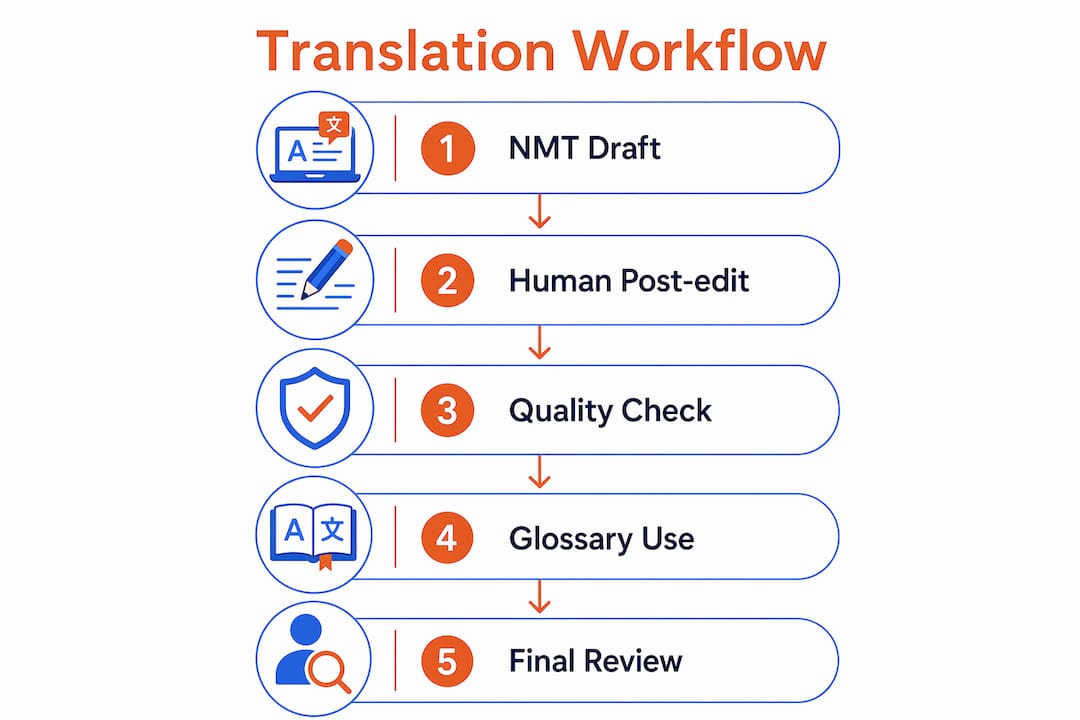
Integrated AI tools that combine terminology management with quality control reduce errors and improve efficiency at scale. The key is integration. A glossary that lives in a separate spreadsheet helps no one. A glossary embedded in your translation environment enforces consistency automatically.
How do businesses integrate translation into product localization?
Product localization is where multilingual translation meets real business outcomes. A translated product is not automatically a localized product. Localization means the translated content fits the cultural context, the UI layout accommodates text expansion, and the brand voice survives the language change intact. Translation is the foundation. Localization is the structure built on top of it.
For product teams, the practical question is how to scale translation without creating a bottleneck that delays every release. The answer lies in choosing technologies that integrate with your existing design and development workflow rather than running parallel to it.
Approach | Best for | Key limitation |
|---|---|---|
Human-only translation | Legal, medical, high-stakes content | Slow and expensive at scale |
Machine translation only | Internal content, low-stakes drafts | Quality gaps in low-resource languages |
MT plus post-editing | Product UI, marketing, documentation | Requires clear scope and skilled post-editors |
AI-native localization platform | Product teams with continuous releases | Requires upfront setup of glossaries and rules |
Website localization automation tools like the WEB-T Joomla plugin demonstrate how translation can be embedded directly into content management workflows, using eTranslation APIs to deliver SEO-friendly localized pages across European languages without manual export-import cycles. The principle scales beyond Joomla. Any product team that automates the handoff between source content and translation engine removes a recurring manual bottleneck.
Content consistency is the other dimension that separates good localization from great localization. When your product uses ten different translations of the same button label across five languages, users notice. AI-assisted content consistency enforcement, where approved translations are locked and reused automatically, protects brand voice at scale. For regulated industries, it also reduces compliance risk.
Choose translation technology that connects directly to your design tools and code repositories.
Enforce terminology consistency through glossaries loaded into your translation memory from day one.
Test every target language independently in context, not just against a source string comparison.
Prioritize vendors and platforms that offer documented data protection for sensitive content.
Plan for text expansion. German and Finnish regularly run 30 to 40 percent longer than English source text, and your UI layout needs to handle that without breaking.
Understanding the full range of multilingual business documents your team needs to manage, from UI strings to legal agreements to marketing copy, helps you scope the right workflow for each content type rather than applying one process to everything.
Key takeaways
Multilingual translation requires a structured combination of ISO-certified human expertise, AI-powered efficiency, and language-specific quality validation to produce results that hold up in global markets.
Point | Details |
|---|---|
ISO 17100 is your quality baseline | Require certified two-stage production with an independent reviser for any business-critical content. |
AI covers scale, humans cover quality | Use NMT for speed and volume, then apply human post-editing to close the quality gap. |
Validate per language, not per project | Low-resource languages need individual quality checks. Aggregate scores hide real deficits. |
Glossaries prevent rework | Lock approved terminology before translation starts to enforce consistency across all languages. |
Integration beats parallel workflows | Translation tools embedded in your design and dev environment remove release-blocking bottlenecks. |
Why the second linguist is the most undervalued step in translation
There is a pattern I see repeatedly with product teams that are new to multilingual translation. They invest in the right NMT engine, they hire qualified translators, they build glossaries. Then, under deadline pressure, they cut the independent revision step. It feels like the safest place to save time because the translation already looks good. That instinct is wrong, and it costs more than the time it saves.
The second linguist catches what the first linguist cannot see after hours of working in the same text. They catch meaning shifts that are technically accurate but contextually wrong. They catch tone inconsistencies that make a product sound like it was written by a committee. They catch the one string where a variable was dropped and the UI now reads “Hello, !” to every user in that market.
I have also seen teams go the other direction and over-invest in human review for content that genuinely does not need it. Internal documentation, low-stakes UI microcopy, and draft content for internal review cycles do not require ISO 17100-level rigor. Matching your quality process to your content risk level is a skill that saves budget without compromising where it matters.
The most practical advice I can give any project team is this: map your content by risk level before you design your workflow. High-stakes content gets the full ISO 17100 process. Medium-stakes content gets MT plus post-editing with a light review. Low-stakes content gets MT with automated QA. That tiered approach is how you scale translation for global audiences without burning your budget on uniform over-engineering.
The teams that get this right treat translation project management as a discipline, not an afterthought. They plan for it at the start of every product cycle, not the week before release.
— Antoine
How Gleef accelerates multilingual translation for product teams
Product teams that manage localization inside Figma know how much time disappears in the export-translate-reimport cycle. Gleef’s AI localization Figma plugin eliminates that cycle entirely by bringing translation directly into your design environment.
With Gleef, you translate in context, see how strings render in your actual UI, and enforce glossary rules automatically across every target language. Semantic translation memory means approved translations are reused and locked, so your brand voice stays consistent whether you are shipping in French, Japanese, or Brazilian Portuguese. Teams using Gleef report faster release cycles and fewer translation-related blockers at the final QA stage. If your product is growing into new markets and your current translation workflow is slowing you down, Gleef is built for exactly that problem.
FAQ
What is multilingual translation?
Multilingual translation is the process of converting content from one source language into multiple target languages to serve global audiences. It covers text, audio, UI strings, and product content across formats.
How does ISO 17100 affect translation quality?
ISO 17100:2015 requires a two-stage production process with an independent reviser reviewing every translation. This mandatory second-linguist step is the standard’s most significant quality assurance requirement.
What is the difference between machine translation and post-editing?
Machine translation produces an automated first draft. Post-editing is the human review process that corrects errors in meaning, tone, and terminology. Mis-scoping post-editing tasks is one of the most common causes of quality failures in hybrid workflows.
How do I choose the best multilingual translation tools for my team?
Match your tool selection to your content type, language pairs, and integration requirements. AI-native platforms work best for product teams with continuous releases, while certified language translation services are better suited for legal or regulated content.
Why do low-resource languages need special attention in multilingual projects?
Meta’s Omnilingual MT research shows that broad language coverage does not guarantee consistent quality across all languages. Low-resource languages require targeted model fine-tuning and independent quality validation to meet production standards.