
TL;DR:
Shipping a product across multiple diverse markets requires a comprehensive, end-to-end multilingual deployment process that goes far beyond simple translation.
Effective global launches involve coordinating UI adaptation, compliance, visuals, QA, and localized support, with continuous locale-specific testing and monitoring.
Shipping a product to one market is hard. Shipping it to twelve, each with its own language, cultural expectations, regulatory environment, and technical quirks, is an entirely different challenge that most teams are not fully prepared for. The surprising truth is that multilingual evaluation reveals failure modes that single-language testing simply cannot surface, no matter how thorough your QA process is. This guide walks you through what multilingual product deployment actually involves, why conventional release workflows break down across locales, and what your team can do to build a truly bulletproof global launch strategy.
Key Takeaways
Point | Details |
|---|---|
Multilingual deployment defined | It means releasing and supporting products in multiple languages, far beyond basic translation. |
Single-language QA is insufficient | Many bugs only appear in certain languages or locales; global teams need cross-locale testing. |
Structured rollout steps | Internationalization, thorough localization, and multi-phase QA are all critical for success. |
Track metrics by locale | Monitoring bugs and user satisfaction per market enables continuous improvement. |
Automation boosts consistency | Integrated workflows and automation make multilingual launches scalable and robust. |
What is multilingual product deployment?
Before we talk about fixing the process, let’s get precise about what we mean. Multilingual product deployment is not just a translation sprint before release. It is a coordinated, end-to-end process for releasing a product across multiple languages and regions simultaneously or in rapid succession, and it touches almost every corner of your product organization.
Think about everything that changes when you shift from a single-locale release to a global one. Your UI strings need to be translated, yes, but also your onboarding flows, error messages, legal disclaimers, push notifications, and in-app help content. Your feature set may need to be gated or modified for certain markets. Your visual design needs to accommodate text expansion (German strings are often 30 to 40 percent longer than their English equivalents), right-to-left scripts, and locale-specific iconography that carries different cultural meanings.
Here is what the process actually covers:
UI and content adaptation: Translating and contextually adapting every user-facing string, including dynamic content generated at runtime
Feature-level compliance: Adjusting or restricting features based on local data privacy laws, financial regulations, or content standards
Visual and UX localization: Redesigning layouts to handle text expansion, bidirectional text, and culturally sensitive imagery
QA and testing across locales: Running functional, visual, and linguistic validation in every target language
Support and documentation: Localizing help centers, release notes, and customer support scripts
Coordinated release management: Aligning engineering, marketing, legal, and localization teams across time zones
“Multilingual product deployment involves managing distinct challenges compared to single-language product launches, requiring coordinated strategies that go far beyond basic string translation.”
Understanding the impact of software localization helps frame just how deeply these decisions ripple through your product, your brand, and your bottom line. Multilingual deployment is not a localization task bolted onto the end of a sprint. It is a product discipline of its own.
Why single-language metrics miss multilingual pitfalls
With the core concepts clear, here is where things get uncomfortable for most global teams. Your existing QA and measurement frameworks were almost certainly built around a single primary locale, usually English. And that creates a dangerous blind spot.
Monolingual QA can hide entire categories of bugs. A string that renders perfectly in English might overflow a button in Finnish, break a regex validation in Japanese, or truncate incorrectly in Arabic when displayed right-to-left. These are not edge cases. They are predictable, systematic failure modes that show up the moment you expand beyond your base language.
Research from the Multi-SWE-bench benchmark demonstrates this clearly: limited generalization across languages and performance drops on cross-file issues illustrate how multilingual capability and measurement can diverge significantly across language and complexity combinations. In plain terms, what works in one locale often falls apart in another, and you will not catch it unless you are specifically looking.
Here is a comparison that illustrates the gap:
QA approach | What it catches | What it misses |
|---|---|---|
Single-language testing | Logic bugs, core feature failures | Text overflow, locale-specific formatting, RTL layout issues |
Translation review only | Terminology errors, obvious mistranslations | Functional bugs triggered by locale settings |
Cross-locale QA | All of the above, plus locale-specific rendering and compliance gaps | Very little, when done systematically |
The pattern is consistent. Teams that rely solely on English QA and then translate find themselves shipping broken experiences to non-English users. French users see truncated labels. Korean users encounter validation errors. Japanese users get date formats that make no sense in their context.
Pro Tip: Build locale-specific test cases from the beginning of your sprint, not as an afterthought. Pair every functional test with a locale variant that checks rendering, validation, and user flows in at least two or three of your highest-priority target languages.
Understanding cross-functional localization with AI gives you the scaffolding to prevent these gaps before they become release blockers. Combining that with solid localization best practices makes the difference between a rocky global launch and a smooth one.
Key steps for deploying multilingual products
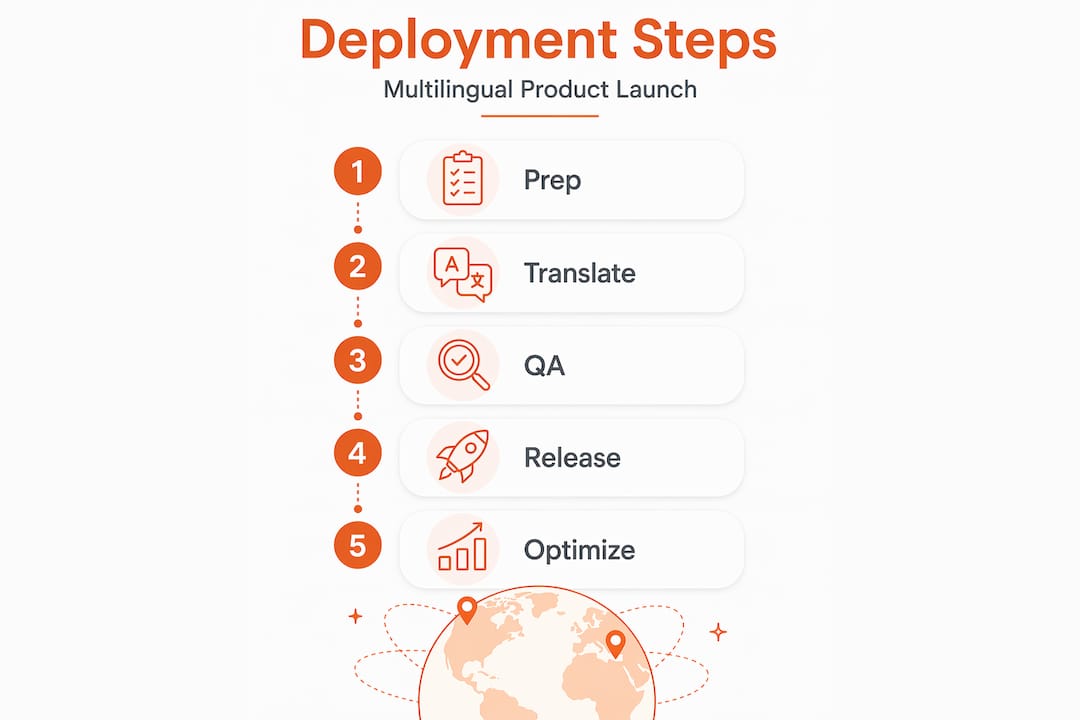
A systematic framework is your strongest defense against the chaos that multilingual launches can generate. Here is a four-phase approach that experienced global product teams use to keep releases on track.
Preparation: Internationalization and content inventory Before any translation work begins, your codebase needs to be internationalization-ready. That means externalizing all strings, removing hardcoded date and number formats, ensuring your architecture supports Unicode and bidirectional text, and building a complete inventory of every content asset that will need localization. Teams that skip this phase spend enormous time reworking code mid-sprint.
Localization: Translating and adapting features, compliance, and visuals This phase is where most teams focus their attention, but it is broader than translation alone. You are adapting UI layouts for text expansion, reviewing features against local regulatory requirements, updating visual assets for cultural relevance, and maintaining consistency through glossaries and translation memory. Refer to a solid localization integrations guide to understand how your tools should connect across this workflow.
Verification: Multi-locale QA, functional and UX validation This is the phase most teams underinvest in. Verification means running your full test suite in every target locale, not just checking that strings are present. It means confirming that UI elements render correctly, that flows function end-to-end in each language, and that native speakers can complete key tasks without confusion. Cross-locale testing during deployment is necessary to surface issues that single-language metrics will always miss.
Launch: Coordinated release and post-launch support A multilingual launch is not a single deployment event. It is a coordinated rollout that requires your localized help center to be live, your support team to be briefed in each language, and your monitoring to be segmented by locale so you can catch market-specific issues within hours of release.
Phase | Key outputs | Common failure point |
|---|---|---|
Preparation | Internationalized codebase, content inventory | Hardcoded strings discovered too late |
Localization | Translated UI, adapted features | Inconsistent terminology across locales |
Verification | Multi-locale QA sign-off | Skipping native speaker UX review |
Launch | Live product, localized support | No locale-segmented monitoring in place |
Pro Tip: Use feature flags to control per-locale releases. This lets you enable a feature for German users while keeping it off for Japanese users until locale-specific QA is complete, dramatically reducing your risk surface.
Streamlining localization across your global product teams becomes far more achievable when each phase has a clear owner and clearly defined exit criteria.
Common challenges and practical solutions
A methodical process is powerful, but even the best frameworks run into the specific, stubborn challenges that multilingual deployment throws at you. Here are the most frequent ones, and what to actually do about them.

String concatenation and formatting errors are among the most common issues, and among the most avoidable. When developers build dynamic strings by concatenating translated fragments (for example, “You have” + item count + “messages”), the result is grammatically broken in almost every language that is not English. Languages have different word orders, grammatical cases, and pluralization rules. The fix is to use proper pluralization libraries and full sentence templates with variables, not string fragments.
Locale-specific regulations caught too late can derail an entire release. GDPR in Europe, LGPD in Brazil, and PIPL in China have very specific requirements about consent flows, data handling disclosures, and user rights that directly affect your UI and feature set. Discovering these requirements during QA rather than during the preparation phase means expensive rework.
Inconsistent updates across locales create a fragmented product experience. When you ship a feature update and only some language versions are updated, you end up with a product where English users see new functionality while French and Spanish users see outdated UI. This is particularly damaging for brand perception in non-English markets.
Practical solutions that address all three:
Invest in automation pipelines that push content updates to all locales simultaneously, triggered by a single source-of-truth update
Build locale-specific compliance checklists into your pre-localization phase so regulatory gaps are caught before a single string is translated
Use QA automation that runs locale-specific test suites on every deployment, not just on release days
Implement a centralized translation memory and glossary to enforce terminology consistency across every market automatically
Multilingual deployment faces unique performance challenges, and measurement must account for diverse languages and locales to give teams actionable signal rather than misleading averages.
Strong tips for managing multilingual content and a clear strategy to automate language workflows together create the kind of resilient infrastructure that makes repeated global launches feel manageable rather than chaotic.
Measuring and optimizing multilingual deployment success
With solutions in hand, sustained success pivots on continuous measurement and iteration. The teams that consistently nail multilingual releases are not the ones who get lucky on the first launch. They are the ones who build feedback loops that get smarter with every release cycle.
Here is what strong multilingual measurement looks like in practice:
Bug tracking by locale and language pair: Do not just log a bug as “UI layout issue.” Tag it with the specific locale, the language pair involved, and whether it is a translation error, a rendering issue, or a functional failure. Over time, you will see patterns that tell you exactly where your process breaks down.
Engagement and usage metrics per market: Track core product metrics (activation rate, feature adoption, retention) segmented by locale. If your German market has a 40 percent lower activation rate than your English market, that is a signal worth investigating at the localization level.
Market-specific user satisfaction surveys: NPS and CSAT scores aggregated globally hide market-specific dissatisfaction. Run surveys in local languages and segment the results by region to catch experience gaps that aggregate scores wash out.
Iteration cadence by launch cycle: After each multilingual release, run a retrospective that specifically reviews locale-specific issues. What patterns emerged? Which locales generated the most bugs? Which QA gaps allowed issues through?
Performance drops in cross-locale testing highlight exactly why locale-level measurement matters. Averages are comfortable but deceptive. A product that scores well globally can be failing specific markets entirely, and you will not know until you break the numbers apart.
Exploring the key features of localization platforms helps you understand what tooling you need to make this measurement systematic rather than manual. Combining that with the five keys to successful localization gives you a practical benchmark for evaluating your own maturity.
Why most teams underestimate multilingual deployment complexity
Here is the uncomfortable truth that most localization guides dance around: the frameworks and checklists above are necessary, but they are not sufficient on their own. The real reason teams repeatedly underestimate multilingual deployment is organizational, not technical.
Most product organizations treat localization as a finishing step rather than a foundational discipline. Translation gets scheduled at the tail end of a sprint, after design is frozen and engineering is code-complete. That timing guarantees that localization will surface issues too late to fix without delays. It is not a process failure. It is a prioritization failure.
There is also a metric silo problem. Product teams track feature adoption and retention. Localization teams track translation throughput and error rates. Neither team is systematically looking at the intersection: whether the translated product actually performs as well as the original. That gap is where global products quietly underperform for years before anyone connects the dots.
The teams that consistently succeed at global launches share one characteristic: they have made localization a cross-functional responsibility rather than a specialist handoff. Product managers who drive successful localization are not just handing off content to a translation team. They are embedding locale-specific success criteria into their product roadmaps, tracking locale-level metrics alongside global ones, and involving localization stakeholders in sprint planning rather than sprint review.
Cultural investment matters too. When your product team has genuine curiosity about the markets they are building for, the quality of localization decisions improves dramatically. That curiosity is what turns a technically correct translation into a native-feeling experience that users in Osaka or São Paulo actually want to keep using.
Take your multilingual deployment to the next level
If this guide has made one thing clear, it is that multilingual deployment is complex enough to require the right tools, not just the right intentions. The teams building world-class global products are the ones who automate what can be automated, instrument what needs to be measured, and invest in platforms that bring translation into the product workflow rather than keeping it at arm’s length.
Gleef is built for exactly this kind of work. Our AI-powered platform brings multilingual deployment expertise directly into your product team’s existing workflow, integrating with Figma and your codebase so that translation happens in context, not in isolation. With semantic translation memory, glossary enforcement, and in-context editing, your team can ship consistent, native-quality experiences across every locale without the release blockers. Explore our optimization strategies for localization to see how teams like yours are accelerating global launches with Gleef.
Frequently asked questions
How does multilingual product deployment differ from localization?
Multilingual deployment covers the complete end-to-end release process across multiple languages, including QA, compliance, and market adaptation. Localization is one component of that process, focused specifically on adapting content, features, and design for a target locale. As multilingual deployment manages issues across languages at a systems level, it requires coordination far beyond what localization alone addresses.
Why is cross-locale testing critical for global tech products?
Cross-locale evaluation reveals bugs and performance drops that standard, monolingual testing consistently fails to catch, including rendering failures, formatting errors, and locale-specific functional breakdowns. Without it, you are shipping known unknowns to your global users.
What metrics should teams track for successful multilingual deployment?
Teams should monitor bugs segmented by locale, user engagement and feature adoption per market, and user satisfaction scores collected in local languages. Performance drops across locales become visible only when you measure at the locale level rather than relying on aggregated global averages.
Is automation necessary for deploying multilingual products?
At scale, yes. Automation supports consistent multilingual releases by catching errors earlier in the pipeline, synchronizing updates across all locales simultaneously, and reducing the manual effort that creates bottlenecks and inconsistencies in large-scale global deployments.