
TL;DR:
True localization adapts culture, UI, imagery, and language for genuine user trust.
Localization significantly boosts user retention, satisfaction, and brand perception across markets.
Combining AI tools with human expertise ensures high-quality, scalable, and culturally nuanced localization.
Many product teams ship a translated product and call it a global launch. That assumption is expensive. Translation converts words from one language to another, but it rarely captures how people think, feel, or decide in a different culture. The result? Users who feel like your product was built for someone else entirely. This guide breaks down what separates translation from true localization, why that gap destroys user trust, and how AI-powered tools can help your team close it faster without sacrificing quality. By the end, you will have a clear framework for building products that genuinely resonate across borders.
Key Takeaways
Point | Details |
|---|---|
Localization vs. translation | Localization goes beyond translating language to adapt your product fully to local markets. |
User experience impact | Culturally tailored products drive higher user satisfaction, retention, and loyalty. |
AI boosts but needs humans | AI speeds up localization, but human oversight is essential for nuance and brand voice. |
Best practices for teams | Integrate localization early, use hybrid AI-human workflows, and foster cross-functional collaboration. |
What is localization and how is it different from translation?
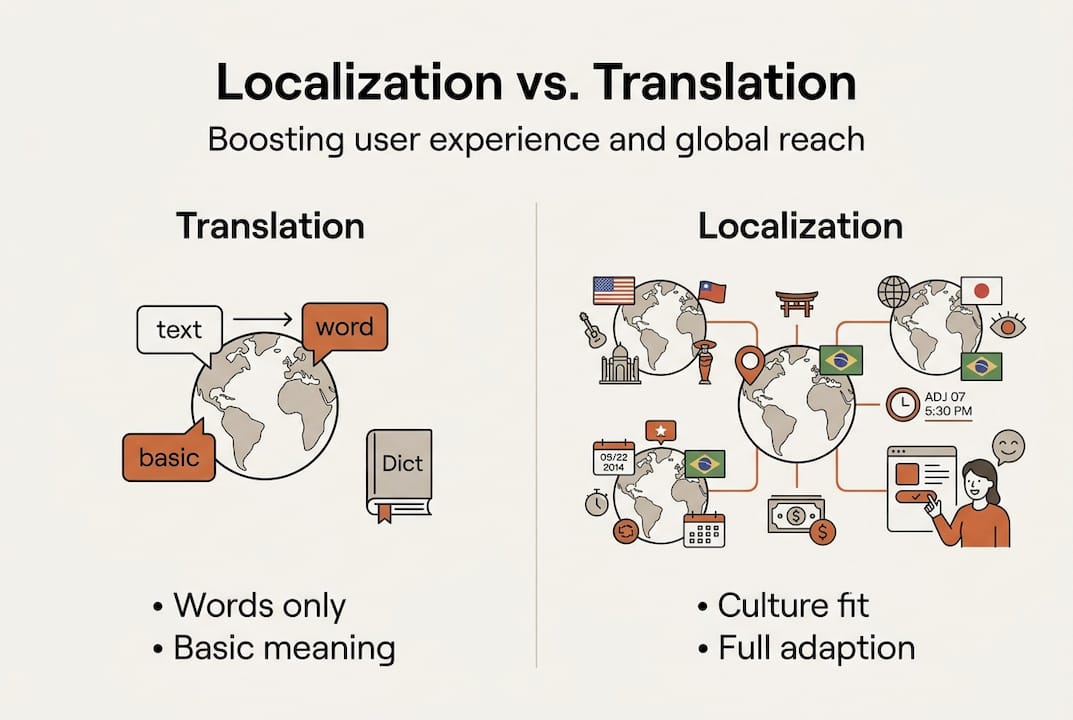
Translation is about words. Localization is about people. That distinction sounds simple, but the operational gap between the two is enormous for any product team targeting multiple markets.
When you translate, you swap text from one language into another. The meaning transfers, but the experience does not always follow. Consider a UI button that reads “Submit” in English. A direct translation into Japanese might be technically correct yet feel abrupt or even rude to a native speaker expecting a softer call to action. That small friction point, multiplied across an entire product, erodes trust fast.
True localization adapts everything a user touches: idioms, date formats, currency symbols, legal notices, imagery, color choices, and even the direction of reading. It is the software localization impact that separates products users merely tolerate from products they love. As Forbes notes, cultural adaptation is the essential bridge between translation and genuine market trust.
Here is a quick comparison of how translation and localization stack up across the dimensions that matter most to product teams:
Dimension | Translation | Localization |
|---|---|---|
Accuracy | High (linguistic) | High (cultural + linguistic) |
Cultural nuance | Low | High |
User trust | Moderate | Strong |
UX fit | Generic | Market-specific |
Brand voice | Often lost | Intentionally preserved |
When you look at what actually needs localization in a digital product, the list goes well beyond copy:
UI labels, tooltips, and error messages
Idioms, humor, and tone of voice
Legal notices and privacy language
Images, icons, and color associations
Date, time, and number formats
“Language is the gateway to culture, and culture is the gateway to trust.” Localization is not a translation project. It is a relationship-building project with every market you enter.
Exploring the localization platform features that support this kind of depth will help your team move from word-for-word swaps to genuine cultural fluency.
Why localization is essential for global user experience
With the distinction clear, let’s explore why localization has such a powerful impact on user experience.
User experience is not just visual design or load speed. It is the feeling a person gets when they interact with your product. When something feels foreign or awkward, users disengage. When it feels made for them, they stay, convert, and recommend.

The data backs this up decisively. Localized products consistently outperform translated-only products across every metric that matters to product teams:
Metric | Translated only | Fully localized |
|---|---|---|
User retention (90-day) | ~52% | ~74% |
Net Promoter Score | +18 | +41 |
Conversion rate | 1.8% | 3.5% |
These are not marginal improvements. They represent a fundamental shift in how users perceive and value your product.
The positive impacts of localization ripple through the entire product lifecycle:
Higher user satisfaction because the product speaks their language, literally and culturally
Reduced churn because users feel understood and are less likely to look for local alternatives
Stronger brand perception in new markets because you signal respect for the local culture
Fewer support tickets because localized error messages and onboarding are clearer
One stat worth anchoring on: users are 3x more likely to recommend products that feel culturally tailored to them. That is referral engine power you cannot buy with ad spend.
Localization also resolves invisible friction. A checkout flow with the wrong currency format, a date picker that ignores local conventions, or a help article using idioms that mean nothing to the target audience: each one is a micro-moment where users question whether your product really belongs in their world. Understanding how AI is transforming localization helps teams identify and fix these friction points at scale. And when designers think about localization from the start, as explored in AI localization for designers, those friction points rarely make it to production.
How AI accelerates and improves localization processes
Optimizing user experience is vital, but how do you achieve localization at scale? Enter AI-powered processes.
Manual localization for a mid-size SaaS product can take weeks per language. AI changes the math dramatically. Here are the key benefits AI brings to a modern localization workflow:
Speed at scale: AI can generate first-draft translations for thousands of strings in minutes, not days.
Consistency across releases: Semantic translation memory ensures that the same term always translates the same way, protecting brand voice across your product.
Integration with design tools: AI-powered localization platforms connect directly with tools like Figma, letting designers and developers work without leaving their environment.
Glossary enforcement: AI applies approved terminology automatically, so no rogue translations slip through.
Continuous improvement: Machine learning models get better with each correction your team makes, gradually reducing the review burden over time.
But AI is not a silver bullet. Pure AI localization risks quality drops in low-resource languages and can miss cultural nuance entirely, especially in markets where tone carries as much meaning as content. Explore why AI in localization still needs careful implementation to avoid these traps.
“AI excels at volume and velocity. Human expertise excels at nuance and brand integrity. The best localization teams use both.”
Pro Tip: Build a hybrid workflow where AI handles the first pass and human reviewers, ideally native speakers with product context, handle final approval. This is the setup that powers AI localization strategy for high-performing global teams.
The cross-functional AI localization approach, where PMs, UX writers, and developers all participate in the review loop, consistently produces the highest-quality outcomes. Think of AI as your speed layer and your human team as your quality layer. Together, they are unstoppable.
Best practices for localization in product teams
Understanding the technology is one thing, but how can product teams put great localization into practice?
The biggest mistake teams make is treating localization as a late-stage task. It gets bolted on after design is locked and code is frozen, which means retrofitting everything at cost and speed penalties. Flip that model. Integrate localization from day one.
Here is how to build localization into your process from the ground up:
Design phase: Use locale-aware design components. Build text containers that flex for languages with longer strings, like German or Finnish. Plan for bidirectional text early.
Copywriting phase: Write in plain, idiomatic-neutral language that AI and human translators can process cleanly. Avoid slang or region-specific humor in source strings.
QA phase: Run in-context reviews so translators and reviewers see strings inside the actual UI, not in a spreadsheet. Context changes everything.
Once your team is in motion, these best practices will keep quality high across releases:
Maintain a style guide per locale: Define tone, formality, and terminology for each target market. This is what keeps your brand voice from fragmenting.
Use translation memory aggressively: Every approved translation should feed back into your memory so future releases are faster and more consistent.
Enforce in-context review: Never approve a translation without seeing it rendered in the product. Truncation, overflow, and tone issues only surface in context.
Run user feedback loops: Collect qualitative data from local users and feed it back into your glossary and style guide. Real users will catch what reviewers miss.
Pro Tip: Pure AI risks real quality drops in low-resource languages like Swahili or Burmese. For these markets, weight human review more heavily and build in more review time before launch.
If you are scaling a SaaS product to multiple markets, the multilingual SaaS localization playbook is worth studying. The core principle is that localization is a discipline, not a one-time project. Build the muscle now and every future launch gets faster.
Our perspective: What most guides miss about localization at scale
Most localization guides focus on tools and tactics. That matters. But after working with product teams across dozens of markets, we have seen a pattern that rarely gets discussed: the teams that sustain localization excellence over time are not the ones with the best software. They are the ones with the strongest feedback culture.
Tools automate the repetitive. Culture drives the iterative. When a team in Berlin notices that a localized onboarding flow is confusing users in Korea, the tool did not catch that. A user interview did. A Slack thread between a local PM and the UX writer did. That human feedback loop, wired directly into your localization process, is what separates good from great at scale.
We believe that iterative fine-tuning beats one-off localization efforts every time. Your first localized release will have gaps. The localization trends that defined recent years all point in the same direction: real-world feedback, continuous iteration, and cross-border collaboration are the actual engines of sustained quality. Build for learning, not just for launch.
Unlock seamless localization with AI-powered tools
Ready to drive real results with your next localization project? The gap between translation and true localization is where global products either win or lose their users. Bridging that gap requires more than good intentions. It requires the right infrastructure.
Gleef gives product teams an AI localization platform built for exactly this challenge: semantic translation memory, glossary enforcement, in-context editing, and a Figma plugin that lets designers handle localization without leaving their workflow. Teams using Gleef report faster release cycles, stronger brand consistency, and higher-quality translations across every market they serve. If you are serious about global reach, this is where you start.
Frequently asked questions
What’s the difference between translation and localization?
Translation converts text from one language to another, while localization adapts your entire product for local culture, tone, and user expectations, including UI, imagery, and legal content. Cultural adaptation is what builds genuine market trust.
How does localization improve user experience?
Effective localization removes cultural friction points so users feel your product was built specifically for them, which directly boosts satisfaction, retention, and conversion. Localization impacts user acceptance in ways that translation alone simply cannot achieve.
Can AI replace humans in localization?
AI handles high-volume translation tasks at speed and scale, but human oversight remains essential for brand voice, tonal nuance, and complex languages. Pure AI risks quality drops in low-resource languages where training data is limited.
What are some best practices for software localization?
Start localization in the design phase, maintain a style guide and translation memory per locale, and combine AI-powered workflows with native-speaker review. Cultural adaptation remains critical even when AI handles the first draft.