
TL;DR:
Effective localization requires native-sounding translations that align with cultural and UI conventions.
Traditional machine translation often produces unnatural, literal, and tone-mismatched text that users detect.
Continuous user feedback, native linguist involvement, and iterative processes are essential for maintaining native quality.
Machine translation scores can look impressive on a dashboard while your users in Tokyo, São Paulo, or Warsaw quietly abandon your product. That gap between synthetic benchmarks and real human perception is where most localization strategies quietly fall apart. Users read only 20-28% of page text, which means awkward phrasing in those precious words costs you attention you can never recover. This guide cuts through the confusion around what native-sounding translation actually means, why your current approach may be producing “translation smell” without your team noticing, and what proven methods you can put in place right now.
Key Takeaways
Point | Details |
|---|---|
Native-sounding matters | Users immediately recognize and react to awkward translations, impacting product adoption. |
AI isn’t enough | Machine translations lack the nuance and local context that only native linguists provide. |
Process beats one-time effort | True native-quality localization comes from ongoing user feedback and continuous refinement. |
Validate with real users | Synthetic benchmarks can overestimate quality; always test with actual target-language users. |
What makes a translation sound native?
Now that we’ve set the scene on why awkward translations matter, let’s clarify what “native-sounding” actually means in practice.
A native-sounding translation reads the way a local author would write it, not the way a bilingual dictionary would render it. It uses the right idioms for that culture, matches the expected formality level for the product category, and respects the UI conventions local users have learned from other software they trust. It feels invisible. When localization works, users never think about the language at all. They just use your product.
The stakes are real. Research on user reading habits confirms that users quickly recognize awkward translations and reduce engagement almost immediately. This is not a matter of taste. It directly shapes your SEO performance, your UX quality scores, and the brand trust you’ve spent months or years building.
Understanding the difference between translation and localization is the first step here. Translation converts words. Localization converts meaning, tone, and context into a form that resonates with a specific audience. Native-sounding output is the goal of true localization, not just accurate translation.
Here are the most common signs a translation isn’t native:
Literal phrasing that maps word-for-word from the source language, creating sentences that are technically correct but feel foreign
Stiff or mismatched tone, such as overly formal language in a casual consumer app, or casual phrasing in a regulated financial product
Unnatural idioms that translate the surface expression but miss the cultural meaning entirely
Nonstandard UI conventions, like button labels or error messages that don’t follow the patterns local users expect from software in that market
Source-language sentence structure preserved in the target language, creating long, awkward clauses that native speakers would never write
Each of these signs acts as a signal to your user that something is off. They may not articulate why. They just feel friction, and friction leads to churn.
Why traditional translation methods fall short
With a clear sense of what true native localization looks like, let’s inspect where common approaches go wrong.
Standard translators and AI-powered machine translation (MT) tools can move fast and handle volume. That speed is genuinely useful. But speed without context is where the problems begin. Most MT systems are trained on broad corpora that don’t account for your product’s specific tone, your audience’s expectations, or the cultural nuance embedded in local market conventions.

Research on translation smell in AI output shows that AI and machine translation produce unnatural structure, formality mismatches, and consistently miss idioms and cultural nuance. The result is text that passes a grammar check but fails a native speaker’s gut check. It “smells” like a translation, even to users who can’t explain why.
Three patterns repeat across failing localization projects:
Source-structure mimicry: The target text follows the grammatical architecture of the source language instead of the target language’s natural patterns.
Frozen formality: MT models default to a formal register that often mismatches the product’s intended tone, making casual products feel stiff or enterprise tools feel flippant.
Idiom blindness: Expressions that carry cultural meaning get translated literally, producing results that confuse or even offend local users.
This is why traditional localization tools fail to deliver native quality at scale. They optimize for throughput, not resonance.
The solution introduces a different role: the native marketing linguist or transcreator. These professionals don’t just translate; they adapt content from the ground up, starting with the effect you want to create in the reader and working backward to the words that create it in the target language. They understand what challenges standard translators face and how to avoid them.
Dimension | Standard translation | Native transcreation |
|---|---|---|
Context awareness | Low | High |
Idiom and nuance handling | Literal | Culturally adapted |
Formality calibration | Often mismatched | Tuned to product and audience |
UI text adaptation | Minimal | Full convention alignment |
User acceptance | Variable | Consistently high |
“Translation smell is easy for users to spot, even if teams miss it internally. By the time your analytics surface the problem, users have already moved on.”
Proven methodologies for native-sounding localization
Recognizing the shortcomings of traditional translation, here’s how your team can systematize native-sounding output.
Building a reliable, repeatable process is what separates teams that ship great localized products from teams that keep patching problems after launch. These steps are actionable and can be adopted incrementally.
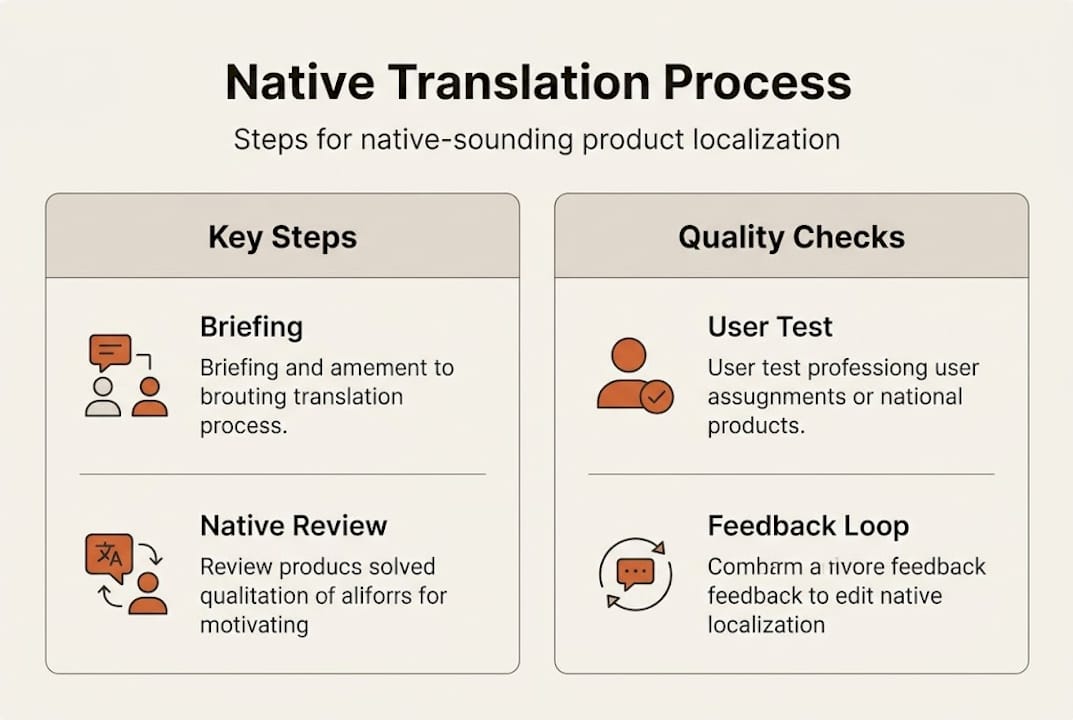
Hire native marketing linguists or transcreators for at least your highest-traffic surfaces: onboarding flows, error messages, pricing pages, and core navigation labels.
Write detailed context briefs for every translation request. Include the target user persona, the emotional tone you want to convey, and examples of similar content done well.
Build and maintain a style guide and glossary in each target language. These documents lock in terminology decisions, formality levels, and brand voice so every contributor works from the same foundation.
Use back-translation checks on critical strings. Have a second native speaker translate the output back to the source language without seeing the original, then compare for meaning drift.
Collect Voice of Customer data in the target language. Support tickets, app store reviews, and in-product surveys written by local users reveal exactly where language feels unnatural.
Schedule native reviews before every release, not just at project launch. Language evolves, and what felt fresh two years ago may already feel dated.
Research on native linguist best practices confirms that using native linguists, structured context briefs, and ongoing user research is what drives genuine native quality output. It’s not a shortcut. It’s a system.
For tips on multilingual content management that keep your glossaries and style guides synchronized across markets, the tooling layer matters as much as the human layer.
Pro Tip: Always test with at least five to ten real users in the target locale before a major release. Even a brief usability session surfaces awkward phrasing that no internal reviewer catches because they’re too close to the source.
Tracking translation quality metrics at each stage of this process gives your team the data it needs to improve continuously rather than guessing.
Measuring quality: How to validate native sound for real users
Best-in-class practices are only valuable if you can verify their impact. Here’s how to measure whether your translation process truly delivers native quality.
Synthetic benchmarks, the BLEU scores and MT evaluation metrics that vendors often highlight, measure how closely a translation resembles a reference translation. They do not measure how comfortable a real user feels reading your product. These metrics can overestimate performance on native user queries, and that overconfidence is dangerous. Shipping based on a high BLEU score while actual users feel friction is one of the most common and costly localization mistakes in product development.
True localization ROI only becomes visible when you measure against real user behavior, not reference strings.
Measurement type | What it captures | Reliability for native quality |
|---|---|---|
BLEU / MT benchmarks | Similarity to reference text | Low |
In-app survey responses | User sentiment in real context | High |
Support ticket language | Recurring confusion points | High |
A/B test conversion rates | Behavioral response to wording | Very high |
Task completion rates | UX effectiveness by locale | Very high |
Here’s what a continuous feedback loop looks like in practice. First, deploy in-app surveys triggered after key user actions, written in the target language. Second, monitor support logs for repeated phrases or complaints that signal language confusion. Third, run A/B tests on high-stakes strings, comparing a literal translation against a transcreated version, and measure which drives better completion rates.
For teams working through localization challenges, the data from these channels is far more instructive than any automated quality score.
Understanding the full impact of software localization goes beyond just measuring errors. It shapes retention, referral rates, and long-term market penetration.
Pro Tip: Set up a dedicated support inbox or tag in your existing ticketing system specifically for target-language queries. Review it monthly to spot patterns that point to systemic localization problems before they compound.
The hard truth: Native-level translation is not a feature but a process
Having covered how to assess and implement native-sounding translation, it’s time for a clear-eyed look at how real teams succeed.
Here’s what we’ve seen repeatedly: teams that treat localization as a one-time feature to ship almost always end up re-doing significant portions of their work within twelve to eighteen months. Language is not static. User expectations shift. Cultural context evolves. What felt native at launch can feel stale or even tone-deaf eighteen months later.
The teams that win long-term treat localization as a living maintenance process with clear ownership, regular review cycles, and direct feedback loops from real users. They invest in localization maturity solutions that grow alongside their product. No AI tool, no matter how advanced, can fully automate context, culture, and user expectation. Technology accelerates the process; human judgment still steers it.
“The moment you treat translation as done, it starts becoming wrong.”
Build your localization process the same way you build your product: with iteration, measurement, and a genuine commitment to the people using it.
Unlock native-sounding localization for your tech product
If you’re ready to transform your localization process with the right technology and native expertise, here’s your next step.
Gleef is built specifically for product teams who refuse to let translation quality become a release blocker. Our AI-powered platform combines semantic translation memory, glossaries, and in-context editing to give your team the infrastructure for native-quality output at scale.
With the Gleef Figma Plugin, your designers and UX writers can manage translations directly inside Figma, eliminating the back-and-forth that slows launches. The full Gleef localization platform connects your entire workflow, from context briefs to native review cycles, so every string ships sounding like it was written by a local. See how teams are shipping faster, with fewer revisions, and stronger brand consistency across every market they enter.
Frequently asked questions
What are the main signs of non-native translations in software products?
Common signs include awkward phrasing, mismatched formality, literal translations, and UI text that feels unnatural to local users. AI and MT tools frequently produce these patterns due to structural and cultural blind spots.
Why can’t AI or standard translators guarantee native quality?
They often miss idioms, context, and subtle tone differences, resulting in unnatural or “smelly” translations that local users detect immediately. AI and MT systems fail on cultural nuance and produce hallucinations that pass automated checks but fail real users.
How can product teams validate if a translation feels native?
Test content with real users in the target locale, review support logs, and use feedback to spot awkward or non-native language. User testing is essential because synthetic benchmarks consistently overestimate actual native-user performance.
What process ensures consistently native-sounding localization?
Using native marketing linguists, providing detailed context briefs, and iterating based on real user feedback delivers authentic results. Native linguists and user research are the foundational elements of any quality native output process.