
TL;DR:
Effective localization requires seamless tool integration, in-context editing, and strong cross-team coordination.
Maintaining translation quality with AI involves human review, quality gates, and clear terminology management.
Success is measured by business outcomes like time-to-market and user retention, not just translation volume.
Localization is the engine behind global product success, yet it consistently trips up even the most experienced product teams. You are juggling speed-to-market pressure, integration headaches, quality control, and the constant question of whether your investment is actually paying off. 76% of global consumers prefer buying in their native language, which means getting localization right is not optional. This article breaks down the four biggest challenges product teams face today and gives you concrete, actionable strategies to solve each one. Think of it as your field guide to building bulletproof localization workflows that scale.
Key Takeaways
Point | Details |
|---|---|
Choose integrated tools | Solutions that fit developer workflows streamline localization and reduce friction. |
AI needs human review | Machine-assisted translations save time but must be checked for quality and context. |
Measure real outcomes | Metrics like time-to-market and retention are more useful than word count for localization ROI. |
Align cross-functional teams | Successful global launches depend on collaborative efforts between dev, product, and translation experts. |
Evaluating localization tools and integration workflows
Choosing the right localization tool used to mean picking the platform with the most language pairs. Not anymore. Today, the criteria have shifted dramatically toward workflow integration, developer experience, and real-time collaboration. If your tool creates friction for your developers, it will slow down every release cycle.
The core issue is that many traditional platforms were built for translators, not for the product teams who live inside GitHub, Figma, or CI/CD pipelines. Traditional localization tools often force developers to export files, hand them off manually, and then re-import translations after review. That process is a release blocker waiting to happen.
Here is what modern tool evaluation should cover:
Workflow integration: Does the tool connect directly to your Git repository, CDN, or design environment? Developer-first tools with Git and CDN integration are strongly preferred by dev teams because they eliminate manual handoffs and keep translations in sync with code.
In-context editing: Can translators and UX writers see strings in their actual UI context? Without this, you get translations that are technically correct but visually broken.
Collaboration features: Does the platform support simultaneous work by product managers, developers, and translators without version conflicts?
Scalability: Can the tool handle 20 languages as easily as it handles 2?
Web-based editors that require constant context-switching are a particular pain point. Developers lose momentum when they have to leave their environment to manage strings. The best localization solutions embed translation management directly into the tools your team already uses.
Pro Tip: Before committing to any localization platform, run a pilot with your actual tech stack. Test the Git integration, the API response times, and the collaboration flow with at least one translator and one developer working simultaneously. Real-world friction shows up fast.
The goal is a setup where a developer pushes a new string to the repo, it automatically surfaces for translation, gets reviewed in context, and flows back into the product without anyone sending a single email. That is the standard worth aiming for.
Managing translation quality in the AI-assisted era
With tools in place, product teams face the next hurdle: ensuring consistent translation quality amid rapid AI adoption. Machine translation has gone from a novelty to the default. 70% of translations are now machine-assisted, and AI adoption in dev teams sits at 73%. Speed is up. But quality? That requires deliberate effort.

The risk is treating AI output as finished work. AI excels at generating first drafts quickly, but it regularly misses cultural nuance, brand voice, and context-specific meaning. A chatbot interface translated word-for-word into Japanese might be grammatically correct but feel robotic and off-brand to native speakers.
Here is a practical quality control framework you can implement today:
Use AI for first drafts only. Set the expectation internally that machine output is a starting point, not a deliverable.
Build a human review layer. Assign native-speaking reviewers for each target market. AI excels at drafts but consistently needs human review for accuracy and nuance.
Set quality gates before release. Define pass/fail criteria: terminology consistency, tone alignment, and character limits for UI strings.
Maintain a living glossary. Lock down brand-specific terms so AI and human translators use the same vocabulary across all languages.
Run in-context QA. Review translations inside the actual product interface, not in a spreadsheet. Strings that look fine in isolation often break layouts or lose meaning in context.
“The teams winning at localization are not the ones with the fastest AI pipelines. They are the ones who treat human review as a feature, not a bottleneck.”
Explore AI translation best practices to understand where automation genuinely helps and where it creates hidden risk. You should also align your team on translation quality standards before you scale, because fixing quality problems at scale is exponentially more expensive than preventing them early.
Pro Tip: Create a “translation debt” tracker alongside your technical debt tracker. Log every instance where a translation was flagged for quality issues. Patterns in that log will tell you exactly where your workflow needs reinforcement.
Measuring business value: Moving beyond word count ROI
After quality control, teams need to justify their localization strategies and investments with meaningful metrics. This is where most product teams hit a wall. Traditional localization metrics like word count, translation volume, and cost per word tell you almost nothing about business impact.
Tying localization to ROI is genuinely hard, and leading teams are shifting to time-to-market and retention metrics to make the case. The good news is that outcome-based measurement is both achievable and far more persuasive to leadership.
Traditional metric | Modern outcome metric |
|---|---|
Words translated per month | Time-to-market by locale |
Cost per word | User retention rate by language |
Translation volume | Feature adoption in new markets |
Turnaround time | Support ticket volume by locale |
Number of languages supported | Revenue growth per localized market |
Shifting to outcome metrics changes how your entire team thinks about localization. Instead of asking “how many words did we translate this sprint?”, you ask “did our German users retain at the same rate as our English users after the last release?”
Here is what to start tracking:
Time-to-market per locale: How many days from feature freeze to localized release? Reducing this number is a direct competitive advantage.
Engagement by language: Are users in localized markets completing key flows at the same rate as your primary market?
Support escalations by locale: A spike in support tickets from a specific market often signals a localization failure, not a product bug.
Explore multilingual SaaS localization outcomes and the real impact of software localization to build a measurement framework your leadership team will actually trust.
Overcoming cross-team and language-specific roadblocks
The final challenge is managing diverse teams and languages at scale. The global language services market is expected to reach $75.7 billion in 2025, which signals just how complex and resource-intensive this space has become. Coordination between dev, product, and translation teams is where localization projects most often break down.
Market | Primary language | Common localization pitfall |
|---|---|---|
Germany | German | Compound words expanding UI text by 30%+ |
Japan | Japanese | Formal vs. informal register mismatches |
Brazil | Portuguese (BR) | False cognates with European Portuguese |
Middle East | Arabic | Right-to-left layout and bidirectional text |
China | Simplified Chinese | Platform restrictions and content compliance |
Language-specific challenges are real and often underestimated. Arabic requires full right-to-left layout support, not just flipped text. German strings routinely run 30% longer than their English equivalents, breaking button labels and navigation menus. Japanese has distinct formal and informal registers, and using the wrong one signals cultural tone-deafness.
Here is how winning teams handle cross-functional coordination:
Assign a localization owner per market. One person accountable for quality, timelines, and escalations in each locale prevents the “everyone’s responsible, no one’s responsible” trap.
Build language-specific style guides. Document tone, register, and terminology rules for each target language before you scale.
Create shared visibility. Use dashboards that show translation status, review progress, and release readiness across all teams simultaneously.
Review real translation challenge examples and the five keys to successful localization to build a cross-functional model that actually holds together. Strong cross-functional localization is not a nice-to-have. It is the difference between a localization program that scales and one that collapses under its own weight.
A fresh perspective: What most localization articles overlook
Most localization content focuses on tools and processes. That is necessary, but it misses the deeper issue: localization fails when teams treat it as a purely technical problem.
The uncomfortable truth is that automation without oversight is a trap. Teams that fully delegate quality to AI pipelines often discover the damage months later, when user trust in a specific market has quietly eroded. Missed cultural context does not trigger an error log. It just silently damages your brand.
The teams that win long-term build genuine cross-functional ownership. That means product managers care about locale-specific retention, not just feature parity. It means developers understand why a 30-character German string matters. Mastering cross-functional localization requires aligning every stakeholder on business outcomes, not just translation accuracy. When localization is everyone’s problem, it stops being a bottleneck and becomes a competitive advantage.
How Gleef helps teams solve localization challenges
Putting these strategies into practice requires tools that match the ambition. Gleef is built specifically for product teams who need speed, quality, and seamless integration without the operational overhead.
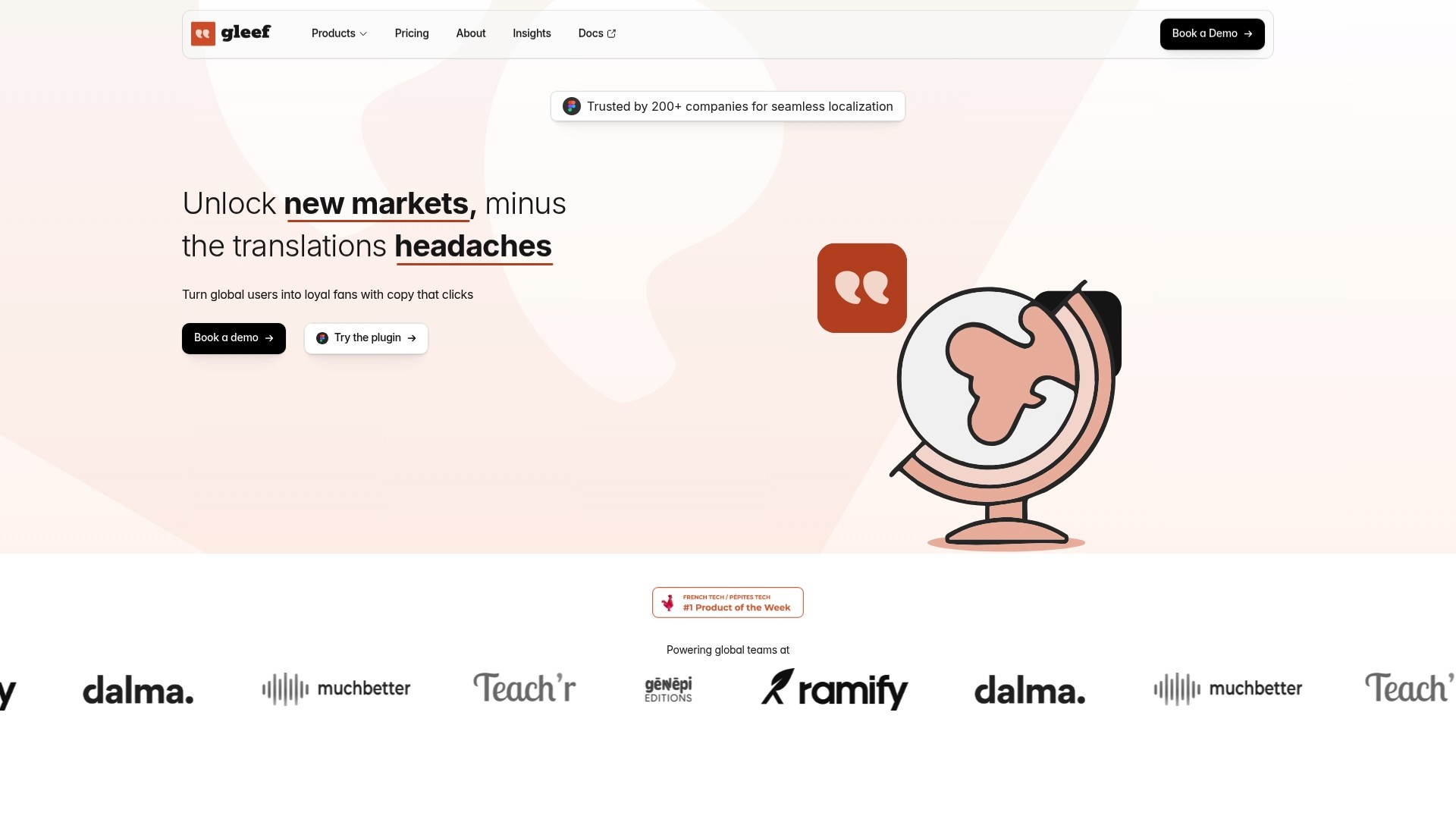
Gleef’s AI-powered platform automates translation workflows while keeping human review firmly in the loop. Its semantic translation memory and glossary features enforce consistency across every language and every release. The Gleef Figma plugin lets designers and UX writers manage translations directly inside Figma, eliminating the context-switching that slows teams down. And the Gleef platform connects your entire localization stack, from in-context editing to API-driven deployments, so your team can ship globally without sacrificing quality or speed.
Frequently asked questions
What are the top three localization challenges for software teams?
The main challenges are tool integration with existing dev workflows, maintaining translation quality as AI adoption accelerates, and tracking outcome-based metrics that reflect real business impact rather than translation volume.
How do teams maintain translation quality with AI tools?
The most effective approach uses AI-generated drafts as a starting point, then applies structured human review and quality gates before any string reaches production.
Why measure localization outcomes beyond word count?
Metrics like time-to-market and retention by locale directly reflect business value. Outcome-based metrics give leadership a clear picture of localization’s contribution to revenue and user engagement.
Why is cross-team coordination such a challenge in localization?
Localization spans product, engineering, design, and translation, and each team has different priorities and timelines. Without shared visibility and clear ownership, coordination at scale breaks down quickly, especially when language-specific requirements add extra complexity.
Recommended
How to streamline localization for global product teams - Gleef
The Ultimate Solution to Localization Key Challenges - Gleef
When and How to Think About Localization in the Product Roadmap in 5 steps - Gleef
How product managers drive successful localization in 2026 - Gleef
Automatic Translations archivo - Kai-zen surf school : Escuela de surf en tenerife sur