
TL;DR:
A disciplined content consistency workflow prevents brand drift and maintains user trust across multiple channels. Establishing clear roles, style guides, and automated quality gates is essential before scaling content operations. Regular measurement of QA pass rates and error rates ensures the workflow’s effectiveness and supports continuous improvement.
Your brand says one thing on the product page, something slightly different in the app UI, and something else entirely in the help docs. Nobody planned for it to be that way. It just happened, one rushed release at a time. A disciplined content consistency workflow is what stops that slow drift before it erodes user trust and burns your team’s capacity chasing corrections. This guide walks product managers and content strategists through the prerequisites, the step-by-step build, the failure points, and the metrics that tell you whether your workflow is actually working.
Key takeaways
Point | Details |
|---|---|
Build foundations first | Define your style guide, roles, and governance policies before touching any workflow tooling. |
Plan content 4 to 6 weeks out | Advance planning creates alignment across teams and prevents last-minute inconsistency spikes. |
Use pre-publish quality gates | Automated QA checks at the review stage cut manual review time significantly at scale. |
Measure what matters | Track QA pass rates, content velocity, and error rates to verify the workflow is improving over time. |
Automation needs governance | AI and automation tools produce consistent output only when paired with enforced approval gates and human editorial oversight. |
Foundations of a content consistency workflow
Before you write a single process doc or open a project management tool, you need three things locked down: a documented content strategy, defined roles, and agreed-upon standards. Without them, any workflow you build will leak.
Here is what the foundational layer actually looks like:
A content strategy tied to product goals. Content strategy transforms ad-hoc writing into a deliberate lifecycle that serves both the product roadmap and the user experience. If your content team does not know what the product is trying to achieve this quarter, they cannot write consistently toward it.
Clearly assigned roles. Who owns ideation? Who writes the first draft? Who approves? Who has final sign-off before publish? Role ambiguity is where voice drift starts. A RACI matrix for content creation solves this in an afternoon.
A living style guide with teeth. Not a Google Doc that nobody reads. A real governance document covering tone, terminology, sentence structure, and brand-specific word choices. This is your single source of truth for every writer, editor, and UX copywriter on the team.
Workflow management tools that match your team size. Small teams can get away with a Kanban board. Larger distributed teams need purpose-built content operations platforms. The key requirement is that every piece of content has a visible status, an owner, and a deadline in one place.
Modular content structures for scale. Scaling content sustainably requires modular components, AI automation, and governance systems rather than artisanal one-off production. Build reusable content blocks: product descriptions, disclaimers, CTAs, and UI microcopy that writers pull from rather than recreate each time.
The table below shows how foundational elements map to the problems they solve:
Foundation element | Problem it solves |
|---|---|
Content strategy document | Prevents misaligned messaging across teams |
RACI roles matrix | Eliminates approval confusion and delays |
Style guide and glossary | Blocks voice drift and off-brand terminology |
Centralized workflow tool | Removes version control failures and lost files |
Modular content library | Reduces creation time and repetition errors |
Building your workflow step by step
A content consistency workflow is not a single process. It is a chain of connected stages where each one depends on the last. Miss one link and the inconsistencies creep back in.
Set up your content calendar 4 to 6 weeks in advance. Research confirms that planning this far ahead gives cross-functional teams enough lead time to align on messaging, coordinate with design and engineering, and avoid the reactive, last-minute content that always goes off-brand.
Run a structured briefing process. Every piece of content should start with a brief that covers the audience, the goal, the key message, the format, and the relevant style guide section. A one-page brief takes 15 minutes to write and eliminates a full round of revision later.
Develop content in modular units. Instead of writing a 1,200-word page as a single document, break it into components: headline, intro, feature blocks, proof point, CTA. Each unit can be reviewed and approved independently, which dramatically speeds up the QA stage and makes reuse across channels realistic.
Apply quality assurance gates before review. Pre-publish automated checks reduce manual review time by 60% at scale. Run grammar and tone checks, verify that all product terms match the approved glossary, and flag any deviations from the style guide before a human editor even opens the file.
Route content through a defined approval chain. This means a single pass through a subject matter expert for accuracy, one pass through an editor for voice and brand compliance, and a final sign-off from the product owner for strategic alignment. No parallel reviews. No “just send it to everyone and see who responds.” Sequential gates create an auditable AI workflow when AI drafting is involved, which is the only way to maintain brand trust at volume.
Publish with metadata and schema readiness confirmed. Before anything goes live, verify that SEO metadata is complete, that internal links point to current URLs, and that any structured data is properly formatted. This step belongs in the workflow, not in a post-publish cleanup task.
Close the loop with performance feedback. Once content is live, route engagement data, search performance, and user feedback back into the planning stage. This is how your workflow actually improves over time rather than running in circles.
Pro Tip: Batch your creation and editing sessions into separate time blocks. Batching similar tasks prevents the cognitive switching that leads to tone inconsistencies across a single piece of content.
Here is a comparison of a reactive versus a structured workflow approach:
Workflow type | Content quality | Time to publish | Error rate | Brand consistency |
|---|---|---|---|---|
Reactive, ad-hoc | Variable | Unpredictable | High | Low |
Structured, governed | Consistent | Predictable | Low | High |

Common mistakes that break consistency
Even well-designed workflows fall apart. Knowing where the cracks typically appear lets you reinforce those spots before they cause problems.
Tool-switching and fragmentation. Disconnected legacy systems cause version control errors and slow down the entire content supply chain. When writers draft in one tool, editors review in another, and approvals happen in email, you get four versions of a file and no clear record of which one is final. A unified platform with in-context review eliminates this.
Voice drift over time. A new writer joins the team, reads one old article, and adopts the wrong register. Without regular calibration sessions and a style guide that is actively maintained, tone inconsistency compounds across every new hire.
Approval bottlenecks that kill momentum. If a single stakeholder becomes the only approval point for all content, the workflow backs up. Designate backup approvers for every role and set SLA timelines for each approval stage.
Over-reliance on automation without human oversight. AI drafting tools are genuinely useful, but they require enforced approval gates and QA checklists to catch generic phrasing, inaccurate claims, or off-brand language. Automation accelerates production. It does not replace editorial judgment.
Skipping team alignment as the team scales. A workflow that works for a team of three breaks at ten people. Build in quarterly workflow reviews and invest in onboarding documentation so new team members can maintain consistency from day one.
Pro Tip: Use a shared content quality assurance checklist that every writer and editor completes before submitting content for review. Checklists take subjective “does this feel right?” judgments and turn them into verifiable pass/fail criteria.
Measuring whether your workflow is working
Workflows without measurement are just good intentions. These are the metrics that tell you whether your content consistency process is actually delivering results.
Metric | What it measures | Target signal |
|---|---|---|
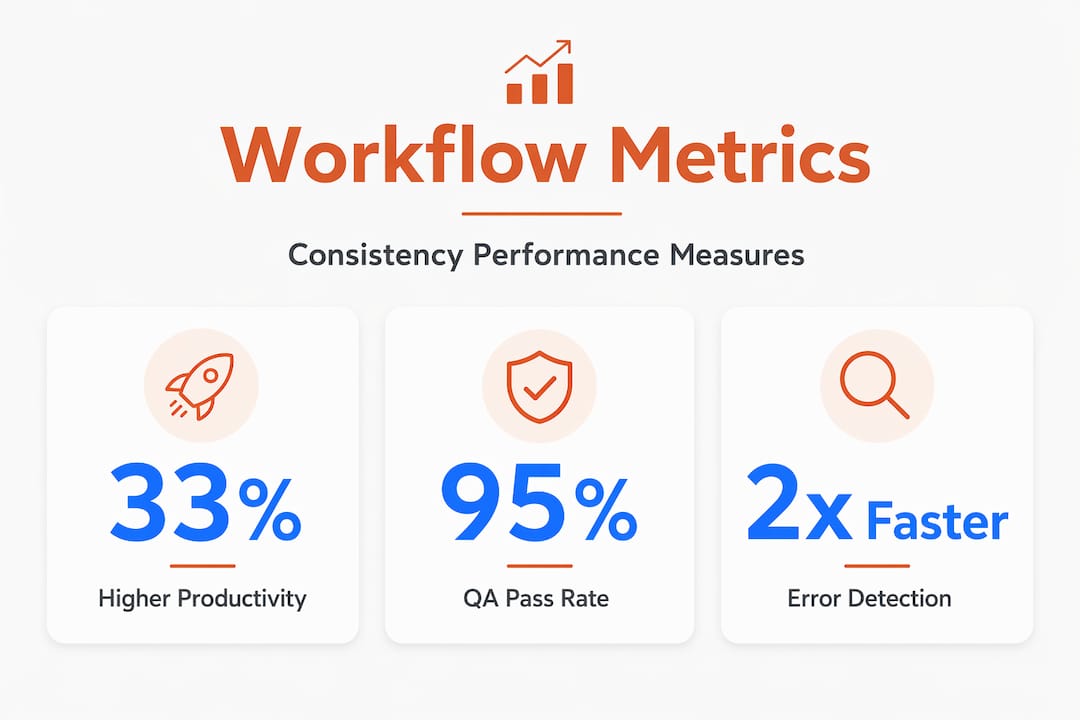
QA pass rate | Percentage of content passing review without major revisions | Above 85% consistently |
Content production velocity | Number of pieces produced per sprint or month | Increasing without quality drop |
Error rate post-publish | Corrections required after content goes live | Trending toward zero |
Time in each workflow stage | Hours spent per stage from brief to publish | Bottlenecks visible and shrinking |
Lead generation from content | Organic leads attributed to published content | Growing month over month |
Documented content strategies generate 3x more leads at 62% lower cost than ad-hoc content production. That gap is not about writing talent. It is about process. When you can predict your output and control your quality, content becomes a compounding asset instead of a recurring expense.
“The teams that scale content effectively are not the ones with the biggest budgets. They are the ones with the clearest processes.”
Beyond the numbers, look at qualitative signals. Are new team members getting up to speed faster? Are fewer corrections happening in the final review stage? Are stakeholders expressing more confidence in published content? These signals confirm that your workflow is building something durable, not just tracking activity.
Workflow tools that reduce admin work improve productivity by 33%, according to Slack’s 2026 data. Apply that to content operations and the math becomes compelling. Less time chasing approvals and hunting file versions means more time producing content that actually moves the needle.
My take on workflows and the consistency trap
I have worked with enough product teams to notice a pattern. The ones who struggle most with content consistency are not the ones with bad writers. They are the ones who treat workflow as overhead rather than infrastructure.
In my experience, the biggest mistake is waiting until inconsistency is already visible to users before building the process. By that point, you are doing remediation instead of prevention, and remediation at scale is brutal. A product that ships to global markets with inconsistent terminology in three languages is not just a brand problem. It is a trust problem that takes months to undo.
What I have learned is that modular content and governed automation genuinely change the equation. When writers pull from a pre-approved component library and every AI draft passes through a QA checklist with enforced approval gates, the cognitive load of “is this on-brand?” nearly disappears. That freed-up attention goes toward the creative judgment that actually makes content good. Tools like Gleef take this further by enforcing content consistency across localization, which is where consistency workflows most often fall apart as products go global.
My honest advice: start smaller than you think you need to. Map one content type through a complete workflow with full QA gates before scaling it to your entire content operation. Prove it works at small scale, measure it, and then expand it. Teams that try to implement everything at once usually implement nothing well.
— Antoine
How Gleef powers your content consistency workflow
Building a content consistency workflow is one thing. Keeping it consistent when your product ships across multiple languages is where most teams hit the wall. Gleef is built specifically for that challenge. It brings AI-powered translation, semantic translation memory, and enforced glossary rules into the same environment where your team already works. Product managers, UX writers, and developers stay in Figma or their existing tools while Gleef handles language workflow automation in context. No file exports. No version mismatches. No brand voice lost in translation. If your content operation is scaling toward global markets, explore Gleef to see how governance-first localization fits your workflow.
FAQ
What is a content consistency workflow?
A content consistency workflow is a repeatable, governed process that takes content from planning through publication while enforcing brand standards, voice, and quality at every stage. It combines defined roles, style guides, review gates, and workflow tools to prevent inconsistencies before they reach the audience.
How far in advance should teams plan content?
Teams should plan their content calendars at least 4 to 6 weeks ahead to allow for cross-functional alignment, proper briefing, and review cycles that do not compress quality.
What tools support a content consistency workflow?
Centralized workflow management platforms, shared style guide repositories, automated pre-publish QA tools, and content management systems with built-in approval routing all support a consistent content strategy process. For multilingual products, localization platforms like Gleef add another layer of consistency enforcement.
How do you measure content consistency?
Track QA pass rates, post-publish error rates, and content production velocity over time. A rising QA pass rate combined with a falling error rate is the clearest signal that your workflow is enforcing consistency effectively.
Why does content consistency break down as teams grow?
Consistency breaks down at scale because undocumented standards depend on individual knowledge rather than shared systems. As new people join and tools multiply, the absence of governed workflows allows voice drift, version errors, and approval delays to compound.