
TL;DR:
A language services provider is a company that offers translation, interpretation, and localization services to help organizations communicate across regions. Choosing the right LSP is a workflow decision that impacts a product team’s ability to ship software on time in global markets.
A language services provider (LSP) is a company that delivers translation, interpretation, and localization services to help organizations communicate across languages and markets. The industry standard term is “language service provider,” recognized formally by ISO and the Globalization and Localization Association (GALA). For product teams shipping software to global markets, choosing the right LSP is not a vendor decision. It is a workflow decision that determines whether your release ships on time or stalls at the localization stage. This guide cuts through the noise and tells you exactly what to look for.
How language services providers support product team workflows
The right LSP does not just translate strings. It plugs directly into your development and design pipeline.

Modern language support solutions integrate with translation management systems (TMS) and content management systems (CMS) through REST APIs and CMS connectors. Lack of these integrations leads to translation drift, manual copy-paste errors, and inconsistent terminology across your product. If your LSP cannot connect to your existing tech stack, you will spend more time fixing errors than shipping features.
Continuous localization is the practice of translating content as it is written, not in a batch at the end of a sprint. LSPs that support agile deployment cycles give your team a real advantage. They receive new strings automatically, return translations within hours, and feed approved copy back into your pipeline without manual handoffs.
AI-powered platforms combined with human linguists are now the standard model for multilingual services. AI handles high-volume, repetitive strings at speed. Human experts review output for cultural accuracy and brand tone. This combination is what separates a capable language localization provider from a basic translation vendor.
Terminology databases are the backbone of content consistency. When your LSP maintains a shared glossary across AI, post-editing, and human translation workflows, your product speaks with one voice in every market. Without it, the same UI element gets translated three different ways across three sprints.
TMS and API integration: Your LSP must connect to tools like Phrase, Lokalise, or your own pipeline via REST API.
Continuous localization support: Look for LSPs that accept string-level updates, not just full-document batches.
Glossary and terminology management: Shared terminology assets prevent tone drift across AI and human workflows.
Agile-compatible turnaround: The best providers return translations within 24 hours for standard language pairs.
Pro Tip: Before signing any LSP contract, ask for a technical integration spec sheet. If they cannot provide one, your developers will spend weeks building workarounds.
What certifications and features should you look for in an LSP?
Certifications are not marketing badges. They are your guarantee that an LSP meets defined quality and security standards.
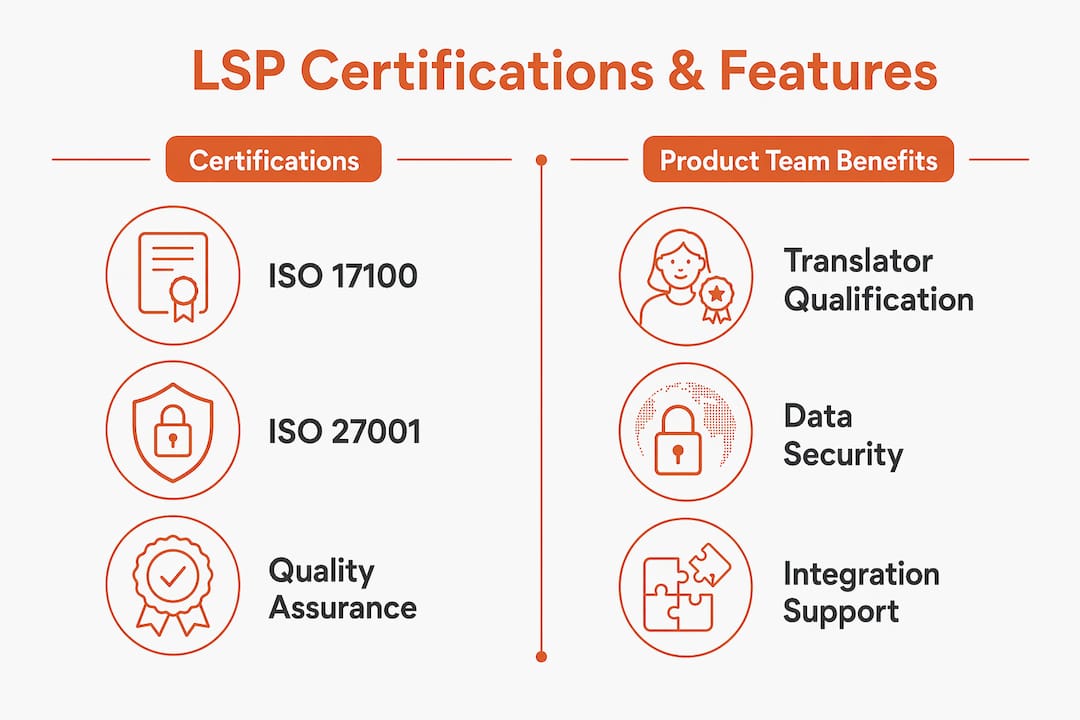
ISO 17100 and ISO 27001 are the two certifications that matter most. ISO 17100 governs translation quality processes, including translator qualifications and review workflows. ISO 27001 covers information security management. For product teams handling user data, proprietary code strings, or regulated content, ISO 27001 is non-negotiable.
Multi-step quality assurance workflows separate professional LSPs from freelance marketplaces. A credible provider runs translation through at minimum three stages: initial translation, independent review, and final proofreading. Some add a fourth stage for in-context review, where linguists check translations inside the actual product UI.
Feature | Why it matters for product teams |
|---|---|
ISO 17100 certification | Guarantees qualified translators and documented QA processes |
ISO 27001 certification | Protects sensitive code strings and user data during transfer |
REST API and TMS connectors | Enables direct integration with your existing localization pipeline |
Terminology and glossary management | Maintains brand voice and UI consistency across all languages |
In-context review capability | Catches layout breaks and truncation before release |
Certified document translation | Required for legal filings, app store submissions, and compliance docs |
Data security protocols matter beyond certification. Ask your LSP how they handle file transfer, data storage, and translator access controls. A provider working on your product strings has access to your intellectual property. Treat that relationship with the same scrutiny you apply to any software vendor.
Pro Tip: Request a sample QA report from any LSP you are evaluating. A real provider will show you exactly how errors are caught and resolved. If they cannot produce one, their QA process exists only on paper.
What does LSP pricing and turnaround actually look like?
Translation pricing follows a per-word or per-page model depending on the content type.
Certified document translation typically costs around $24 per page with a turnaround of 24–48 hours. That rate applies to standard language pairs like English to Spanish or French. Rare language pairs, technical content, and expedited delivery all carry premium pricing. For software localization, most LSPs price per source word, with rates varying by language pair complexity and required quality tier.
Turnaround time depends on three variables: content volume, language pair, and quality tier. A 2,000-word UI update in English to German returns faster than the same content in English to Thai. Plan your release calendar around these realities, not around optimistic vendor estimates.
Certified translations include a signed accuracy statement and follow strict formatting to meet legal or institutional requirements. These are distinct from general localization work. You need certified translation for app store legal agreements, GDPR compliance documentation, and government filings. General localization covers UI strings, marketing copy, and help content.
Per-word pricing: Standard for software localization; rates vary by language pair and quality tier.
Per-page pricing: Common for document translation services; certified documents start around $24 per page.
On-demand interpretation: Available for user research sessions, stakeholder calls, and live product demos in foreign markets.
Multimedia localization: Covers subtitling, voice-over, and video localization for product tutorials and onboarding content.
One detail product teams consistently miss: specifying the intended use of a document upfront prevents delays and rejections. A translation submitted for legal approval needs different formatting and credentials than one used for internal review. Tell your LSP exactly where the output will be used before the project starts.
How do hybrid AI and human workflows deliver better results?
The hybrid approach is the industry’s established best practice for translation quality. It is not a compromise. It is the architecture that makes scale and quality coexist.
AI handles high-volume, routine translation tasks at a speed no human team can match. Think UI strings, error messages, and repetitive help content. Machine translation engines process these accurately and consistently when trained on your product’s terminology. AI cannot fully replace human translators for creative copy, emotionally resonant content, or high-stakes legal text. That is where human linguists perform linguistic quality assurance and cultural tuning.
Here is how a well-structured hybrid workflow runs in practice:
Ingest: New strings enter the TMS automatically from your code repository or design tool.
Machine translation: AI translates strings using your approved glossary and translation memory.
Human review: A qualified linguist checks output for accuracy, tone, and cultural fit.
In-context QA: A reviewer checks translations inside the live product or a staging environment.
Approval and export: Approved strings return to the pipeline, ready for release.
Integrated technology-driven platforms can reduce localization project management costs by up to 50%. That reduction comes from eliminating manual handoffs, reducing rework, and compressing review cycles. The savings are real, but they only materialize when the technology is properly integrated with your workflow from day one.
“The best localization outcomes happen when AI handles the volume and humans own the judgment calls. Neither alone produces a product that feels native to its market.”
Building and maintaining terminology databases is what makes hybrid workflows durable over time. When your glossary is shared across AI engines, post-editors, and human translators, every output reflects the same brand voice. Without that shared asset, each workflow layer introduces its own interpretation of your product’s language.
Key Takeaways
A language services provider is a critical infrastructure partner for product teams, not a one-time vendor. Selecting one without vetting technology compatibility, certifications, and workflow fit creates localization debt that slows every future release.
Point | Details |
|---|---|
Vet technology compatibility first | Confirm REST API and TMS integration before signing any LSP agreement. |
Require ISO certifications | ISO 17100 and ISO 27001 protect translation quality and your data security. |
Build terminology assets early | A shared glossary prevents brand voice drift across AI and human workflows. |
Use hybrid workflows for scale | AI handles volume; human linguists own cultural accuracy and QA. |
Specify document use upfront | Stating intended use prevents certified translation rejections and delays. |
Why most product teams pick the wrong LSP (and how to avoid it)
The most common mistake I see product teams make is treating LSP selection like a software procurement decision. They compare pricing tiers, check a few reviews, and sign the contract. Then they spend the next three sprints untangling integration failures and inconsistent terminology.
The real selection criteria are not on any vendor’s pricing page. Technology compatibility is the first filter. If an LSP cannot connect to your TMS via API, your developers will build a manual bridge that breaks every time either system updates. I have watched teams lose weeks to this exact problem.
The second thing teams consistently underinvest in is terminology. Your glossary is not a nice-to-have. It is the foundation that keeps your product sounding like itself in every language. Build it before your first localization project, not after you notice that your product name is being translated differently in three markets.
The third factor is the LSP’s understanding of your product context. A provider that translates legal documents all day will approach your onboarding flow with the wrong instincts. Look for LSPs with direct experience in software and digital product localization. Ask for case studies from product teams, not law firms.
The teams that get this right treat their LSP as a LangOps partner, meaning a cross-functional collaborator embedded in the release process. That relationship pays off in faster releases, fewer localization bugs, and a product that genuinely resonates in each market.
— Antoine
Gleef brings localization directly into your design workflow
Product teams that want to close the gap between design and localization have a direct path forward with Gleef.
Gleef’s Figma plugin puts AI-powered translation inside the tool your designers already use. Translations happen in context, inside the actual design file, so your team catches layout breaks and truncation before a single line of code is written. Gleef’s semantic translation memory and glossary enforcement mean every string stays consistent with your brand voice across every language. For product managers, developers, and designers who want to automate language workflows without adding process overhead, Gleef removes the handoff friction that turns localization into a release blocker.
FAQ
What is a language services provider?
A language services provider is a company that delivers translation, interpretation, localization, and related multilingual services to help organizations communicate across languages. LSPs range from boutique agencies specializing in one industry to large platforms offering AI-powered, full-service localization.
What certifications should an LSP have?
ISO 17100 and ISO 27001 are the two most important certifications. ISO 17100 governs translation quality and translator qualifications. ISO 27001 covers information security, which matters when your LSP handles proprietary product strings or user data.
How much does certified document translation cost?
Certified document translation typically starts around $24 per page with a 24–48 hour turnaround for standard language pairs. Rates increase for rare languages, technical content, and expedited delivery.
What is the difference between certified translation and localization?
Certified translation produces a legally recognized document with a signed accuracy statement, used for official filings and compliance. Localization adapts software UI, marketing copy, and product content for cultural and linguistic fit in a target market.
Why do hybrid AI and human workflows produce better translations?
AI processes high-volume, repetitive strings at speed and scale. Human linguists catch cultural errors, tone mismatches, and context failures that AI misses. The hybrid model delivers both speed and quality, which neither approach achieves alone.