
TL;DR:
Translation involves converting text into other languages, while localization adapts products for specific markets beyond language. Effective workflows combine translation memories and glossaries to maintain consistency and prevent costly errors during localization. Incorporating AI-assisted translation with human oversight ensures quality, speed, and measurable business outcomes, making localization a strategic advantage.
Translation in business is the process of converting company content into other languages so your organization can operate, sell, and grow in international markets. The industry term for the full discipline is localization, which goes beyond word-for-word conversion to include cultural adaptation, UI adjustments, and legal compliance. Business professionals who treat these two concepts as interchangeable consistently run into costly mistakes. This guide covers the core strategies, AI-assisted workflows, and terminology tools that make multilingual communications work at scale, with named examples from XTM, Gleef, and current research from Kobalt Languages.
What is translation in business, and how does it differ from localization?
Translation and localization are related but not the same. Translation converts text from one language to another. Localization adapts the entire product or document experience for a specific market, including currency formats, date conventions, UI layout, and legal requirements.
The difference becomes obvious when you look at a software product entering a right-to-left market like Arabic or Hebrew. A translated interface still breaks if the UI was never built to support RTL layout. Internationalization (i18n) is the technical preparation that makes localization possible without rebuilding the product from scratch. Skipping it causes expensive rework when interface elements break during the localization phase.
The table below shows where translation ends and localization begins:
Element | Translation | Localization |
|---|---|---|
Text conversion | Yes | Yes |
Cultural tone and idioms | No | Yes |
UI layout and RTL support | No | Yes |
Currency and date formats | No | Yes |
Legal and regulatory compliance | No | Yes |
Local payment methods | No | Yes |
Ignoring localization requirements creates real business risk. A product that reads correctly but displays broken UI or uses the wrong currency format signals to local users that your brand does not take their market seriously. That perception is hard to reverse.
How do businesses maintain terminology and brand consistency across languages?
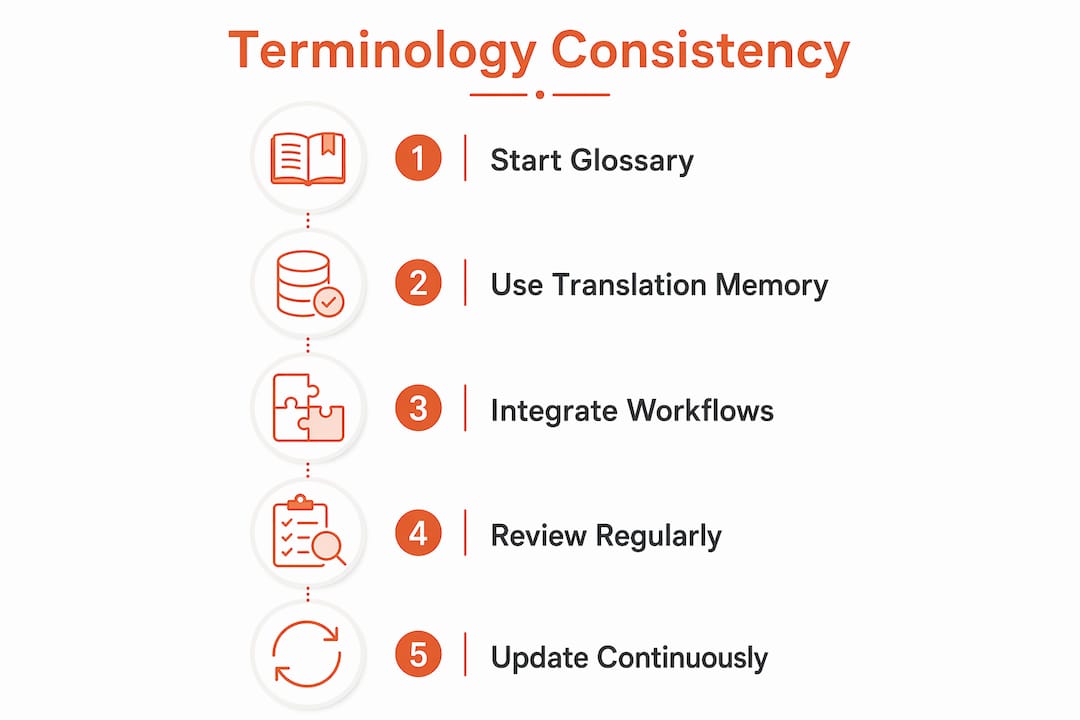
Terminology consistency is the single most common failure point in corporate translation services. Two tools prevent most of these failures: Translation Memories ™ and glossaries, also called termbases.

A Translation Memory stores approved translated segments. When a translator or AI system encounters a sentence that matches a previously approved segment, it reuses that approved output. A glossary stores approved terms, such as product names, legal phrases, and brand-specific vocabulary. Using both together is the industry best practice for maintaining consistency and reducing rework across large projects.
The risk of using only one resource is real. Relying on a TM alone means your approved terms can still drift when they appear in new sentence structures the memory has not seen before. Relying only on a glossary means full segments get retranslated inconsistently even when an approved version already exists. Partial use of either tool causes late-stage terminology errors that are expensive to fix after content has been published.
Effective workflows integrate both resources from the start. Translators and AI systems check the TM first for segment-level matches, then validate against the glossary for term-level accuracy. Gleef builds this logic directly into its platform with semantic translation memory and glossary enforcement, so product teams maintain brand voice without manual cross-checking. You can also explore how TM and glossaries work together in localization workflows.
Pro Tip: Start your glossary with 20–30 critical terms: your product name, key feature names, and any legally sensitive phrases. Scale from there. A small, well-maintained termbase beats a large, inconsistent one every time.
What are effective AI-assisted approaches for business translation workflows?
AI-assisted translation is now the default approach for most business document translation at scale. The question is not whether to use AI, but how to structure human oversight so AI output does not create compliance or quality failures.
The answer is Human-in-the-Loop (HITL) localization. HITL localization combines AI machine translation with professional post-editing and structured quality assurance. It does not replace human translators. It inserts them at the points where AI output carries the highest risk: regulated content, brand-critical copy, and legally binding documents.
A practical HITL workflow follows this structure:
Content triage. Classify content by risk level. Marketing copy, UI microcopy, and internal communications carry lower risk than legal contracts or medical instructions. High-risk content gets full human review. Low-risk content gets automated QA checks.
AI drafting. The AI translation engine generates a first draft using your TM and glossary as constraints. This keeps output consistent with approved terminology from the start.
Human post-editing. A professional translator reviews AI output for the segments flagged as medium or high risk. They correct errors, adjust tone, and validate compliance.
Automated QA. Tools check for terminology consistency, formatting issues, and missing translations before final delivery. XTM Intelligent Post-Editing automates linguistic review steps while preserving human oversight and full auditability of every change.
The result is faster delivery without sacrificing governance. Automated review solutions preserve human oversight while accelerating global content delivery with attributed changes that support root cause analysis when issues arise.
Pro Tip: Build a content matrix before you configure your AI workflow. Map each content type to a risk level and assign a review tier. This single document prevents most quality failures and makes your workflow auditable.
How can businesses align translation processes with measurable outcomes?
Translation teams that measure only word counts and turnaround times are invisible to business leadership. The shift toward measuring real business impact is the defining trend in corporate translation services right now.
Kobalt’s 2026 research found that localization teams are shifting from service desks to strategic advisors, focusing on KPIs like customer satisfaction and time-to-market. That shift requires translation professionals to speak the language of business outcomes, not just linguistic quality. The teams that make this shift gain influence over product roadmaps and market entry decisions.
Practical KPIs that connect translation to business outcomes include:
Time-to-market per language. How long does it take to release a localized version after the source content is final? Reducing this metric directly affects revenue in new markets.
Customer satisfaction scores by locale. Support ticket volume and CSAT scores broken down by language reveal where localization quality is failing users.
Terminology consistency rate. Automated QA tools can report what percentage of translated content uses approved terms. This metric ties directly to brand integrity.
Rework rate. Track how often translated content is sent back for corrections. A high rework rate signals a broken workflow upstream, not just a translator error.
Risk assessment and content matrices are now the structural backbone of mature translation programs. Teams that tier content by business impact and apply appropriate quality levels stop wasting budget on over-engineering low-risk content and under-investing in high-stakes copy. The real impact of localization on business performance becomes measurable when you connect workflow decisions to these outcomes.
What are the key steps for building a business translation strategy?
A translation strategy that actually works combines technical preparation, terminology governance, AI-assisted drafting, and continuous improvement. Here is how to build one:
Start with internationalization. Before you translate anything, prepare your product or content infrastructure to support multiple locales. This means externalizing strings, supporting Unicode, and designing UI components that flex for text expansion. Skipping this step means your translation fits textually but fails in the product interface.
Build your terminology foundation. Create a glossary of critical terms before your first translation project begins. Connect it to your TM so both resources enforce consistency from day one.
Configure AI-assisted translation with human review tiers. Use a content matrix to assign review levels. Automate QA for low-risk content and reserve human post-editing for regulated or brand-critical copy. Platforms like Gleef and automated language workflows make this configuration manageable for product teams without dedicated localization engineers.
Adapt for each market beyond text. Localization engineering covers SEO metadata in the target language, local payment method display, date and number formats, and legal disclaimer requirements. Each of these elements affects conversion and compliance independently of translation quality.
Measure and audit continuously. Review QA reports after each release cycle. Track rework rates and terminology consistency scores. Use audit trails to identify where errors originate, whether in AI output, human review, or source content.
Pro Tip: Treat your first localization into a new language as a pilot. Document every decision, every terminology conflict, and every rework request. That documentation becomes the foundation of a repeatable, scalable process for the next language.
Key Takeaways
Effective translation in business requires combining terminology governance, AI-assisted workflows, and localization engineering to deliver consistent, market-ready content at speed.
Point | Details |
|---|---|
Translation vs. localization | Localization covers UI, legal, and cultural adaptation that translation alone cannot address. |
Terminology governance | Use both translation memories and glossaries together to prevent costly late-stage inconsistencies. |
AI with human oversight | Human-in-the-Loop workflows assign human review to high-risk content and automate QA for low-risk copy. |
Measure business outcomes | Track time-to-market, CSAT by locale, and rework rates to connect translation to real business impact. |
Internationalization first | Prepare your technical infrastructure before translation begins to avoid UI failures in localized products. |
Translation as a competitive weapon, not a cost center
The most persistent mistake I see business professionals make is treating translation as a downstream task. They finish the product, write the content, lock the design, and then hand it to a translation team as the last step before launch. That sequence guarantees delays, rework, and localized versions that feel like afterthoughts.
The teams that win in global markets build translation into the workflow from the start. They internationalize their product architecture before writing a single line of copy. They build glossaries before they brief their first translator. They configure AI workflows with risk tiers before they scale to ten languages. The result is not just faster delivery. It is a localized product that feels native to each market, because the decisions that make localization possible were made early.
The rise of AI in translation has not changed this fundamental truth. It has made the gap between prepared and unprepared teams wider. AI can draft a thousand translated segments in minutes. But if your terminology is inconsistent, your UI was never internationalized, and your review process is ad hoc, AI just produces errors faster. The teams that benefit most from AI-assisted translation are the ones who already had their governance in place.
The future of translation in business belongs to teams that position themselves as strategic advisors, not service desks. That means speaking in KPIs, owning the content matrix, and connecting every localization decision to a business outcome. That is not a linguistic skill. It is a business skill that happens to require linguistic expertise.
— Antoine
How Gleef fits into your translation workflow
Product teams that want AI-powered localization without the overhead of a complex TMS setup have a direct path forward.
Gleef integrates AI-assisted translation directly into Figma, so designers, UX writers, and product managers can manage multilingual content without leaving their design environment. The platform combines semantic translation memory, glossary enforcement, and in-context editing in one place. Teams using Gleef report faster release cycles and stronger brand consistency across international markets. If you are building or scaling a multilingual product, the Gleef Figma Plugin is worth evaluating as the operational core of your localization workflow.
FAQ
What is the difference between translation and localization in business?
Translation converts text from one language to another. Localization adapts the full product or content experience for a specific market, including UI layout, currency, legal compliance, and cultural tone.
Why do businesses need translation memories and glossaries?
Translation memories store approved translated segments to prevent retranslation of existing content. Glossaries store approved terms to enforce brand and legal consistency. Using both together prevents the terminology drift that causes expensive rework.
What is Human-in-the-Loop localization?
Human-in-the-Loop localization combines AI machine translation with professional post-editing at defined risk points. It preserves human oversight for high-stakes content while automating QA for lower-risk copy.
How do you measure the business impact of translation?
Track time-to-market per language, customer satisfaction scores by locale, terminology consistency rates, and rework rates. These metrics connect translation quality directly to revenue and brand performance.
What is internationalization and why does it matter for translation?
Internationalization (i18n) is the technical preparation of a product to support multiple locales, including RTL layout, Unicode support, and flexible UI components. Without it, translated text fits linguistically but fails in the product interface.