
TL;DR:
Rapid localization accelerates product launch, user adoption, and competitive advantage globally.
Integrating localization early and automating workflows enhance quality and significantly reduce cycles.
Building shared tools like translation memory and in-context editing maintains consistency while increasing speed.
Why localization speed drives global software success
Delaying localization by even a single week can cost your product real market share. It sounds dramatic, but software teams see it happen every quarter: a release is ready, the code is clean, the design is polished, and yet the product sits in staging because translations are not finished. There is a widespread belief that moving fast on localization means accepting errors, mistranslations, or brand inconsistency. That belief is wrong, and holding onto it is costing your team velocity. In this article, you will learn exactly why localization speed is mission-critical, how quality and speed reinforce each other, and what workflow strategies make both possible simultaneously.
Key Takeaways
Point | Details |
|---|---|
Slow localization is costly | Delays can hurt product launches, market share, and user satisfaction. |
Speed and quality can coexist | Early collaboration and tech enable fast localization without errors. |
Workflow changes accelerate success | Upstream localization and automation keep global launches on schedule. |
Localization is now a competitive edge | Faster, integrated localization provides a real advantage in global markets. |
The real cost of slow localization
Slow localization is not just a workflow inconvenience. It is a business liability that shows up in delayed launches, reduced user adoption, and inflated costs. When your product reaches an English-speaking audience on day one but arrives in German, Japanese, or Portuguese weeks later, you are not just late. You are handing your competitors a head start in those markets.
Consider how time-to-market directly shapes user adoption curves. Early adopters set the tone for organic growth. They leave reviews, share referrals, and generate the social proof that fuels retention. When localized versions arrive late, these adoption windows close. Users in those markets either move to a competitor or download your app and leave immediately after encountering an English-only interface. Neither outcome is recoverable cheaply.
The friction points that cause slowdowns are well documented. Here are the most common culprits:
Manual string extraction: Developers copy-paste text from code files into spreadsheets, which introduces errors and eats hours.
Late-stage localization: Teams treat translation as a post-development step, meaning every design or content change triggers a full restart of the translation cycle.
Slow feedback loops: Translators work without context, submit work, and then wait days for reviewer responses before corrections can be applied.
Fragmented tooling: Product managers use one platform, UX writers another, and translators a third, creating version conflicts and rework.
Here is a comparison of what localization timelines typically look like in teams operating without a streamlined process versus those that have invested in localization workflow optimization:
Metric | Unoptimized workflow | Optimized workflow |
|---|---|---|
Average localization cycle | 3 to 5 weeks | 3 to 7 days |
Rework rate | 30 to 40% | Under 10% |
Translator context errors | High | Minimal |
Release delay due to localization | Frequent | Rare |
As UI text expansion and cultural nuances require flexible, timely collaboration, teams that localize late are structurally unprepared to handle these realities. German text, for example, can be 30% longer than its English equivalent. If your layout was designed without that buffer, you are looking at broken UI components and last-minute design patches that further delay launch.

The cost compounds quickly. Teams that localize late also spend more money per word because rushed translation requests often require premium turnaround fees. Quality drops because reviewers have less time. And the strategic cost, missed feedback from real users in new markets during that critical first month, is nearly impossible to quantify but very real.
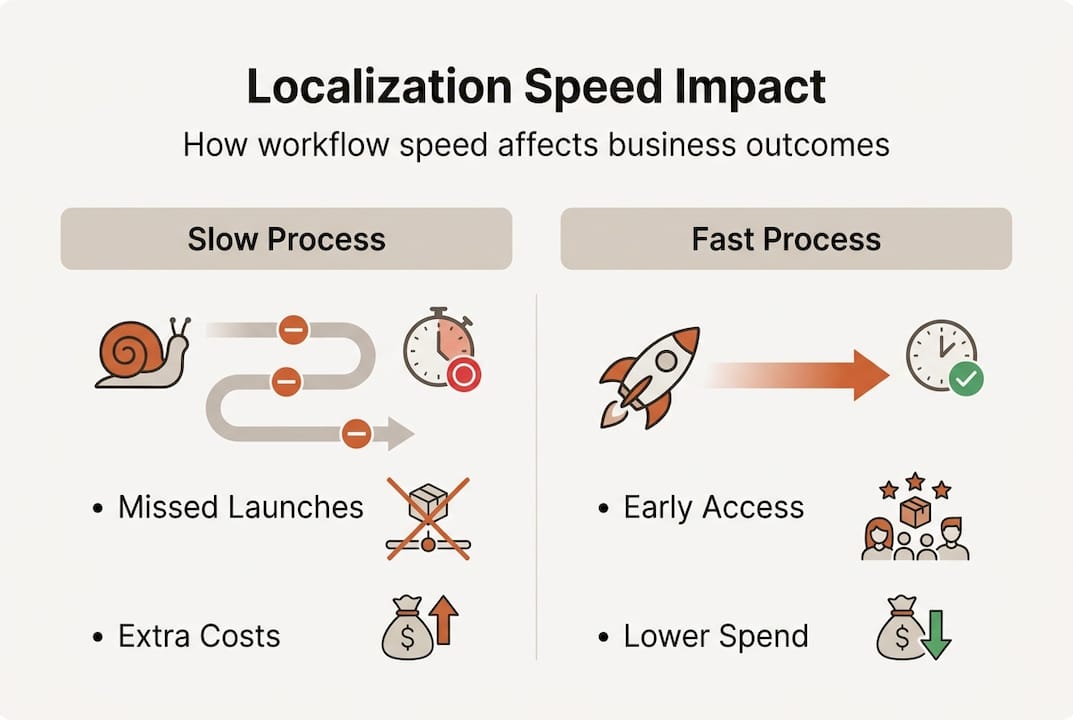
The pitfalls of traditional localization tools make this worse. Spreadsheet-driven workflows, disconnected translation management systems, and the absence of in-context editing leave teams patching problems rather than preventing them. Speed is not an optional upgrade for your localization stack. It is a survival requirement.
Why speed does not mean sacrificing quality
Here is the counter-intuitive truth: slow localization processes are often the cause of quality problems, not the cure. When teams rush at the end of a development cycle because localization was left too late, the result is poor translations, missed cultural references, and brand inconsistency. Speed, when built into the right workflow, actually prevents these failures.
The key is embedding localization earlier in your design and development process. When translators and UX writers collaborate from the design phase, they catch issues before they become expensive. A UX writer who flags an ambiguous English string during wireframing saves the team a full translation cycle downstream. This upstream integration is what separates fast, high-quality localization from the frantic, error-prone kind.
Translation memory ™ is one of the most powerful tools for maintaining quality at speed. A TM stores previously approved translations so that when similar or identical strings appear in future releases, translators can reuse verified work rather than starting from scratch. This is not just a time-saver. It is a quality enforcer. Your brand voice stays consistent across releases, across markets, and across team members.
Termbases, which are glossaries of product-specific terminology with approved translations for each language, work alongside TM to eliminate terminology drift. When every team member, from developer to translator to reviewer, operates from the same source of truth, the review cycle shortens and errors drop dramatically.
As collaboration among writers, designers, and developers is key to both speed and quality, the structural advantage goes to teams that build cross-functional localization habits early.
“The teams that localize fastest are not cutting corners. They are cutting friction. There is a profound difference.”
Pro Tip: Set up a shared termbase before your first localization sprint. Even 50 to 100 approved terms per language can cut your review cycle by 20% and eliminate the most common brand voice inconsistencies.
Here is how a quality-first versus speed-first framing stacks up against an integrated approach:
Approach | Quality | Speed | Sustainability |
|---|---|---|---|
Quality-first only | High initially | Slow | Bottlenecks over time |
Speed-first only | Inconsistent | Fast | Errors accumulate |
Integrated (TM + collaboration) | Consistently high | Fast | Scales well |
When you invest in understanding localization cultural nuance from the beginning rather than retrofitting it later, you avoid the costly cycle of re-translation and interface rework. Quality is not a trade-off for speed. It is a product of a well-structured process. The localization and UX impact data consistently confirms this: teams that localize early and iteratively produce better user experiences at lower overall cost.
Streamlined localization workflow: Best practices
With quality and speed now recognized as partners rather than opponents, let’s get specific about the workflow changes that make this combination real. These are not theoretical improvements. They are the structural shifts that software teams use to cut localization cycles from weeks to days.
Move localization upstream into design. Do not wait for development to complete before beginning localization. Start during wireframing. Flag strings early, use placeholder content that mirrors real-world text length across target languages, and have translators review copy as UX writers produce it. This single change eliminates the most expensive rework cycles.
Implement and maintain translation memory actively. Translation memory maintenance is essential for consistent, fast localization. Review your TM quarterly to remove outdated segments, add newly approved strings, and ensure entries reflect current brand voice. A stale TM is worse than no TM because it speeds up the delivery of incorrect translations.
Automate repetitive steps with tools that integrate into your existing stack. Automation does not replace human translators. It removes the administrative burden around them. Auto-routing strings to the correct translator based on language pair and subject matter, triggering review workflows on completion, and flagging strings that exceed character limits automatically are all tasks that automation in localization handles without human intervention.
Assign clear ownership for each stage of the workflow. Ambiguity in approval chains is a silent killer of localization speed. Define who owns string review, who approves final translations, and who has authority to ship. When everyone knows their role, review bottlenecks shrink dramatically.
Use in-context editing to eliminate translator guesswork. Translators who can see their translation inside the actual UI catch layout breaks, tone mismatches, and character overflows in real time. This is one of the most impactful capabilities for improving both quality and speed simultaneously.
Standardize your localization best practices into a documented process. A shared playbook that covers string formatting rules, placeholder conventions, character limits, and review standards gives every team member a reference point. Consistency at the process level produces consistency in the output.
Pro Tip: Schedule a 30-minute weekly sync between your UX writer, lead developer, and localization lead. These short loops catch string changes before they cascade into multi-language rework. Teams using collaborative localization practices consistently report faster cycle times and fewer escalations at launch.
The payoff from these changes is not marginal. Teams that implement upstream localization and automation routinely report cutting their total localization timeline by 50 to 70%. That is not a rounding error. That is the difference between hitting a global launch date and missing it entirely.
Real-world results: Speed in global deployments
Best practices are compelling on paper. Real results are what make them worth acting on. Here is what actually happens when software teams prioritize localization speed with the right systems in place.
Teams that adopt early, automated localization consistently report improvements in Net Promoter Score (NPS) within the first two release cycles in new markets. Why? Because users in those markets experience a product that feels native from day one, not a clearly translated afterthought. When an app feels like it was made for you, you engage more, retain longer, and recommend it more readily.
Consider the inverse scenario. A mid-size B2B SaaS company launches in Europe with an English-only interface while their localized version is still being finalized. Early users encounter broken UI, English strings inside a German interface, and terminology that does not match industry standards. The app store reviews roll in immediately: confusing, unprofessional, not ready. By the time the corrected localized version ships two weeks later, the damage to first impressions is done and the team is playing catch-up on retention instead of growing.
Here is what the data looks like for teams that get this right:
Teams using early localization integration report up to 40% faster user adoption in new regional markets compared to those localizing post-launch.
Automated localization workflows reduce per-word costs by an average of 25 to 35% due to higher TM reuse rates.
Products that launch localized in multiple languages simultaneously see 2x higher Day-30 retention rates compared to staggered regional rollouts.
Localization errors caught in design phase cost roughly 10x less to fix than those caught after development is complete.
As flexible UI and cross-functional collaboration lead to smoother global rollouts, teams that build these habits into their process are not just launching faster. They are launching better. The real impact of software localization extends well beyond translation quality into product-market fit, user satisfaction, and competitive positioning in each market.
The pattern is consistent across company sizes and product categories. Mobile apps, enterprise platforms, developer tools, and consumer SaaS products all share the same dynamic: the teams that localize early, iterate fast, and maintain quality through structured processes outperform those that treat localization as a final checklist item. Speed is not an accident in these teams. It is an architecture decision.
Why speed-first localization is now a product advantage
Here is what we see too often: product teams invest heavily in design systems, CI/CD pipelines, and sprint ceremonies, and then treat localization like an ops task that someone handles at the end. That framing is a strategic mistake. Localization speed is now a product advantage in the same category as performance optimization or accessibility compliance.
The teams left behind are not the ones with bad translators. They are the ones where localization is still a handoff that happens after the sprint closes. They experience the same pattern every release: a scramble, a delay, a compromised launch in at least one market. The feedback loop from those markets is delayed, and the team iterates slower as a result.
Speed-first localization means readiness, not recklessness. It means your team is structurally prepared to enter a new market the moment the business decision is made, because the localization infrastructure is already in place. When you invest in design-localization integration early, you are not just saving time on the next release. You are building a compounding advantage that grows with every market you enter.
The teams winning globally right now are treating localization as a core product capability. That is the shift worth making.
Accelerate your localization with Gleef
Everything covered in this article points to one reality: localization speed requires the right infrastructure, not just the right intentions. Gleef is built for exactly this challenge. It gives product managers, UX writers, and developers a unified platform to manage translations in real time, directly inside the tools they already use.
With Gleef’s AI-powered translation engine, semantic translation memory, and in-context editing capabilities, your team can cut localization cycles dramatically without compromising brand voice or cultural accuracy. The Figma localization plugin lets designers and UX writers manage translations in situ, eliminating the handoff delays that slow most teams down. If you are ready to turn localization from a release blocker into a genuine competitive advantage, Gleef gives you the tools to do it today.
Frequently asked questions
How does localization speed affect user experience?
Faster localization ensures users receive consistent, high-quality experiences in their language at product launch, boosting satisfaction and engagement. Cross-functional collaboration and flexible UI design are foundational to making this work at scale.
What are common barriers to speeding up localization?
Manual processes, late-stage localization, and lack of cross-team collaboration are the most frequent bottlenecks. As UI text expansion and cultural nuances require timely collaboration, teams without integrated workflows consistently struggle with these compounding delays.
Can localization be fast and still high quality?
Yes. Speed and quality align when teams use collaborative processes, maintain translation memory, and integrate localization early. TM maintenance is essential for keeping both consistent across releases.
What workflow changes help increase localization speed?
Upstream integration of localization into design and development, combined with greater automation throughout the process, significantly boost speed and reduce errors. Writers, designers, and developers collaborating from the earliest stages is the most impactful single change a team can make.