
TL;DR:
Managing multilingual teams requires upfront preparation of language practices to prevent miscommunication delays and mistrust. Implementing a structured localization workflow, effective communication frameworks, and inclusive leadership fosters seamless collaboration across diverse languages and cultures. Leveraging AI-powered tools like Gleef accelerates workflows, ensuring faster, higher-quality global product launches.
Managing a multilingual team sounds like a global success story until a launch-day miscommunication freezes your release pipeline. Product managers running international projects know the reality: language gaps don’t just create awkward moments in standups, they delay deployments, fragment documentation, and quietly erode team trust over time. Knowing how to manage multilingual teams is no longer optional for product leaders shipping to global markets. This guide gives you a structured, practical framework covering preparation, workflow execution, communication tools, and continuous improvement so your team stops losing time to language friction and starts shipping faster.
Key Takeaways
Point | Details |
|---|---|
Prepare with language agreements | Establish clear language use rules and map team needs to prevent communication breakdowns. |
Follow a localization workflow | Use structured 8-step localization workflows managed by TMS for consistency and quality. |
Use a communication framework | Diagnose, document, transcribe, and reinforce language practices to reduce friction. |
Avoid common pitfalls | Prevent misunderstandings by using glossaries, meeting summaries, and clear turn-taking rules. |
Measure and iterate | Collect feedback and monitor inclusion metrics to continuously improve team collaboration. |
Understanding multilingual team challenges and preparing for success
Every product manager who has led a multilingual team has felt the exact moment a meeting derails because a term means something different to the Berlin engineer and the São Paulo UX writer. That’s not an edge case. It’s a structural risk built into teams where language skill variation, cultural context differences, and uneven information flow are daily realities.
The first challenge is language skill variation. Not every team member has the same proficiency in the team’s working language, and assuming they do creates invisible hierarchies where the most articulate speakers dominate decisions while quieter contributors disengage. The second challenge is cultural misunderstanding, where communication styles, levels of directness, and attitudes toward hierarchy vary widely across cultures. A Korean engineer’s silence in a meeting is not agreement; a Brazilian designer’s enthusiasm is not a commitment.
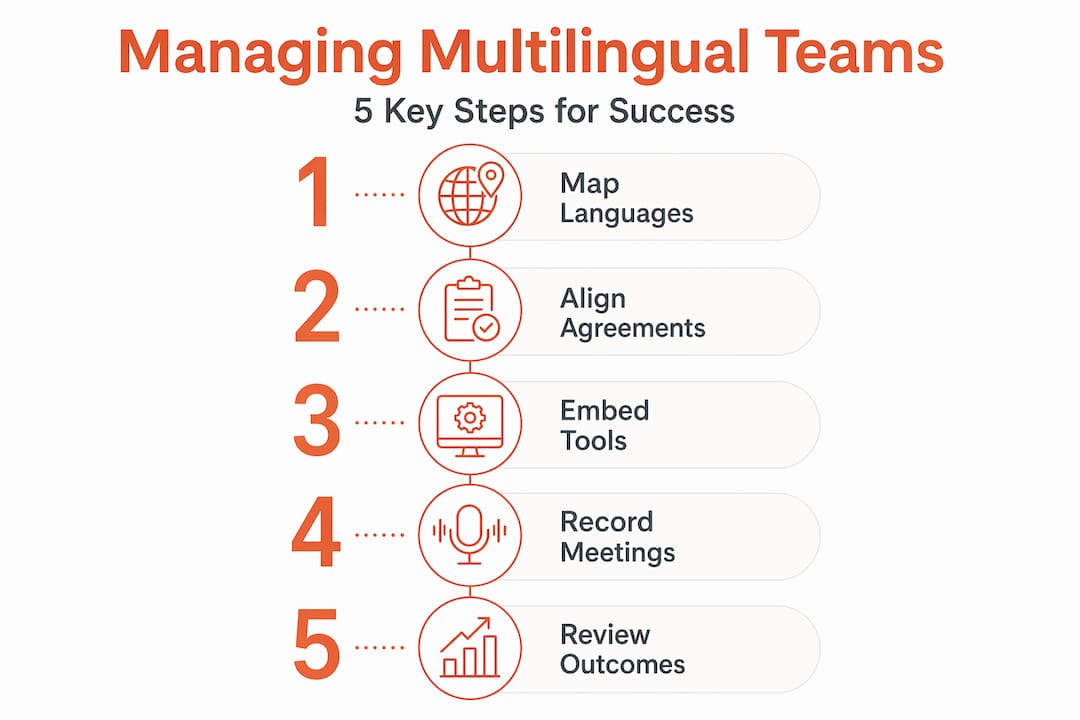
Preparation is the antidote. Start by mapping your team’s actual language landscape:
Identify the working language(s) for documentation, code comments, product specs, and meetings
Assess proficiency levels honestly, not by assuming everyone is “fine” in English
Document communication channels and which language governs each (Slack in English, local standups in native language, etc.)
Agree on terminology for product-specific concepts before the project starts
Aalto University’s 2024 language guidelines emphasize jointly agreeing on language use to promote smooth workflows and reduce workplace tensions. This is not bureaucratic. It’s preventive. Teams that have that conversation upfront move faster than those who discover the gaps mid-sprint.
Allocate extra time in your project planning for multilingual prep. A monolingual team might spend two hours aligning on a new feature spec. Your multilingual team needs three, and that investment pays dividends in every sprint that follows. You can find more specific tips for managing multilingual content that align with this preparation mindset.
Pro Tip: Before kickoff, hold a dedicated “language alignment” meeting where team members share their preferred communication styles, flag any topics they find harder to discuss in the working language, and agree on how to handle unclear moments. Thirty minutes here saves weeks downstream.
Implementing a localization workflow for product teams
With language agreements in place, you need a repeatable process for getting product content from source to every target locale without errors stacking up or deadlines slipping. A standard localization workflow includes 8 core steps, and each one has a clear owner.
Scoping — Define which content needs localization, target locales, and timelines
File preparation — Export source strings in developer-friendly formats (JSON, XLIFF, etc.)
Context sharing — Provide translators with screenshots, in-context references, and product glossaries
Translation — Assign to linguists with product-domain expertise
Review — Native-speaker reviewers check for accuracy, tone, and cultural fit
Quality assurance — Automated and manual checks for missing strings, UI truncation, and formatting errors
Build and deployment — Integrate translated files into the product build pipeline
Monitoring — Track user engagement and collect in-market feedback post-release
Role clarity makes or breaks this process. Here’s how accountability typically maps across the team:
Role | Primary responsibility |
|---|---|
Product manager | Scoping, timeline ownership, stakeholder alignment |
Localization manager | Workflow coordination, vendor management |
Linguist / translator | Translation accuracy and fluency |
Reviewer | Cultural adaptation and tone consistency |
QA specialist | Functional and visual quality checks |
Engineer | File export, integration, and build deployment |
Translation Management Systems (TMS) act as the command center for this workflow. They centralize string files, manage reviewer assignments, flag inconsistencies against your terminology glossary, and give every stakeholder real-time visibility into progress. Without one, you’re managing localization in spreadsheets and email threads, which is how strings get lost and launches get pushed.
Pro Tip: Build your product glossary before translation starts, not after. Include product-specific terms, brand names, and any strings that should never be translated (like UI component names). This single document can cut review cycles by 30% or more. For deeper guidance, the localization workflow optimization guide and a breakdown of key localization platform features will help you pick the right tooling for your team’s scale.
Enhancing multilingual collaboration with communication frameworks and tools
Effective communication in multilingual teams doesn’t happen by accident. The FluentCap 4-step framework gives product teams a concrete method for reducing language friction in remote and hybrid settings.
Diagnose friction points — Survey your team to identify where communication breakdowns occur most often. Is it async Slack threads? Live sprint reviews? Cross-functional planning docs? You can’t fix what you haven’t located.
Document shared standards — Create a written “communication playbook” that covers glossary terms, meeting summary formats, response time expectations, and how to signal when something is unclear without embarrassment.
Add real-time transcription — Deploy transcription in live meetings so non-native speakers can read alongside listening. This dramatically reduces the cognitive load of parsing fast-spoken English (or any working language) under meeting pressure.
Reinforce with language support — Pair newer team members with “multilingual buddies,” offer optional language coaching, and create space to celebrate the team’s linguistic diversity rather than treating it as a liability.
Here’s a quick guide to when each communication support tool earns its place:
Situation | Best tool | Why it helps |
|---|---|---|
Live sprint review | Real-time transcription | Reduces comprehension gaps during fast-paced discussion |
Async project updates | Written summary templates | Standardizes clarity without requiring fluency |
Onboarding new multilingual hire | Buddy pairing + glossary | Builds context and confidence simultaneously |
Cross-cultural conflict | Facilitated dialogue + documentation | Creates shared record of agreed understanding |
Technical specification review | In-context annotation tools | Ties language to visual context, reducing ambiguity |
Beyond tools, consider these practical habits for fostering teamwork across diverse languages:
Rotate meeting facilitators across regions to distribute ownership and surface different communication styles
Publish structured meeting summaries within one hour of every cross-team call, using a consistent template
Use written async check-ins for complex topics before live discussions, giving non-native speakers time to prepare
You can find collaborative translation tips that extend these principles directly into localization workflows, and if you’re shipping a SaaS product globally, the guide on how to accelerate global SaaS translation connects communication efficiency to deployment speed.
Pro Tip: Record every key cross-team meeting and auto-generate transcripts. Even if team members don’t watch the replay, knowing the record exists reduces the anxiety of missing something during live discussion, and that psychological safety translates directly into better participation.

Overcoming common communication pitfalls in multilingual teams
Even well-prepared teams hit the same avoidable walls. The most common is speed. Native speakers naturally accelerate when excited or under pressure, and non-native speakers struggle with hypothetical language and idioms, which shuts down real-time contribution and leaves decisions unchallenged.
Specific habits that cause the most damage and how to counter them:
Using idioms and sports metaphors (“let’s move the goalposts,” “ballpark figure”) — replace with plain, literal language in mixed-language settings
Assuming silence means agreement — build in explicit confirmation checkpoints: “Does this make sense? Any parts unclear?”
Skipping meeting summaries — every undocumented meeting creates interpretation gaps; summaries are your shared ground truth
Neglecting cultural adaptation in product copy — localization mistakes often stem from ignoring local cultural nuances, not from bad translation mechanics
One-size-fits-all communication templates — what works for your German engineering team will land differently with your Indonesian customer success team
Build these structural countermeasures into your team culture:
Project-specific glossaries for every product feature area, reviewed by native-speaking team members from each locale
Turn-taking rules in all meetings: no one speaks twice before everyone speaks once
Pulse checks every 4 to 6 weeks where team members rate communication clarity on a simple 1 to 5 scale and flag recurring friction points anonymously
The goal is not to flatten all differences. It’s to build a structure where those differences produce better thinking rather than silent confusion. For more depth on this, see the guide on managing multilingual content effectively.
Pro Tip: Create a shared “plain language” style guide specific to your team’s working language. List the 20 most commonly used idioms or jargon terms in your team’s conversations and provide plain-language alternatives. It takes 90 minutes to build and saves far more than that in clarification conversations.
Measuring success and iterating on multilingual team practices
Running a multilingual team without measurement is guesswork with good intentions. Once your communication and localization workflows are live, you need feedback loops that tell you what’s actually working and what’s quietly degrading team performance.
Start with psychological safety. Inclusive leadership fosters psychological safety, empowerment, and engagement, all of which are critical for multilingual teams where power imbalances can hide behind language barriers. If your non-native speakers aren’t speaking up in planning sessions, that’s a measurement problem before it’s a communication problem.
Track these signals regularly:
Language comfort scores collected in team retrospectives: how comfortable did each person feel communicating this sprint?
Participation rates across languages: are all voices contributing to async discussions or are the same people driving every thread?
Localization quality metrics post-release: translation error rates, in-market user feedback, and support ticket patterns by locale
Time-to-localization per release: is the workflow getting faster or are the same bottlenecks recurring?
Jointly agreed language practices improve workflow and support occupational well-being, which means revisiting your language agreements is not a one-time setup but an ongoing practice. Schedule a language retrospective every quarter to ask: what’s working, what’s creating friction, and what needs updating?
Celebrate linguistic diversity as a team asset. Recognize team members who help bridge language gaps, who catch culturally problematic phrasing, and who mentor colleagues navigating a second or third language at work. Recognition reinforces the behavior you want to scale. Find additional strategies in the guide on how to streamline localization for global teams.
Why managing multilingual teams requires more than translation software
Here’s the uncomfortable truth most localization articles skip: technology is not the hard part. A great TMS, a well-integrated Figma plugin, real-time transcription in every meeting, and a bulletproof glossary will still produce a dysfunctional multilingual team if the leadership approach is wrong.
The failure mode we see most often is product managers who treat multilingual management as a process problem when it’s actually a culture problem wearing a process mask. They buy the tools, build the workflow, and still watch their non-native speaking team members go silent in reviews and defer to whoever sounds most confident. The tools handled the translation. The leadership never handled the belonging.
Inclusive leadership develops specific skills that empower diverse teams to build solutions together, and psychological safety sits at the center. That means modeling vulnerability as a leader: admitting when you didn’t understand someone, asking for clarification without making it feel like the other person failed, and treating a non-native speaker’s slower articulation as a feature, not a friction point.
The product managers who build the highest-performing multilingual teams do three things differently. They ask more questions than they answer in cross-cultural settings. They create space before meetings, not just during them, by sharing agendas and context early enough for everyone to prepare in their own language. And they treat every mistranslation or miscommunication as a system failure, not a personal one, which means the fix goes into the workflow rather than the performance review.
Technology and mindset aren’t competing priorities. They’re a stack. Your essential translation standards handle the repeatable work. Your leadership handles the human layer that no algorithm can automate. Get both right and your multilingual team becomes one of your biggest competitive advantages in global markets.
Streamline your multilingual localization with Gleef’s AI-powered tools
Putting these strategies into practice is dramatically faster when your tooling is built for product teams managing multilingual projects from day one. Gleef’s AI-powered localization platform integrates directly into your design workflow, so your team stops switching between platforms and starts shipping faster.
The Gleef Figma plugin brings translation management into the design environment itself, with in-context editing, terminology glossaries, and semantic translation memory that keeps your brand voice consistent across every locale. Whether you’re running an 8-step localization workflow or managing an ad-hoc sprint release, Gleef reduces the manual overhead that turns localization into a launch blocker. Teams using Gleef report significant improvements in translation quality, process speed, and cross-functional alignment. If you’re serious about building a multilingual product team that ships with confidence, the guide on how to streamline localization for global teams shows exactly how the platform fits into your existing process.
Frequently asked questions
What is the first step to managing a multilingual team effectively?
Begin by mapping your team’s language needs and establishing clear agreements on language use across communication channels to prevent misunderstandings and create a predictable workflow from the start.
How can Translation Management Systems improve multilingual team workflows?
A TMS centralizes files, translators, reviewers, and quality checks into one platform, giving your team real-time visibility into localization progress and maintaining terminology consistency across every target language.
When should real-time transcription tools be used in multilingual teams?
Real-time transcription is most valuable during live meetings, onboarding sessions, and client presentations where non-native speakers face the highest comprehension load under time pressure.
What common mistakes should be avoided in multilingual team communication?
Rushing speech and using idioms exclude non-native contributors; combat this with meeting summaries, plain-language style guides, and structured turn-taking rules that give every team member equal space to contribute.