
TL;DR:
Consistent terminology management improves translation speed, quality, and brand cohesion across markets.
Effective glossaries require structured workflows, regular audits, and seamless tool integration.
Hybrid governance models and leveraging termbases enhance scalability and maintain glossary relevance.
Inconsistent translations are a silent killer for global software products. Your users encounter a feature called “Dashboard” in English, “Panneau” in French, and something entirely different in German, and suddenly your brand feels fragmented. Companies that invest in structured glossary management see 15-30% faster turnaround and dramatically lower cost per word. This article walks you through exactly how to build, govern, and integrate a localization glossary that actually sticks, turning terminology chaos into a competitive advantage across every market you target.
Key Takeaways
Point | Details |
|---|---|
Consistency protects brands | A well-managed glossary ensures your key terms and concepts are translated the same way, strengthening user trust and experience. |
Start with core terms | Prioritize 50–100 high-impact words to maximize glossary value in your early localization efforts. |
Integrate for automation | Connect your glossary to CAT/TMS tools to automate QA, cut errors, and dramatically reduce localization review time. |
Governance drives ROI | Hybrid ownership models and regular audits keep your terminology relevant as products evolve. |
Scale with termbases | Move to a termbase as your product, team, or market coverage grows to support multiple languages and robust quality checks. |
What is glossary management for localization?
Glossary management in the localization context means building and actively enforcing a curated list of key terms alongside their approved translations across every language your product supports. It is not a one-time task. It is an ongoing discipline that sits at the heart of every high-performing localization program.
To understand why it matters so much, it helps to know the core concepts:
Glossary: A simple, approved list of product-specific terms and their translations. Think UI labels, product names, legal phrases, and technical concepts your users encounter every day.
Termbase: A more structured, metadata-rich database that stores definitions, context notes, part-of-speech labels, prohibited alternatives, and quality assurance rules. Think of it as the enterprise-grade evolution of a glossary.
Ad hoc approach: Translators make their own decisions about key terms, leading to inconsistency across files, teams, and languages.
Governed approach: Every critical term has a single approved translation, documented and enforced across the entire workflow.
The difference between ad hoc and governed is enormous in practice. Without governance, a product feature might be translated five different ways across five versions of your app. That is not just an aesthetic problem. It creates real user confusion and can undermine trust in markets where your brand is still building credibility.
“Glossaries ensure terminology consistency by defining approved translations for key terms, preventing brand dilution and user confusion.”
For software teams managing key industry terminology across multiple product areas, a governed glossary is the foundation that makes everything else in your localization best practices stack actually work. It is also the single fastest way to get new translators up to speed without sacrificing quality.
A well-maintained glossary protects your brand identity the same way a style guide protects your visual design. Understanding the translation vs localization differences clarifies why raw word-for-word translation is never enough. Terminology is where localization and brand voice intersect, and terminology management strategies help you treat that intersection with the rigor it deserves.
Building an effective localization glossary: Steps and best practices
Once you know the strategic value, you will need a practical process for building your glossary from scratch. Here is a proven sequence that avoids the common pitfalls.
Identify candidate terms. Run a frequency analysis across your source content. Focus on UI labels, product names, legal terms, and technical concepts that repeat often.
Prioritize ruthlessly. Not every word needs to be in the glossary. Target high-impact, high-frequency terms first. This is where many teams go wrong by trying to document everything at once.
Research target language equivalents. Work with native speakers, review competitor products in each target market, and consult existing content consistency with AI tools to find validated options.
Document full metadata for each entry. A term without context is just a word. You need definition, part of speech, translation per language, usage example, prohibited alternatives, and any cultural notes.
Review and approve. Bring in subject-matter experts and native speakers before locking a term. One wrong approval creates downstream errors at scale.
Publish and communicate. Push the glossary to every contributor: translators, reviewers, developers, and product managers. No one can follow rules they do not know exist.
Here is what a strong glossary entry looks like in practice:
Field | Example |
|---|---|
Term (source) | Dashboard |
Definition | The main overview screen showing key metrics |
Part of speech | Noun |
French translation | Tableau de bord |
German translation | Übersicht |
Prohibited alternatives | Panneau, Startseite |
Context note | Always used for the main landing screen after login |
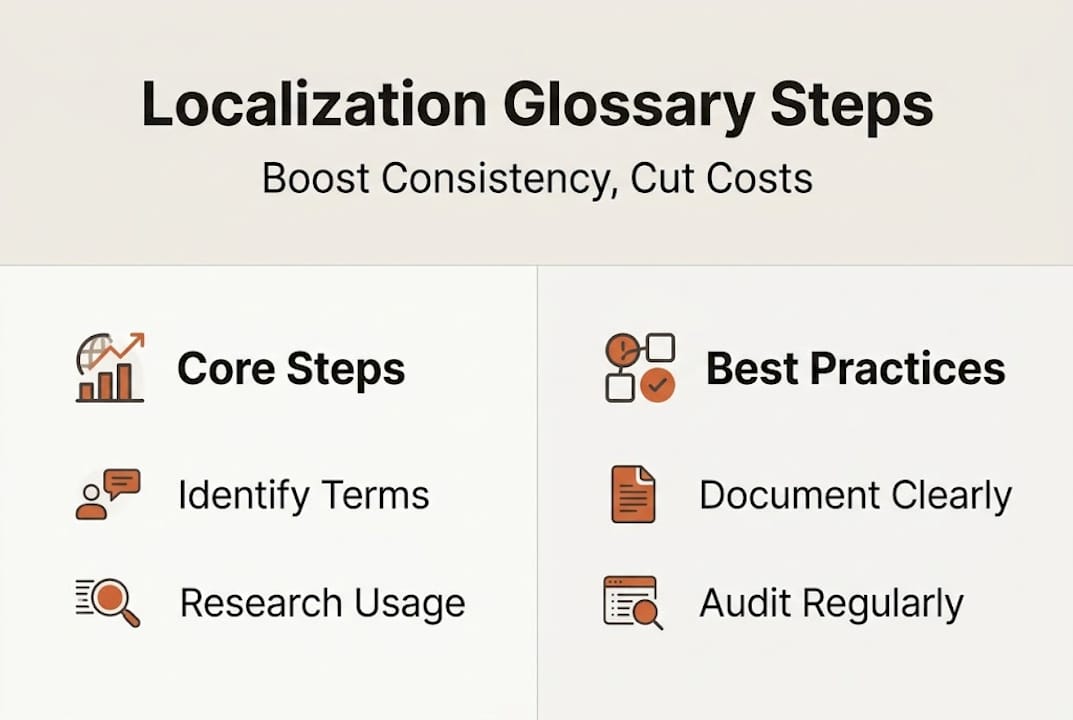
Key steps include identifying terms, researching through native speakers and competitors, and documenting rich metadata for each entry. Teams that skip the metadata layer pay for it later with constant clarification requests and revision cycles.
For teams looking to streamline localization for product teams, starting lean is always the right move.
Pro Tip: Launch with 50 to 100 carefully selected core terms. A focused, actionable glossary drives adoption far better than an overwhelming list of 1,000 entries that nobody reads.
Glossary governance models: Centralized, federated, or hybrid?
Having documented your terms, the next challenge is ensuring the glossary stays relevant and is actually used by all localization contributors. That depends almost entirely on your governance model.
Three main approaches exist:
Centralized: One team (usually the localization or linguistics team) owns all decisions. Fast to start, but prone to bottlenecks as product complexity grows.
Federated: Domain experts in each product area own terminology for their domain. Better coverage, but harder to keep consistent across the product.
Hybrid (recommended): A central team manages core brand and UI terms, while domain experts handle specialized language. This balances speed, accuracy, and scalability.
Here is how the models compare side by side:
Model | Decision speed | Coverage | Bottleneck risk | Scalability |
|---|---|---|---|---|
Centralized | Fast | Limited | High | Low |
Federated | Slow | Broad | Medium | Medium |
Hybrid | Balanced | Broad | Low | High |
Hybrid governance is recommended: a central team handles core terms while domain experts manage specialized language. The best workflow follows a clear cycle: proposal, research, review, approval, and a continuous feedback loop.
For teams tracking design localization trends, hybrid governance also aligns well with modern product team structures where designers, PMs, and developers all contribute to product language.
Pro Tip: Use a dedicated workflow tool or a shared project management board to manage term proposals. Email chains for terminology approvals are a bottleneck waiting to happen, and they create zero visibility into where a term stands in the review process.
Integrating glossaries into localization tools and workflows
Now, to unlock the full ROI of your glossary, you need seamless enforcement through integration with your localization tools and development workflows.

Why does tool integration matter so much? Because a glossary that lives only in a spreadsheet is invisible to translators working inside a Translation Management System (TMS) or Computer-Assisted Translation (CAT) tool. Integration brings the glossary to where the work actually happens.
Key integration benefits include:
TBX format support: The TermBase eXchange (TBX) format is the industry standard for importing glossaries into TMS and CAT tools. It carries full metadata, not just term pairs.
Inline highlighting: When translators see flagged terms in context, they automatically use the approved translation instead of improvising.
Automated QA enforcement: Automated quality checks catch terminology errors before they reach review, dramatically cutting the error rate.
AI prompt integration: Modern AI translation engines accept glossaries as hard constraints, ensuring that machine-generated output respects your approved terms.
The ROI numbers are striking. Glossary integration enabled a 57% shorter lead time and a 70 to 80% reduction in review hours for teams that committed to full tool integration. That is not a marginal gain. That is a structural change in how fast and how cheaply you ship localized product.
For teams working on optimizing localization workflow, glossary integration is one of the highest-leverage moves available. It also solves persistent issues in localization keys management by ensuring that the same key always carries the right translated term. And if you are tackling localization key challenges, having an enforced glossary baked into your pipeline removes an entire category of errors.
Pro Tip: Schedule a quarterly glossary audit. Products evolve, markets shift, and the terms you approved 12 months ago may no longer reflect how your users talk about your product today.
Advanced glossary strategies: Termbases, edge cases, and scaling success
For software products growing in complexity and audience, advanced strategies keep terminology scalable and fit for global markets.
Let’s clarify the distinction one more time. A glossary is a lightweight, accessible list suited for early-stage localization programs. A termbase is a structured database for scale and QA, holding rich metadata, workflow history, and machine translation integration hooks. When your product spans multiple verticals, dozens of languages, and thousands of reused UI strings, a termbase is not optional. It is essential.
Know when to upgrade:
You support more than five languages and 2,000 unique translatable strings.
Your review cycles consistently surface terminology disputes.
You are integrating machine translation and need hard constraints on output.
Multiple product teams are contributing to the same source content.
Real-world edge cases trip up even experienced teams. Gender sensitivity in Romance languages means a single English noun can require different forms depending on grammatical context. Ambiguous product names that carry unintended connotations in a target culture need cultural review, not just linguistic translation. These issues are best caught at the UX localization best practices stage before they ship.
Scaling your glossary long-term requires three things: structured feedback loops from translators and reviewers, scheduled audits tied to product release cycles, and continuous integration so new source strings are automatically checked against existing glossary rules. You can learn more about the mechanics of a well-maintained localization glossary explained from practitioners who have navigated this transition at scale.
“Maintenance is key: regular audits, feedback, and adaptation prevent glossary obsolescence.”
The teams that sustain glossary ROI are not the ones with the biggest term lists. They are the ones with the tightest feedback loops and the most disciplined governance.
Why most localization glossary projects fail—and what actually works
Many localization teams invest real effort in their glossaries early on, then watch them quietly die over the next six months. Here is the uncomfortable truth: most glossary failures are not terminology failures. They are process and culture failures.
Conventional wisdom says build a big spreadsheet, share it with translators, and call it done. But spreadsheets go stale fast. They sit outside the tools translators actually use. Approval processes live in email threads nobody can find. And when a product update introduces 50 new UI strings, nobody remembers to check the glossary.
What actually works starts with industry terminology workflows that are baked into your toolchain, not bolted on as an afterthought. Start with a pilot of your 50 most critical terms, measure the impact on turnaround time, error rate, and review cost, and then expand. Use hybrid governance. Automate enforcement inside your TMS. Build a feedback loop where translators can flag outdated or problematic terms with one click. The teams that win at glossary management treat it like a living product, not a static document.
Ready to transform your localization workflow?
Effective glossary management is one of the highest-ROI investments your localization team can make. It accelerates translation, protects your brand voice, and reduces costly review cycles at every scale. But the right tools make the difference between a glossary that gets used and one that collects dust.
Gleef solutions for localization are purpose-built to help product teams enforce terminology consistency at speed, with AI-powered glossary integration, in-context editing, and seamless Figma workflows. If you are ready to move from scattered spreadsheets to a bulletproof localization engine, Gleef gives your team the infrastructure to make it happen. Explore how Gleef can help you ship faster, sound native, and stay consistent across every market.
Frequently asked questions
What is the main difference between a glossary and a termbase?
A glossary is a simple list of approved terms, while a termbase is a structured DB for scale and QA, holding metadata, workflow history, and integration capabilities for advanced localization programs.
How do I choose which terms to include in my glossary?
Focus on high-frequency product, brand, and technical terms. Terms appearing 50+ times in your content should be your first priority, as they generate the most translation inconsistency when left ungoverned.
What’s the best way to keep a glossary up to date?
Establish regular audits tied to your product release cycles and structured feedback loops so translators can flag issues. Regular audits and feedback loops are the most reliable way to prevent terminology from going stale.
Why do localization glossaries fail in practice?
They typically fail from lack of real adoption by translators, entries that go stale after product updates, and unclear ownership of the update and approval process. Glossaries fail due to lack of adoption and poor upkeep far more often than from bad initial terminology choices.