
TL;DR:
Semantic translation focuses on meaning and context, ensuring natural, accurate product localization.
Proper tools, team roles, and detailed context are essential for effective AI-powered semantic translation.
Human review and in-context testing remain critical to ensuring high-quality, culturally appropriate translations.
Literal translation has a way of making your product feel foreign, even to the people you built it for. A button label that reads perfectly in English can become confusing, awkward, or even offensive when converted word for word into Japanese or Portuguese. For localization managers and product teams shipping digital products globally, this is not a theoretical risk. It is a release blocker. Semantic translation, the practice of preserving meaning rather than just words, is the approach that solves this. Powered by modern AI, it gives your team the ability to produce native-sounding, contextually accurate translations at scale. This guide walks you through what semantic translation is, how to prepare for it, how to execute it, and how to verify the results.
Key Takeaways
Point | Details |
|---|---|
Semantic translation essentials | AI-driven semantic translation preserves meaning and context, reducing embarrassing errors. |
Preparation is critical | Set up the right tools, glossaries, and team roles before starting for consistent results. |
Workflow integration | Building semantic QA into your process ensures higher product quality and user trust. |
AI has limits | Even top AI models miss nuanced context and require human checks for best outcomes. |
What is semantic translation?
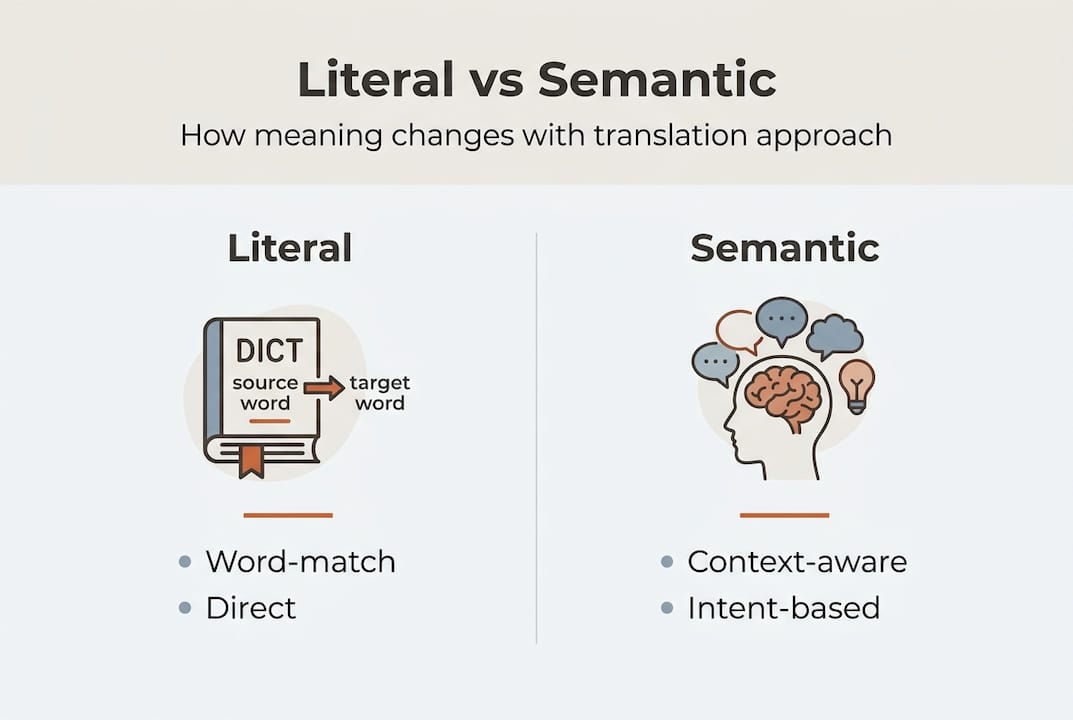
Semantic translation is the practice of converting content from one language to another by prioritizing meaning, intent, and context over a direct, word-for-word substitution. Where literal translation asks “what does this word mean in isolation?”, semantic translation asks “what does this sentence mean to a native speaker in this situation?”
The difference sounds subtle. In practice, it is enormous. Consider the English phrase “Submit your request.” A literal translation into German might produce something grammatically correct but tonally stiff, like a bureaucratic form rather than a modern SaaS interface. Semantic translation would produce phrasing that feels natural to a German user in a digital product context.
Literal vs. semantic translation: a quick comparison
Dimension | Literal translation | Semantic translation |
|---|---|---|
Focus | Word-for-word accuracy | Meaning and intent |
Context awareness | Low | High |
Tone preservation | Often lost | Actively maintained |
Risk of errors | High in idiomatic content | Lower with proper context |
Best for | Legal word-matching | User-facing digital products |
For digital products, the stakes are especially high. Users interact with microcopy, tooltips, error messages, and onboarding flows. A single mistranslated label can break trust instantly. Understanding the difference between translation vs localization is the first step to appreciating why semantics matter so much in product work.
Modern AI has transformed what is possible here. Neural Machine Translation (NMT) uses Transformer architectures, attention mechanisms, and contextual embeddings to map meaning across languages, not just vocabulary. This means AI can now understand that “crash” in a software context means an application failure, not a collision.
The key capabilities that make this work include:
Contextual embeddings: Words are represented as vectors that shift meaning based on surrounding text
Attention mechanisms: The model weighs which parts of a sentence matter most for accurate translation
Transfer learning: Models trained on billions of sentences generalize to new domains quickly
Ignoring semantics in product localization does not just produce awkward copy. It produces broken user experiences that erode trust, increase support tickets, and stall global growth.
The good news is that AI-powered semantic translation is now accessible to product teams of any size. The challenge is implementing it correctly.
Preparing: Tools and requirements for effective semantic translation
Knowing what semantic translation is gets you excited. Knowing what you need to execute it keeps you from making expensive mistakes. Preparation is where most teams underinvest, and it shows in their output quality.
Choosing your AI translation engine
Not all translation tools are created equal. NMT systems using Transformers and contextual embeddings deliver the strongest semantic results today. When evaluating models, consider how well they handle your specific language pairs, your product’s domain vocabulary, and your volume requirements. For a deeper comparison, the guide on best LLMs for translation is a strong starting point.
Required tools and resources
Resource | Purpose |
|---|---|
NMT engine (e.g., GPT-4, DeepL, custom model) | Core semantic translation capability |
Translation memory ™ | Stores approved translations for reuse |
Glossary / termbase | Enforces consistent terminology |
Style guide | Defines tone, formality, and brand voice per locale |
Context documentation | Provides screenshots, user flows, and UI descriptions |
QA tooling | Flags errors in translated strings automatically |
Team roles that matter
AI does the heavy lifting, but your team shapes the outcome. The essential roles are:
Localization manager: Owns the workflow, sets quality standards, and coordinates between teams
In-language reviewer: A native speaker who validates semantic accuracy and tone
UX writer or content designer: Ensures translated copy fits UI constraints and brand voice
Developer or localization engineer: Manages string extraction, file formats, and integration with your TMS
Pre-translation checklist
Before you run a single string through your AI model, confirm you have:
A finalized glossary covering product-specific terms in all target languages
A style guide that specifies formality levels and tone for each locale
Context files (screenshots or Figma frames) attached to strings
A translation memory seeded with previously approved content
Clear quality thresholds defined for each content type
The reality is that AI in localization performs dramatically better when it has rich context to work with. Feeding a model raw strings with no surrounding information is like asking someone to proofread a document without telling them what it is for.

Step-by-step: Executing semantic translation in your workflow
With your tools and team assembled, you are ready to embed semantic translation into your product localization process. The steps below reflect a workflow that works for digital product teams shipping across multiple locales.
Extract and prepare source strings. Pull translatable content from your codebase or design files. Tag each string with metadata: screen name, component type, character limits, and any contextual notes. Strings without context are the single biggest cause of semantic errors downstream.
Run AI translation with context injection. Feed your NMT engine the strings along with their metadata. Modern platforms allow you to include surrounding UI text, user flow descriptions, and glossary terms as part of the prompt or configuration. This is what separates a semantic output from a literal one.
Apply glossary and terminology enforcement. After the initial AI pass, run output through your termbase to ensure product-specific terms are consistent. A feature called “smart sync” should not become “intelligent synchronization” in one locale and “auto-update” in another.
Conduct in-context review. Have your in-language reviewer check translations inside the actual product or a staging environment, not in a spreadsheet. Meaning shifts dramatically when you see a translation inside a modal dialog versus in isolation.
Resolve UI and UX constraints. Some languages expand significantly. German text can run 30% longer than English. Work with your UX writer to identify strings where length will break layouts and flag them for adaptation.
Iterate and approve. Use a structured feedback loop to capture reviewer changes and feed corrections back into your translation memory. Every approved edit makes your next translation cycle faster and more accurate.
Handling edge cases is where teams often stumble. Even leading MT systems in 2025 struggle with ambiguity, collocations, false friends, case government, discourse-level coherence, and persistent literal word order issues. For guidance on navigating these, the resource on translation accuracy for teams covers practical mitigation strategies. You can also explore real-world translation challenges to understand where AI most commonly needs human support.
Pro Tip: Always review AI output for nuanced meaning in user-facing interfaces before shipping. A translation that scores well on automated metrics can still feel robotic or culturally off to a native speaker. Human review at this layer is not optional; it is a quality gate.
Verifying quality: Testing and troubleshooting semantic translations
Running semantic translation is only half the job. Verifying that the output actually works for real users in real contexts is where quality is either locked in or lost. This stage is where many teams cut corners, and global users notice immediately.
Stepwise QA and testing process
Automated string validation: Check for missing translations, broken placeholders, and character limit violations using QA tooling before any human review begins.
Semantic spot-check: Select a representative sample of strings across content types (error messages, CTAs, onboarding copy) and have a native reviewer assess meaning accuracy.
In-context functional testing: Load translated strings into a staging build and walk through key user flows in each locale. Look for truncation, layout breaks, and tone mismatches.
Back-translation check for high-risk strings: Translate critical strings back into English using a separate model and compare to the original. Significant divergence signals a semantic problem.
User testing with native speakers: Where possible, run brief usability sessions with native-speaking users to surface meaning issues that internal reviewers might normalize.
Most frequent semantic errors to watch for
False friends: Words that look similar across languages but mean different things (e.g., “sensible” in English vs. Spanish)
Idiom failures: Phrases that translate literally but lose meaning entirely
Register mismatches: Formal language used where informal is expected, or vice versa
Ambiguity carryover: Source strings with multiple interpretations that the AI resolves incorrectly
Collocation errors: Unnatural word pairings that a native speaker would never use
Top MT systems in 2025 still show persistent failures across these categories, which means your QA process needs to actively target them. The guide on AI translation quality outlines specific metrics and benchmarks worth tracking. For concrete failure patterns, translation challenge examples provides real cases that sharpen reviewer instincts.
Pro Tip: Build a structured feedback loop between your in-language reviewers and your AI system. Every correction a reviewer makes should be captured, categorized, and fed back into your translation memory and glossary. Over time, this turns your QA process into a compounding asset that makes each release cycle better than the last.
Our perspective: Why true semantic translation is still an edge, not a commodity
Here is something most localization vendors will not tell you: even in 2026, with all the advances in large language models and NMT, deep semantic translation remains genuinely hard. MT systems still struggle with ambiguity, discourse-level coherence, and idiomatic expression in ways that matter enormously for product copy.
The teams winning at global localization are not the ones with the biggest AI budget. They are the ones who treat semantic QA as a product feature, not an afterthought. They build glossaries before they need them. They attach context to every string. They run in-context reviews as a standard part of every release cycle, not just when something breaks.
The uncomfortable truth is that AI in localization is a powerful amplifier. It amplifies good processes into great outcomes, and it amplifies poor preparation into embarrassing failures at scale. The teams who close the gap between AI capability and real-world quality are the ones who invest in the human layer: skilled reviewers, rich context, and disciplined feedback loops. That combination is still a competitive edge, and it will remain one for the foreseeable future.
Next steps for smarter global localization
Semantic translation is not a one-time project. It is a capability you build, refine, and scale as your product grows into new markets. The frameworks in this guide give you the foundation, but the real gains come from integrating these practices into your standard release workflow.
Gleef is built to make exactly that integration seamless. From AI-powered semantic translation memory and in-context editing to glossary enforcement and Figma-native workflows, Gleef’s localization platform is designed for product teams who refuse to let translation be a release blocker. If you want to sharpen your team’s approach further, the localization accuracy guide is a practical next read that connects directly to the quality standards covered here.
Frequently asked questions
What is the difference between semantic and literal translation?
Semantic translation preserves meaning and context, while literal translation converts words directly, often missing deeper intent. NMT systems using Transformers are specifically designed to close this gap by modeling contextual meaning rather than vocabulary alone.
Can AI tools fully automate semantic translation?
AI tools excel at context-aware translation but still benefit from expert human oversight, especially for edge cases. Even top MT systems in 2025 show persistent failures with ambiguity, collocations, and discourse-level coherence that require human judgment to resolve.
Which AI models are most effective for semantic translation?
Neural Machine Translation with Transformer architectures and contextual embeddings currently delivers the strongest semantic results. NMT’s contextual approach allows models to shift word meaning based on surrounding text, which is essential for accurate product localization.
What are the top mistakes when implementing semantic translation in digital products?
The most common mistakes are not providing context to the AI model, relying entirely on automation without native review, and skipping in-context testing inside the actual product interface. Each of these shortcuts produces translations that are technically correct but semantically wrong for real users.