
TL;DR:
A translation aggregator connects multiple machine translation engines to automate content routing and comparison. It improves translation quality by choosing the best output based on confidence scores and fallback logic. Proper security practices and continuous workflow integration are essential for effective multilingual product localization.
A translation aggregator is a software platform that connects multiple machine translation engines and large language models simultaneously, consolidating their outputs into a single interface for comparison, selection, and workflow automation. For product teams and localization managers, this architecture solves a problem that no single engine can: no one tool wins across every language pair, content type, or domain. The best translation aggregators route your content to DeepL, Google Translate, GPT-4o, Claude, or Papago based on the task at hand, then present the results in one place. That means faster decisions, fewer release blockers, and translation quality that actually holds up in production.
What is a translation aggregator and how does it work?
A translation aggregator works by intercepting your source text, sending parallel queries to multiple machine translation engines, and returning consolidated output for review or automated selection. The platform does not translate content itself. It acts as a routing and comparison layer on top of existing engines.
The most capable aggregators include several technical features that separate them from basic API wrappers:
Fallback chains: When one engine fails or returns low-confidence output, the system retries alternate engines automatically. This keeps high-frequency update pipelines running without manual intervention.
Confidence scoring: Each engine response receives a score. The aggregator selects or surfaces the highest-scoring output, reducing the chance of a poor translation reaching production.
Rate limiting and caching: Repeated queries for identical strings return cached results, cutting API costs and latency. Rate limiting prevents quota exhaustion across engines.
Translation API integration: Most aggregators expose their own API, so your CI/CD pipeline, CMS, or design tool can trigger batch translations without a human in the loop.
Document parsing: Layout-preserving aggregators parse complex file types like PDFs and InDesign files upstream, reconstruct the document structure after translation, and preserve headers, footers, tables, and charts.
Pro Tip: When evaluating aggregators, test their fallback behavior by simulating an engine outage. A platform that degrades gracefully under failure is worth far more than one that simply crashes your pipeline.
The open-source project Transitext and commercial tools like Doclingo each demonstrate different points on the feature spectrum. Transitext prioritizes developer control and fallback logic. Doclingo supports multiple AI engines optimized by document type and language pair, with OCR and bilingual side-by-side output for document formatting preservation.
How do the leading AI translation engines compare in accuracy?
The engine mix inside your aggregator determines your output quality ceiling. Each engine has a distinct strength profile, and knowing those profiles is what makes aggregation genuinely useful rather than just redundant.

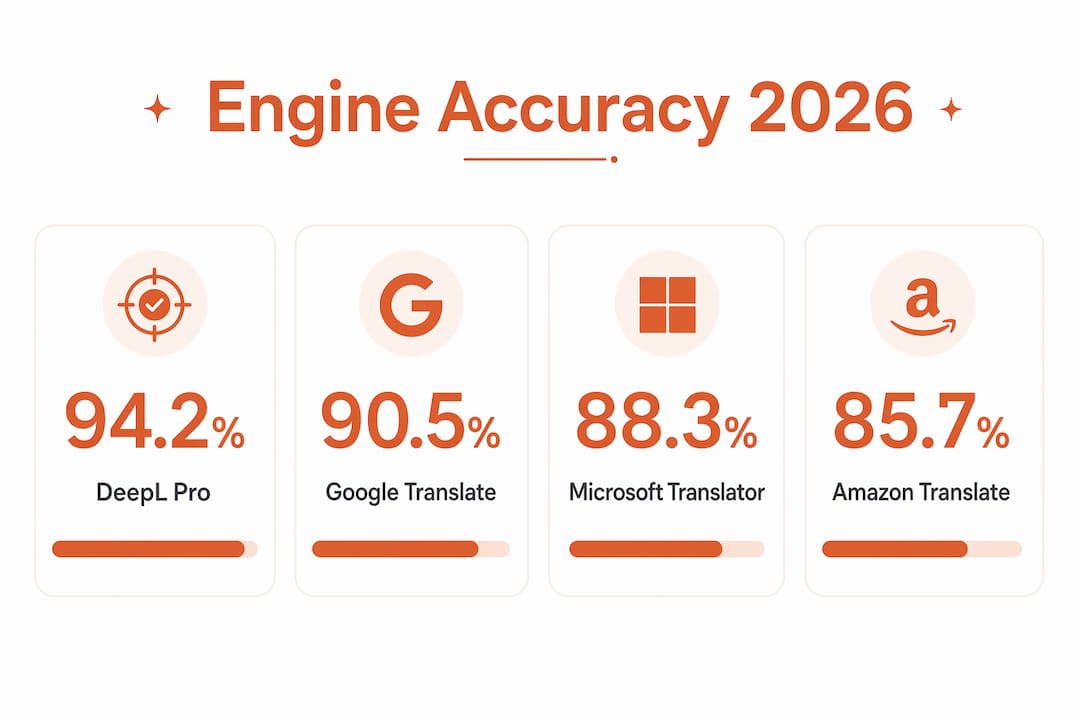
DeepL Pro achieves up to 94.2% accuracy in European language translations as of Q2 2026, measured across 12 language pairs with native speaker scoring. That number makes DeepL the default choice for teams shipping products in French, German, Spanish, Italian, or Polish. Its neural architecture is trained specifically on European corpora, which shows in fluency and idiomatic accuracy.
GPT-4o and Claude take a different approach. Both excel in complex, domain-specific translations where context, tone, and nuance matter more than raw speed. Legal disclaimers, marketing copy, and long-form UX content all benefit from their contextual reasoning. The tradeoff is cost and latency: LLM-based translation runs slower and more expensively than dedicated MT engines.
Engine | Strength | Best use case | Limitation |
|---|---|---|---|
DeepL Pro | European languages, 94.2% accuracy | UI strings, product copy in EU markets | Limited Asian language support |
GPT-4o | Contextual, long-form content | Marketing, legal, nuanced UX copy | Higher cost and latency |
Claude | Complex reasoning, tone preservation | Brand voice, editorial content | Not optimized for speed at scale |
Google Translate | Broad language coverage | High-volume, low-stakes content | Lower accuracy on specialized text |
Papago | Korean language accuracy | Korean-market products | Limited to East Asian languages |
Key patterns that emerge from this comparison:
Use DeepL as your primary engine for European markets and fall back to Google Translate for language pairs outside DeepL’s coverage.
Route legal, marketing, and brand-sensitive strings to GPT-4o or Claude, then apply human post-editing.
Human post-editing remains essential for legal, literary, and marketing translations even when AI accuracy reaches 90–95% for general content.
Assign Papago as the primary engine for any Korean-market content to capture language-specific fluency that general engines miss.
The specialization of AI translation tools is overtaking one-size-fits-all solutions. That trend makes aggregator platforms critical: you need the right engine per use case, not one engine for everything.
What are the security and compliance risks of translation aggregators?
Security is the most underestimated risk in multilingual content management. When you send product strings, legal text, or user data through a translation API, that content leaves your environment. Consumer-facing translation portals often use submitted text to retrain their commercial models.
Organizations handling sensitive data should prioritize enterprise-grade AI translation tools to avoid data being used for commercial model training. The European Commission issued this guidance in may 2026. The implication for product teams is direct: if your strings contain PII, proprietary feature names, or regulated content, a free or consumer-tier engine is not an acceptable choice.
Enterprise AI translation solutions operate within secure, ISO-certified environments following risk-based safeguards to ensure data protection, balancing innovation with compliance requirements for global organizations.
Enterprise-grade solutions operate within ISO-certified environments with documented risk-based safeguards. That certification matters when your legal or security team asks how translation data is handled.
Best practices for product teams managing compliance:
Classify your content before routing it. Separate PII, regulated text, and proprietary copy from general UI strings. Route each category to the appropriate engine tier.
Review data processing agreements for every engine in your aggregator. DeepL Pro, for example, offers a data privacy mode that does not store or use submitted text for training.
Prefer on-premise or private cloud deployments for the most sensitive content categories, especially in healthcare, finance, or government-adjacent products.
Audit your fallback chain. If your primary engine fails and the system falls back to a consumer-tier engine, sensitive content may be exposed without your knowledge.
Pro Tip: Build a content classification layer before your aggregator’s routing logic. Tag strings as “public,” “internal,” or “restricted” at the source, then configure your aggregator to block restricted strings from consumer-tier engines entirely.
Compliance is not a one-time setup. Regulations change, engine providers update their terms, and your product content evolves. Schedule a quarterly review of your aggregator’s data handling configuration.
How should product teams integrate translation aggregators into their workflows?
Effective integration turns a translation aggregator from a standalone tool into a continuous localization engine. The goal is zero manual handoffs between code commit and translated string delivery.
Map your content pipeline first. Identify every point where translatable strings enter or exit your system: code repositories, design files in Figma, CMS entries, and API responses. You cannot automate what you have not mapped.
Configure fallback chains with confidence thresholds. Set a minimum confidence score for each engine. Strings that fall below the threshold automatically retry with the next engine in the chain. This requires understanding the error patterns specific to each backend.
Integrate at the API level. Connect your aggregator’s API to your CI/CD pipeline so that every new string triggers an automated translation request. Tools like Gleef provide translation API integration that fits directly into product development workflows without requiring a separate localization sprint.
Handle complex file formats upstream. Before sending PDFs, InDesign files, or structured documents to any engine, run them through a document parser that extracts text while preserving layout metadata. Reconstruct the document post-translation using that metadata.
Apply human post-editing selectively. Assign post-editing to legal, marketing, and brand-sensitive content. General UI strings at 90–95% AI accuracy can ship without review, but specialized content needs a human check before release.
Monitor and iterate. Track translation quality scores, engine fallback rates, and post-editing correction volumes over time. Use that data to rebalance your engine routing rules quarterly.
Balancing multiple AI engines via aggregators lets product teams improve translation accuracy and manage costs and latency simultaneously. The key is treating your aggregator configuration as a living system, not a one-time setup. SaaS teams shipping to global markets benefit most from this approach because their content changes continuously and release cycles are short.
For teams scaling multilingual SaaS products, the aggregator layer also provides a natural place to enforce translation standards: glossaries, brand terminology rules, and tone guidelines can all be applied at the routing layer before strings reach any engine.
Key Takeaways
A translation aggregator delivers its full value only when you match each engine to the right content type, enforce data security at the routing layer, and treat the configuration as a continuously maintained system rather than a static setup.
Point | Details |
|---|---|
Engine matching drives quality | Route European UI strings to DeepL, contextual copy to GPT-4o or Claude, and Korean content to Papago. |
Fallback chains prevent downtime | Configure confidence thresholds so failed or low-quality engine responses trigger automatic retries. |
Security requires content classification | Classify strings before routing to prevent sensitive data from reaching consumer-tier engines. |
Human post-editing stays necessary | AI accuracy reaches 90–95% for general content, but legal, marketing, and brand copy still need human review. |
Integration belongs in your CI/CD pipeline | Connect your aggregator API to your build process so translation runs automatically on every new string. |
Why the “best engine” question is the wrong starting point
Most product teams I work with arrive asking which single translation engine they should use. That question assumes one tool can win across every language, domain, and content type. The 2026 accuracy data makes clear it cannot. DeepL at 94.2% accuracy for European pairs is genuinely impressive. But that same engine will underperform on Korean marketing copy or a nuanced legal disclaimer in English to Japanese.
The more productive question is: what routing logic should govern your aggregator? That reframe changes everything. You stop evaluating tools in isolation and start building a system. You think about confidence thresholds, fallback behavior, and content classification before you think about which engine has the best marketing page.
The compliance dimension adds another layer that teams consistently underestimate until something goes wrong. I have seen product teams route strings containing internal feature names and roadmap references through consumer-tier APIs without realizing those strings could be used for model training. A quarterly audit of your aggregator’s data handling configuration is not optional if you work on anything sensitive.
The teams that get the most out of aggregator platforms are the ones that treat localization as an engineering problem, not a translation problem. They instrument their pipelines, track fallback rates, and iterate on routing rules the same way they iterate on product features. That mindset, more than any specific tool choice, is what separates teams that ship globally with confidence from teams that treat translation as a release blocker.
— Antoine
How Gleef fits into your translation aggregator setup
Gleef is built for product teams that need AI-powered localization to run inside their existing workflow, not alongside it. The platform connects directly with Figma, exposes a full localization API, and applies semantic translation memory and glossaries to keep your brand voice consistent across every engine output. Gleef’s in-context editing and rules-based translation standards mean your team can review and approve translations without leaving the tools they already use. If you are building a multilingual product and want translation quality that holds up at release speed, Gleef gives your team the infrastructure to make that happen.
FAQ
What is a translation aggregator?
A translation aggregator is a software platform that sends source text to multiple machine translation engines simultaneously and consolidates the outputs in one interface. It enables teams to compare results, apply fallback logic, and automate engine selection based on confidence scores.
Which translation engine is the most accurate in 2026?
DeepL Pro leads in European language accuracy, reaching 94.2% in blind testing across 12 language pairs as of Q2 2026. GPT-4o and Claude outperform dedicated MT engines on complex, contextual, or domain-specific content.
How do translation aggregators handle data security?
Enterprise-grade aggregators operate within ISO-certified environments and apply risk-based safeguards to prevent data leakage. Teams should classify content before routing and avoid sending sensitive strings through consumer-tier engines that may use submissions for model training.
Do I still need human translators if I use a translation aggregator?
Yes, for specialized content. AI translation reaches 90–95% accuracy for general content, but legal, literary, and marketing translations still require human post-editing to preserve nuance, tone, and regulatory accuracy.
How does translation API integration work in a product pipeline?
A translation aggregator exposes an API that connects to your CI/CD pipeline, CMS, or design tools. Every new string triggers an automated translation request, routes through your configured engine chain, and returns a translated output without manual handoffs.