
TL;DR:
Translation involves faithfully transferring meaning from a source text to an equivalent target text, emphasizing intent and context over word-for-word matching. It differs from interpretation, which is real-time oral conversion, and transliteration, which maps scripts without conveying meaning; each serves a distinct purpose in multilingual communication. Understanding formal versus functional approaches, along with the broader applications across disciplines and technology, is crucial for effective, culturally sensitive translation processes.
Translation is defined as the transfer of meaning from a source-language text into an equivalent target-language text, where the goal is not word-for-word substitution but faithful communication of intent, tone, and context. Whether you are a linguistics student, a software product manager, or a professional working across borders, understanding what translation actually means, and what it does not mean, changes how you approach every multilingual project you touch. The field sits at the intersection of language, culture, and technology, and its core concepts, including source text, target text, and equivalence, are the vocabulary you need to work confidently in it.
What is the translation definition in linguistics and beyond?
Translation is the transfer of meaning from a source-language text into an equivalent target-language text, distinct from interpretation, which is oral or signed communication between languages. That distinction matters immediately: translation involves written texts, allows for research and revision, and produces a durable artifact. Interpretation happens in real time and leaves no permanent record.
The word itself carries a rich history. “Translation” originates from the Latin translatio, meaning “to carry across,” and its meaning has expanded across disciplines over centuries. That etymology is not just trivia. It reveals the concept’s core logic: something is picked up in one place and set down, intact, somewhere else.
What surprises many people is how far beyond language the term reaches. Translation applies across disciplines including physics, geometry, and law, each with distinct meanings but rooted in the same idea of transfer or conversion. Here is how those meanings break down:
Linguistic translation: Converting written text from one language into another while preserving meaning and intent.
Geometric translation: Moving a shape from one position to another without changing its size, orientation, or form.
Physics translation: The motion of a body where every point moves the same distance in the same direction.
Legal translation: Rendering contracts, statutes, or court documents into another language with precise terminological accuracy.
Cultural translation: Adapting ideas, practices, or texts so they resonate within a different cultural framework.
Each of these uses the same underlying logic: carry something across a boundary without distorting it. For students and professionals in linguistics or technology, the linguistic definition is the primary one. But knowing the broader family of meanings sharpens your understanding of why translation is treated as both a technical discipline and a creative art.
How does translation differ from interpretation and transliteration?
These three terms get confused constantly, and the confusion has real consequences in professional settings. Translation, interpretation, and transliteration are related but distinct processes, and treating them as interchangeable produces errors in project scoping, hiring, and quality assessment.

Translation produces a written text in the target language. A translator works with documents, software strings, books, or web content, and has the time to consult references, verify terminology, and revise.
Interpretation is the real-time rendering of spoken or signed communication. An interpreter at a United Nations session or a medical appointment does not have the luxury of revision. The cognitive demands are different, the training is different, and the output is different.
Transliteration is a third process entirely. Transliteration maps text into a different script without changing pronunciation, unlike translation, which conveys meaning and intent. Romanizing Greek or Russian characters so an English speaker can approximate the sounds is transliteration. The word Москва becomes Moskva. No meaning is transferred. No language is learned. Only the script changes. This is why transliteration is useful for names and proper nouns but useless for communicating ideas.
The practical implications are significant. If you hire a transliterator when you need a translator, your audience will be able to pronounce words they cannot understand. If you hire an interpreter for a document project, you lose the revision process that catches errors. Knowing which process you need is the first decision in any multilingual project.
Pro Tip: When briefing a language services vendor, always specify whether you need written translation, real-time interpretation, or script conversion. These are billed differently, require different specialists, and produce fundamentally different outputs.
You can also explore the difference between translation and localization to understand where linguistic transfer ends and cultural adaptation begins.
What are the key types and approaches to translation?
Translation is not a single method. It is a spectrum of approaches, each suited to different purposes, audiences, and texts. The two foundational poles are formal equivalence (literal translation) and functional equivalence (dynamic translation), and these approaches influence translation style across literary and technical work.
Approach | Core principle | Best suited for |
|---|---|---|
Formal equivalence (literal) | Mirrors source structure and wording as closely as possible | Legal documents, sacred texts, academic papers |
Functional equivalence (dynamic) | Prioritizes natural meaning in the target language | Marketing copy, user interfaces, children’s books |
Free translation | Paraphrases ideas without strict fidelity to source form | Creative adaptations, advertising campaigns |
Machine translation | Uses AI models to generate target text at scale | High-volume content, first drafts, internal documents |
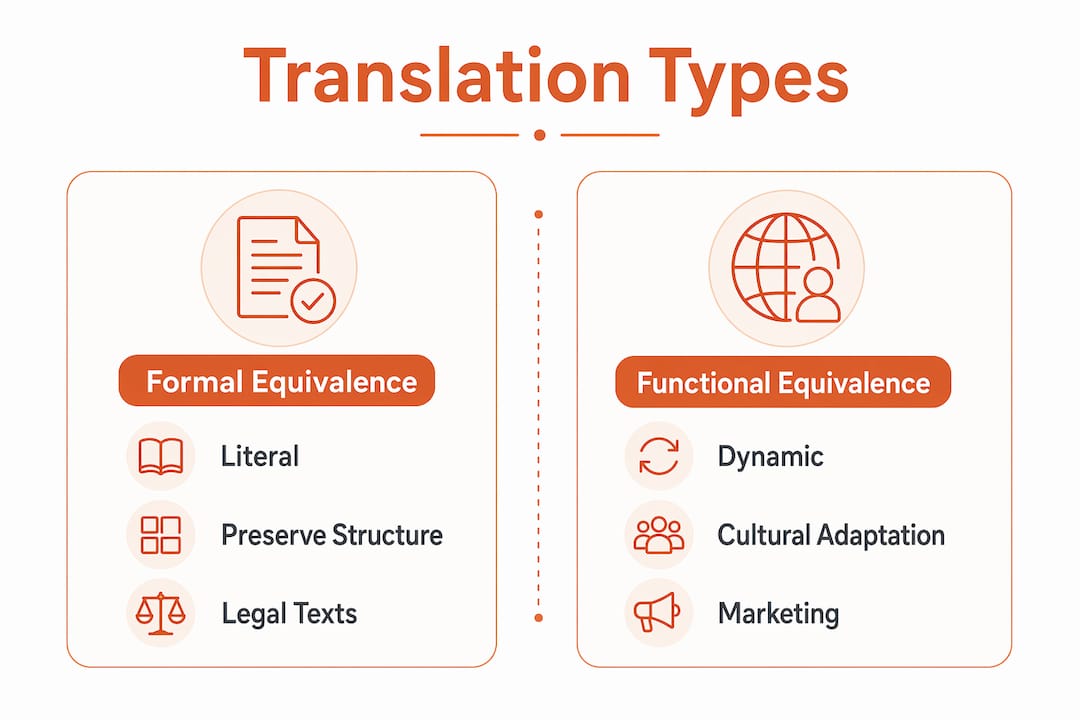
Formal equivalence preserves the architecture of the original. A legal contract translated with formal equivalence keeps clause structures and terminology intact because precision matters more than readability. Functional equivalence asks: what would a native speaker say to convey this same idea? A product tagline translated dynamically sounds natural in the target market rather than like a foreign phrase wearing local clothes.
There is also a subtler distinction worth knowing. The use of “the” versus “a” before “translation” signals whether you are referring to a unique, authorized version or one of many possible renderings. “The French translation of Hamlet” implies a canonical version. “A French translation of Hamlet” acknowledges that many exist. This grammatical nuance reflects a deeper philosophical question: is there one correct translation, or is every translation an interpretation? Most translation theorists land firmly in the second camp.
A skilled translator brings cultural knowledge to every decision. Choosing between “the” and “a,” between formal and dynamic, between a borrowed word and a coined equivalent, these are judgment calls that no style guide can fully automate.
How is translation applied in modern technology and software localization?
Software localization is where translation meets engineering, and the stakes are high. A mistranslated button label or a broken string placeholder can block a product release. The real impact of software localization goes far beyond swapping words. It requires preserving code structure, maintaining brand voice, and keeping every string consistent across an entire product.
Here is how a professional software translation workflow typically operates:
Extract strings: Pull all human-readable content from the codebase into a translation management system, separating it from code logic.
Apply translation memory: Match new strings against previously translated content to maintain consistency and reduce redundant work.
Translate with context: Provide translators with screenshots or in-context previews so they understand where each string appears in the UI.
Preserve placeholders: Variables like "{username}
or%s` must survive the translation process untouched. AI models with large context windows are useful here because translating entire files in one pass preserves syntax and code integrity better than string-by-string prompting.Review and validate: Human reviewers check for cultural fit, tone consistency, and technical accuracy before strings are pushed to production.
The collaboration between AI and human translators defines modern localization. AI handles volume and speed. Human translators handle nuance, cultural resonance, and edge cases that probabilistic models miss. Neither alone produces publication-quality results at scale.
Pro Tip: Build a project glossary before translation begins. Defining key terms, product names, and UI labels upfront prevents inconsistency across languages and saves significant review time downstream.
Common translation challenges in localization include text expansion (German text is often 30% longer than English), right-to-left script handling for Arabic and Hebrew, and maintaining a consistent brand voice across 20 or more languages simultaneously.
Why does translation matter beyond words?
Translation is a culturally powerful act that shapes societal perceptions and relationships, requiring deep contextual understanding far beyond literal language conversion. That is not a rhetorical flourish. It is the consensus of working translators who have seen their choices affect how communities understand each other.
“Translation is not just a linguistic act. It is a cultural one. Every word choice carries assumptions about the world, and those assumptions travel with the text into new hands.” Paraphrased from PEN America’s translators on their profession
A single mistranslation can have serious cultural and social consequences, underlining translation as a powerful cultural act rather than mere word substitution. In diplomatic contexts, a mistranslated phrase in a treaty or speech has historically escalated tensions. In healthcare, a mistranslated dosage instruction endangers lives. In product design, a mistranslated error message destroys user trust in seconds.
Translation also shapes identity. When a community’s literature, legal rights, or medical information exists only in a language they do not speak, they are effectively excluded from participation. Translation is, in this sense, an act of access. The translator becomes a cultural ambassador, deciding which ideas cross the border and how they arrive.
AI translation tends to average out meanings based on probabilities, which can dilute cultural and contextual nuance. This is why human translators remain indispensable for any content where tone, identity, or cultural resonance matters. You can learn more about essential translation standards that product teams use to protect quality at scale.
Key takeaways
Translation is the transfer of meaning between languages, not a mechanical word swap, and every decision in the process, from approach to article choice, reflects a philosophy about language, culture, and fidelity.
Point | Details |
|---|---|
Core translation definition | Translation transfers meaning from source to target text; it is not word-for-word substitution. |
Translation vs. interpretation | Translation is written and revisable; interpretation is real-time and oral or signed. |
Transliteration is not translation | Transliteration converts scripts without transferring meaning; it serves pronunciation, not comprehension. |
Types shape outcomes | Formal equivalence suits legal texts; functional equivalence suits UI copy and marketing. |
Technology requires human oversight | AI handles volume, but human translators preserve cultural nuance and code integrity in software localization. |
Translation as both craft and infrastructure
I have spent years watching product teams treat translation as the last step before launch, a checkbox rather than a discipline. That assumption is the single most expensive mistake in global product development. When translation is an afterthought, you get inconsistent terminology across languages, broken UI strings, and brand voice that sounds robotic in every market except the original.
What I find genuinely underappreciated is how much translation theory, specifically the tension between formal and functional equivalence, applies directly to software localization decisions. When you decide whether to translate a button label literally or adapt it to local idiom, you are making the same call a literary translator makes when rendering a metaphor. The stakes feel different, but the cognitive process is identical.
AI translation technology trends are moving fast, and I am genuinely optimistic about what large language models can do for high-volume, low-stakes content. But I am also clear-eyed about the ceiling. AI averages. It finds the most probable rendering of a phrase based on training data. That works well for straightforward UI strings. It fails quietly but consistently for culturally loaded content, humor, legal precision, and anything where the wrong word choice signals disrespect to the target audience.
My advice to students entering translation or localization: learn the theory before you rely on the tools. Understanding why formal equivalence exists, and when to break from it, makes you a better reviewer of AI output, a better briefer for human translators, and a better advocate for quality inside your organization.
— Antoine
How Gleef makes translation work inside your design workflow
If you manage multilingual product content, you know the gap between understanding translation theory and executing it at speed inside a real product cycle. Gleef closes that gap directly inside Figma, where your design work already lives. The Gleef Figma plugin brings AI-powered translation, semantic translation memory, and in-context editing into your design environment, so your team can translate, review, and validate strings without switching platforms. Glossaries keep terminology consistent across every language. Preview simulations show you exactly how translated text fits your layouts before a single line of code ships. For product teams building globally accessible digital products, Gleef turns translation from a release blocker into a built-in workflow.
FAQ
What is the definition of translation in linguistics?
Translation is defined as the transfer of meaning from a source-language text into an equivalent target-language text. It is distinct from interpretation, which is oral or signed, and from transliteration, which converts scripts without transferring meaning.
What are the main types of translation?
The two foundational types are formal equivalence (literal translation, which mirrors source structure) and functional equivalence (dynamic translation, which prioritizes natural meaning in the target language). Free translation and machine translation are additional approaches suited to specific contexts.
How does translation differ from transliteration?
Translation conveys meaning and intent across languages. Transliteration maps text into a different script to preserve pronunciation without transferring meaning. Romanizing the Russian word Москва as Moskva is transliteration, not translation.
Why is translation important in software and technology?
Software localization requires translating UI strings, help content, and error messages while preserving code placeholders and maintaining consistent terminology. Errors in this process can block product releases and damage user trust in international markets.
What is the difference between “a translation” and “the translation”?
“The translation” refers to a specific, often canonical version of a text. “A translation” acknowledges that multiple valid renderings exist. This grammatical distinction reflects a real philosophical debate about whether any single translation can be definitive.