TL;DR:
Effective translation projects follow structured workflows incorporating technology, quality standards, and continuous KPI monitoring to ensure consistent, high-quality localization. Proper use of translation memories, glossaries, and tiered AI review minimizes costs, maintains brand voice, and manages risks, enabling faster global market delivery. Emphasizing early preparation, automation, and process transparency helps product teams build reliable localization engines that adapt seamlessly to scale.
Translation projects are coordinated workflows that manage multilingual content adaptation by integrating technology, quality frameworks, and expert oversight to deliver efficient, high-quality localization at scale. For product teams shipping to global markets, the difference between a chaotic multilingual release and a predictable one comes down to process. This article breaks down the full lifecycle of translation projects, from workflow design and terminology management to AI integration and KPI tracking, so you can build a localization engine that actually holds up under pressure.
How translation projects are structured for success
Translation projects, known in the industry as localization projects, are managed activities that coordinate the adaptation of multilingual content across defined phases, tools, and quality checkpoints. They are not simply “send text, get translation back.” They involve Translation Management Systems (TMS) like Phrase or Lokalise, translation memories (TMs), glossaries, and human review gates that work together to protect consistency and speed.

Standardized localization processes reduce costs by up to 60% while improving quality and delivery speed. That figure reflects what happens when ad hoc translation requests get replaced by repeatable, auditable workflows. Product teams that invest in process architecture early spend far less time firefighting during release cycles.
The scope of a translation project typically spans UI strings, marketing copy, legal documentation, and support content, all of which carry different risk profiles and quality requirements. A TMS serves as the operational backbone, automating linguist assignment, deadline tracking, and glossary enforcement across every content type. Getting that infrastructure right before you scale is what separates teams that ship confidently from those that treat localization as a last-minute blocker.
What does a translation project lifecycle look like?
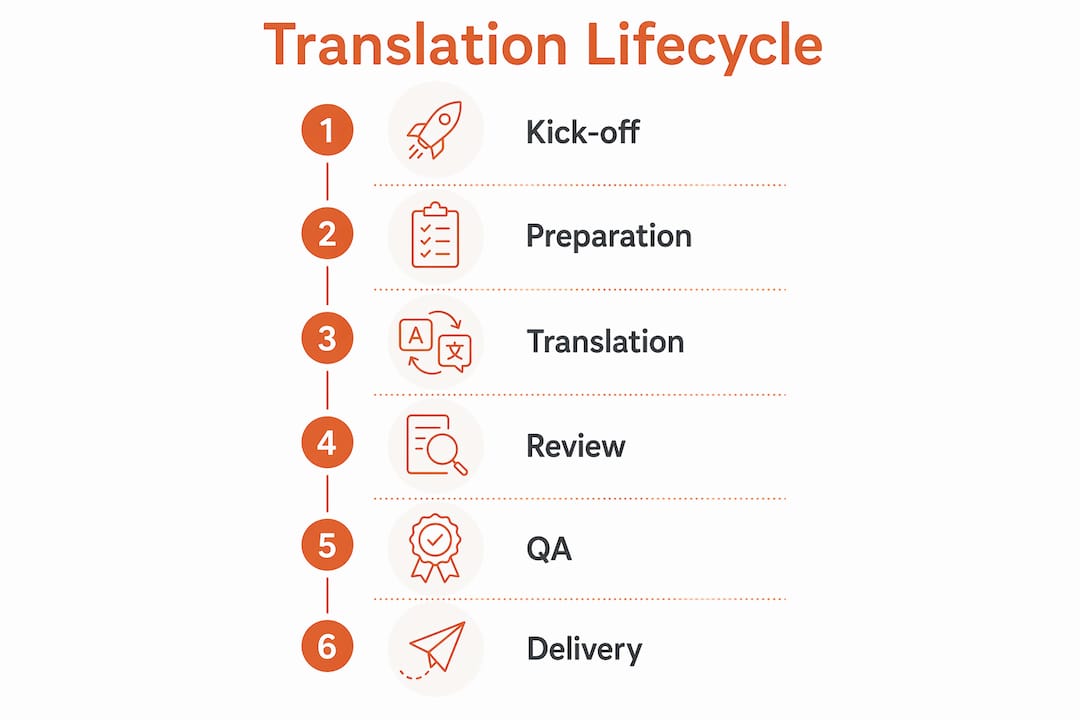
Every well-run localization effort follows a six-phase structure that moves content from source to market without losing quality or momentum.
Phase | Description |
|---|---|
Kick-off | Define scope, languages, tools, and quality requirements with all stakeholders |
Preparation | Extract content, configure TMS, assign linguists, and set up glossaries and TMs |
Translation | Linguists translate using TM suggestions and glossary enforcement in the TMS |
Desktop publishing | Reformat translated content to match original layout and design specifications |
Quality assurance | Run automated checks, human review, and in-context UI testing for accuracy |
Delivery | Return formatted, quality-checked translations ready for integration and launch |
Adobe Experience Manager’s create and translate workflow copies assets to the language root and triggers translation project creation either manually or automatically based on configuration. This kind of CMS-native automation eliminates the handoff friction that typically causes delays between content authoring and translation start. When your workflow triggers are built into the authoring environment itself, your localization team gets access to content the moment it is ready.
Well-defined phases reduce bottlenecks because every stakeholder knows exactly what they own and when. Ambiguity in handoffs is where most localization delays originate. A project manager who maps each phase to a responsible party, a deadline, and a quality gate turns a chaotic multilingual release into a predictable delivery.
Pro Tip: Set up automated project creation in your TMS so that content reaching a “ready for translation” status in your CMS or design tool triggers a new translation job without manual intervention. This alone can cut your average project start time by days.
What quality frameworks do high-performing translation projects use?
Quality in translation is not a final review step. It is a system built into every phase of the project. Implementing a quality best practice framework shifts translation quality management from subjective judgment to objective, proactive measurement. The four pillars of that framework are clear guidelines, technology enforcement, defined metrics, and human feedback loops.
Here is how to establish and monitor quality controls across your translation projects:
Define quality standards upfront. Document acceptable error rates, style guide requirements, and brand terminology before translation begins. Ambiguity at this stage creates expensive rework later.
Configure your TMS to enforce standards automatically. TMS platforms automate glossary adherence, TM leverage, and rejection of non-compliant segments, so quality gates run without manual policing.
Assign human reviewers to high-risk content. Legal copy, medical instructions, and brand-critical UI strings require subject-matter expert review regardless of how strong your AI output is.
Track KPIs at the project level. Key metrics include on-time delivery above 97%, cost per 1,000 words, and a quality score below one critical error per 10,000 words. These numbers make performance visible and accountable.
Run in-context UI testing before release. Text overflow, truncated labels, and misrendered placeholders only appear in the live product environment, not in a spreadsheet review. Build UI testing into your QA phase as a non-negotiable step.
Create a feedback loop from reviewers back to linguists. Errors caught in review should update your TM and glossary so the same mistake does not recur in future projects.
Pro Tip: Use your TMS’s quality assurance report as a project health dashboard, not just a final checklist. Reviewing it mid-project lets you catch systemic issues, like a linguist misusing a glossary term, before they multiply across thousands of segments.
How do translation memory and glossaries work together?
Translation memory and glossaries are the two most powerful consistency tools in any localization workflow, and they serve distinct but complementary functions.
Tool | Function | Primary benefit |
|---|---|---|
Translation memory ™ | Stores approved source-target segment pairs for reuse | Reduces cost and speeds up translation of repeated content |
Glossary | Defines approved terminology and brand-specific terms | Enforces consistent naming and brand voice across all content |
A translation memory is a secure database that stores segmented source and target translations, automatically suggesting matches when similar content appears in new projects. The higher your TM match rate, the lower your cost per word and the faster your turnaround. Teams that maintain clean, well-structured TMs see compounding returns as their content library grows.
Glossaries protect brand voice by locking down product names, feature labels, and legal terms so they translate consistently regardless of which linguist handles the project. Without a glossary, “checkout” might become three different words across your French, German, and Japanese markets, and your users will notice. You can explore the TM vs. glossary distinction in depth to understand when each tool does the heavy lifting.
Segmentation quality critically affects TM match performance. Poorly structured source text produces fragmented segments that fail to match against your TM, forcing translators to work from scratch on content you have already paid to translate. Planning your segmentation strategy by content type, whether UI strings, marketing paragraphs, or legal clauses, is one of the highest-ROI decisions you can make before a project starts.
Pro Tip: Audit your TM for “pollution” every quarter. Outdated or incorrect approved segments silently degrade translation quality by feeding bad suggestions to linguists. A clean TM is worth more than a large one.
What are the real risks of using AI translation without oversight?
AI translation improves throughput dramatically, but AI translation alone risks inconsistencies in terminology and cultural adaptation that accumulate into serious quality debt. Product teams that ship raw AI output without a review layer are essentially betting their brand voice on a model that has no knowledge of their glossary, their users, or their legal obligations.
The risks are specific and manageable once you name them:
Terminology drift. AI models default to common translations, not your approved glossary terms. A product feature called “Workspace” may become “Espace de travail,” “Arbeitsbereich,” or “Area di lavoro” inconsistently across markets.
Cultural mismatch. Idioms, humor, and tone that work in English often fail in direct translation. AI has no cultural judgment; it has pattern matching.
Accountability gaps. When a compliance error appears in a translated legal document, “the AI did it” is not an acceptable answer to a regulator.
Placeholder misrendering. Dynamic variables like "{username}
or{count}` can be reordered or dropped by AI models unfamiliar with your string format.
The solution is a tiered quality model. Use raw AI output for low-risk, high-volume content like internal documentation or draft copy. Apply post-editing with triage and risk scoring for product UI and marketing content. Reserve fully human translation for legal, medical, or brand-critical material. Human-AI symbiosis empowers linguists by automating repetitive segments while keeping expert judgment focused on nuance and compliance. That balance is what makes AI a genuine accelerator rather than a liability.
How does automation and KPI tracking improve translation delivery?
Automating translation workflows from authoring tool handoffs to final delivery reduces errors and accelerates market launch by removing the manual steps where delays and miscommunications accumulate. When your localization team receives content directly from your CMS or design tool, formatted and ready to process, you eliminate the email chains and file conversion steps that quietly eat days off your timeline.
Practical automation wins for product teams include:
Automated content handoff from Figma, Contentful, or your codebase directly into your TMS, triggered by a status change or a Git commit.
Linguist auto-assignment based on language pair, content type, and availability, so projects start moving the moment content arrives.
Deadline monitoring with escalation alerts that notify project managers when a job is at risk before it misses its window.
Automated QA checks that flag missing translations, formatting errors, and glossary violations before human review begins.
KPI dashboards make the invisible visible. Tracking on-time delivery, cost per 1,000 words, and error rates at the project and vendor level gives you the data to identify where your workflow breaks down and where it excels. Centralizing project communication and consolidating vendors through a single TMS turns multilingual complexity into predictable, ROI-positive results. You can go deeper on this with Gleef’s guide to automating language workflows for faster global deployment.
Pro Tip: Set a weekly KPI review cadence with your localization team. Fifteen minutes reviewing on-time delivery and error rate trends catches process drift before it becomes a release blocker.
Key takeaways
Effective translation project management requires structured workflows, enforced terminology, tiered AI integration, and KPI-driven continuous improvement to deliver consistent quality across global markets.
Point | Details |
|---|---|
Structure every project in phases | A six-phase lifecycle from kick-off to delivery prevents handoff gaps and quality failures. |
Enforce quality through technology | TMS platforms automate glossary adherence and segment rejection, making quality standards operational. |
Maintain clean TM and glossaries | Segmentation quality and regular TM audits protect consistency and reduce cost per word over time. |
Use a tiered AI model | Match AI output, post-editing, or human translation to content risk level to avoid quality debt. |
Track KPIs continuously | On-time delivery above 97% and error rates below one critical error per 10,000 words are your baseline targets. |
What I’ve learned managing complex translation projects in 2026
The biggest mistake I see product teams make is treating localization as a downstream task. They finalize the product, then hand off strings to a translation team with a two-day deadline and wonder why quality suffers. The preparation phase is where you win or lose a translation project, and most teams spend almost no time on it.
Terminology management is the unglamorous work that pays the highest dividends. A glossary built before translation starts, reviewed by your product, legal, and marketing teams, prevents the kind of inconsistency that erodes user trust in ways that are hard to measure but very real. I have seen products where the same button label translated three different ways in the same app because no one owned the glossary. That is not a translation problem. It is a process problem.
The role of the project manager is also shifting. You are no longer just coordinating linguists and deadlines. You are designing AI-human workflows, setting risk thresholds for post-editing, and reading KPI dashboards to find where your process leaks. That is a more technical job than it was five years ago, and the teams that embrace it are shipping faster and with fewer rework cycles than those still managing translation by email. Invest in your project management practices early. The compounding returns are real.
— Antoine
How Gleef helps you take control of your translation projects
Gleef is built for product teams that cannot afford to let translation slow down their release cycle. The platform connects directly to Figma, giving designers and UX writers the ability to manage translations in context without switching tools. Gleef’s semantic translation memory and glossary enforcement keep your brand voice consistent across every language and every release. With in-context editing, automated quality checks, and a developer-friendly API, your entire team, from product managers to engineers, works from a single source of truth. If you are ready to turn your localization workflow into a competitive advantage, Gleef is where that starts.
FAQ
What is a translation project in localization?
A translation project is a structured, managed workflow that coordinates the multilingual adaptation of content through defined phases, tools like TMS and translation memories, and quality checkpoints. It differs from a one-off translation request by incorporating process, accountability, and measurable outcomes.
How do translation memories reduce localization costs?
Translation memories store approved source-target segment pairs and automatically suggest matches for repeated content in new projects. Higher TM match rates mean fewer words translated from scratch, which directly lowers cost per word and speeds up delivery.
When should you use AI translation vs. human translation?
Use AI output for low-risk, high-volume content like internal documentation, and apply human post-editing or full human translation for product UI, marketing copy, and legal or compliance material. The tiered quality model matches review effort to content risk.
What KPIs should project managers track for translation quality?
The core metrics are on-time delivery above 97%, cost per 1,000 words, and a quality score below one critical error per 10,000 words. Tracking these at the project and vendor level makes performance visible and drives continuous improvement. You can find a deeper breakdown of translation quality metrics on the Gleef blog.
How does glossary management protect brand consistency?
A glossary locks down approved translations for product names, feature labels, and brand-specific terms, preventing linguists or AI models from using inconsistent alternatives. Effective glossary management is one of the fastest ways to close the gap between raw translation output and native-sounding, on-brand localization.