
TL;DR:
Translation involves converting content from one language to another while maintaining meaning, tone, and cultural nuances. It now encompasses digital content like software and multimedia, requiring different approaches for various contexts, legal standards, and audience needs. Effective localization goes beyond translation by culturally and technically adapting content to resonate with specific markets.
Translation is defined as the process of converting content from a source language into a target language while preserving meaning, tone, and cultural nuances. Modern translation extends far beyond written documents. It now covers software, video, and multimedia content, making it a foundational skill for any team building products for global audiences. Whether you work in localization, legal, or product design, understanding what translation actually means, and what it does not mean, shapes every decision you make about reaching people in their own language.
What is the definition of translation in linguistics?
Translation, in linguistics, is the rendering of meaning from one language into another, not the mechanical substitution of words. The distinction matters enormously. A word-for-word swap produces text that is technically readable but often culturally hollow or grammatically awkward. The goal is always equivalence of meaning, not equivalence of form.
The scope of translation has expanded with technology. Where translation once meant printed documents and literary texts, it now includes app interfaces, video subtitles, legal contracts, and marketing campaigns. Each context demands a different level of cultural sensitivity and technical precision. A medical consent form and a social media post both require translation, but they require completely different approaches.
Translation also carries legal weight in many contexts. EU legislative texts require equal legal validity across all language versions, which means a mistranslation is not just a communication failure. It can be a legal one. That standard of precision defines what professional translation actually demands.
What are the main types of translation?
Different content types require different translation approaches to effectively convey meaning and emotion. Choosing the wrong type for your content is one of the most common and costly mistakes teams make.
Translation by method
The three primary delivery methods are human translation, machine translation, and hybrid translation. Human translation relies on a professional linguist who understands both source and target cultures. Machine translation uses AI models like DeepL or Google Translate to generate output automatically. Hybrid translation combines both: machine output is refined through human post-editing to balance speed with quality.

Translation by text type
Type | Approach | Best Use Case |
|---|---|---|
Literal | Word-for-word conversion | Technical manuals, legal documents |
Free | Meaning-focused, flexible phrasing | General content, news articles |
Transcreation | Creative rewriting for cultural fit | Marketing, advertising, brand copy |
Localization | Full cultural and technical adaptation | Software, apps, digital products |
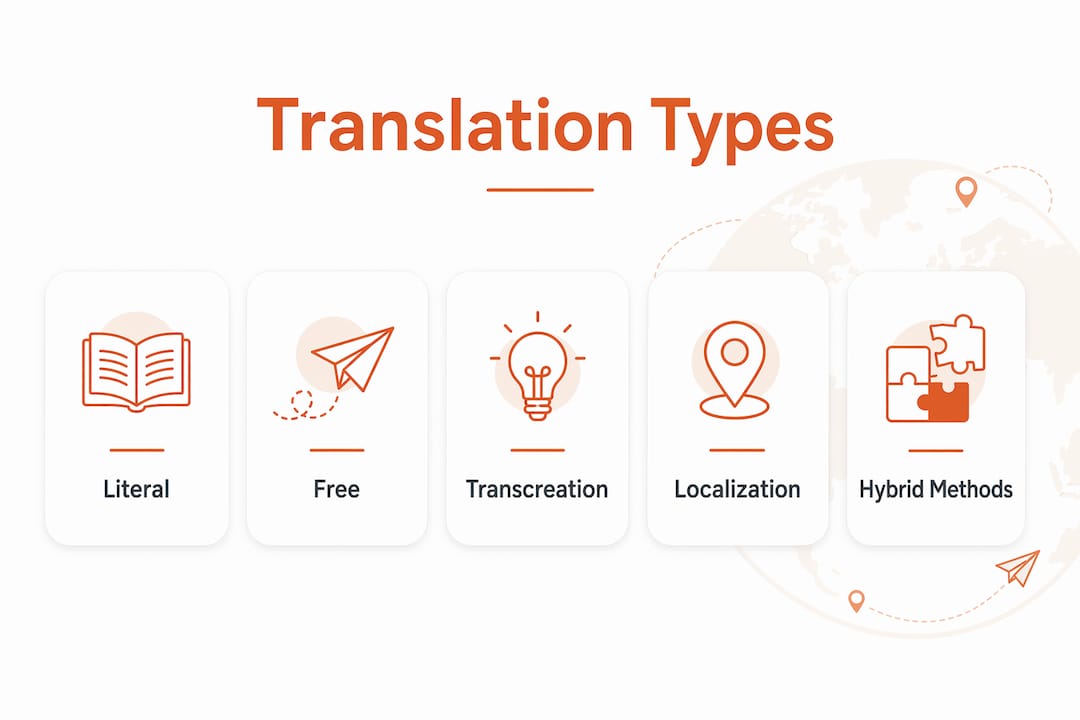
Literal translation often fails to capture idiomatic meaning, making it insufficient for marketing or literary texts. A tagline that lands perfectly in English can read as nonsense when translated word-for-word into Japanese or Arabic. Transcreation solves this by treating the emotional intent as the source material, not the words themselves.
Industry-specific translation adds another layer. Legal translation requires certified accuracy and precise terminology. Medical translation demands subject expertise because errors can harm patients. Marketing translation prioritizes brand voice and emotional resonance over strict linguistic accuracy.
Pro Tip: Before choosing a translation type, ask one question: Is the goal to inform or to persuade? Informational content can tolerate literal or free translation. Persuasive content almost always needs transcreation or localization.
How does translation differ from interpreting and localization?
These three terms are frequently confused, and mixing them up leads to real operational problems.
Translation and interpreting are distinct disciplines with separate professional standards and outcomes. Confusing them when hiring or scoping a project means you get the wrong service entirely.
Here is how each concept differs in practice:
Translation is written. A translator works with a source document and produces a written target document, with time to research, revise, and refine.
Interpreting is oral or signed. An interpreter works in real time, converting spoken language during a meeting, courtroom proceeding, or medical appointment. There is no time to look things up.
Localization goes beyond language. It adapts content culturally and technically so it resonates with a specific market. Localization includes adjusting humor, measurement units, date formats, and cultural references that would otherwise confuse or alienate the target audience.
A practical example makes this clear. Translating a software app from English to French changes the words. Localizing it changes the currency symbol, the date format, the units of measurement, and any idioms that do not carry across cultures. The French translation of “it’s raining cats and dogs” is not a phrase about animals. Localization knows that. Direct translation does not.
Pro Tip: If your product ships to multiple markets, you need localization, not just translation. Hire a localization specialist or use a platform built for that workflow from the start.
What tools and technologies support modern translation?
Professional translation today relies on a technology stack, not just a bilingual expert with a dictionary.
Computer-assisted translation (CAT) tools
CAT tools like Trados, MemoQ, and Memsource improve translation quality by providing translation memory and glossaries for consistent terminology. These tools do not translate automatically. They assist human translators by surfacing previously approved translations for repeated phrases, flagging inconsistencies, and maintaining project-wide glossaries.
Translation memory and glossaries
Translation Memory ™ and glossaries enable consistent reuse of terminology across projects, especially in software or technical translation. A TM stores every approved translation segment. When a similar segment appears in a new document, the tool surfaces the stored version for review. This cuts time and prevents the kind of terminology drift that makes a product feel inconsistent across markets.
Tool / Method | Primary Function | Ideal For |
|---|---|---|
Trados Studio | TM management, CAT editing | Enterprise translation teams |
MemoQ | Collaborative translation, TM | Agencies and large projects |
Memsource | Cloud-based TM and workflow | Mid-size localization teams |
Machine Translation | Automated first-draft output | High-volume, low-complexity content |
Hybrid Workflow | MT + human post-editing | Speed with quality control |
Machine translation has advanced significantly but still requires human post-editing to ensure quality and appropriateness. Raw machine output is a starting point, not a finished product. Teams that skip post-editing often discover the problem only after a product launches in a new market, which is the worst possible time. You can learn more about how translation technology trends are reshaping product localization workflows for digital teams.
What are the key challenges in delivering quality translations?
Translation quality breaks down in predictable ways. Knowing where the failure points are lets you build processes that prevent them.
The most common challenges include:
Idioms and figurative language. Phrases like “break a leg” or “hit the nail on the head” have no direct equivalent in most languages. Translating them literally produces confusion or unintended humor.
Terminology inconsistency. Failing to implement glossaries leads to costly mistakes in technical translation. One document calls it a “dashboard,” another calls it a “control panel.” Users notice, and trust erodes.
Cultural nuance. Colors, numbers, and symbols carry different meanings across cultures. White signals mourning in parts of East Asia. The number four is associated with death in Japanese culture. A translator who misses these signals can damage a brand.
Subject expertise gaps. A general translator working on a cardiology report or a patent filing is a liability. Specialized content requires translators with domain knowledge, not just language skills.
Legal and equity requirements. High-quality translation ensures legal validity and equity among different language versions. In regulated industries, a translation error is not just embarrassing. It can void a contract or create compliance exposure.
Best practices that prevent these failures include using approved glossaries from day one, building a translation memory before scaling to new markets, requiring subject-matter expert review for technical content, and running quality assurance checks with native speakers before release. For teams managing translation accuracy at scale, a structured review process is non-negotiable.
Pro Tip: The best translations read as if they were written in the target language from the start. If a reviewer can tell the text was translated, the job is not finished.
Key takeaways
Effective translation requires matching the right method and tools to the content type, audience, and legal context.
Point | Details |
|---|---|
Translation preserves meaning | Converting languages means matching intent and tone, not just words. |
Types vary by method and purpose | Human, machine, and hybrid methods each suit different content types and budgets. |
Localization goes beyond translation | Cultural adaptation of formats, idioms, and references is required for market fit. |
CAT tools enforce consistency | Trados, MemoQ, and Memsource prevent terminology drift across large projects. |
Quality requires human review | Machine translation output needs post-editing before it reaches any audience. |
Translation is not a commodity. treat it like the craft it is.
I have watched product teams treat translation as the last item on the launch checklist. They finish the product, then hand it off for translation as if it were a formatting task. That assumption costs them months of rework and, sometimes, entire market entries.
What I have learned from working in localization is that translation shapes the product itself. The moment you commit to a string of text in English, you are making decisions that affect every language version downstream. A button label that is three words in English might become twelve words in German, breaking your entire UI layout. A headline that is punchy in American English might land as aggressive or confusing in Korean.
The rise of AI translation tools has made this more complex, not simpler. Teams now have access to faster output, but faster wrong is still wrong. The professionals who thrive in this environment are the ones who use AI to handle volume and use human expertise to handle judgment. That combination is where the real quality lives.
The surprising truth about website translation is that most teams underestimate how much cultural context shapes user trust. A technically accurate translation that feels foreign to a native speaker will underperform every time. Translation is not a cost center. It is a product decision.
— Antoine
Build your localization workflow around the right tools
If you are a product team shipping to global markets, the gap between a good translation and a great localized experience often comes down to where translation happens in your workflow.
Gleef’s Figma plugin brings AI-powered translation directly into your design environment. You can manage translations in context, without switching platforms or losing your pixel-perfect layout. Gleef combines semantic translation memory, glossaries, and in-context editing so your team maintains brand voice and terminology consistency across every market. Product managers, UX writers, and developers all work from the same source of truth. The result is fewer release blockers, faster deployment, and translations that actually sound native.
FAQ
What is the definition of translation?
Translation is the process of converting content from a source language into a target language while preserving meaning, tone, and cultural nuances. It covers written documents, software interfaces, multimedia, and more.
How is translation different from interpreting?
Translation is written and allows time for research and revision, while interpreting is oral and happens in real time. They are distinct disciplines requiring different skills and professional training.
What are the main types of translation?
The main types include literal, free, transcreation, and localization, delivered through human, machine, or hybrid methods. The right type depends on the content purpose and target audience.
Why do CAT tools matter for translation quality?
CAT tools like Trados, MemoQ, and Memsource store approved translations in a translation memory and enforce glossary use, preventing terminology inconsistency across large or ongoing projects.
When does translation become localization?
Translation becomes localization when the work extends beyond language conversion to include cultural adaptation of humor, units of measurement, date formats, and market-specific references.