
TL;DR:
Semantic translation focuses on conveying the intended meaning naturally in the target language, enhancing localization quality. It accounts for cultural, contextual, and emotional nuances, avoiding awkward or misleading wording and ensuring user trust. Implementing structured frameworks, glossary management, and AI enhancements helps product teams achieve accurate, consistent global communication.
Your app launches in French. Users click the button labeled “Supprimer” (delete) where you intended “Retirer” (remove) and start panicking. One word off, entirely different meaning, real damage to trust. This is what happens when product teams treat localization as a word-swapping exercise. Understanding what is semantic translation — and applying it deliberately — is the difference between software that feels native and software that feels foreign even after translation.
Key Takeaways
Point | Details |
|---|---|
Meaning over wording | Semantic translation prioritizes conveying the true meaning and intent rather than literal word-for-word conversion. |
Context is essential | Preserving cultural and product context ensures translations sound natural and avoid user confusion. |
Governance drives quality | Consistent terminology rules and layered intent mapping prevent semantic drift in software localization. |
AI enhances accuracy | AI with domain context and glossary injection significantly reduces terminology errors in semantic translation. |
Granular QA needed | Evaluating terminology and intent separately from overall scores catches vital semantic mistakes. |
What is semantic translation and why it matters for software localization
Semantic translation is a meaning-first approach. Rather than converting each word from a source language directly into its dictionary equivalent, it asks a more important question: what does this text actually mean, and how do we express that meaning naturally in the target language?
The definition of semantic translation is clear: it conveys the source text’s meaning in the target language with maximum naturalness, preserving contextual intent while allowing flexible wording. That flexibility is not a compromise — it is the entire point. A word-for-word rendering of “tap to refresh” might be grammatically correct in German but feel awkward to a native speaker. Semantic translation finds the phrasing a German speaker would actually use.
This contrasts sharply with two other common approaches:
Literal translation converts each word directly, ignoring how meaning shifts across languages and cultures. It produces technically accurate but often unnatural, sometimes misleading output.
Faithful translation stays close to the source structure, adapting only when absolutely necessary. It is more natural than literal, but still prioritizes form over function.
Semantic translation prioritizes the intended meaning and user perception above grammatical mirroring. As semantic translation scholars note, it selects the closest contextual meaning to convey the source “essence” where a literal rendering simply does not exist.
For software UI, this distinction is everything. Understanding the difference between translation vs localization clarifies why: localization adapts a product for a specific market, and semantic translation is the linguistic engine that makes that adaptation feel genuine rather than mechanical.
Cultural, environmental, and even ethnic factors shape how meaning lands. A word that carries urgency in American English might read as casual in Brazilian Portuguese. A button label that sounds polite in Japanese may sound cold in Korean. Semantic translation accounts for those layers, not just the dictionary.
Key nuances and challenges of semantic translation in software products
Knowing the definition is one thing. Applying it to a product with hundreds of UI strings, version-controlled copy, and multiple target languages is another challenge entirely.

The core complexity of semantic translation is that it evaluates intent equivalence, not just linguistic similarity. Two phrases can share the same words but carry different intent depending on context. In a software product, context includes the screen the user is on, the action they are about to take, and the emotional register you want to convey. Without that context, even skilled translators default to the safest wording, which is rarely the most accurate.
Semantic equivalence) in translation may deliberately diverge from the source’s grammatical form to achieve natural target-language phrasing while preserving intent. Here is where teams get surprised: the target translation of a short English UI string can be significantly longer in German, or require a completely restructured sentence in Arabic. If your design does not accommodate that, you have a layout problem on top of a translation problem.
Common pitfalls product teams encounter include:
Decontextualized strings — sending isolated text snippets to translators without screen context, making semantic intent nearly impossible to infer.
Over-relying on string reuse — assuming the same translated phrase works across different UI contexts when the intent actually differs.
Ignoring register and tone — translating a casual onboarding message with formal language because the target language has a formal default.
Terminology inconsistency — using different translations for the same product concept across features, fragmenting user understanding.
For practical guidance on real-world cases where these pitfalls cause failures, translation challenges examples cover situations product teams regularly underestimate.
Pro Tip: Always include a context field and usage instructions for every string you send to translators. A single sentence describing the screen, user state, and desired emotional tone can dramatically improve semantic accuracy — even for automated translation systems.
Implementing semantic translation effectively: frameworks and quality assurance
Understanding semantic translation nuances leads directly to practical frameworks and quality assurance methods your product team can apply now.
Semantic translation governance is essentially a rules problem: consistent guidelines for meaning over wording are what prevent misleading UI copies from shipping. Without a framework, every translator and every AI model makes independent judgment calls, and those calls drift over time and across languages.
A solid implementation framework has three layers:
Intent mapping — Document the communicative goal of each UI component. What decision or action should this string prompt? What emotional tone should it carry? This becomes the brief for every translator.
Glossary management — Maintain a product-specific glossary of key terms with their approved translations in every target language. “Workspace,” “project,” “template” all mean something specific in your product and must translate consistently.
Developer and UX notes — Attach inline comments to translation keys that describe character limits, screen placement, and user context. Translators working with constraints produce better semantic output.
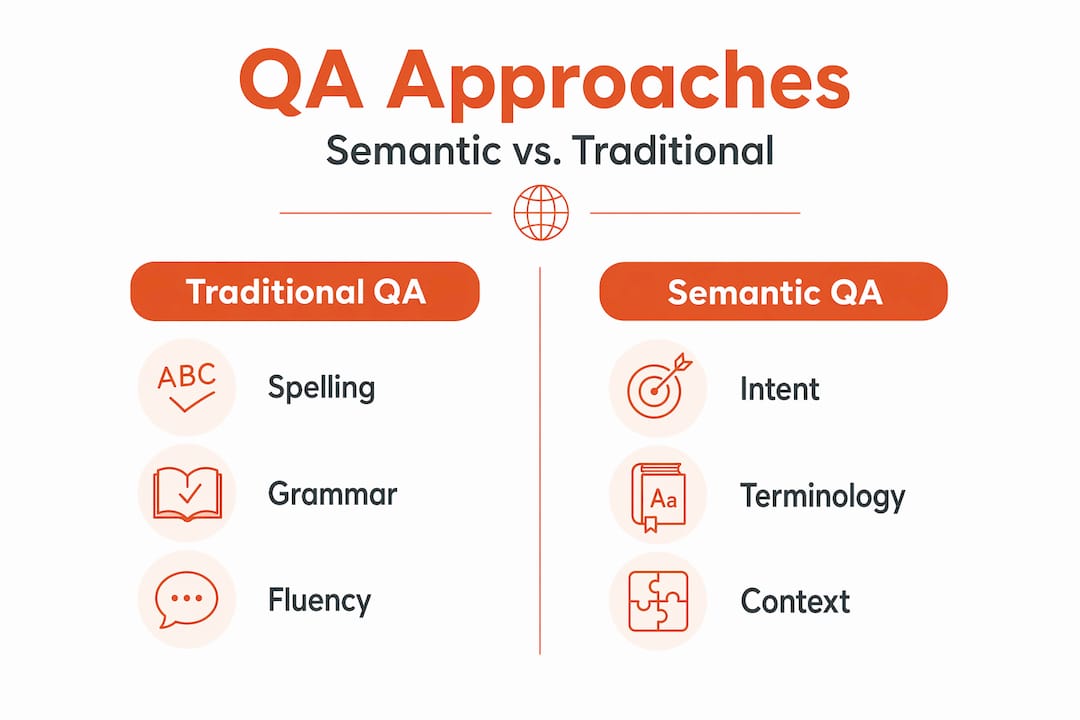
Traditional QA vs. semantic QA
Dimension | Traditional QA | Semantic QA |
|---|---|---|
Focus | Spelling, grammar, fluency | Intent accuracy, terminology, register |
Scoring | Holistic quality scores | Granular metrics per dimension |
Error detection | Surface-level errors | Meaning drift and term inconsistency |
Feedback loop | Post-release review | Integrated at string and component level |
Tools used | Generic spellcheck | Glossary validators, context comparison |
The table above illustrates a critical shift. Granular QA dimensions like terminology accuracy and intent scoring catch errors that holistic quality scores consistently miss. A translation can read fluently and still convey the wrong intent. That is the invisible failure mode that damages user trust in localized products.
For a detailed walkthrough of building a translation consistency guide into your workflow, you will find step-by-step methods that complement intent mapping directly. Pairing that with semantic translation with AI shows how automation amplifies what a strong framework can achieve.
Pro Tip: Build terminology accuracy and intent fidelity as separate QA dimensions in your review process. Treating them as one combined metric hides the specific failure type, which makes it nearly impossible to fix systematically.
Leveraging AI to enhance semantic translation in product localization
Building upon traditional frameworks, AI innovations now give product teams a significant quality upgrade in semantic translation performance — one that was not accessible even three years ago.
Modern Neural Machine Translation (NMT) models do not translate word by word. They use attention mechanisms and contextual embeddings to model meaning across entire sentences and paragraphs. As AI translation researchers describe it, AI models generate dynamic, contextual embeddings allowing them to move beyond literal translation toward semantic and pragmatic understanding. That shift is meaningful: today’s best AI translation understands that “save” in a file menu means something different from “save” in a payment context.
The latest advancement pushing this further is Retrieval Augmented Localization (RAL). Rather than relying on a generic model, RAL injects domain-specific context at inference time: your product glossary, brand voice guidelines, and locale-specific instructions. The result is significant: RAL reduces terminology errors by injecting domain context like glossaries and brand voice at inference time, cutting LLM terminology errors by 17 to 45 percent.
Here is what that means in practice:
Glossary injection — The AI checks every output against your approved term list in real time, replacing generic translations with product-specific ones.
Brand voice enforcement — Tone instructions (formal, conversational, technical) travel with every translation request, not just the text.
Contextual consistency — The AI references prior translations for the same component, reducing drift across iterative product releases.
Reduced review cycles — Fewer semantic errors at the AI output stage means fewer rounds of human correction before shipping.
“The real advantage of AI in semantic translation is not speed — it is persistence. A human translator has to re-learn your product glossary with each new string. An AI with RAL never forgets it.”
For a broader view of what AI in localization actually delivers beyond the headlines, it is worth separating genuine capability from hype. And when you are evaluating specific tooling decisions, the AI translation benefits breakdown maps capabilities to real product team outcomes.
One practical consideration: humanizing AI-generated text remains a necessary step for customer-facing copy, even when the semantic accuracy is high. AI handles structure and terminology well; humans still catch the emotional register.
Pro Tip: When configuring AI translation tools, supply a domain glossary of at least 50 to 100 product-specific terms. Even a small, well-curated glossary produces a measurable improvement in semantic consistency across languages.
Why semantic translation is the unsung hero in global product success
Here is the uncomfortable truth most product teams never fully reckon with: semantic translation failure is invisible until users start leaving.
A grammatically correct but semantically wrong translation does not throw an error. It does not break a build. It ships clean, passes QA review on fluency, and reaches users looking polished. Then it quietly erodes trust every time someone encounters a button that says the wrong thing, a message that conveys the wrong urgency, or a term that contradicts what they learned on the previous screen.
The teams that build trusted global products treat semantic translation as continuous intent mapping across all localization layers, not a one-time task handed off at release. Isolated string translation without intent causes meaning drift in iterative releases — and most teams are doing iterative releases constantly.
What separates them from the teams shipping semantically broken products? Layered governance. Glossaries that travel with every translation request. Intent specs attached to every UI component. QA processes that score terminology accuracy independently from fluency. And a cultural shift inside the product organization: localization is not a last step before launch; it is embedded in how the product is built.
The teams that get this right do not just avoid embarrassing mistranslations. They build products that feel locally crafted in every market — which is a serious competitive advantage. The real impact of software localization extends into user retention, brand credibility, and market penetration in ways that translate directly to revenue.
Semantic translation is not a nice-to-have polish step. It is the foundation of whether your product communicates at all.
Boost your product localization with Gleef’s AI-powered semantic translation
You now have the framework. The question is how to implement it without adding weeks of overhead to every release cycle.
Gleef’s Figma plugin puts semantic translation directly inside your design workflow, so your team manages translations in context — not in disconnected spreadsheets or separate tools. Glossary enforcement runs automatically, catching terminology drift before it reaches developers. AI-powered translation applies your brand voice and product-specific terms at every step, using the same RAL principles that reduce terminology errors by up to 45 percent. Cross-functional collaboration between designers, UX writers, developers, and QA teams happens in one place. For a deeper dive into how Gleef approaches semantic quality, the methodology behind the tooling makes the outcomes predictable, not accidental. Faster global launches with fewer meaning errors start here.
Frequently asked questions
What is the main difference between semantic and literal translation?
Semantic translation preserves intended meaning and adapts wording for naturalness, while literal translation converts words directly and often ignores how context shapes meaning in the target language.
How does semantic translation improve software user experience?
Semantic translation avoids misleading UI copy by keeping the focus on meaning over wording, so users encounter text that matches their expectations and supports the action they are trying to take.
Why is glossary management important in semantic translation?
Injecting glossary terms at translation time drastically reduces terminology errors and drift, ensuring product concepts translate consistently across all languages and features.
Can AI fully replace human semantic translators?
AI enables more accurate and natural translations but still requires human expertise for deep cultural nuances and creative language decisions where intent is ambiguous or emotionally complex.