
TL;DR:
Translation memory is a database of past translations used by CAT tools to suggest reuse and improve consistency. It can reduce translation volume by up to 70%, but maintaining quality requires proper governance, source text consistency, and human review. Owning, maintaining, and integrating translation memory effectively boosts localization efficiency and cost savings over time.
Translation memory is defined as a database of previously translated source-target segment pairs that CAT tools and translation management systems use to suggest reuse of prior translations. For localization professionals managing multilingual product releases, documentation, or software strings, this technology is the single most powerful tool for cutting costs and enforcing consistency across every language. Platforms like memoQ, SDL Trados, and Phrase all place translation memory at the center of their workflows. Mature translation memories can reduce new translation volume by approximately 30–70% depending on content repeatability. That number compounds with every project cycle, turning your TM into an institutional asset that grows more valuable over time.
How does translation memory work and what match types exist?
A translation memory system searches its stored segments every time a translator opens a new string. It compares the incoming source text against every previously approved segment and returns a match score. That score reflects text similarity, not guaranteed correctness.
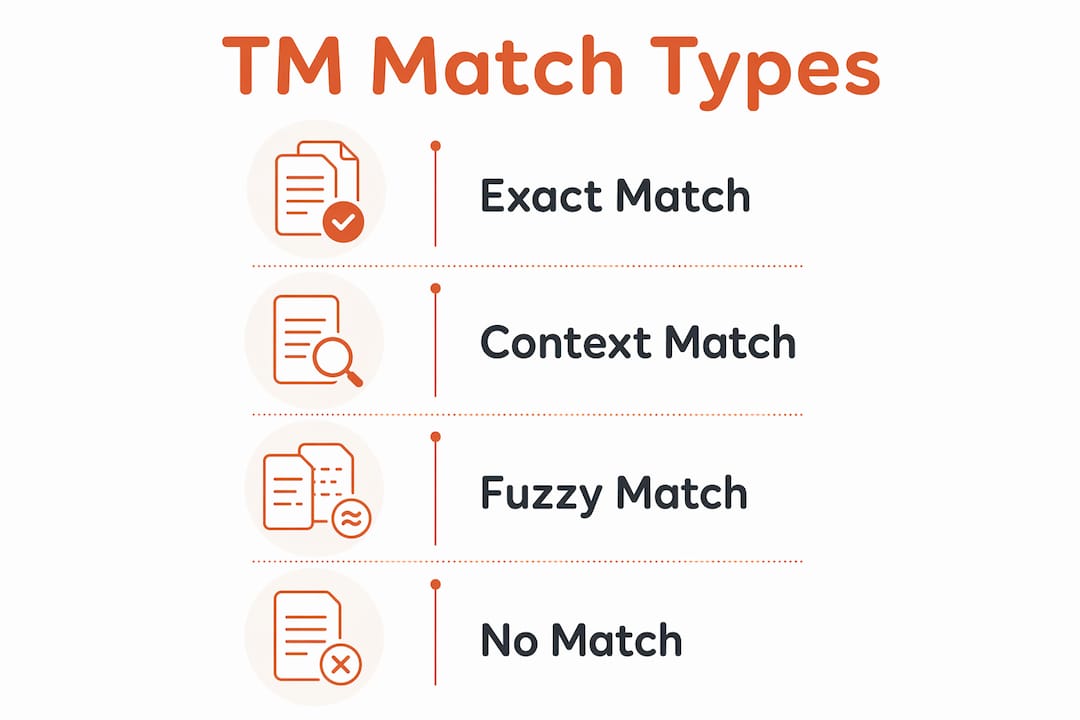
Three match types define how TM suggestions are used in practice:
Exact match (100%): The incoming segment is character-for-character identical to a stored segment. The TM returns the stored translation directly.
Fuzzy match: The incoming segment is similar but not identical, typically scored between 50% and 99%. The translator reviews and edits the suggestion.
Context match (101%): The segment is identical and the surrounding segments also match stored context. This is the highest-confidence match type because it verifies adjacent content, not just the string itself.
The critical point most teams miss: match scores reflect similarity, not definitive correctness. A 100% match can still carry an outdated term, a brand name change, or a formatting error from a previous project. Human review remains non-negotiable even at the highest match levels.
Pro Tip: Set your TM penalty thresholds deliberately. Many teams accept 95%+ matches without review. Dropping that threshold to 100% for unreviewed auto-propagation, and requiring human sign-off on everything below, prevents error propagation across thousands of strings.

In tools like memoQ and SDL Trados, translators see match scores inline as they work. A segment showing 85% fuzzy will display the stored translation with differences highlighted, so the translator edits only what changed. This workflow is faster than translating from scratch and more accurate than blind reuse.
What are best practices for optimizing translation memory performance?
TM performance depends as much on how you write source content as on how you configure your tools. A TM filled with inconsistent source strings will return low match rates no matter how good the software is.
Write source text for reuse. Consistent phrasing in UI labels, error messages, and help text directly improves TM match rates. If your product calls the same action “Save,” “Save changes,” and “Save your work” across different screens, your TM treats those as three separate segments.
Standardize segmentation rules. Small variations in segmentation — sentence breaks, tag boundaries, inline code — cause missed matches and manual rework. Localization engineers should lock segmentation rules in the CAT tool before the first project begins.
Use controlled vocabulary and glossaries. Pair your TM with a glossary of approved terms. When translators use approved terminology consistently, the TM builds a clean, reusable corpus. Mixing synonyms degrades future match quality.
Clean your TM regularly. Outdated segments, superseded product names, and legacy terminology pollute match suggestions. Schedule a TM audit at least once per year, or after any major product rebrand.
Layer in automated quality checks. TM matches alone do not guarantee quality. Combine TM reuse with automated consistency checks and targeted linguistic quality assurance sampling to catch errors before they propagate.
Pro Tip: Create a “TM maintenance guide” document for your team that defines which segments are approved for auto-propagation, which require review, and who has authority to add or delete entries. Without governance, TM quality degrades fast.
The translation consistency guide from Gleef covers source text authoring practices that feed directly into TM effectiveness. Consistent source writing is the upstream fix that makes every downstream TM match more reliable.
How should localization teams manage TM ownership and portability?
Translation memory is a business asset. Many teams discover this too late, when they switch vendors and find their TM data locked inside a proprietary system. Ownership and portability need to be addressed contractually before a project starts.
The key principles for TM ownership and portability:
Establish ownership in writing. Your contract with any translation vendor or LSP should state explicitly that you own the TM data generated from your content. This is not the default assumption in every vendor relationship.
Request delivery in TMX format. TMX (Translation Memory eXchange) is the open standard XML format compatible with all major CAT tools, including memoQ, SDL Trados, and Phrase. A TMX file contains segments with full metadata, so you can import it into any platform.
Require updated TM delivery after every project. TM ownership and portability only hold value if you receive the updated file after each completed project. Stale TMs from six months ago miss everything your team approved since then.
Audit TM access before switching vendors. When transitioning to a new LSP or tool, request a full TM export and validate the file before the old vendor’s access ends.
Scenario | Risk without TM ownership | Solution |
|---|---|---|
Switching translation vendors | Losing all approved translations | Contractual TMX delivery clause |
Migrating to a new CAT tool | Incompatible proprietary format | Request TMX; verify import before migration |
Vendor goes out of business | No access to translation history | Maintain your own TM backup on internal storage |
Scaling to new languages | Starting from zero on shared content | Use existing TM as reference for new language pairs |
The portability argument is especially strong for software and game localization teams. Repeated segments in release patches and DLCs translate instantly when a clean TM is in place, cutting ongoing translation effort significantly with every update cycle.
What are the practical benefits of translation memory in project management?
The efficiency gains from a well-maintained TM are not theoretical. They show up in project timelines, vendor invoices, and consistency audits.
Benefit | Practical impact |
|---|---|
Volume reduction | 30–70% fewer new segments to translate per project cycle |
Cost savings | Lower per-word costs for fuzzy and exact matches versus new translation |
Faster turnaround | Translators spend less time on repeated content, freeing capacity for new strings |
Cross-project consistency | Approved terminology and phrasing replicate automatically across all content types |
Institutional knowledge | Approved translations accumulate into a compounding asset that grows with every project |
The compounding effect is what makes TM genuinely powerful. A product team that launches in three languages and runs quarterly updates will see match rates climb with each release. By the second year, a mature TM can cover the majority of recurring UI strings, legal boilerplate, and help documentation automatically.
Technical documentation, software UI, and legal content benefit most from TM reuse. These content types repeat phrases at high frequency. A legal disclaimer that appears in 40 documents translates once and propagates everywhere. A UI button label like “Confirm” or “Cancel” never needs retranslation once it is approved and stored.
The translation technology trends shaping product localization show that teams combining TM with AI-assisted translation are seeing the fastest turnaround times. TM handles the known content; AI handles the new content; human reviewers validate both. That three-layer model is becoming the standard for high-volume localization in 2026.
Key takeaways
Translation memory delivers compounding efficiency gains only when teams own their data, maintain clean segments, and pair TM reuse with human review at every match level.
Point | Details |
|---|---|
TM match types matter | Exact, fuzzy, and context matches each require different review thresholds to prevent error propagation. |
Source text quality drives TM performance | Consistent phrasing and standardized segmentation directly increase match rates across projects. |
Own your TM data | Always request TMX delivery after each project and include ownership clauses in vendor contracts. |
TM compounds over time | Match rates and cost savings grow with every approved translation added to the database. |
Pair TM with quality checks | Automated consistency checks and linguistic sampling prevent TM from becoming a source of repeated errors. |
Why I think most teams underuse their most valuable localization asset
After working with localization teams across software, SaaS, and digital product companies, the pattern I see most often is this: teams invest in a CAT tool, build a TM over two or three projects, and then treat it as a passive background feature rather than an active asset.
The biggest missed opportunity is TM governance. Teams that assign a TM owner, run quarterly audits, and enforce source text consistency rules see match rates that genuinely hit the upper range of efficiency gains. Teams that let anyone add segments without review end up with a TM full of contradictions, outdated product names, and inconsistent tone. At that point, the TM becomes a liability, not an asset.
The second thing I would push back on is the assumption that high match percentages mean you can skip review. A 100% match on a segment that was approved before a product rebrand will push the wrong brand name into your next release. Context matches are more reliable, but they are not infallible. The translation memory vs glossary comparison is worth reading if you want to understand how pairing these two tools creates a much stronger consistency layer than either one alone.
The emerging practice I find most compelling is combining TM with AI-assisted translation in a structured workflow. TM covers the known, approved content. AI handles the new segments. Human reviewers focus their attention on AI output and edge cases. That model respects the value of your existing TM while accelerating the parts of the project where TM cannot help. It is the most practical translation memory strategy for 2026 and the years ahead.
— Antoine
How Gleef fits into a modern translation memory workflow
Gleef is built for product teams that need localization to move at the speed of product development. Its semantic translation memory works inside Figma, so designers and UX writers see translation suggestions in context without switching tools. Glossaries, in-context editing, and consistency rules layer on top of TM reuse to catch errors before they reach production. For teams managing multilingual releases across multiple markets, the Gleef Figma plugin connects AI-powered translation memory directly to the design workflow. That means fewer release blockers, faster deployment, and translations that stay consistent with your brand voice from the first string to the last.
FAQ
What is translation memory in localization?
Translation memory is a database of previously translated source-target segment pairs. CAT tools like memoQ, SDL Trados, and Phrase use it to suggest reuse of approved translations, reducing manual effort and enforcing consistency across projects.
What is the difference between a 100% match and a context match?
A 100% match means the incoming segment is identical to a stored segment. A context match (101%) means both the segment and its surrounding segments match stored content, providing higher confidence that the reused translation is correct in context.
How do I keep my translation memory from degrading in quality?
Run a TM audit at least once per year to remove outdated segments, superseded terminology, and legacy brand names. Pair TM reuse with automated consistency checks and linguistic quality assurance sampling to prevent errors from propagating across projects.
Who owns the translation memory data?
You do, provided your vendor contract states this explicitly. Always include a clause requiring TMX file delivery after each project. TMX is the open standard format compatible with all major CAT tools, so your data remains portable regardless of which vendor or platform you use next.
How much can translation memory reduce translation costs?
Mature translation memories can reduce new translation volume by approximately 30–70% depending on content repeatability. The efficiency gains compound with each project cycle as more approved segments accumulate in the database.