
TL;DR:
Effective translation combines AI tools, structured workflows, and human expertise to ensure culturally accurate content at scale.
Choosing the right AI translation tool depends on content sensitivity, with commercial options for volume and eTranslation for official documents.
Translation is the process of converting meaning from a source language text into an equivalent target language text, preserving intent, tone, and cultural context across every word. For product teams, localization managers, and marketing professionals, choosing the right translation or translations approach determines whether your product lands globally or gets lost in linguistic noise. Tools like Google Translate, powered by Gemini AI, and the European Commission’s eTranslation platform now represent opposite ends of the professional spectrum: one optimized for speed and reach, the other for security and official accuracy. Getting this choice right is not a detail. It is the foundation of every global launch.
How do modern AI translation tools improve quality and workflow?
AI translation has moved well past word-for-word substitution. Gemini-powered models now produce more natural text by handling idioms, slang, and culturally specific phrasing with far greater accuracy than previous neural machine translation systems. Google Translate’s beta for live speech-to-speech translation via headphones is expanding language support in 2026, opening real-time multilingual conversation for global teams and customer-facing roles. These advances make AI a genuine first-draft engine rather than a novelty.
On the institutional side, the European Commission’s eTranslation tool covers all EU official languages with a critical differentiator: data submitted to eTranslation is never used to train commercial AI models. For legal, regulatory, or government-facing content, this matters enormously. Commercial tools like Google Translate or DeepL prioritize speed and breadth; eTranslation prioritizes trust and compliance. Knowing which tool fits which content type is the first decision every professional localization workflow must make.
The practical split looks like this:
Commercial AI tools (Google Translate, DeepL): best for high-volume, low-sensitivity content where speed matters most
EU eTranslation: best for official documents, regulatory filings, and content requiring strict data governance
CAT tools with integrated MT (computer-assisted translation platforms): best for professional translators combining machine output with human post-editing
Specialized language translation services: best for brand-sensitive, emotionally complex, or legally binding content
Machine translation combined with skilled post-editing doubles throughput but cannot replace human judgment for nuance. This is the operating reality of 2026: AI handles volume, humans handle meaning.
Pro Tip: Never route brand voice copy, legal disclaimers, or emotionally sensitive content through raw machine translation without a qualified human reviewer. The cost of a mistranslation in these categories far exceeds the cost of post-editing.
What are best practices for building scalable localization workflows?
Scalable localization does not happen by accident. It is the product of deliberate architecture: glossaries, style guides, translation memory, and automation working together as a system. Most teams that struggle with consistency are missing at least one of these components.
Here is a proven sequence for building a workflow that scales:
Define your glossary first. A glossary classifies high-impact terms: product names, UI labels, legal terms, and brand-specific vocabulary. Glossaries and style guides shape brand voice and prevent translators from making inconsistent choices across projects or locales. Without a glossary, every translator makes independent decisions about the same terms.
Build your translation memory before you scale. Translation memory ™ stores approved source-target segment pairs. Every new project draws from this asset, reducing redundant work and keeping terminology consistent. Set up language pair distinctions from day one.
Automate pre-translation with TM and MT fallback. Automated pre-translation workflows apply 100% TM matches automatically, then use machine translation as a fallback for unmatched segments, with human review as the final gate. This sequence cuts turnaround time without sacrificing quality.
Integrate QA checks into the pipeline. Automated QA tools catch formatting errors, missing placeholders, and terminology violations before content reaches reviewers. This prevents the most common release blockers.
Version your assets like code. Glossaries and style guides should be versioned to track changes, explain terminology decisions, and maintain trust in TM suggestions across locales. A glossary without version history is a liability.
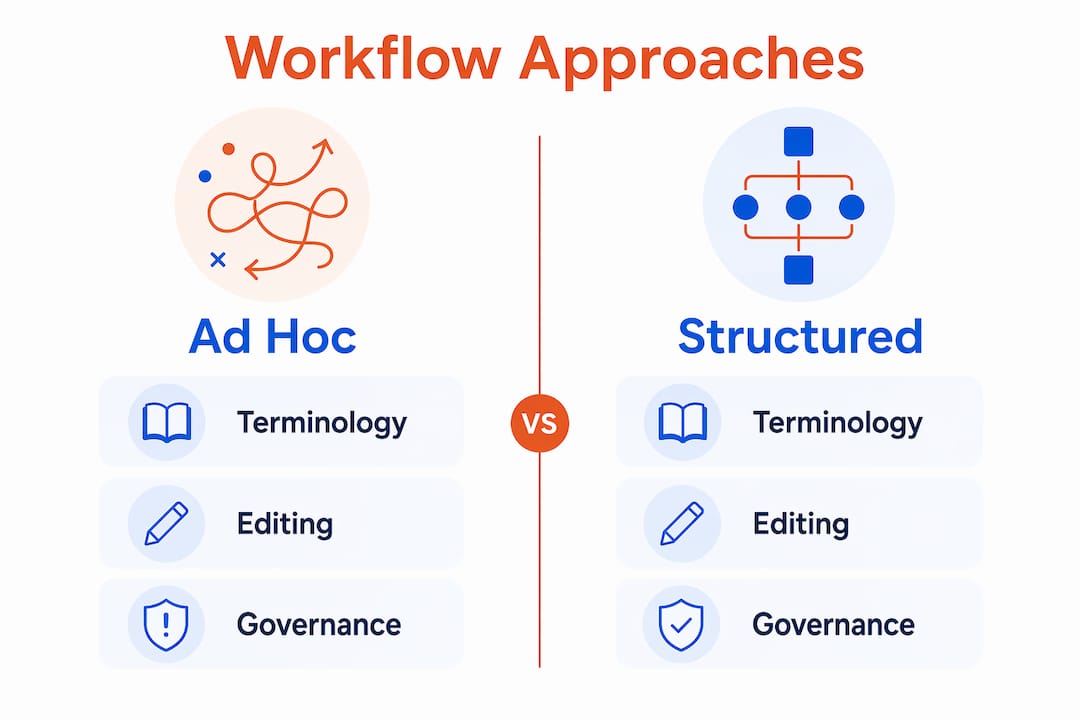
The comparison below shows the difference between an ad hoc workflow and a structured one:
Workflow element | Ad hoc approach | Structured approach |
|---|---|---|
Terminology management | Translator discretion | Centralized glossary with versioning |
Repeated content | Retranslated each time | TM match applied automatically |
QA process | Manual review only | Automated checks plus human review |
MT usage | Inconsistent or absent | Defined fallback with post-editing rules |
Style guidance | Informal or verbal | Versioned style guide per locale |
Pro Tip: Segment your content by project type, locale, and content category before building your TM. A UI string behaves differently from a marketing headline, and mixing them in a single TM degrades match quality for both.
How do translation memories and human expertise work together?
Translation memory is defined as a database that stores previously translated source and target language segment pairs, allowing translators and automated systems to reuse approved content across projects. TM sits at the core of every professional computer-assisted translation (CAT) tool and translation management system (TMS), from Phrase to memoQ to Lokalise. The ROI case is direct: TM implementation reduces translation costs by 20 to 40 percent on repetitive content, with faster time-to-market as an additional benefit. That cost reduction compounds over time as the TM grows.
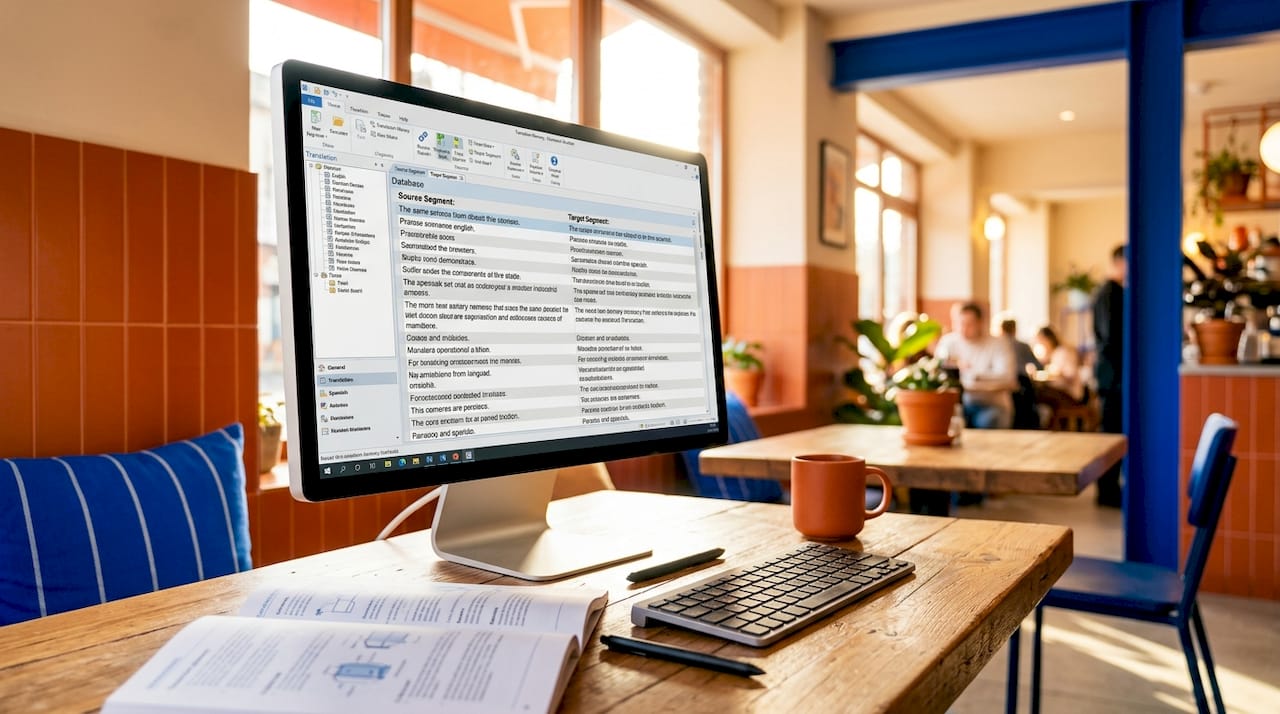
Governance is where most teams fail. The distinction between a master TM and a project TM is critical. The master TM stores only reviewed, approved segments and serves as the source of truth across all projects. Project TMs handle active translation work and act as a buffer, preventing unreviewed content from polluting the core asset. Teams that skip this separation end up with a TM full of errors that propagates bad translations at scale.
Segmentation rules also determine TM quality. Poorly defined segmentation splits sentences at the wrong points, creating fragments that never match future content. Well-defined rules produce clean, reusable segments that accumulate value over time.
The human element is irreplaceable in this system. Machine translation combined with post-editing works best when human linguists focus their attention on low-match and no-match segments, leaving 100% TM matches for automated application. This division of labor maximizes both speed and accuracy. Skilled post-editors also catch errors that automated QA misses: tonal mismatches, register shifts, and culturally inappropriate phrasing that a rule-based checker cannot flag.
Pro Tip: Schedule quarterly TM cleaning sessions. Remove duplicate segments, retire outdated terminology, and promote high-quality project TM segments to the master TM. A maintained TM appreciates in value; a neglected one becomes a source of errors.
Why cultural and ethical considerations still define translation quality
Translation is not a technical process with a cultural layer on top. It is a cultural act that happens to involve technical tools. Translators function as cultural ambassadors, and a single mistranslated word can carry consequences that ripple through communities, legal systems, and political relationships. This is not hyperbole. It is the documented professional reality that PEN America’s expert panel has articulated clearly.
“One mistranslated word can heavily impact societies, underscoring the need for accuracy beyond AI capabilities.” — PEN America translators panel
The risk of AI reliance is not that machines produce bad translations. The risk is that they produce plausible translations that flatten expression, strip cultural specificity, and eliminate the creative choices that make a text resonate in its target language. Marketing copy that sounds natural in English can read as robotic or tone-deaf in Japanese or Arabic if the translator has not made active cultural decisions at the sentence level.
Professional translators bring three things that no current AI system replicates: emotional intelligence, cultural lived experience, and accountability. When a localization team treats translation as a commodity to be automated away, they are trading short-term cost savings for long-term brand damage in markets they are trying to win. The ethical responsibility of translation integrity means collaborating with translators as creative partners, not treating them as post-editors for machine output.
Key takeaways
Effective translation combines AI tools, structured workflows, and human expertise to deliver consistent, culturally accurate content at scale.
Point | Details |
|---|---|
AI tools serve different use cases | Use commercial AI for volume; use EU eTranslation for data-sensitive or regulatory content. |
Glossaries prevent inconsistency | Build and version a centralized glossary before scaling to any new locale or content type. |
TM governance drives ROI | Separate master and project TMs to protect quality and reduce costs by 20 to 40 percent on repetitive content. |
Human review is non-negotiable | Post-editing by qualified linguists catches tonal, cultural, and contextual errors that automated QA cannot flag. |
Cultural depth protects brand value | Translators as cultural ambassadors make active decisions that preserve meaning and prevent reputational risk. |
Why I think most teams underinvest in translation governance
I have watched product teams spend months perfecting their UI and then hand off localization as a last-minute task with no glossary, no TM, and no style guide. The result is always the same: inconsistent terminology, delayed releases, and expensive rework in markets that were supposed to be easy wins.
The teams that get this right treat their glossary management and TM architecture as product infrastructure, not administrative overhead. They version their assets, define their segmentation rules early, and build human review into the pipeline rather than bolting it on at the end. They also choose their AI tools deliberately, matching tool capabilities to content sensitivity rather than defaulting to whatever is fastest.
My honest observation is that the gap between good and great localization is almost never about the translation itself. It is about the system surrounding the translation: the governance, the tooling, the collaboration between product managers, UX writers, and linguists. AI is genuinely powerful here, but only when it operates inside a well-designed workflow. Without that structure, you are not accelerating localization. You are accelerating inconsistency.
The teams I respect most are the ones building cross-functional localization workflows where designers, developers, and translators share a single source of truth. That is where the real gains live in 2026.
— Antoine
Build bulletproof localization workflows with Gleef
If the workflows described in this article sound like where you want to be, Gleef is built to get you there faster.
Gleef’s AI localization platform gives product teams glossary management, semantic translation memory, in-context editing, and API-driven automation in one place. It integrates directly with Figma so designers and developers work in the same environment without switching tools. Teams using Gleef report measurable improvements in translation quality, brand consistency, and release velocity across international markets. If translation bottlenecks are slowing your global deployments, explore what Gleef can do for your workflow at gleef.eu/studio.
FAQ
What is the difference between translation and localization?
Translation converts text from one language to another. Localization adapts the entire product experience, including UI, date formats, currency, and cultural references, to feel native in the target market.
How much can translation memory reduce costs?
TM reduces translation costs by 20 to 40 percent on repetitive content. The savings increase as the TM grows and more segments reach 100% match rates.
When should you use machine translation vs. a professional translator?
Use machine translation for high-volume, low-sensitivity content like internal documentation or product metadata. Use professional translators for brand copy, legal content, and any material where cultural nuance or legal accuracy is required.
What makes the EU eTranslation tool different from commercial options?
The EU eTranslation tool operates under strict EU data rules and does not use submitted content to train commercial AI models. This makes it the right choice for official, regulatory, or government-facing translation work.
How do you maintain glossary consistency across multiple locales?
Version your glossary like code, assign ownership to a localization manager, and integrate it directly into your TM and CAT tools so translators see approved terms in real time during every project.