
TL;DR:
Business translation accurately converts business documents into target languages to ensure compliance and cultural appropriateness. High-quality services rely on structured processes, glossaries, and technology, especially for legal, financial, and regulated content. Treat translation as a strategic, ongoing function to protect brand integrity and minimize costly errors.
Business translation is the precise conversion of business documents and communication into target languages to support accurate, compliant, and culturally appropriate global operations. It covers everything from contracts and financial reports to marketing copy and HR documentation. Poor translation in any of these areas creates real risk: legal liability, regulatory fines, and brand damage that can take years to repair. This guide explains the core types, quality standards, best practices, and technology that decision-makers need to manage professional translation services effectively across their organizations.
What is business translation and why does it matter?
Business translation is defined as the accurate and professionally adapted conversion of internal and external business communication into target languages. The industry term for managing this at scale is language operations, or LangOps. Both terms matter: “business translation” describes the task, while LangOps describes the strategic function that governs it.

The scope is wider than most teams expect. Legal, financial, marketing, technical, and HR content each carry distinct requirements. A contract mistranslated in a single clause can void an agreement. A compliance filing with imprecise terminology can trigger a regulatory penalty. A product manual with ambiguous safety instructions creates liability. The stakes are not theoretical.
Professional translation services require adaptation beyond language to culture and compliance. A phrase that reads as authoritative in English may read as aggressive in Japanese or vague in German. Cultural adaptation is not optional for organizations that want to build trust in new markets.
What types of documents require professional translation?
Different content types require specific translation approaches to meet the unique demands of legal, marketing, HR, and technical materials. Understanding those differences before you assign work saves time and prevents costly revisions.
Document type | Core requirement | Key risk if mistranslated |
|---|---|---|
Contracts and legal agreements | Strict compliance with jurisdiction-specific terminology | Voided clauses, legal disputes |
Financial reports and filings | Numerical accuracy and regulatory vocabulary | Regulatory penalties, investor misinformation |
Marketing and brand content | Cultural adaptation and tone alignment | Brand damage, audience alienation |
Technical manuals and specs | Precision in terminology and safety language | Product liability, user error |
HR documentation | Clarity in policy and benefit language | Employee misunderstanding, compliance gaps |
Website and digital content | SEO relevance and localized user experience | Lost traffic, poor conversion |
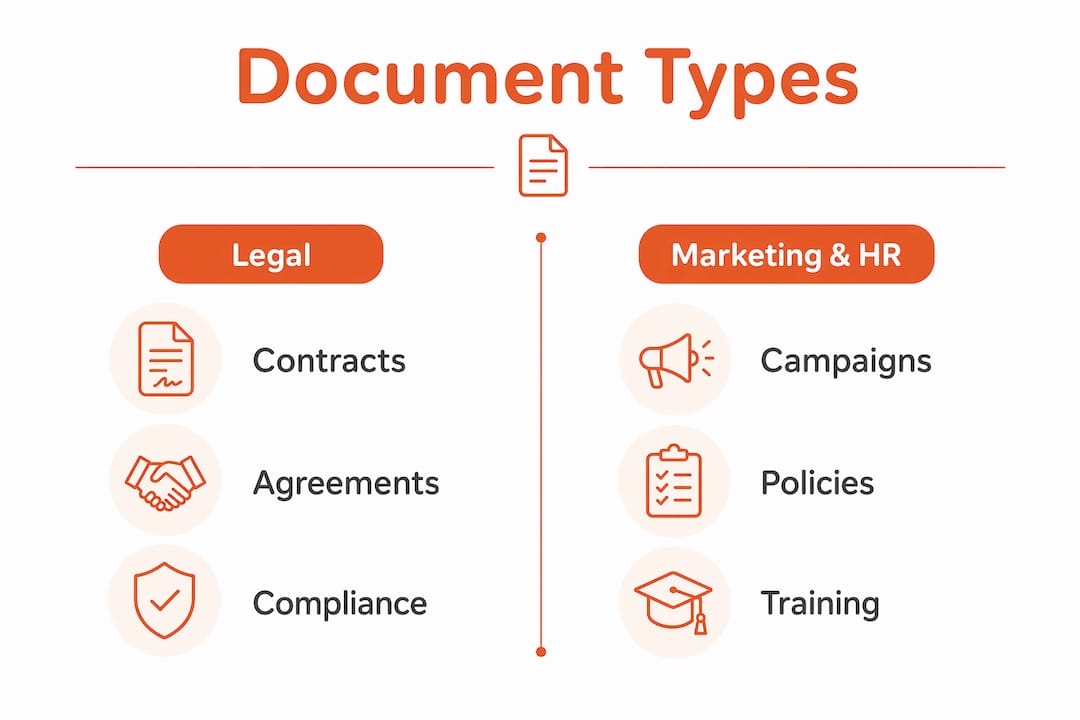
Legal documents demand translators who understand jurisdiction-specific vocabulary. Financial content requires familiarity with IFRS or GAAP terminology depending on the target market. Marketing materials need cultural fluency, not just linguistic accuracy. Technical documentation requires subject-matter knowledge to translate specifications without introducing ambiguity.
Pro Tip: Prioritize documents by risk level, not volume. Translate contracts and compliance filings first, then marketing content, then internal communications. This sequencing protects your organization where exposure is highest.
How do quality assurance standards work in business translation?
Quality assurance in business translation includes dual human review, audit trails, terminology management, and compliance with ISO certifications. Each element serves a specific purpose in protecting accuracy and legal standing.
The dual-review process assigns a second qualified linguist to check the first translator’s work. This catches errors that a single reviewer misses, particularly in technical or legal content where one wrong word changes meaning entirely. Audit trails document every version of a translated document. For regulated industries, that version history is proof of compliance.
A standard QA workflow in professional translation follows these steps:
Terminology setup. Build or import a glossary of approved terms before translation begins.
Initial translation. A subject-matter expert linguist completes the first draft.
Editing. A second linguist reviews for accuracy, consistency, and tone.
Proofreading. A third pass checks formatting, punctuation, and final readability.
Terminology audit. Automated or manual check confirms all glossary terms were applied correctly.
Client review. The requesting team approves or flags revisions.
Audit trail update. Final version is logged with timestamps and reviewer credentials.
ISO 17100 is the recognized standard for translation service providers. It specifies competence requirements for translators, revisers, and project managers. Asking a vendor whether they operate under ISO 17100 is the fastest way to assess their process maturity.
Viewing business translation as LangOps elevates it from a reactive task to a strategic process integrating terminology governance and quality management. Organizations that treat translation as an ongoing function rather than a one-off project maintain stronger brand consistency and face fewer compliance surprises.
Pro Tip: Request an audit trail with version control for every high-stakes document. This is not bureaucracy. It is your legal protection if a translated contract or regulatory filing is ever challenged.
What are the best practices for managing translation projects?
Centralized glossaries and style guides prevent inconsistent terminology that harms brand and legal clarity across multilingual projects. Building these assets before translation starts is the single highest-leverage action a project manager can take.
Effective glossary management defines approved translations for product names, legal terms, and brand-specific vocabulary. Without it, different translators produce different versions of the same term across markets. That inconsistency confuses customers and creates legal ambiguity in contracts.
Key steps for managing a business translation project well:
Select linguists with domain expertise. A translator with finance experience handles shareholder agreements differently than a generalist. Match the linguist to the document type.
Define the target audience before briefing. A French-speaking audience in Quebec reads differently than one in France. Regional variation matters.
Set a realistic timeline. Rushed translation produces errors. Build review cycles into the schedule, not just the initial translation.
Use a translation memory system. This stores previously approved translations and reuses them automatically. It cuts costs and enforces consistency across large projects.
Brief translators on brand voice. Provide examples of approved tone, preferred vocabulary, and content that should never be translated literally.
Establish a single point of contact. Fragmented communication between departments and translators produces conflicting instructions and delays.
Cultural adaptation deserves its own attention. Localization goes beyond word-for-word translation. It adjusts idioms, examples, date formats, currency references, and visual cues to fit the target market. A marketing campaign that resonates in the United States may fall flat in South Korea if the cultural references do not transfer. Localization is what separates a translated document from one that actually works.
Pro Tip: Never launch a multilingual campaign without native-speaker review of the final copy. Automated tools catch grammar errors. Native speakers catch the cultural missteps that damage trust.
How does technology enhance business translation today?
Translation technology includes translation management systems, CAT tools, semantic translation, and AI-assisted workflows that improve efficiency without replacing expert human judgment. Technology is a productivity multiplier, not a substitute for domain expertise.
Approach | Speed | Accuracy for complex content | Best use case |
|---|---|---|---|
Traditional human translation | Slower | Highest | Legal, financial, regulated documents |
AI-assisted with human review | Fast | High when reviewed | Marketing, product content, HR materials |
Fully automated machine translation | Fastest | Lower for nuanced content | Internal drafts, low-risk communications |
Computer-assisted translation (CAT) tools store approved translations in a translation memory database. When similar text appears in a new document, the system suggests the stored translation. This reduces repetitive work and enforces consistency across large content volumes. Semantic translation goes further by analyzing meaning in context rather than matching words literally.
AI-assisted workflows accelerate first drafts significantly. The critical discipline is knowing when human review is non-negotiable. Legal contracts, financial disclosures, and medical or safety documentation require a qualified human reviewer regardless of how good the AI output looks. For SaaS translation and digital product content, AI-assisted tools with in-context editing produce strong results when paired with a glossary and style guide.
Gleef combines AI-powered translation with semantic translation memory, glossary management, and in-context editing. Product teams using Gleef can manage translations directly inside their design workflow without switching platforms, which removes a common source of delay and inconsistency in digital product localization.
Key Takeaways
Business translation done well requires domain expertise, structured quality assurance, and technology that supports rather than replaces skilled linguists.
Point | Details |
|---|---|
Define scope by document type | Legal, financial, marketing, and technical content each require different expertise and workflows. |
Build glossaries before you translate | Centralized terminology prevents inconsistency across markets and protects legal clarity. |
Apply ISO 17100 as your quality benchmark | This standard defines competence requirements for translators, revisers, and project managers. |
Treat translation as LangOps | Managing translation as an ongoing strategic function produces better consistency than reactive, project-by-project work. |
Match technology to risk level | Use AI-assisted tools for speed on lower-risk content; require human review for legal and regulated documents. |
The uncomfortable truth about business translation budgets
Most organizations underfund translation until something goes wrong. A mistranslated contract clause, a compliance filing rejected by a regulator, a product launch that offends a target market. I have seen all three. The cost of fixing those problems dwarfs what proper translation would have cost upfront.
The pattern I see most often is this: a company expands into a new market, assigns translation to whoever speaks the language internally, and calls it done. That person may be fluent, but fluency is not the same as professional translation expertise. A bilingual employee does not automatically understand IFRS terminology, jurisdiction-specific contract language, or the cultural nuances of a B2B marketing campaign in a different country.
The organizations that get this right treat translation as a function, not a favor. They build glossaries. They assign qualified linguists. They run dual-review processes. They track versions. And they integrate technology thoughtfully, using AI to accelerate work on lower-risk content while keeping human experts on anything with legal or regulatory exposure. That balance is where the real efficiency gains live.
The other thing worth saying: speed and quality are not opposites in translation. They become opposites only when you skip the preparation. A well-built glossary and a clear brief cut translation time significantly. The teams that complain about slow turnaround are usually the ones who hand over content with no context and expect results in 24 hours.
— Antoine
How Gleef supports your global translation needs
Building a reliable translation process takes more than good intentions. It takes the right tools, the right terminology governance, and a workflow that keeps quality consistent at scale.
Gleef is built for product teams and organizations that need high-quality translations without the back-and-forth that slows releases. The platform combines AI-powered translation with semantic translation memory, glossary management, and in-context editing, so your team maintains brand consistency across every market. Gleef also supports compliance-grade terminology control, which matters when your content touches legal or regulated subject matter. If you are ready to build a translation process that actually holds up under pressure, explore Gleef and see how it fits your workflow.
FAQ
What is business translation?
Business translation is the accurate conversion of business documents and communication into target languages, covering legal, financial, marketing, HR, and technical content. It requires cultural adaptation and compliance awareness, not just linguistic accuracy.
Why do businesses need professional translators?
Professional translators with domain expertise prevent costly errors in high-stakes documents like contracts and regulatory filings. Generalist or machine-only translation creates legal liability and brand risk in these contexts.
What is ISO 17100 in translation?
ISO 17100 is the international standard for translation service providers. It defines competence requirements for translators, revisers, and project managers, and serves as the benchmark for professional translation quality.
How does a translation glossary protect my business?
A centralized glossary ensures consistent use of approved terms across all translated documents and markets. Inconsistent terminology creates legal ambiguity in contracts and confuses customers in multilingual markets.
When should I use AI translation versus human translation?
Use AI-assisted tools for speed on lower-risk content like internal communications and marketing drafts. Require qualified human review for legal agreements, financial disclosures, and any regulated documentation where accuracy is mandatory.